Section Modulus calculation and optimization
AIM- To calculate section modulus for the given hood model for two iterations and analyze which will be the better to be considered for product,for that we check it at different iterations by using different offset curves.
SECTION MODULUS- Section modulus is a geometric property for a given cross-section used in the design of beams or flexural members. Other geometric properties used in design include area for tension and shear, radius of gyration for compression, and moment of inertia and polar moment of inertia for stiffness. Any relationship between these properties is highly dependent on the shape in question. Equations for the section moduli of common shapes are given below. There are two types of section moduli, the elastic section modulus and the plastic section modulus.
It is a ration of the Moment of inertia about a neutral axis to the distance of the outer most layer from the neutral axis.
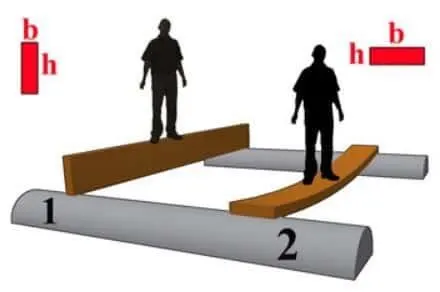
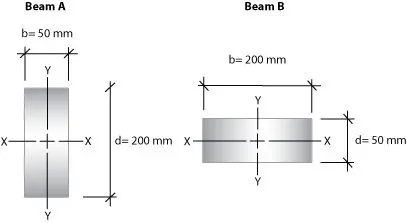
here we use same beam for example ,we use same beam if we want to bend for 1 it gets easily bend or 2 gets easily bend
for that we use formula
Imax=bd^3/12
where b is breadth and d is depth
FORMULA FOR SECTION MODULUS -
It may be defined as the ratio of total moment resisted by the section to the stress in the extreme fibre which is equal to yield stress.
Which is equal to yield stress.
Therefore
S=I/y, Where
S= Section modulus (mm^3)
I = Moment of inertia of the section to the stress in the extreme end of the object (mm^4)
Y= Distance between the neutral axis and extreme end of the object (mm).
AREA MOMENT OF INERTIA- The area moment of inertia of a beam cross section area measures the beam ability to resist bending .The larger the moment of inertia less will be the bend
where
M - Bending Moment
I- Area moment of inertia
E-young modulus
R- Radius of gyration
NEUTRAL AXIS - when beam is subjected to pure bending the top most fibers of the beam are subjected to maximum compression ,while the bottom most fibers of the beam are subjected to maximum tension.
- This picture contains the following scene, a Diagram of a beam on its narrow edge supported at both ends. A man is walking on a straight beam. Diagram of a beam resting on its flat side supported at both ends. A man is walking on a straight beam and it's bending in the middle.
CASE 1- The hood which was already created is importedand the section inertia analysis is done we have to make sure that the curve obtain is a single curve /closed curve
some time there will be some gap is remaining at embosses area so for those areas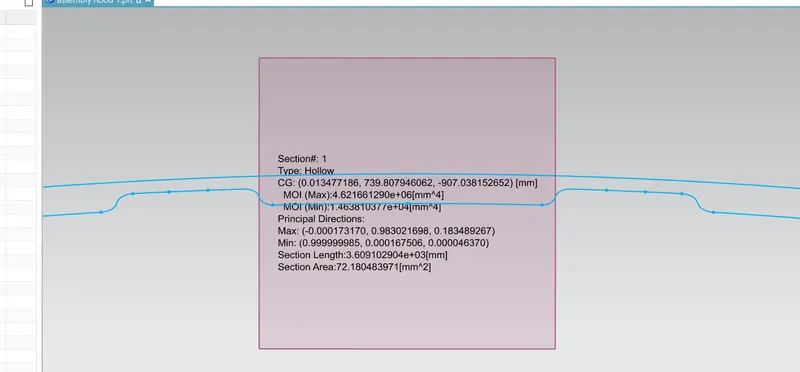 we can use studio spline to complete the closed curve.
Imax=4.621661290e+06(mm^4)
Imin=1.463810377e+04(mm^4)
as per the section modulus equation
s=I/Y
I=MOI min value is considered
Y=total distance/2
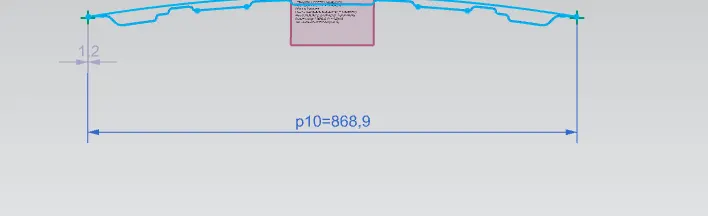
so Y =868.9/2=434.45
S=I/Y , where Imin will be consider
why we consider only I min to understand this lets go with an example like
if there is a person can run 10km without taking food and after taking food he runs 15km ,it means after food distance will be enhanced but with or without he can acheive 10 km distance in any way ,that why we dont know condition in which we are working or applying load for crash test for safey so at minimal condition to survive in any condition we go with min load ,here we go with Imin
S=1.463810377e+04(mm^4)/434.45=14638.10377mm^4/434.45
S=33.693414132811mm^3
S=33.693414132811mm^3
Case 2-After optimazation
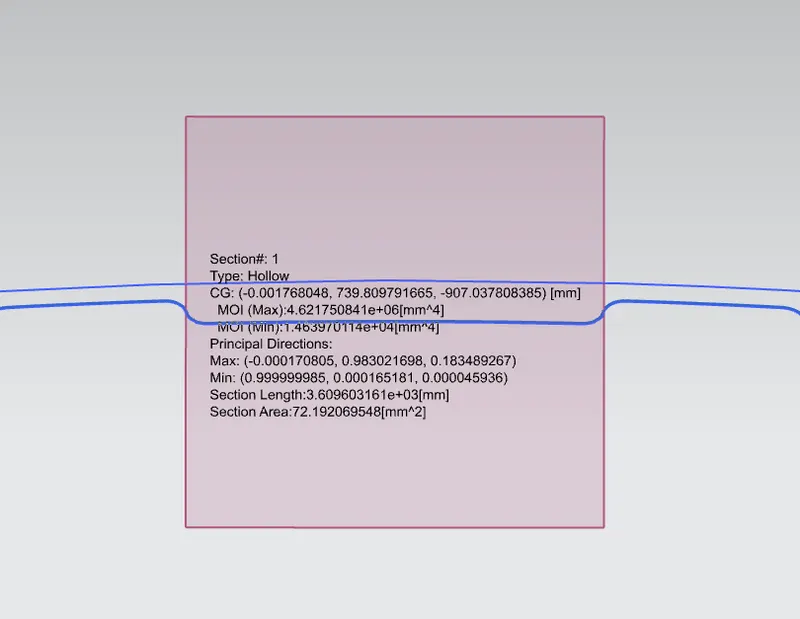
In case 2 we just change the curve 0.5 offset and section inertia analysis is done as previously we done.
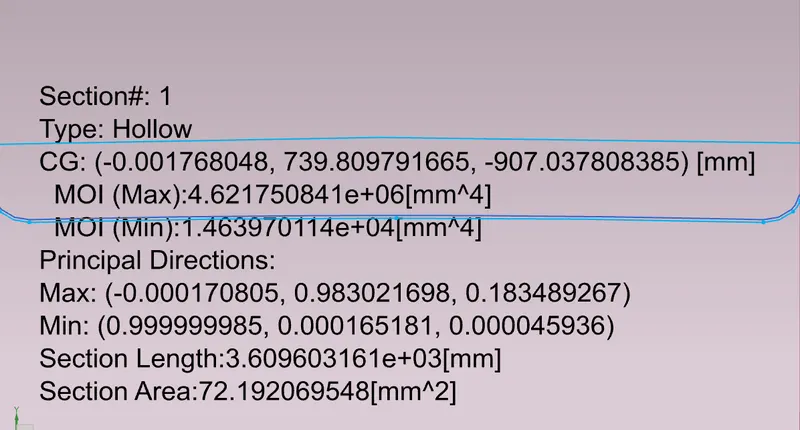
Imax=4.621750841e+06(mm^4)
Imin=1.463970114e+04(mm^4)
as per the section modulus equation
s=I/Y
I=MOI min value is considered
Y=total distance/2
Y =868.9/2=434.45
S=I/Y , where Imin will be consider
S=14639.70114/434.45=33.697090896535mm^3
S=33.697090896535mm^3
Conclusion:
Resulting by comparing case 1 & case 2,
- The section modulus value of case 2 is higher than case 1
- As we increase the section area, the moment of inertia & section modulus increase which means strength and load material also increases. Which the moment of inertia directly proportional to the strength of the material.