Section Modulus calculation and optimization
Section Modulus:
It is a way of quantifying a cross-section of a given geometry. It is directly proportional to the area moment of inertia of the cross-section. Higher the section modulus, the more the moment of inertia, the more stiffness and thus more resistance to deformation and bending. Section modulus can also be improved by varying the geometry of the cross-section. In other words, stiffness can be improved by just improving the geometry without the need for adding extra material.
SECTION MODULUS (S): I/Y(MAX)
I= AREA MOMENT OF INERTIA OR SECOND-ORDER MOMENT OF INERTIA.
Y(MAX)= DISTANCE OF EXTREME LAYER FROM NEUTRAL AXIS.
Alternatively, it can also be defined by the below formula
M/I = σ/Y
M = σ*S
σ= YIELD STRENGTH
S= SECTION MODULUS(I/Y)
Calculation of section modulus of the Hood:
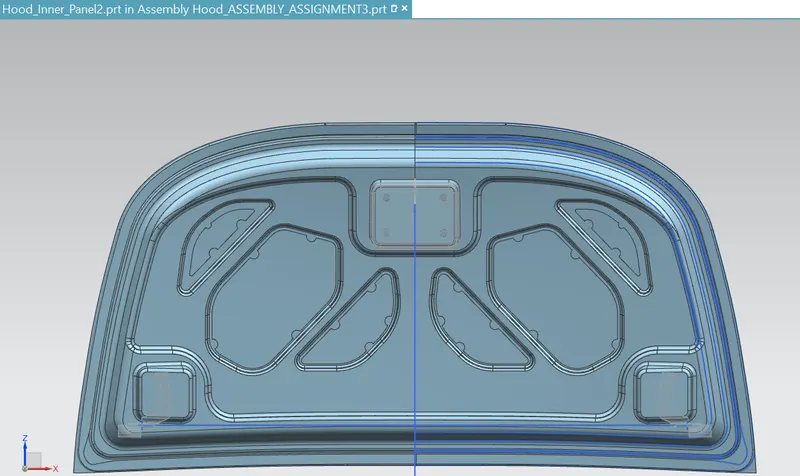
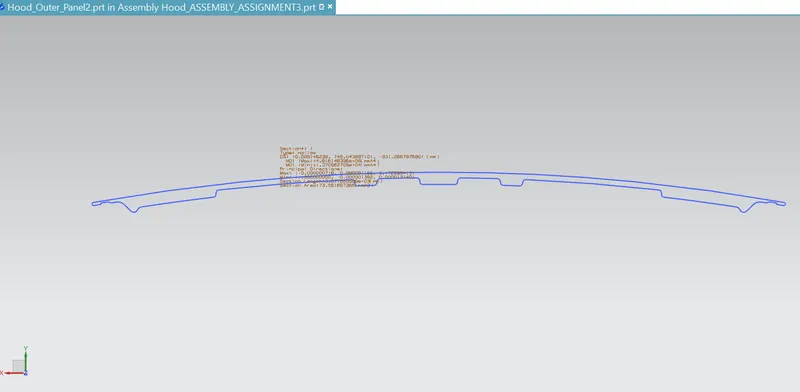
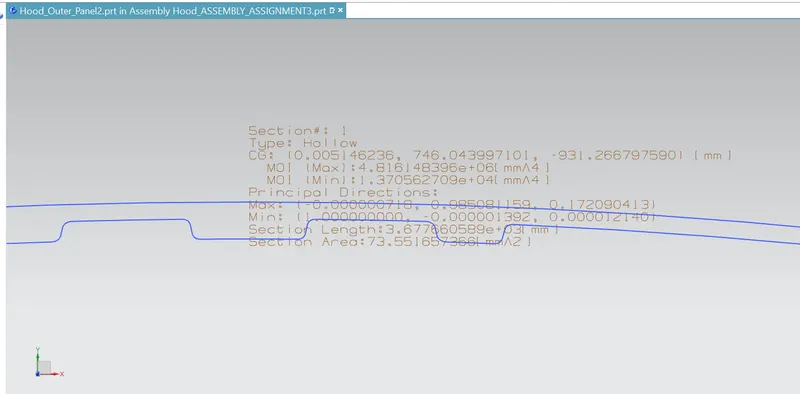
From the above picture, we can see
Moment of inertia, I(max) = 4.81615×10^6×mm^4
Moment of inertia, I(min) = 1.37056×10^4×mm^4
Y=440.47 mm
S=I(max)/Y
S=4.81615×10^6/440.47 = 1.0934x10^4 mm^3
Conclusion: A different section modulus is tried in order to achieve a higher moment of inertia. Increasing the gap between the inner and outer panels will result in decreasing bending moments. On the contrary, if we tend to add more geometric features to the master section will result in a drastic increase in section modulus. It is best to add more geometric features to the master section to improve the stiffness of a section. However, this could result in an increase in manufacturing costs.