SECTION MODULUS CALCULATION AND OPTIMIZATION
SECTION MODULUS CALCULATION AND OPTIMIZATION
Objective
To calculate the section modulus and thereby optimize the section for better strength.
Section Modulus
Section Modulus is a mathematical property of structural shapes. It has great use in structural analysis and design. Section properties have nothing to do with the strength of materials, but are based solely on the shape of the section. It explains why some shapes are more efficient at supporting loads than others. A beam that has a larger section modulus than another will be stronger and capable of supporting greater loads.
There are two types of section modulus, they are Elastic section modulus and Plastic section modulus. For general design, the elastic section modulus is used, applying up to the yield point of the material.
The elastic section modulus is defined as,
S = I / Y
I = Second moment of area (or area moment of inertia)
Y = Distance from the neutral axis to the extreme end.
Calculation of section modulus for the hood
Section modulus are commonly used at smaller sections to improve the strength locally by adjusting its geometry. But here we are considering the section of hood only for a practice.
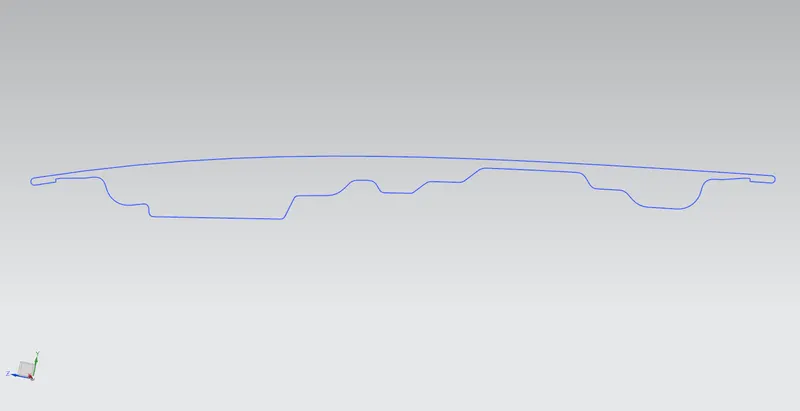
Figure 1: Section of the hood.
Step 1: Determine the minimum moment of inertia of the section.
Conditions applied for the calculation of Moment of inertia(I),
- Section type : Hollow
- Hollow thickness : 0.75mm
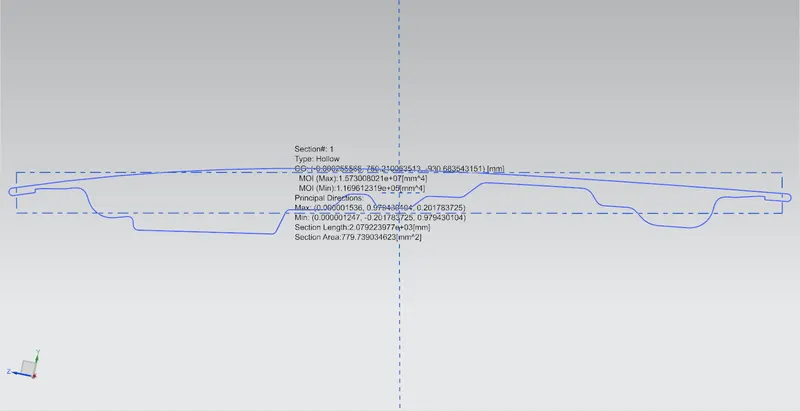
Figure 2: Calculated section inertia.
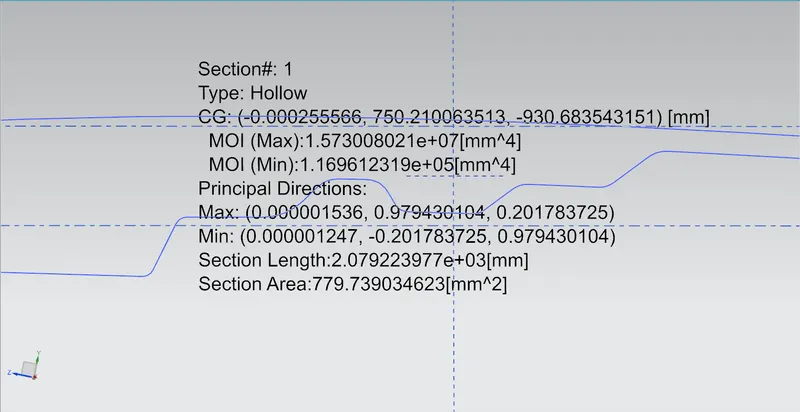
Figure 3: Section inertia analysis result.
MOI max (I max) : 1.573008021e+07[mm^4]
MOI min (I min) : 1.169612319e+05[mm^4]
Total length of the section= 487mm
Distance from the neutral axis, Y= 487/2 = 243.5mm
Step 2: Calculating section modulus
For the calculation of section modulus, it is preferred to substitute the minimum value of MOI. Because it will show the worst case or the minimum strength of that section.
Section modulus, S= I/Y
= 116961.23/243.5 = 480.33 mm^3
Optimization
As an optimization I have tried to offset the inner panel by 2mm away from the previous position.
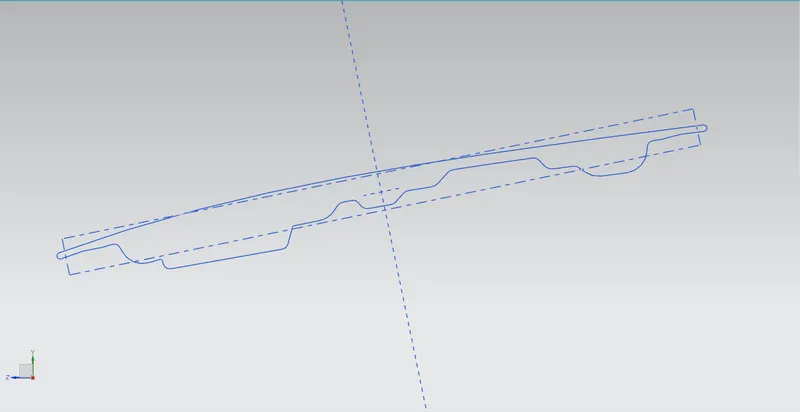
Figure 4: Area of the section increased by offsetting the bottom line (inner panel) by 2 mm.
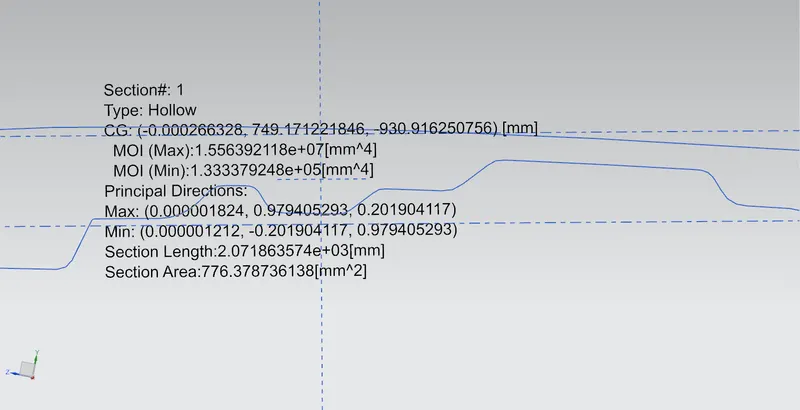
Figure 5: Section inertia analysis result.
Calulating section modulus,
MOI min= 1.333379248e+05[mm^4]
Distance from the neutral axis, Y= 487/2 = 243.5mm
Section modulus, S= I/Y
= 133337.92/243.5 = 547.59 mm^3
Conclusion
Section modulus in the first case, S = 480.33 mm^3
Section modulus in the second case, S = 547.59 mm^3
From these result we can conclude that after offsetting the bottom line by 2mm away, strength of the section was improved.