Section Modulus calculation and optimization
Section Modulus
Section modulus is a geometric property for a given cross-section used in the design of beams or flexural members. The section modulus of the cross-sectional shape is of significant importance in designing beams. It is a direct measure of the strength of the beam. A beam that has a larger section modulus than another will be stronger and capable of supporting greater loads. There are two types of section modulus, the elastic section modulus and the plastic section modulus.
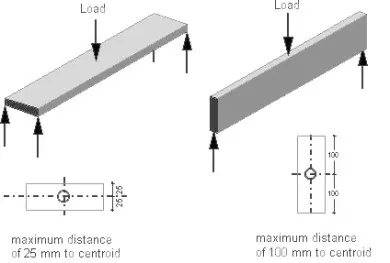
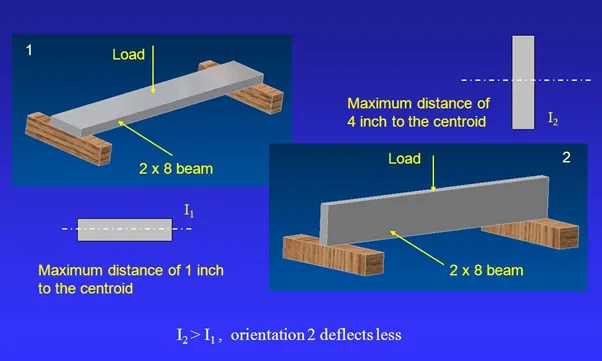
Section Modulus (S) = I / Y
Here,
S = Section modulus
I= Moment of Inertia (Unit mm 4)
Y= Distance from Neutral axis to the extreme end (unit mm)
Moment of Inertia is a measure of the resistance of a body to angular acceleration about a given axis that is equal to the sum of the products of each element of mass in the body and the square of the element's distance from the axis.
Section Modulus Study
Case - I Hood Design Study
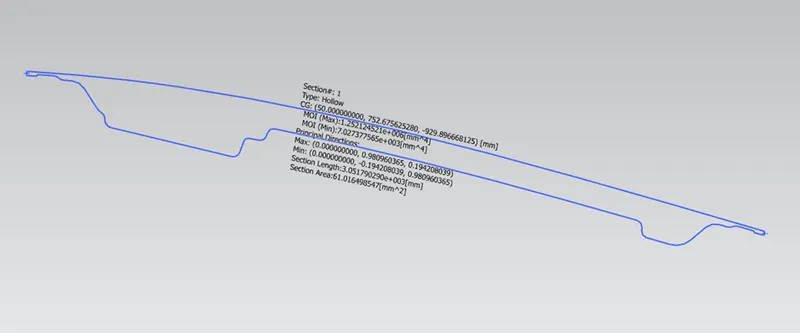
Moment of Inertia(Max) = 1.252124521e+006[mm^4]
Moment of Inertia(Min) = 7.027377565e+003[mm^4]
Y= 487.1054/2 =9 243.5527
Section Modulus (S) = I / Y
S = (7.02737*10^3) / 243.5527
S = 28.58 mm^3
Case - II Optimisation of the Hood Design
Depth of the section is increased by 5mm in the design
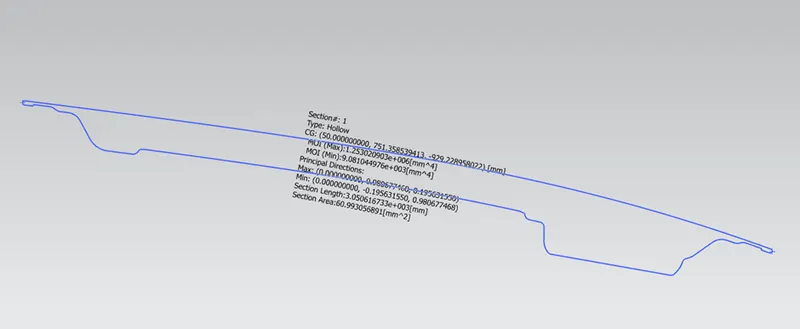
Moment of Inertia(Max) = 1.253020903e+006[mm^4]
Moment of Inertia(Min) = 9.081044976e+003[mm^4]
Y= 487.1054/2 =9 243.5527
Section Modulus (S) = I / Y
S = (9.08104*10^3) / 243.5527
S = 37.28 mm^3
Hence, the strength of the material is directly proportional to the moment of inertia, as there is an increase in cross-sectional area the overall mass of the object the value of the section modulus also got increased which implies the increase in strength.