Section Modulus calculation and optimization
Aim:
To find the section modulus of the hood and optimization to improve the overall section modulus.
Objective:
Use the section from your Hood design and calculate the section modulus using the formula S= I/y.
Section Modulus:
The section modulus (S) is geometry property of the cross section used for designing beams and flexural members. It does not represent anything physically.
The section modulus is classified into two types:-
1] Elastic section modulus:- The elastic section modulus is applicable up to the yield
point of material.
It is used in most engineering applications.
2] Plastic section modulus:- The plastic section modulus is generally used for material
in which plastic behavior is observed.
Formula of section Modulus: It may be defined as the ratio of total moment resisted by the section to the stress in the extreme fibre which is equal to yield stress.
Which is equal to yield stress.
Therefore
S=I/y
Where,
S= Section modulus (mm^3)
I = Moment of inertia of the section to the stress in the extreme end of the object (mm^4)
Y= Distance between the neutral axis and extreme end of the object (mm).
Area Moment of Inertia:
M/I = σ/Y = E/R
(M = Bending moment, I = Area moment of aria, σ = stress, y = distance from nutral axia, E = modulus of elasticity & R = radius of curvature)
The area moment of inertia of a beam cross section area measures the beam ability to resist bending. The larger the moment of inertia less will be the bend.
Where,
M = Bending Moment
I = Area moment of Inertia
E = modulus of elasticity
R = radius of curvature
Neutral Axis: When beam is subjected to pure bending the top most fibres of the beam are subjected to maximum compression, while the bottom most fibre of the beams are subjected to maximum tension.
When a beam experiences bending, as shown in the picture above, the upper layer of the beam experiences compression and hence reduces in length. Similarly the bottom layer of beam elongates due to tension.
There has to be some line in between which do not change its length no matter what. And that line or axis is not necessarily at the midway of the depth of beam. But yes, that line which doesn't experience any tension or compression while bending is a Neutral axis. And hence neutral axis does not elongate.
Calculation:
Case 1: Before Optimization
The hood which was already created is imported and the section inertia analysis is done.
We have to make sure that the curve obtained is a single/closed curve.
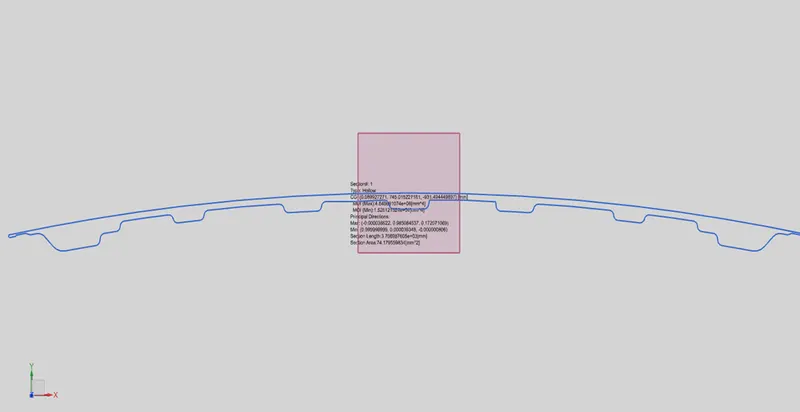
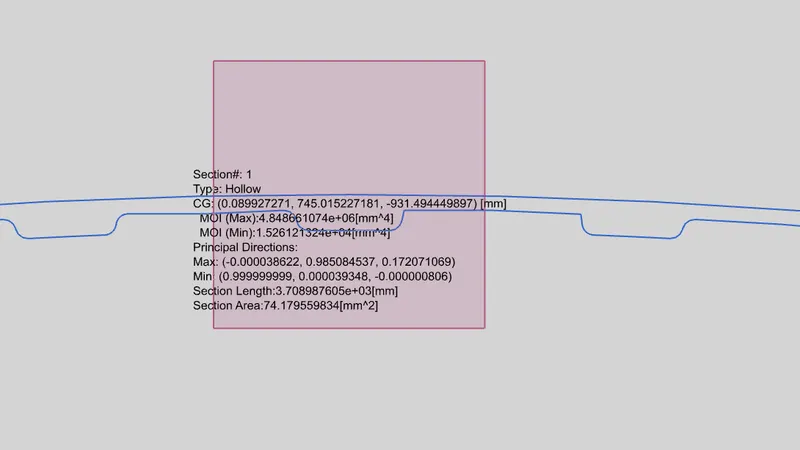
I (MAX) = 4.848661074e+06 (mm^4)
I (MIN) = 1.526121324e+04 (mm^4)
As per the section modulus equation,
S = I/Y
I = MOI (min) Value is considered
Y = Total distance / 2, Total distance = 878.5832 mm
Y = 878.5832 / 2
= 439.291 mm
Therefore, S = 152612.132 mm^4 /439.291 mm
S = 347.405 mm^3
Case 2: After Optimization
The hood inner panel’s curve is offset by 0.5mm outwards and section inertia analysis is done same as case 1 for a closed curve.
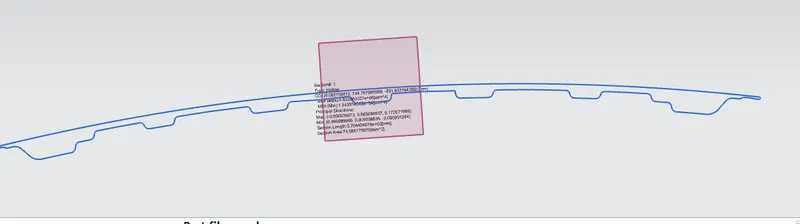
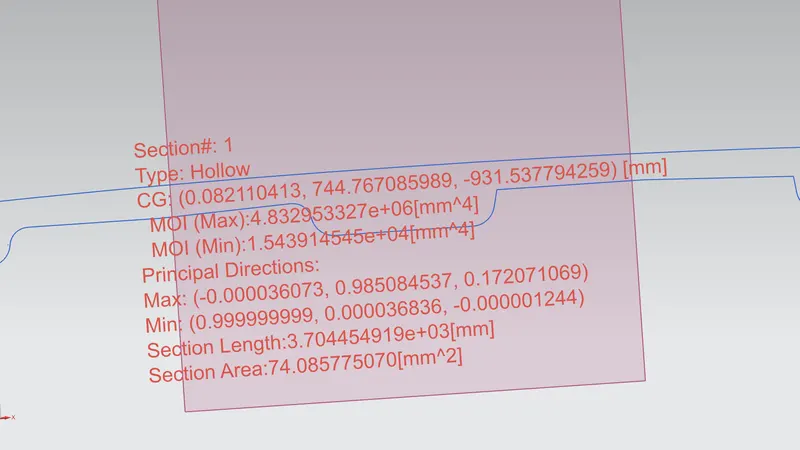
I (MAX) = 4.832953327e+06 (mm^4)
I (MIN) = 1.543914545e+04 (mm^4)
As per the section modulus equation,
S = I/Y
I = MOI (min) Value is considered
Y = Total distance / 2, Total distance = 875.7184 mm
Y = 878.5832 / 2
= 439.291 mm
Therefore, S = 154391.454 mm^4 / 439.291 mm
S = 351.455 mm^3
Conclusion:
Resulting by comparing case 1 & case 2,
- The section modulus value of case 2 is higher than the case 1
- As we increase the section area, the moment of inertia & section modulus increase which means strength and load material also increase. Which the moment of inertia directly proportional to the strength of the material.