Section Modulus calculation and optimization
SECTION MODULUS
Section modulus is a geometric property for given cross section used in the design of beams or flexural members. Other geometric properties used in the design include ana area for tension and shear, the radius of gyration for compression, and the moment of inertia, and polar moment of inertia for stiffness.
Types of Section modulus:
- Elastic section modulus (S)
- Plastic section modulus (Z)
Elastic section modulus:
For general design, the elastic section modulus is used, applying up to the yield point for most metals and other common materials.
The elastic section modulus is defined as S = I/y, where I is the moment of inertia and y is the distance from the neutral axis to any given fibre. It is often reported using y = c, where c is the distance from neutral axis to the most extreme fibre. It is also often used to determine the yield moment (My) such that My = S`xx``sigma`y, where `sigma`y is the yield strength of the material.
Plastic section modulus:
The plastic section modulus is used for materials where elastic yieldsing is acceptable and plastic behavior is assumed to be an acceptable limit. Designs generally strive to ultimately remain below the plastic limit to avoid permanent deformations, often comparing the plastic capacity against amplified forces or stresses.
The plastic section modulus depends on the location of the plastic neutral axis (PNA). The PNA is defined as the axis that splits the cross section such that the compression force the area in compression equals the tension force from the area in tension. So, for sections with constant yielding stress, the area above and below the PNA will be equal, but for composite sections, this is not necessarily the case.
Signification of section modulus:
- Section modulus is the important factor for design of beam and flexural member.
- Higher the value of section modulus, higher will be the resistance of member to bending.
- It is required to calculate stresses in beams.
- It is used to calculate strength of the steel structure.
- More the section modulus, it can withstand more load and it is also considered to be more tougher.
SECTION MODULUS CALCULATION AND COMPARISON
1. HOOD ORIGINAL DESIGN
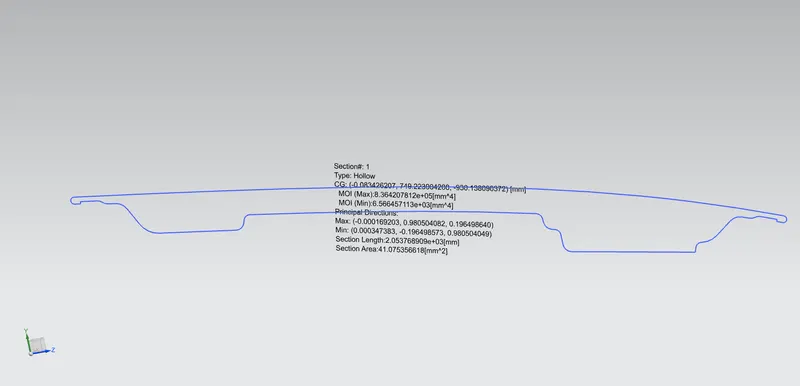
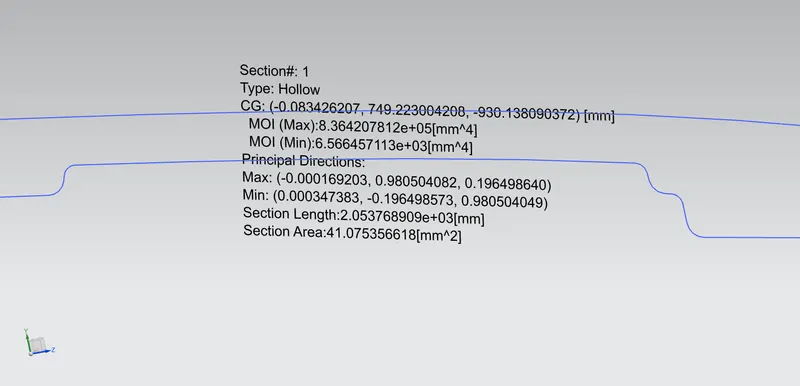
From the above image, the following date can be noted:
I(max) = 8.364207812 `xx`10^5(mm^4)
I(min) = 6.566457113 `xx`10^3(mm^4)
y = 482.7660mm/2
y = 241.383mm
Section modulus
S = I/y
For Maximum MOI
S = (8.364207812`xx`10^5)/241.383
S = 3465.118 mm^3
For Minimum MOI
S = (6.566457113`xx`10^3)/241.383
S = 27.203 mm^3
2. HOOD OPTIMIZED DESIGN
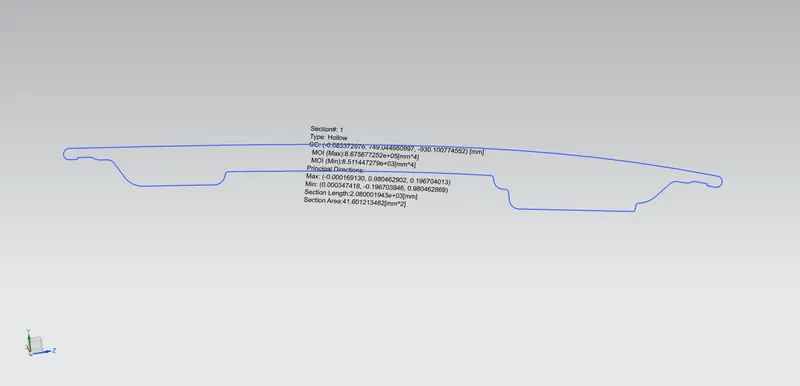
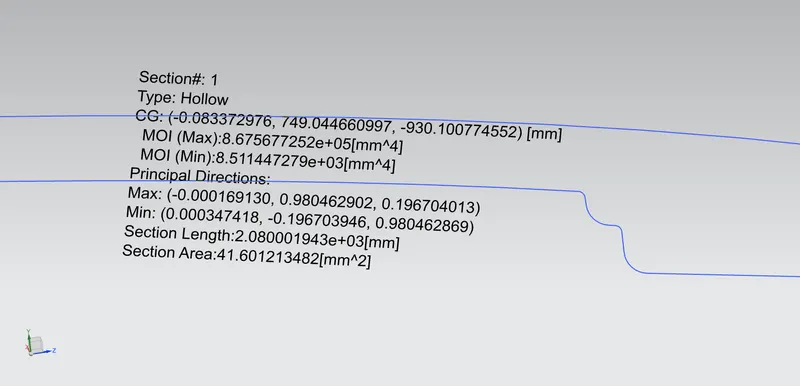
From the abvove image, the following data can be noted:
I(max) = 8.675677252`xx`10^5(mm^4)
I(min) = 8.511447279`xx`10^3(mm^4)
y = 241.383mm
Section modulus
S = I/y
For Maximum MOI
S = 867567.7252/241.383
S = 3594.154 mm^3
For Minimum MOI
S = 8511.447279/241.383
S = 35.261 mm^3
HOOD DESIGNS MAXIMUM SECTION MODULUS MINIMUM SECTION MODULUS
1. Original Design 3465.118 mm^3 27.203 mm^3
2. Optimized Design 3594.154 mm^3 35.261 mm^3
CONCLUSION:
Hence when comparing case 1 and case 2. The section modulus value of case 2 is higher than the case 1. As we increase the section area, the moment of inertia and section modulus increases which means strength and load material also increase.