Section Modulus calculation and optimization
Objective
This project aims to explore Siemens NX CAD tools for calculating section modulus and optimizing it for better structural performance.
Introduction to Section Modulus
In the field of structural and mechanical designs, especially for components that experience bending loads, understanding how the shape of a part influences its strength is essential. One of the key parameters used to evaluate this bending resistance is the section modulus. This property helps engineers determine the ability of a given cross-sectional shape to withstand bending stresses. It is especially relevant in automotive panel design, such as car hoods, which must remain stiff and durable under operational loads.
Understanding Fiber Behaviour and the Neutral Axis
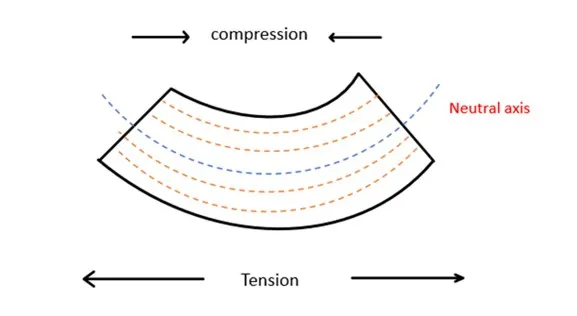
When a structural element such as a beam or hood panel is subjected to bending, the internal fibers react differently based on their positions:
- Fibers above the neutral axis are compressed, becoming shorter during bending.
- Fibers below the neutral axis are stretched, undergoing tension.
- The neutral axis itself is the boundary between these two regions. It is the imaginary line within the cross-section without tension or compression. At this point, internal stress is zero.
This variation in stress creates a linear stress distribution across the height of the section. The further a fiber is from the neutral axis, the more stress it experiences.
Hence, maximizing the distance between the material and the neutral axis leads to increased strength - an idea that is fundamental to optimizing section modulus.
Moment of Inertia and Section Modulus: The Link to Bending Resistance
To quantify the resistance a cross-section offers against bending, we use two important geometric properties: moment of Inertia (I) and Section modulus(Z).
Moment of Inertia(I)
The moment of inertia is a geometric measure of how the area of cross-section is distributed about its neutral axis. A higher moment of inertia means more material is located farther from the neutral axis, increasing the section's resistance to bending deformation. It does not depend on the material but entirely on the shape and size of the cross-section.
Mathematically, for a simple rectangular section:
I = BH3/12
Where:
- B is the width of the section
- H is the height (or depth)
Section Modulus(Z)
Section modulus is a property that represents the bending strength of a cross-section. It helps determine how well the shape of a part can resist bending under load. This is particularly important in areas like vehicle hood design, where the panel is constantly exposed to forces during operation and needs to maintain structural integrity without deformation.
Z = I/Y
Where:
- Z = Section Modulus
- I = Area Moment of Inertia about the neutral axis
- Y = Distance from the neutral axis to the extreme fiber
From this equation. It is clear that to increase Z, one must increase I (the moment of inertia) or reduce y. However, in partial terms - especially in automotive design - the distance Y is often constrained by design geometry. Therefore, the most effective strategy is to maximize the moment of inertia, which leads to the largest possible section modulus.
This relationship can be stated as:
To achieve maximum bending resistance, the section modulus must be at its maximum value (Zmax), and to achieve Zmax, the moment of inertia must also be maximized (Imax).
By intelligently shaping the component - for instance, adding ribs or increasing height in the cross-section - more material is positioned further away from the neutral axis. This geometric adjustment significantly boosts the moment of inertia (I) and, as a result, enhances the bending strength of the component through a higher section modulus (Z).
Section Modulus Analysis Using UGNX:
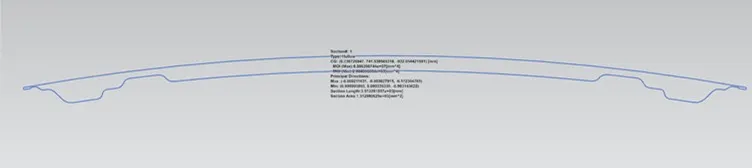
In Case of Front Impact
This section analysis is conducted considering the front impact condition of the car. During a frontal collision, the hood experiences significant bending forces. The resistance to these forces is determined by the section modulus, which reflects how efficiently the cross-section resists bending stress.
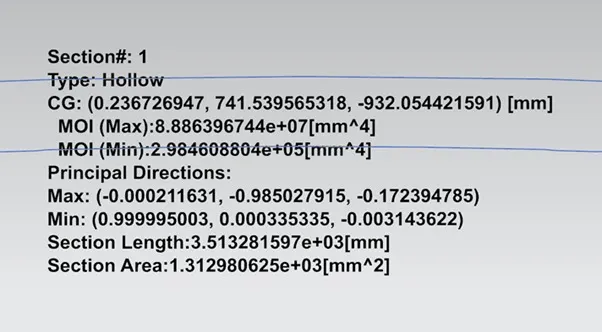
From the NX Section Inertia analysis:
- MOI (Max): 8.886396744 x 107 mm4
- MOI (Min): 2.984608804 x 105 mm4
- Overall, Height of Section: 877.0081 mm
- y (Distance from Neutral Axis): 877.0081/2 = 438.502 mm
Using the section modulus formula:
- Section Modulus (Max):
Zmax = 8.886396744 x 10⁷/438.504 = 202652.64 mm3
- Section Modulus (Min):
Zmin = 2.98468804 x 10⁵/438.504 = 680.44 mm3
This calculation is crucial in evaluating how well the hood structure can withstand deformation in a front impact scenario. Increasing the moment of inertia improves section modulus and thus enhances crash energy absorption while preventing structural failure.
In Case of Side Impact
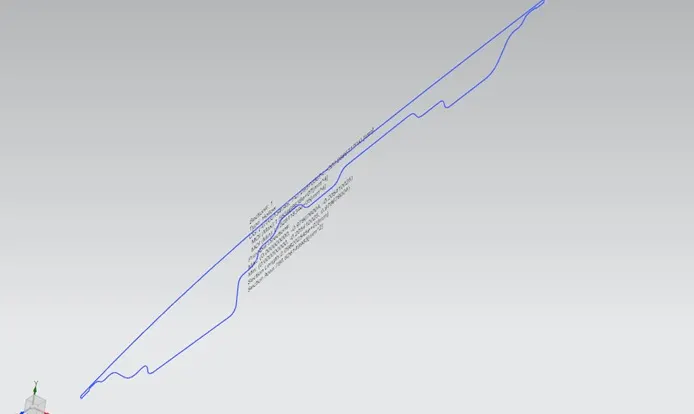
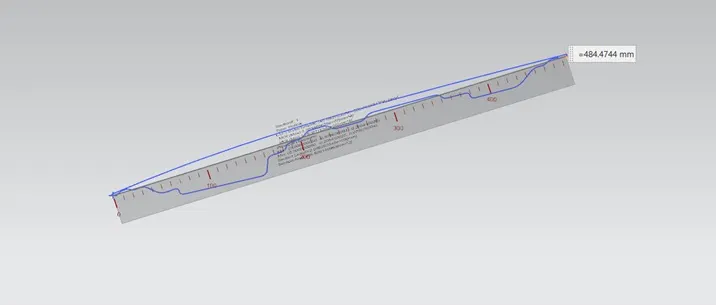
When a side impact occurs, the hood structure experiences lateral bending. To assess its resistance, we calculate the section modulus using the updated section properties.
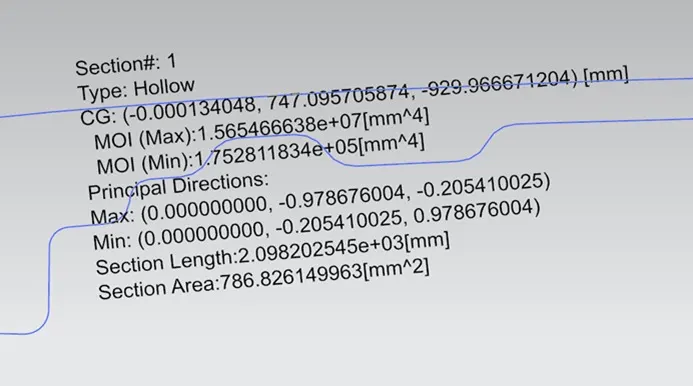
From the NX analysis:
- MOI (Max): 1.565466638 x 107 mm4
- MOI (Min): 1.752811834 x 105 mm4
- Overall, Height of Section: 484.4744 mm
- Y(Distance from Neutral Axis): 484.4744/2 = 242.2372 mm
Using the section modulus formula:
- Section Modulus (Max):
Zmax = 1.565466638 x 10⁷/ 242.2372 = 64632.87 mm3
- Section Modulus (Min):
Zmin = 1.752811834 x 10⁵/242.2372 = 723.57 mm3
Hood Optimized Design:
With 0.5mm Offset
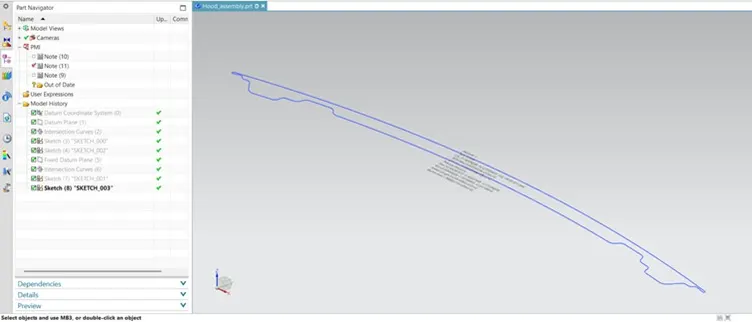
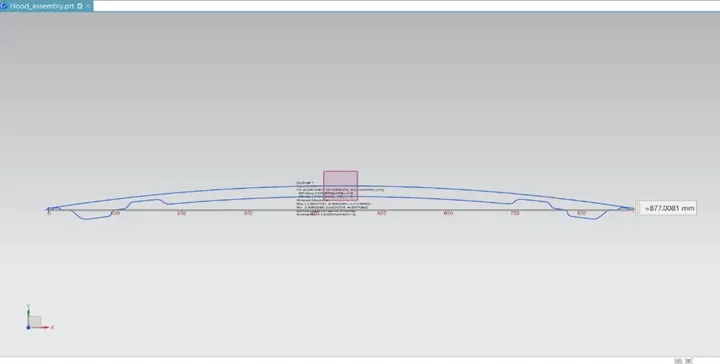
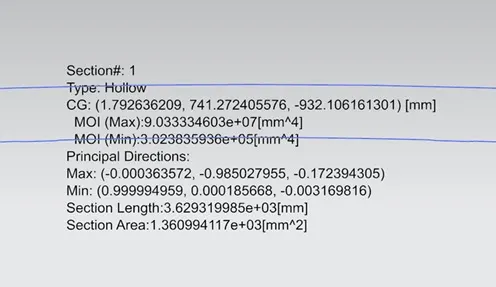
Frontal Impact with 0.5 mm Offset
- MOI (Max) = 9.033334603 x 107 mm4
- MOI (Minn) = 3.023835936 x 105 mm4
- Distance (Y) = 438.504 mm (from previous calculations)
Section Modulus Calculation
Using the formula:
- Z (Max) = (9.033334603 x 10⁷) / 438.504 = 205503.66 mm3
- Z (Min) = (3.023835936 x 10⁵) / 438.504 = 687.99 mm3
Conclusion
The Section modulus analysis was carried out to evaluate the structural strength of the hood under different impact scenarios. The results demonstrate that even small geometric offsets can influence the bending resistance of the component.
The section modulus values for each case are summarized below:
Frontal Impact (Original) :
Frontal Impact (0.5 mm offset) :
Side Impact:
From the comparsion:
- The 0.5 mm offset in the frontal section slightly increased the section modulus, improving the hood's bending stiffness and energy absorption capacity during frontal collisions.