Section Modulus calculation and optimization
SECTION MODULUS CALCULATION
Aim :-
To calculate the section modulus of the previously designed hood for analyzing its strength and also optimizing the design to see the difference in the bending strength of the hood. Higher the section modulus of a structure, the more the resistive it becomes to bending.
SECTION MODULUS :-
Section modulus is a geometric property for a given cross-section used in the design of beams or flexural members,Its also defined as the ratio of polar moment of inertia to the radius of the shaft or the distance from the neutral axis to the outer fibres. Other geometric properties used in design include area for tension and shear, radius of gyration for compression, and moment of inertia and polar moment of inertia for stiffness. The common way of calculating Section Modulus for a shaft requires is its diameters even if it is a solid or hollow shaft.
There are two types of section modulus:-
- Elastic section modulus
- Plastic section modulus.
Elastic section modulus
The elastic section modulus is defined as S = I / y, where I is the second moment of area (or area moment of inertia, not to be confused with moment of inertia) and y is the distance from the neutral axis to any given fibre.
Plastic section modulus
The plastic section modulus is used for materials where elastic yielding is acceptable and plastic behavior is assumed to be an acceptable limit. Designs generally strive to ultimately remain below the plastic limit to avoid permanent deformations, often comparing the plastic capacity against amplified forces or stresses.
S=I/Y
Here,
S = Section modulus
I= Moment of Inertia (Unit mm 4)
Y= Distance from Neutral axis to the extreme end (unit mm)
The Unit of a “section modulus” is (mm3)
S = I/Y(max)
The elastic section modulus is used, applying up to the yeild point of most metals and other common metals.
The elastic section modulus is defined as S= I/Y, where I is the moment of inertia and Y is
the distance from neutral axis to the outer most boundary.
It is often used as Y=c, where c is the distance of boundary from neutral axis. It can also be
defined from yield moment given by equation-
My=S⋅σy
where σyis the yield strength of material.
ROLE OF CROSS SECTION IN SECTION MODULUS:-
- It depends only the cross section shape of the beam. Cross section shapes like rectangular, square, circular, I section and T, composite section etc.
- For symmetric sections, the value of “section modulus”is for both above and below of centroid of the fiber.
- An asymmetric section has two values for top and bottom of the fiber due to different distance from centroid to the top and bottom of the material, the maximum “section modulus” is S max and the minimum section modulus is S min.
CALCULATIONS FOR SECTION MODULUS OF HOOD:-
Initial Hood design and its moment of inertia
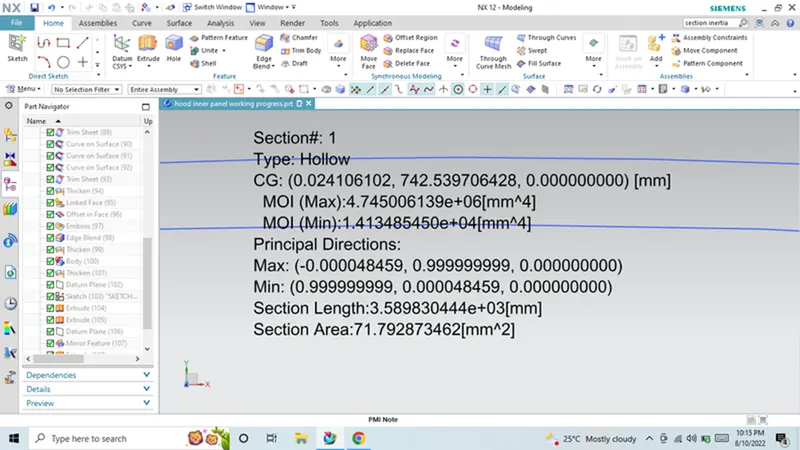
In this Hood design, minimum Moment of Inertia(MOI) is 1.4134e85450+04[mm^4].
We have, Stainless steel AISI 302 – cold-rolled which has yield strength = 520 MPa.
To find out section modulus
S=I/Y
Here, I is “moment of inertia” and y is distance from “neutral axis” to top or bottom of fiber.
Unit of a “section modulus” is mm^3
As we absorb above equation of Section modulus,
Section modulus is directly proportional to Moment of Inertia(MOI)
S α I
For unit Y distance, S= 3.589830444e+04 mm^3
Modified section of hood-
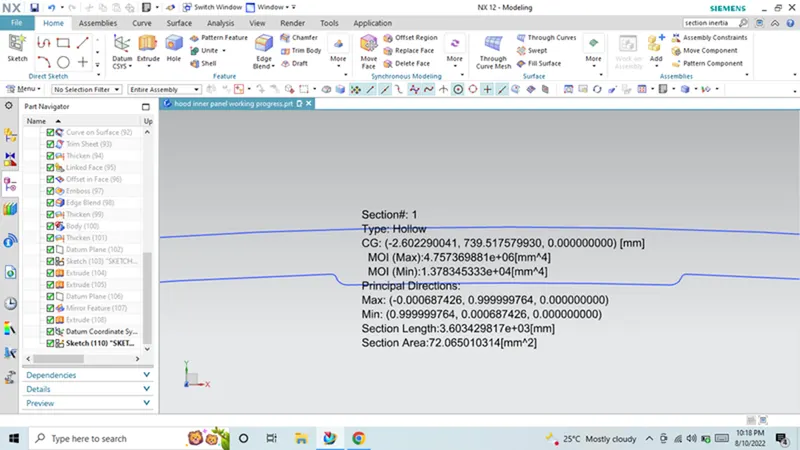
In this New Hood design, minimum Moment of Inertia(MOI) is 1.378345333e+04[mm^4].
We know, Stainless steel AISI 302 – cold-rolled has yield strength = 520 MPa.
To find out section modulus
S=I/Y
Here, I is “moment of inertia” and y is distance from “neutral axis” to top or bottom of fiber.
Unit of a “section modulus” is mm^3
We know that,
Section modulus is directly proportional to Moment of Inertia(MOI)
S α I
For unit Y distance, S= 3.6034298e+04 mm^3
Therefore, a small modification in Sectional area, results to variation of section modulus
between initial and and New hood is about 0.17364653e+04 mm^3
Conclusion
The difference can be seen in the moment of inertia and the change in the section modulus can be seen by the change in the design.