Section Modulus calculation and optimization
Aim - To Come up with a new section of a car hood that has an improved Section Modulus compared to the previous one.
About -
Section Modulus - Section modulus is a term associated with the cross sectional area. It is a geometric property for a given cross section used in the design of beams or those members which are susceptible to bending. It is a direct measure of the strength of a beam. It is of significant importance in designing beams or flexural members.
A beam or a flexural member that has a greater section modulus are capable of supporting greater loads. Most of the work in bending is being one by extreme fibres of the member, i.e the top and bottom fibres of the section. The distancce of the neutral axis from the extreme fibres is therefore taken into account while calculating the section modulus of a cross section.
It is denoted by Z.
It is calculated using the formula -
Z = I/y ,
I is the Area oment of inertia of a cross section and y is the distance of neutral axis from extreme fibre of a cross section.
Procedure -
The hood of car is a member which due to its own weight is suxceptible to bending. To avoid bending of the hood panel, it is optimised using section modulus property of a cross section.
Sectional view of hood assembly -
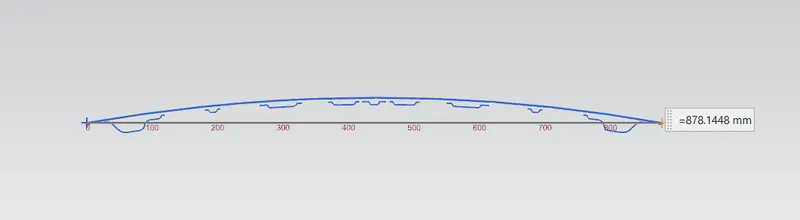
Fig 1
We have designed a car hood and have done its section inertia analysis to reach at the following data -
Case - 1 Inherent car hood section without any optimisation done
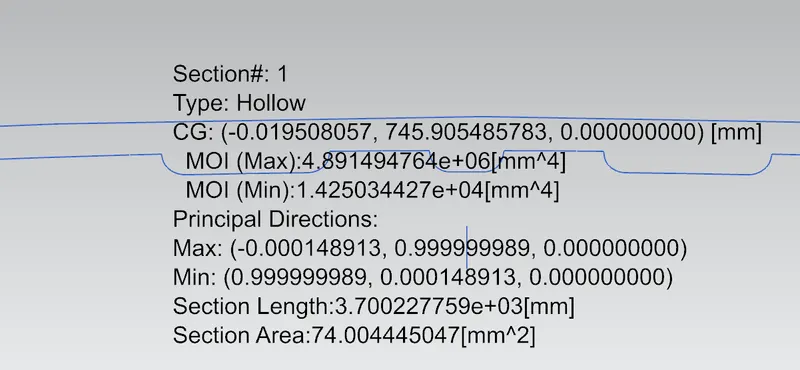
Fig 2
For this case, Minimum area moment of inertia is 1.425034427e+04 [mm^4]
Maximum area moment of inertia is 4.891494764e+06 [mm^4]
Distance of extreme fibre from neutral axis along the measured length y = 439.0724 mm
therefore, Section modulus (Z) = Imin/y
= 1.425034427e+04/439.0724
= 32.455 mm^3
Case - 2 After optimisation in the form of increased thickness of sheet by 0.5 mm
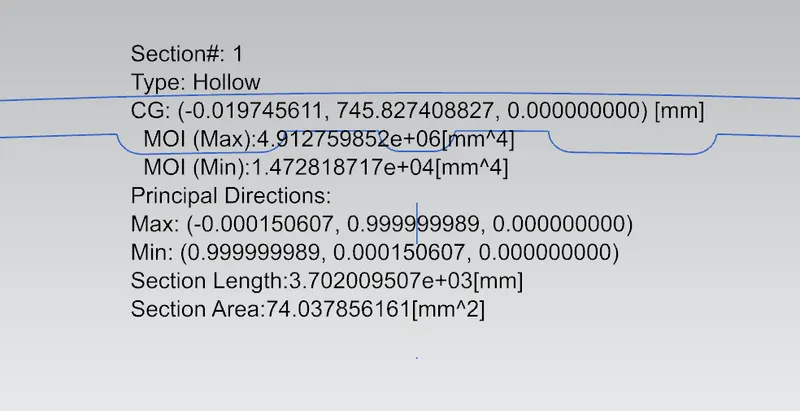
fig 3
For this case, Minimum area moment of inertia is 1.472818717e+04 [mm^4]
Maximum area moment of inertia is 4.912759852e+06 [mm^4]
Distance of extreme fibre from neutral axis along the measured length y = 439.0724 mm
therefore, Section modulus (Z) = Imin/y
= 1.472818717e+04/439.0724
= 33.54 mm^3
Conclusion - On comparing case 1 and case 2, it is understable that for the second case which is the optimised case the value of section modulus of the cross section is greater than that of the previous unoptimised case. Hence, the optimised case will be able to withstand more bending stress than the previous unoptimised case. The strength is therby increased by increasing the thickness of sheet by 0.5 mm.