Section Modulus calculation and optimization
Section modulus
Section modulus is a geometric property for a given cross section used in the design of beams or flexural members. It determines the objects strength and ability to resist external forces which acts tries to flex the object. The moment carrying capacity id directly dependent on the geometrical property and material property
Geometric properties used in the design include area for tension and shear, radius of gyration of compression, and moment of inertia and polar moment of inertia or stiffness. Any relation between these properties is highly depend on shape.
There are two types of section moduli, the elastic modulus and plastic section modulus. For general design the elastic moduli are used, applying up to yield point for most materials and other common materials. Plastic moduli are used where elastic yielding is acceptable and plastic behaviour is assumed to be in acceptable limit.
The definition of section modulus according to mechanics is the ratio of moment of inertia and the distance from the neutral axis to any given fiber.
Section Modulus (S)=I/y (units mm3)
Where I – Moment if inertia mm4
y- distance between neutral axis and extreme end of fiber.
For symmetric sections the section modulus is same above or below the centroid.
For asymmetric sections, two values are found max and min of section modulus.
Case 1
Design of section modulus of initial hood
Calculating the section modulus of existing design by taking cross section of hood and calculating moment of inertia
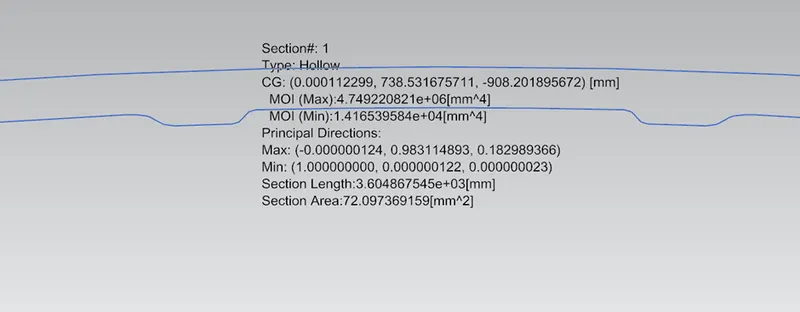
As the hood section is asymetric two values of moment of inertia is given
Imax :4.7492 x 106 mm4
Imin : 1.4165 x 104 mm4
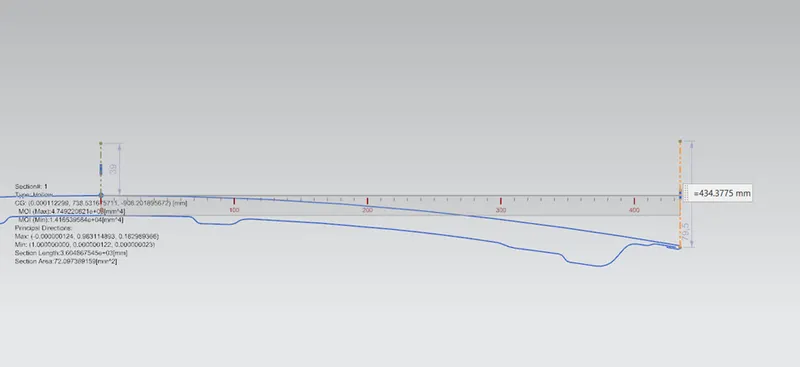
Y= 434.3775 mm
S max= 4.7492 x10⁶ /434.3775 mm3
10993.347 mm3
S min= 1.4165 x 10⁴/434.3775 mm3
32.60 mm3
This is the result of the section modulus for initial design of the hood
Case 2
Section modulus of optimised hood
To improve the section modulus of the hood we have to increase the moment of inertia of the hood, as section modulus is directly proportional to the moment of inertia
By offsetting the hood outer panel by 0.5mm we can increase the moment of inertia of the hood section.
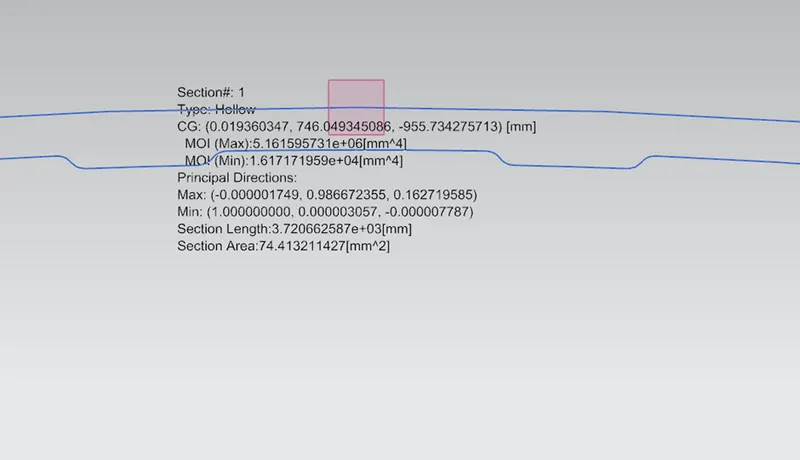
As we can see that the moment of inertia is increased, the section modulus of the hood will also increase.
Imax : 5.1615 x 106 mm4
Imin : 1.6171 x 104 mm4
Y= 434.3775 mm
S max= 5.1615 x10⁶ /434.3775 mm3
11882.521 mm3
S min= 1.6171 x 10⁴/434.3775 mm3
37.22 mm3
Hence the section modulus of our hood has been increased compared to initial hood design section modulus.
Conclusion
From the above study it is clear that optimisation helps to improve the result in design