Fender Design - Wheel Arch Challenge
Objective:
To calculate the wheel arch area and decide whether the car will pass the European standards or not.
Fender
Fender is the American English term for the part of an automobile or other vehicle body that frames a wheel. Its primary purpose is to prevent sand, mud, rocks and liquids and other road spray from being thrown into the air by the rotating tire
Sticky materials, such as mud, may adhere to the smooth outer tire surface, while smooth loose objects, such as stones, can become temporarily embedded in the tread grooves as the tire rolls over the ground. These materials can be ejected from the surface of the tire at high velocity as the tire imparts kinetic energy to the attached objects. For a vehicle moving forward, the top of the tire is rotating upward and forward, and can throw objects into the air at other vehicles or pedestrians in front of the vehicle.
Fenders are basically present to prevent the injuries to the pedestrians and contain the motion of these particles
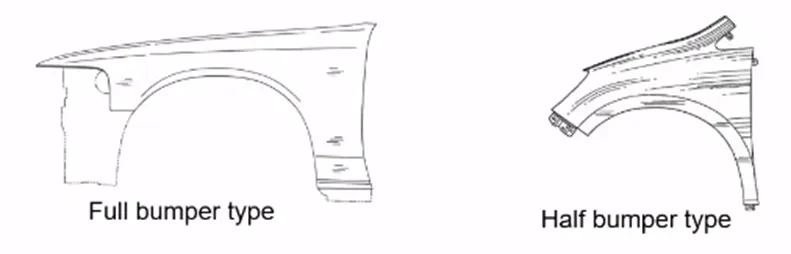
We have two types of fenders
- Full bumper fender
- Half bumper Fender
Full Bumper fender
Full bumper type fender is the traditional type of fender which was used commonly in olden days. This type of fender have more material consumption as compare to present day fenders. Since the material used for manufacturing fenders will be steel or aluminium are generally increases the overall weight and expensive . so this type of fenders are not recommended in the market.

Half bumper fender
Half bumper fender is the type of fenders commonly used in the current markets. The material consumption is less compared to full bumper fender. The scrap produced during part production is less also this design allows space for using plastic component at bumper. As the material consumption is less the weight of the body is also reduced which increase over all performance of the vehicle.
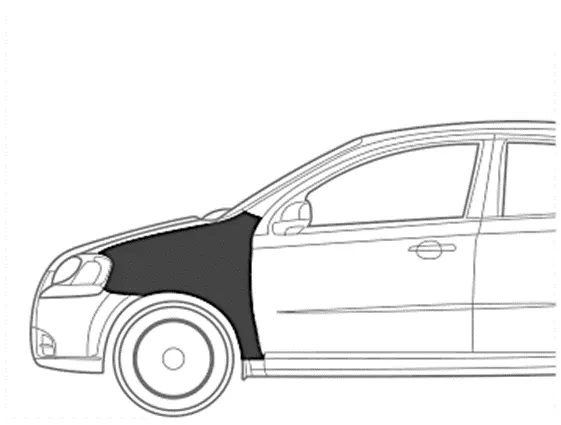
Wheel Arch
Wheel arch is the semi-circular curve on the fender above the wheels of the car. It has standard specifications because when the position of wheel is outside the fender, the fender cannot provide the full cover to the wheel which leads to road debris thrown into the air by the tire.
Different countries have different conditions based on the road conditions.
Japan Requirement
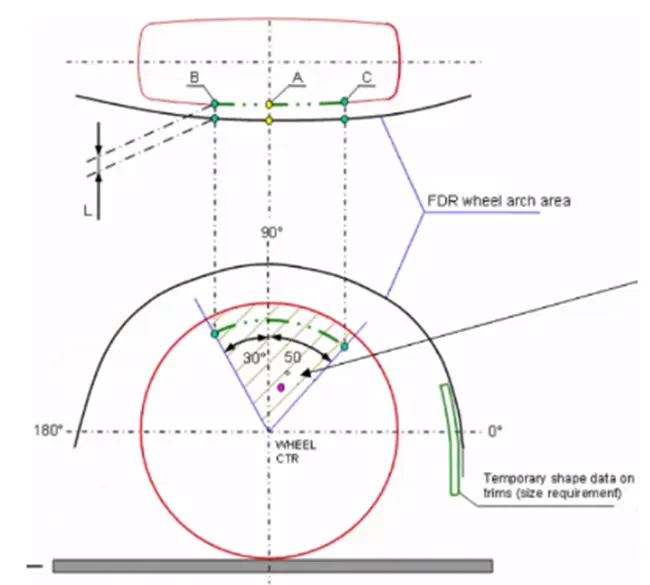
The clearance for L for tire, hub, cap and fender is to be measured with in the area K and create a clearance check chart to validate. The valve L should be greater than 5mm at all the positions. Wheel guard requirement valve ‘a’ should be more than 5 mm at line 30o forward and 50o rearwards from the central vertical axis of the wheel.
European Requirement
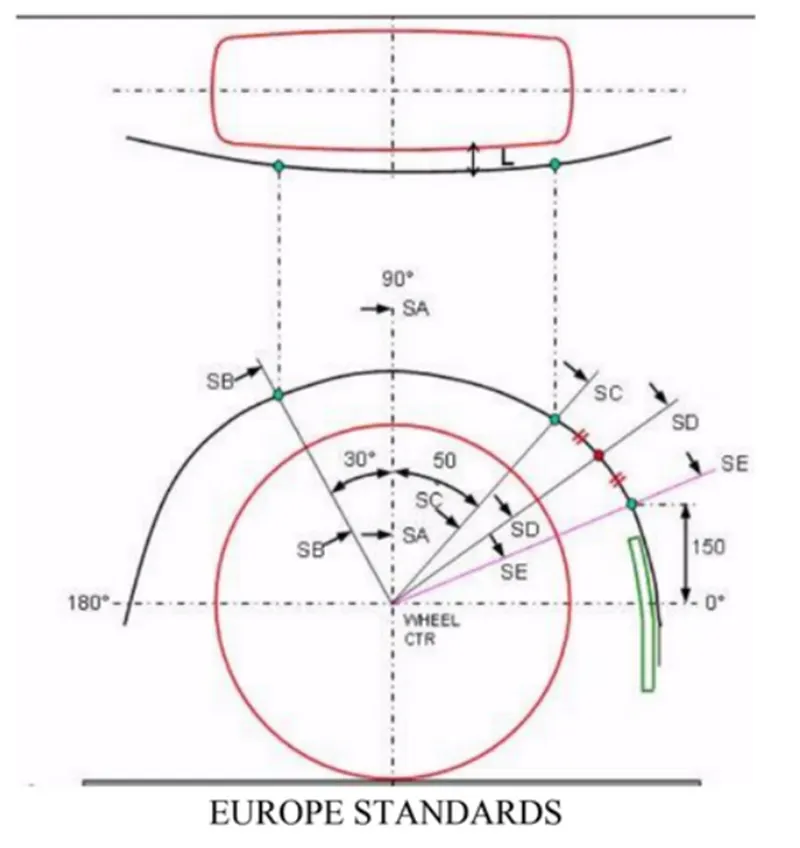
The Clearance ‘L’ should be measured at sections SA-SA, SB-SB, SC-SC, SD-SD and SE-SE and create clearance check chart to validate. At all five sections the valve of L should be greater than 10 mm. wheel guard requirement ‘a’ should be more than 5 mm at line 30o forward and 50o rearwards from the central vertical axis of the wheel.
US Requirement
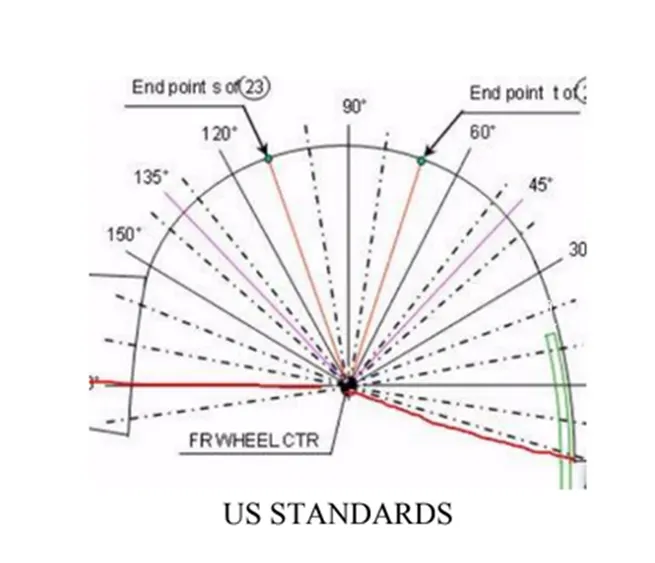
clearance ‘L’ is to be checked at all positions from -20° to 180° and create clearance check chart to validate. The value of L should be greater than 5mm to satisfy the regulations. Wheel guard requirement: The value of ‘a’ should be more than 5mm at line 30° forward and 50° rearwards from the central vertical axis of the wheel.
Wheel arch calculations
Drawing the sketch as per the European standard requirement by creating a datum plane on the outer most surface of the tire.
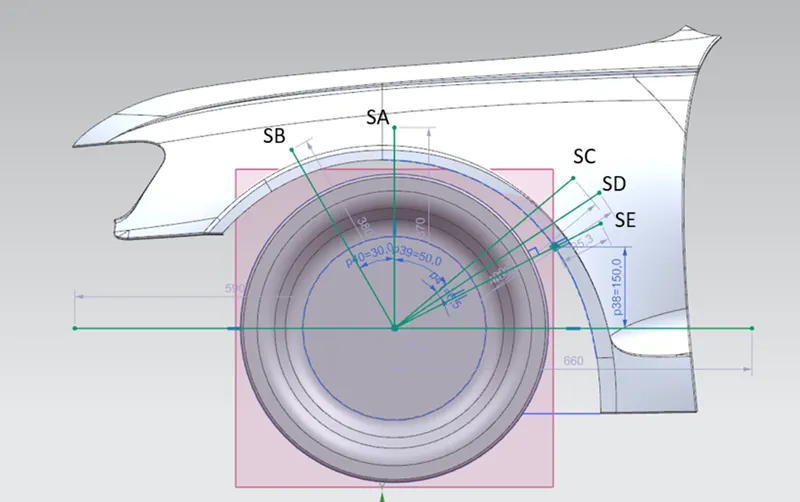
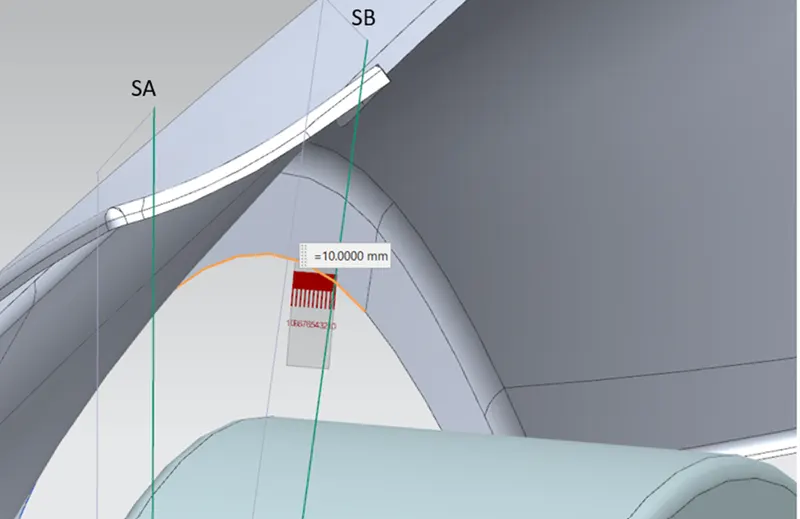
Measuring the values of clearance L at all the five sections. As per the European standards the L should be greater than 10 mm.
Clearance at SB
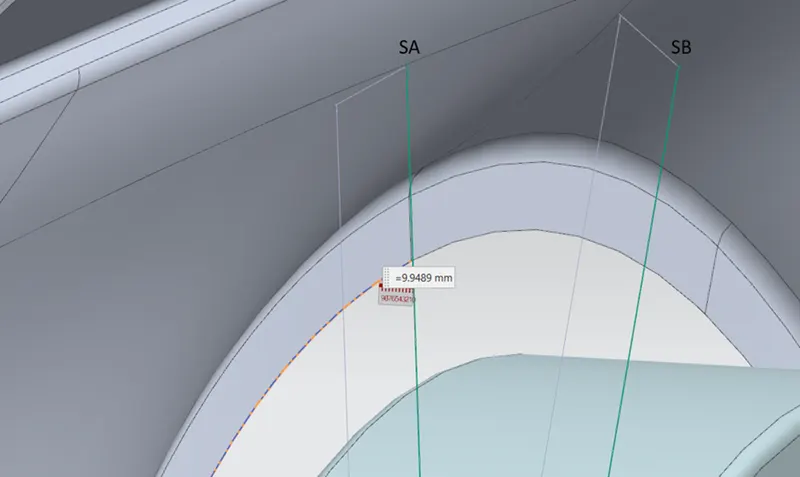
Clearance at SA
Clearance at SC
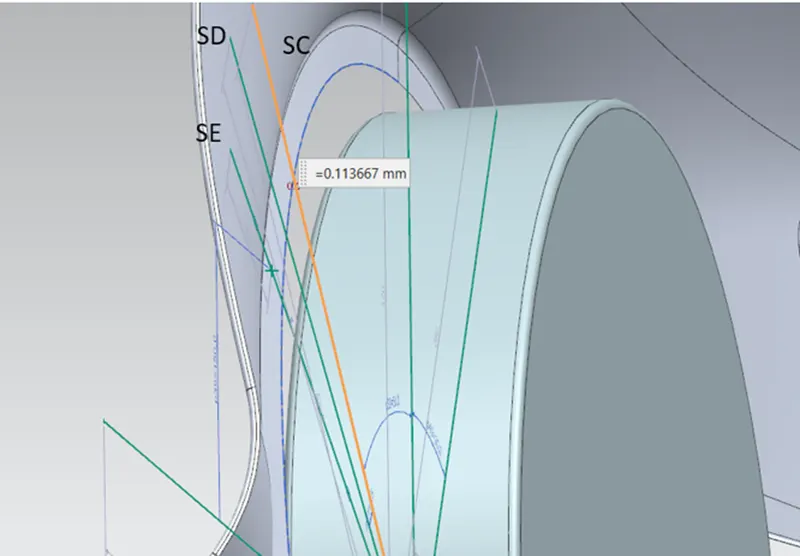
Clearance at SD
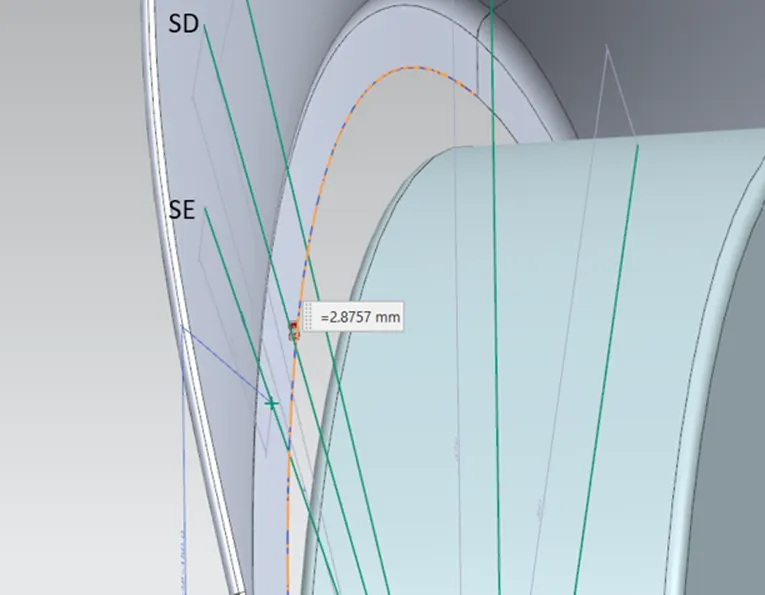
Clearance at SE
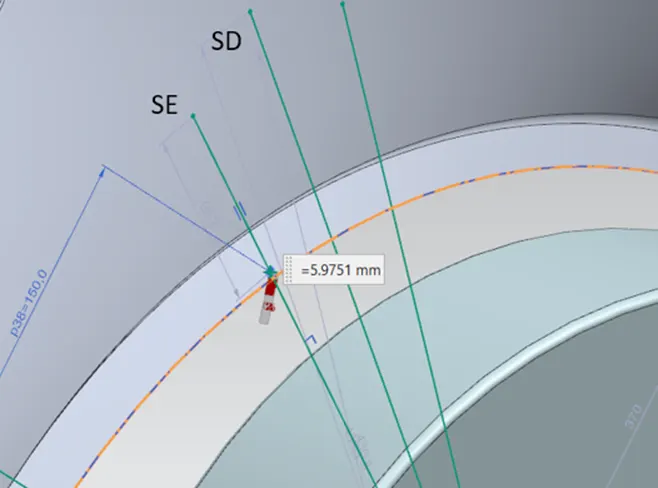
Observation table
| Section | Clearance | Result |
| SA-SA | 9.9489 | Fail |
| SB-SB | 10 | Pass |
| SC-SC | 0.1136 | Fail |
| SD-SD | 2.8757 | Fail |
| SE-SE | 5.9751 | Fail |
Conclusion
From the above measurement it was observed that clearance value 'L' at sections SA,SC,SD and SE was lower than 10mm therefore it does not satisfy European Standards.