Section Modulus calculation and optimization
Aim: Use the Section from your Hood design and calculate the section modulus using the formula S = I/y.
Method:
-Section modulus:
- A "section modulus is the value of the "moment of inertia of area" related to the neutral axis of the cross-section of a beammultiplied by the distance from the neutral axis to the outer surface". Therefore, the relationship between the section modulus Z andthe moment of inertia of area I is as expressed by the following equation.
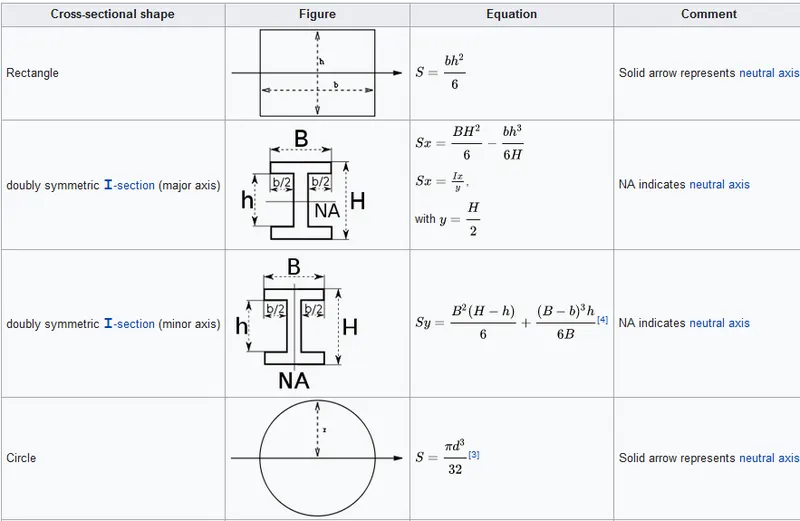
- Second moment of area or moment of inertia
- The second moment of area is also known as the moment of inertia of a shape. It is directly related to the area of material in thecross-section and the displacement of that area from the centroid. Once the centroid is located, the more important structuralproperties of the shape can be calculated. The axis that determines the centroid is also known as the neutral axis (N/A).
- The second moment of area is a measure of the 'efficiency of a shape to resist bending caused by loading. A beam tends tochange its shape when loaded. The second moment of area is a measure of a shape's resistance to change.
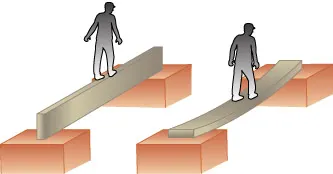
This picture contains the following scene. Diagram of a beam on its narrow edge supported at both ends. A man is walking on astraight beam. Diagram of a beam resting on its flat side supported at both ends. A man is walking on the straight beam and it isbending in the middle.
- Certain shapes are better than others at resisting bending as demonstrated in the diagram. Clearly, the orientation of the shapealso influences bending.
-In its simplest way, the more the section modulus is more the material is resistant to the deformation
SECTION MODULUS OF AN HOOD
Section modulus is a direct measure of strength of any sectional area of an object about an reference axis(neutral axis).
Strength is nothing but, capable of supporting greater loads, so higher the strength it has a high capable of supporting greaterloads.
This strength can measured directly from Section modulus formula, and defined by below formula.
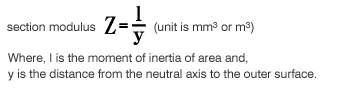
where 'I'moment of inertia
'Y' is the distance from the reference line(neutral axis) to one of the extreme endof an object.
Moment of inertia is nothing but offering resistance against of moment, bending or twisting, i.e if we applied any external loadon the body, how much resistance its offering to tend to deform.
So, higher the value of moment of inertia , have higher resistance to deform under certain load, hence we can say that momentof inertia directly proportional to the strength of the material , and strength of the material can be calculated with the help ofsection modulus.
If we vary the neutral axis towards positive or negative side the overall strength of the body will decrease , because whennuetral axis line lies on the middle of the section only have higher strength at particular point, so, here 'Y' value was inverselyproportional to section modulus.
- The symbol Z is used customarily for the section modulus. In general, as the section modulus becomes larger, the strength againstbending also becomes larger. Regarding bending, the maximum bending stress σ acting on the outer surface of the part can becalculated using the following equation.
Procedure-
- firstly convert the assembly part into cat part.
- create a plane normal to the hood surface.
- take intersection between the Hood outer surface and the plane.
- take intersection between the Hood inner surface and the plane.
- create a sketch on new plane
- take 3d elements projection and isolate them and exit the skeches.
- rename with section 1 and fill the surface.
- find movement of inertia aand calculate the section modulus using above equation.
- copy the sketch and edit it.
- give the 5mm offset to outer hood.
- and then again calculate moment of inertia and section modulus.
SECTION-1
HOOD ORIGINAL SURFACE
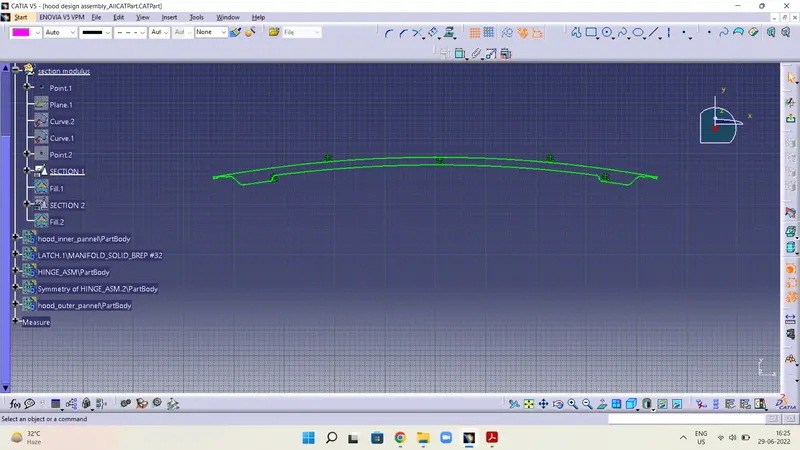
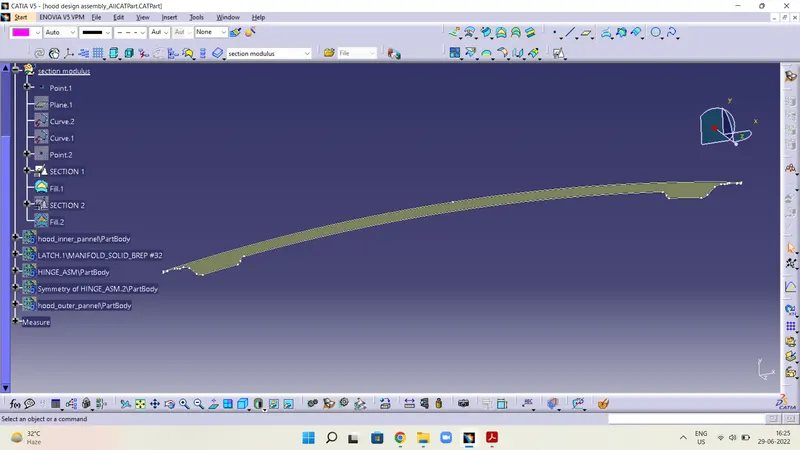
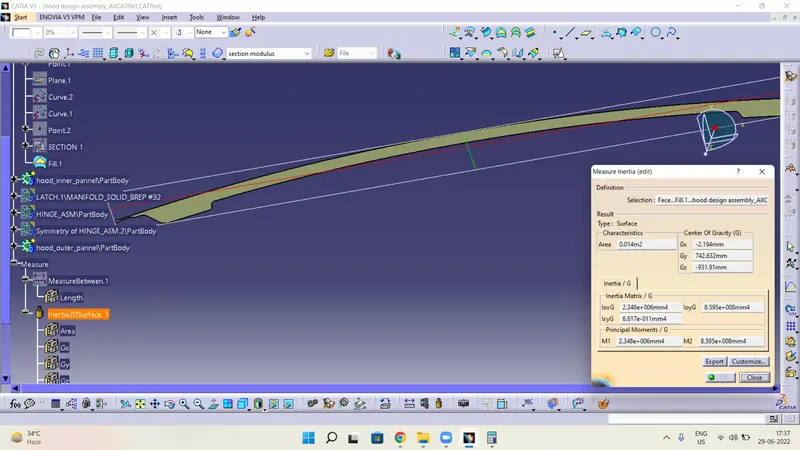
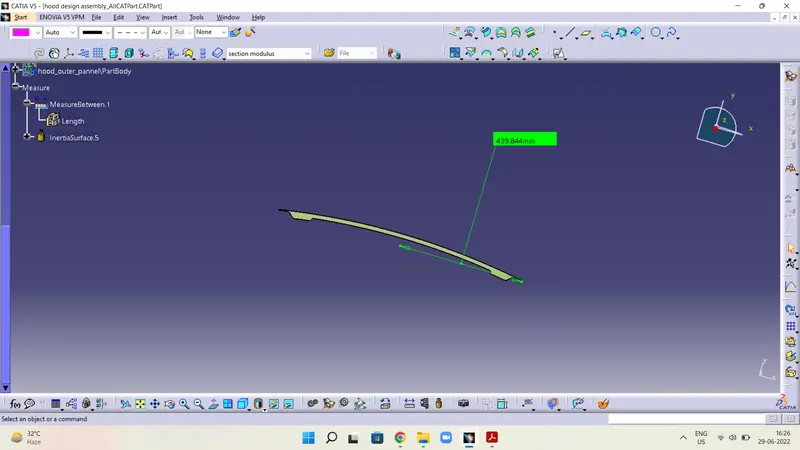
Y DISTANCE- THE NEUTRAL AXIS
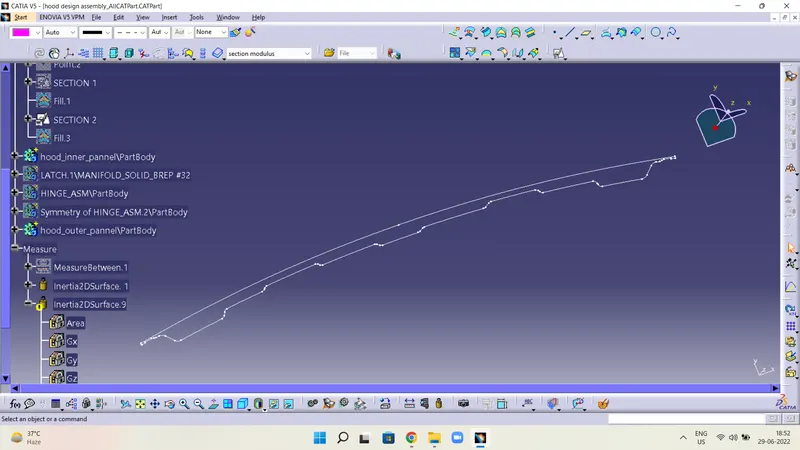
SECTION 2-
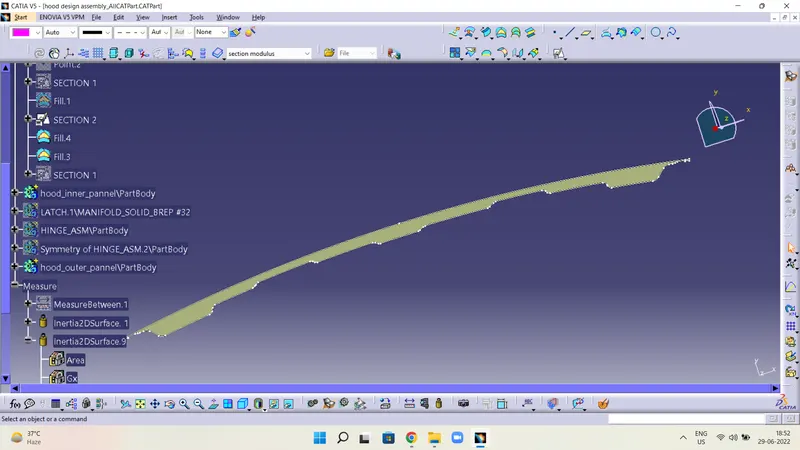
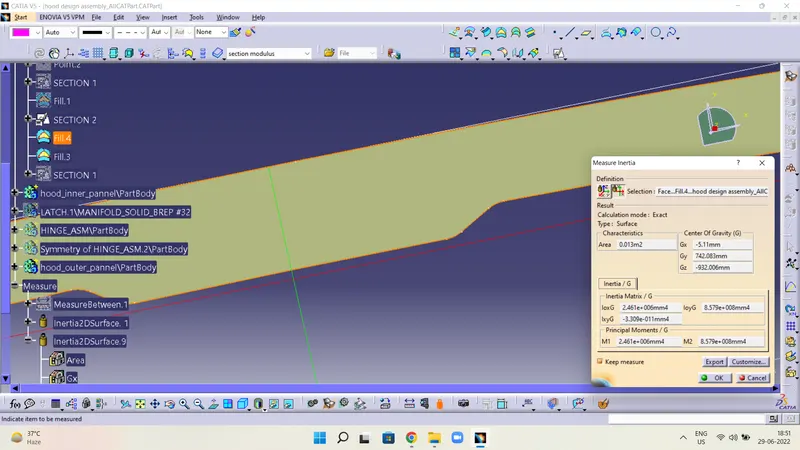
CALCULATION
for section 1
I=2.348e+006mm4
Y=439.844mm
z=I/Y
z=2.348e+006mm4/439.844mm
z=533.82
for section 2
i do some modification in the inner hood creat some emobosses and and increase the length of emboses
I=2.461e+006mm4
Y=439.844MM
Z=I/Y
Z=559.51
So the strength of an hood varies from 533.82MM to 559.51MM
- Newton's first law also explains that ,if higher the mass , the force required to move the object is also high due to offering more resistance in order to move the object, This resistance we called it as a MOMENT OF INERTIA.
In case of hood also same principle will work, i.e when increase in cross sectional area by 1mm the minimum load carryingcapacity or strength was increased by approximately 8% percentage what we observed from the above discussion.The strength of the material also depends upon the composition of material ,thickness and cross sectional area of an object.
CONCLUSION:-
The strength of the material is directly proportional to the moment of inertia, hence increase in sectional area there is haveincrease in overall mass of an object ,hence have increase in strength