Section Modulus calculation and optimization
AIM:
To analyse the hood we have designed by calculating the Section Modulus and optimize the design for better performance.
THESIS:
In this challange we will be taking the section of our Hood design and calculate the section modulus. we will take the section along the length of the load and find the moment of Intertia using the "Intertia Analysis" tool. The Value will be used to find out the section modulus.
Section Modulus:
The ratio of total moment reisted by the section to the stress in the extreme fibre. The sectin modulus gives us and idea about how much of load the given structure can take. If the section modulus increases the moment of resistance increases and hence its load bearing capacity.
Section modulus is a geometric property for a given cross-section used in the design of beams or flexural members. Other geometric properties used in design include area for tension and shear, radius of gyration for compression, and moment of inertia and polar moment of inertia for stiffness.
Section modulus(S) = I/y
Where,
- S - section modulus
- I- moment of inertia value from the "inertia Analysis"
- y - Distance from the neutral axis to the Outer most Fiber.
Moment of Inertia:
The moment of inertia of a plane area about a given axis describes how difficult it is to change its angular motion about that axis (another way to put it is how resistant the object is to bending and torsional stresses) . Therefore, it encompasses not just how much mass the object has overall, but how far each bit of mass is from the axis. The farther out the object's mass is, the more rotational inertia the object has, and the more force is required to change its rotation rate.
Case I:
In this case, we calculate the Section modulus of our Hood.
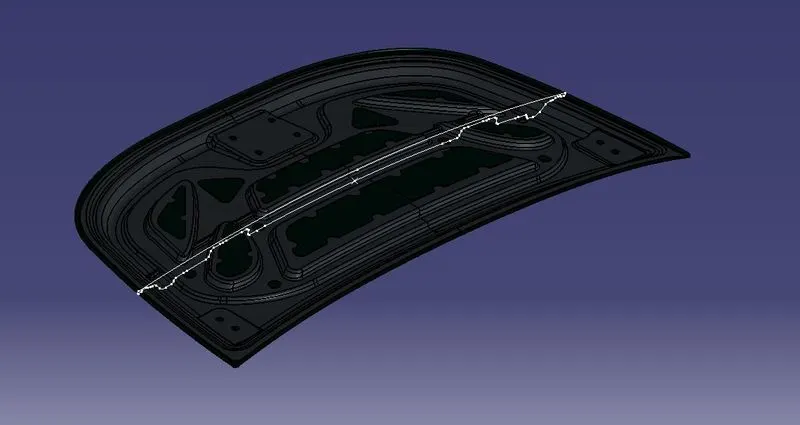
Distance from neutral axis (Y):
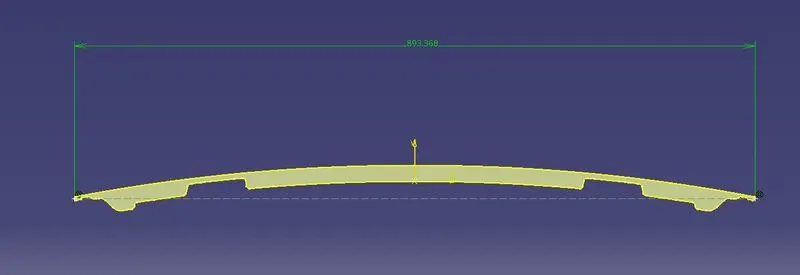
The distance from the neutral axis from the outer most fiber is half the distance.
hence, Y= 893.368 / 2
Y = 446.684mm
Intertia Analysis data:
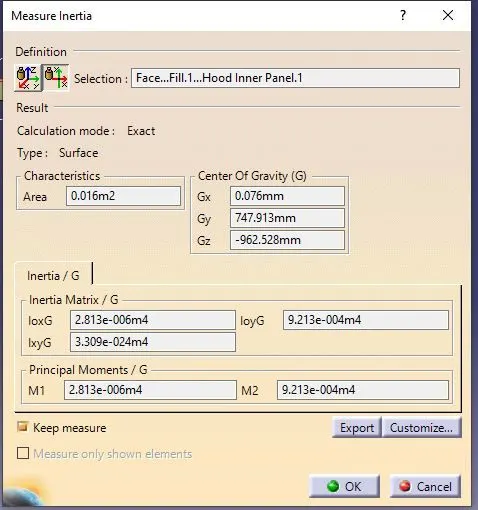
Calculation:
M1= 2.81305 x `10^-6` `m^4`
= 2.81305 x `10^-6` x `10^12` `mm^4`
M2 = 9.213 x `10^-4` `m^4`
= 9.213 x `10^-4` x `10^12` `mm^4`
S= I/Y
we consider the lowest value of I, in this case it is M1
hence,
S = (2.81305 x `10^-6` x `10^12`) / 446.684
S = 6297.628 mm
Case II:
In this case, we have have increases the distance between the outer panel and inner panel by 0.5mm.
Distance from neutral axis (Y):
The distance from the neutral axis from the outer most fiber is half the distance.
hence, Y= 893.368 / 2
= 446.684mm
Intertia Analysis data:
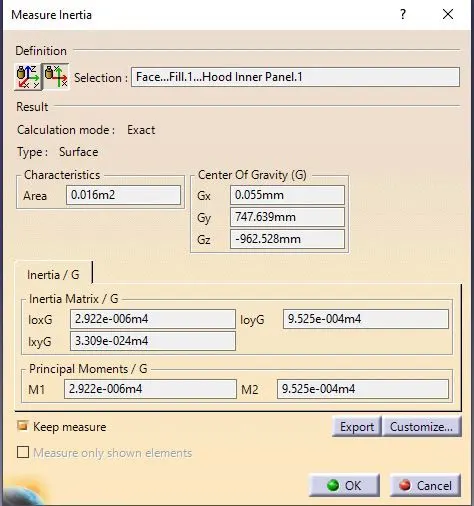
Calculation:
M1= 2.922 x `10^-6` `m^4`
= 2.922 x `10^-6` x `10^12` `mm^4`
M2 = 9.525 x `10^-4` `m^4`
= 9.525 x `10^-4` x `10^12` `mm^4`
S= I/Y
we consider the lowest value of I, in this case it is M1
hence,
S = 2.922 x `10^-6` x `10^12` x 446.684
S = 6541.649mm
Conclusion:
From our case study, we observe that the increase in the surface area increases the load carrying capacity and stiffness of the component.