Section Modulus calculation and optimization
AIM:
To use the section from the hood design and calculate the section modulus using the formula S=I/Y
S = Section Modulus
I = Moment of inertia
Y = DIstance bteen the neutral axis and the extreme end of the object
Come up with a new section that has improved the section modulud of the previous section and mention what change you made that has increased the strength.
PROCEDURE
SECTION MODULUS
it is termed as the ratio of second moment of area and distance from N.A(Neutral axis) to the extreme fiber.Also it is the measure of strength of given member. The stress in the outermost section of beam is computed with the help of section modulus.
SECTION MODULUS 1
INTERSECTION OF INNER AND OUTER HOOD PANEL
Take an intersection of the hood outer and inner panel wirh reference with the plane created on the zero Y - azis. Then do an extract with tangent continiuty of the outer end curve for both the hood outer and inner curve simultaneously. Then create points and do split on both hemming region.Draw necessary lines to close the open end curves. Finally join the curve. In order to measure inertia we have a closed surface. Use fill to create closed surface.
INTERSECTION LINES/CURVES
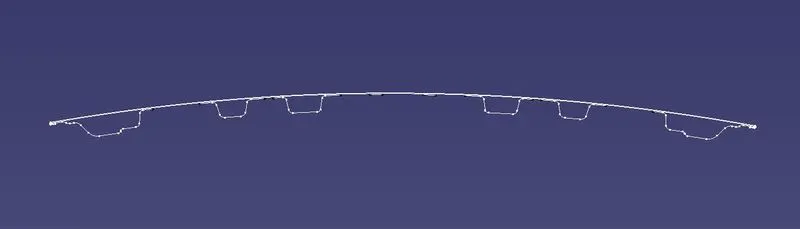
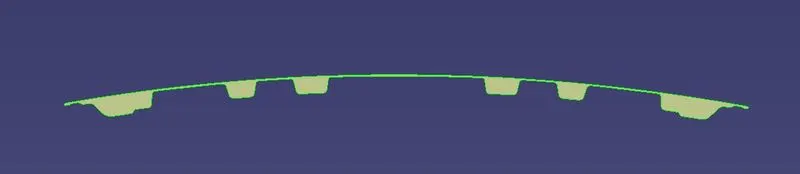
MEASURING INERTIA
Now We Have a Closed Surface. go To Measure Inertia and Select Measure Inertia 2D From The Popup then select the surface. Now we have got the got the value for the Moment of Inertia. M1 is the Minimum Principal Moment of Inertia and M2 is the maximum Principa moment of Inertia.
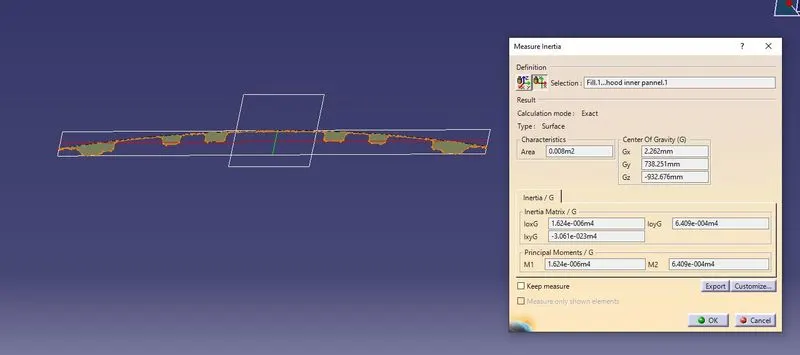
Principal Moment Of Inertia Values as Displayed
(Min.Principal Moment of Inertia)M1= 1.624e-006m4 (Max.Principal Moment of Inertia)M2=6.409e-004m4
Conversion of m^4 to mm^4
M1 - 1.624 x 10^6 m^4
1.624 x 10^(-6) x (10^3)^4 mm^(4)
1.624 x 10^(6) mm^(4)
M2- 6.409 x 10^(-4) m(^4)
6.409 x 10^(-4) x (10^30)^4 mm^(4)
6.409 x 10^(8)mm^(4)
Here we choose M1= 1.624 x 10^(6) mm^(4) Min.Principal Moment of Inertia.
Moment if Inertia I = 1.624 x 10^(6) mm^(4)
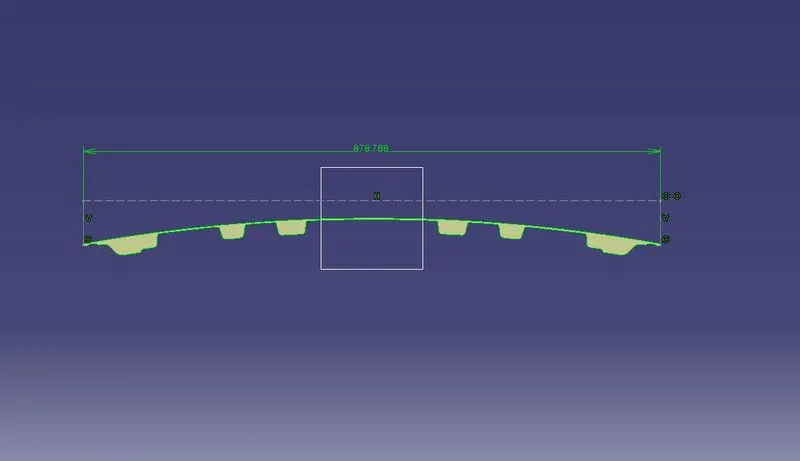
Distance between the neutral axis and the extreme end of the object y = 439.394mm
FORMULA
S=I/Y
S = Section Modulus
I = Moment Of Inertia
Y = Distance between the neutral axis and the extreme end of the object
S = 1.624 x 10^6 mm^4/439.394mm
(SECTION MODULUS 1) S = 3695.9MM^3
SECTION MODULUS 2
Here we used the same intersection data.but we modify by giving a parallel curve definition offset of o.5 outwaqrds to the outer end curve of the outer panel.
MOMENT OF INERTIA DATA
Here we used the same intersection data.but we modify by giving a parallel curve definition offset of 0.5 outwords to the outer end curve of the outer panel.
Moment of Inertia Data
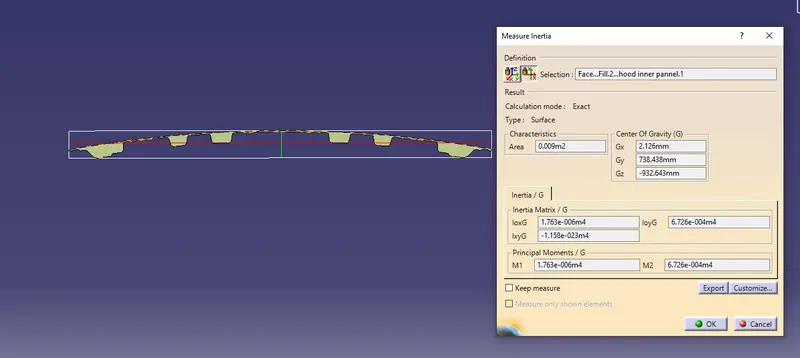
Principal moment Of Inertia Values as display
(Min.Principal Moment of Inertia)M1 - 1.763e-006m4 ; (max.Principal Moment of Inertia) M2 -6.726e-004m4
Conversion of m^4 to mm^4
M1 - 1.763 x10^-6 m^4
1.763 x 10^-6 x (10^3)^4 mm^4
1.763 x 10^-6 x 10^12
1.763 x 10^6 mm^4
M2 - 6.726 X 10^6 MM^4
Here we choose M1 as the minimum Principal Moment of Inertia.
Moment of Inertia = 1.763 x 10^6 mm^4
Distance between the neutral axis and of the object y = 439.394mm.
FORMULA = SI/Y
S = 1.763 x 10^6 mm^4 / 439.394 mm
S = 4012.3
(Section modulus 2) S = 4012.3mm^(3)
Comparisson
(SECTION MODULUS 1) S = 3695.9MM^(3) to the existing car.
(SECTION MODULUS 2) S = 4012.3mm^(3) to the new car.
Based on the Section Modulus analysis we know that new car material is more power and strong than the old car.