Section Modulus calculation and optimization
Section Modulus Calculation Of Hood
AIM :- To Calculate the section modulus of the previouly designed hood and to analyse the strength and movement of inertia Also to improvee it.
The section modulus is a geometric property of a cross-sectional shape that describes its resistance to bending. It is a critical parameter in structural engineering and mechanics, particularly when analyzing the behavior of beams and other load-bearing components.
S=I/Y
Here,
S = Section modulus
I= Moment of Inertia (Unit mm 4)
Y= Distance from Neutral axis to the extreme end (unit mm)
The Unit of a “section modulus” is (mm3)
I)">
The elastic section modulus is defined as S = I / y, where I is the second moment of area (or area moment of inertia, not to be confused with moment of inertia) and y is the distance from the neutral axis to any given fibre. It is often reported using y = c, where c is the distance from the neutral axis to the most extreme fibre, as seen in the table below. It is also often used to determine the yield moment (My) such that My = S ⋅ σy, where σy is the yield strength of the material.
FORMULA FOR DIFFRENT SHAPES :-
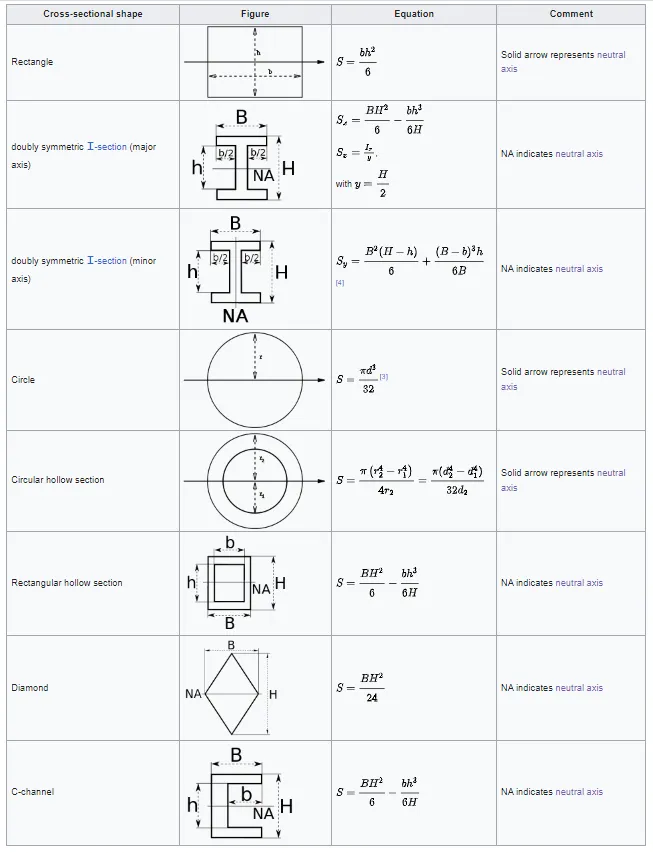
The larger the section modulus, the greater the shape's resistance to bending. It provides an indication of how effectively a shape can distribute and handle bending stresses. Different shapes with the same cross-sectional area can have different section moduli, which influences their suitability for various structural applications.
In simpler terms, the section modulus measures how efficiently a given shape can resist bending stresses. It is often used to compare and design different cross-sectional shapes for beams or columns to ensure that they can withstand the loads and forces they will experience without failing or deforming excessively.
Mathematically, the section modulus (S) is calculated as:

Where:
- I is the moment of inertia of the cross-sectional shape about a specific axis perpendicular to the bending direction.
- c is the distance from the neutral axis (the axis that experiences no stress during bending) to the outermost fiber of the shape.
The plastic section modulus is a specialized variant of the section modulus used in structural engineering to analyze the behavior of a cross-sectional shape under extreme loading conditions, specifically when the material has entered the plastic deformation range.
When a material undergoes plastic deformation, it can sustain larger deformations without returning to its original shape. The plastic section modulus takes this behavior into account and is used to analyze the plastic bending capacity of a structural member, such as a beam or a column.
In plastic analysis, it is assumed that a portion of the cross-section has yielded (experienced plastic deformation), while the rest remains elastic. The plastic section modulus (Zp) is calculated based on the plastic moment (Mp) and the yield stress (fy) of the material:
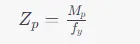
Where:
- Mp is the plastic moment of the cross-section, which is the moment at which yielding occurs throughout a portion of the cross-section while maintaining equilibrium.
- fy is the yield strength of the material.
DESIGN STUDY :-
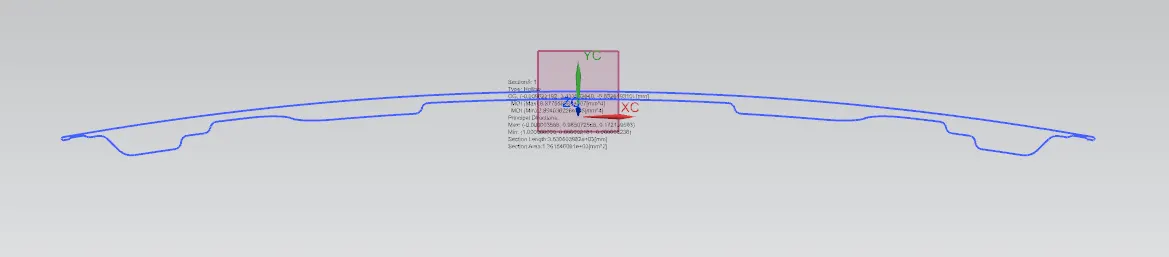
1. create an datum plane in the middle of the hood assembly
2. use intersection curve to create an inter section curve
3. close the sketch with the help of studio spline & line coomand
4. Use section Inertia analysis to calculate the movement of inertia
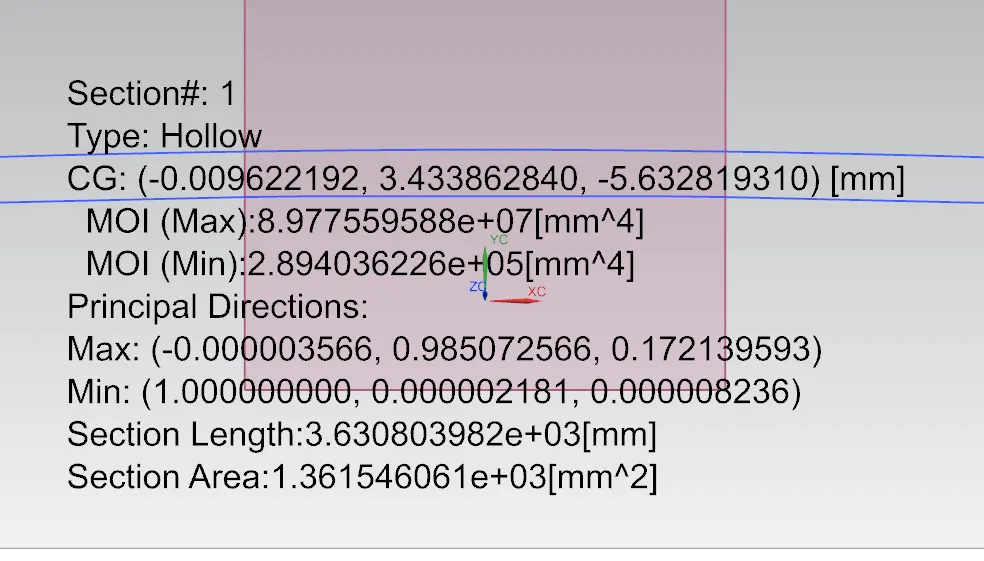

Moment of inertia(max) = 8.977559588x10^7×mm^4
Moment of inertia(min) = 2.89403622×10^5×mm^4
Y= 438.1968 mm
S=I/Y
S(max) = 8.977559588x10^7×mm^4 / 438.1968
S(max)= 204.8750604×10^3xmm^3
S(min) = 2.89403622×10^5×mm^4/ 438.1968
S( min)= 0.6604421164×10^3xmm^3
Hood Design Optimization
By increasing the depth of the inner panel by 0.5 mm
AFTER THE CHANGES MADE THE VALUES ARE:
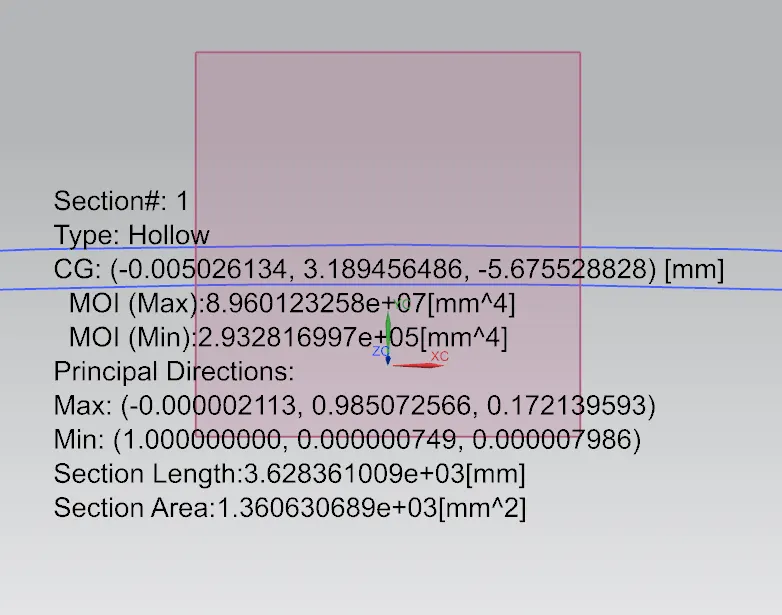
Moment of inertia(max) = 8.960123258x10^7×mm^4
Moment of inertia(min) = 2.932816997×10^5×mm^4
Y= 438.1968 mm
S=I/Y
S(max) = 8.960123258x10^7×mm^4 / 438.1968
S(max)= 204.4771495×10^3xmm^3
S(min) = 2.932816997×10^5×mm^4/ 438.1968
S( min)= 0.6692921986×10^3xmm^3
Conclusion
So, here the difference can be seen in the moment of inertia and the change in the section modulus can be seen by the change in the design(depth).