Section Modulus calculation and optimization
Section Modulus (Z) is a geometric property of a cross-sectional shape that measures its resistance to bending. It is calculated by dividing the moment of inertia (I) of the section about the bending axis by the distance (Y) between the neutral axis and the extreme end of the object. The section modulus represents the ability of a section to withstand bending stresses.
The moment of inertia (I) is a measure of an object's resistance to changes in its rotational motion around an axis. It quantifies the distribution of an object's area relative to an axis. For a beam, the moment of inertia is calculated by summing the products of each small element's area and the square of its perpendicular distance to the axis of interest.
Z = I/Y, Where
Z = Section modulus (mm^3)
I = Moment of Inertia of the section about the bending axis. (mm^4)
Y = Distance between the neutral axis and extreme end of the object (mm)
Area moment of Inertia:
The area moment of inertia (I) can be calculated using integration or specific formulas based on the shape of the cross-section. Common formulas for calculating the area moment of inertia for different shapes include:
M = Bending moment
I = Area moment of Inertia
Calculation
case 1:
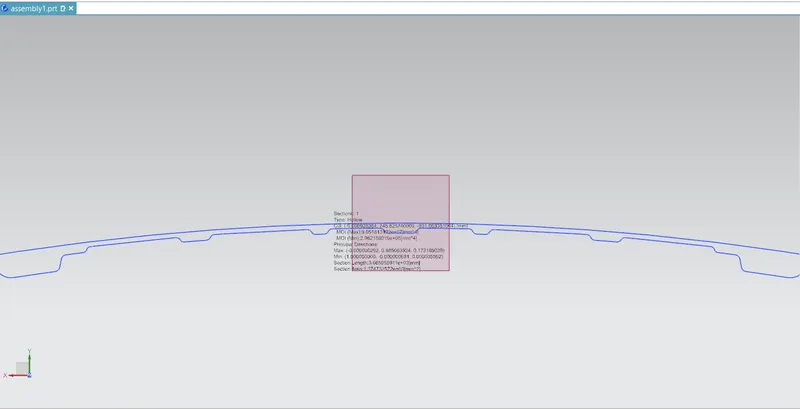
Fig: 1
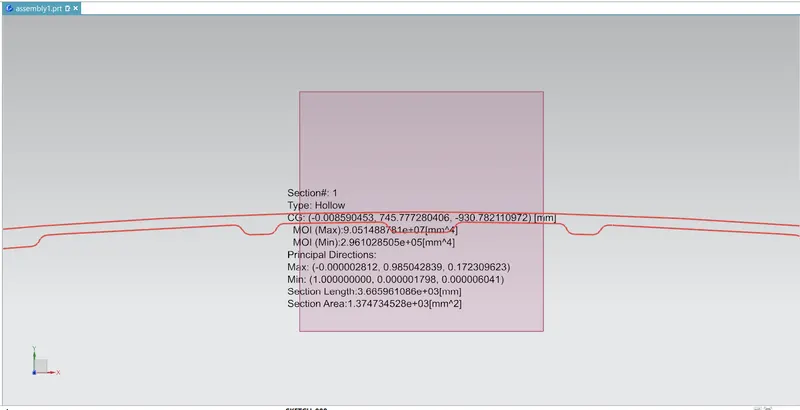
Fig: 2
MOI (max) = 9.051488781e+07 (mm^4)
MOI (min) = 2.961028505e+05 (mm^4)
As per the section modulus equation,
Z1 = I/Y
I = MOI (min) value is considered
Y = Total distance /2,
Total distance =880.53 mm
Y = 880.53 / 2
= 440.265 mm
Therefore, Z1 = 2.961028505e+05 mm^4/440.265 mm
Z1 = 672.555 mm^3
Case 2 :
The design is optimized to improve section modulus .
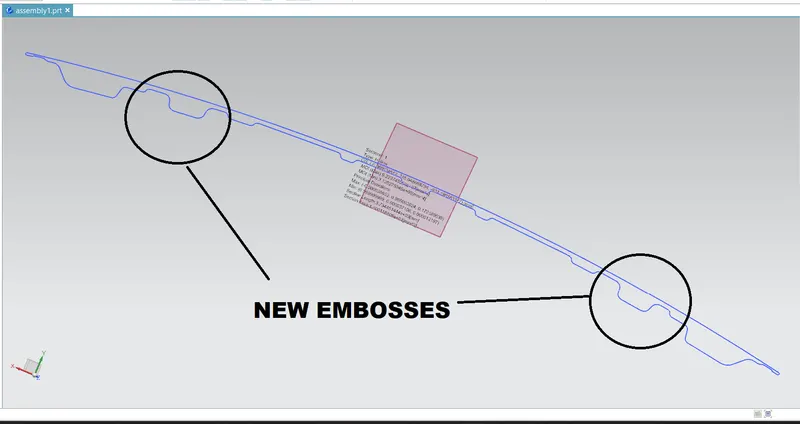
Fig: 3
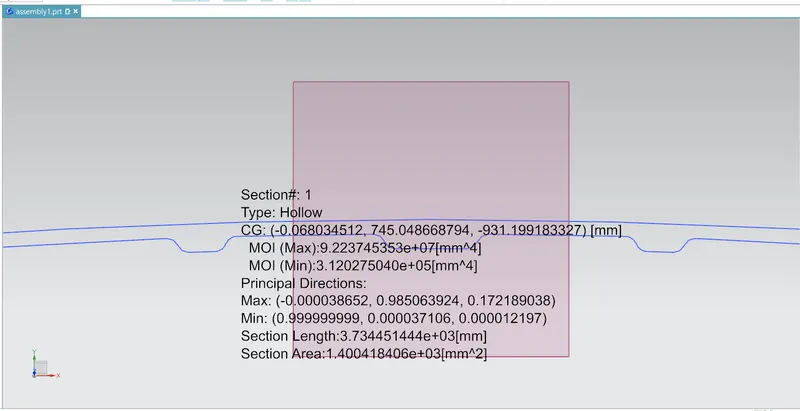
Fig : 4
MOI (max) = 9.223745353e+07 (mm^4)
MOI (min) = 3.120275040e+05 (mm^4)
As per the section modulus equation,
Z2 = I/Y
I = MOI (min) value is considered
Y = Total distance /2,
Total distance =880.53 mm
Y = 880.53 / 2
= 440.265 mm
Therefore, Z2 = 3.120275040e+05 mm^4/440.265 mm
Z2 = 708.726 mm^3
Conclusion :
The comparison of two section modulus values, Z1 and Z2, reveals that the optimized design (Z2) outperforms the initial design (Z1) by having a higher section modulus. This indicates that the optimized design offers improved resistance to bending, showcasing greater strength and rigidity. The optimization process, which may involve modifying dimensions, shape, or material properties, aims to enhance the section modulus and create a more efficient structure. With Z2 surpassing Z1, the optimized design provides enhanced structural performance, increased safety margins, and potential cost savings, ensuring a reliable and robust component for its intended application.