Section Modulus calculation and optimization
AIM:
To Create Section from our Hood design and calculate the Section Modulus using the formula.
Section Modulus:
It is the ratio between area moment of inertia to the distance from neutral axis to outmost fibre.
S = I / y
Bending Equation M / I = σ /y = E / R
where I = Moment of Inertia,
E = Young's modulus
σ = Stress at any fibre at a distance of y from the neutral axis,
M = Bending moment and
R = Radius of curvature.
S= Section Modulus
So, M = (I x σ) ⁄ Y
In simple words bending moment is how much deformation is happening in our Component, when we applying load.
Bending moment is directly proportional to the area moment of inertia, here our Y length of our neutral axis is constant. If area moment of inertia is increased, bending moment will increase as well.
Why we are calculating Bending Moment and Section Inertia Analysis?
Now we are creating Hood, so we need to know how much impact resistance it has and how much it can withstand while collusion with another. As a design engineer we should consider the engineering aspects for design of Hood. So, we are calculating the Bending moment and Section Inertia Analysis report for comparing our report with our parent design or other competitor’s design.
How I did the section modulus calculation?
- Mid line is created on our surface by using this perpendicular datum plan is created.
- By using intersecting option, we did intersection with it together.
- Now we got outer boundary of our design surface.
- Sketching is done because it was having some patches, so we joined those lines together.
- Now we got a closed surface, for doing section inertia analysis we need only the closed surface.
- Analysis is done we got Minimum moment of inertia for our design is shown below.
- Then Again we did offset from the intersection sketch 0.5 mm, then again analysis is done that also attached below and its calculations as well.
Initial Analysis
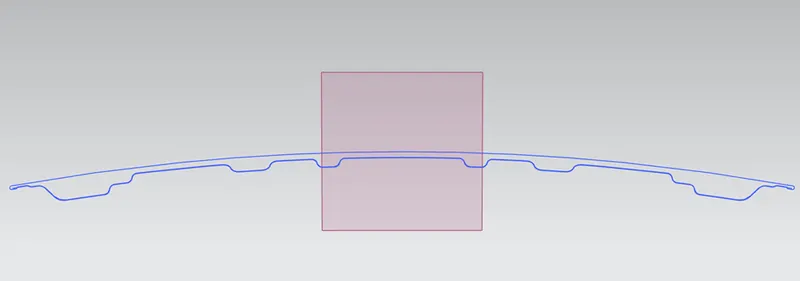
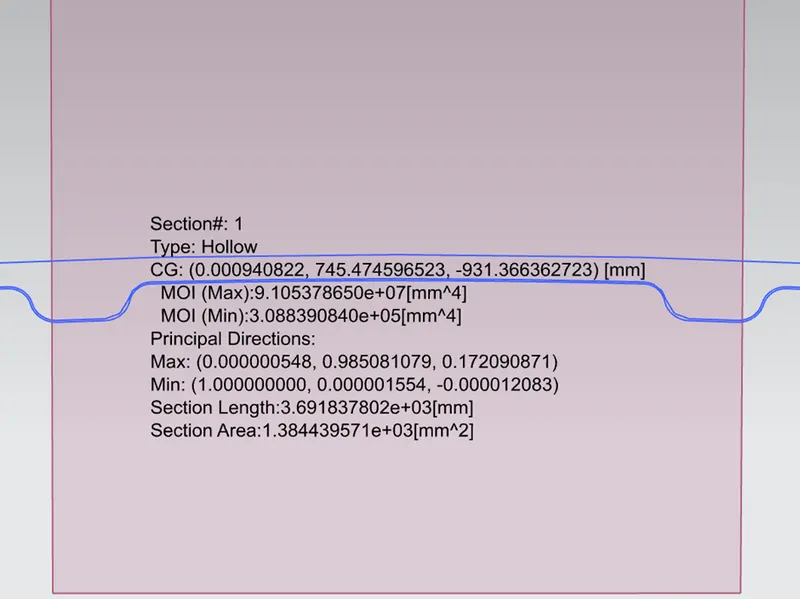
I1 = 3.088390840 X 105 mm4
Y1= 438.27 mm
|
S1 = I1/Y1 => 704.67 mm3 |
Offseted Surface:
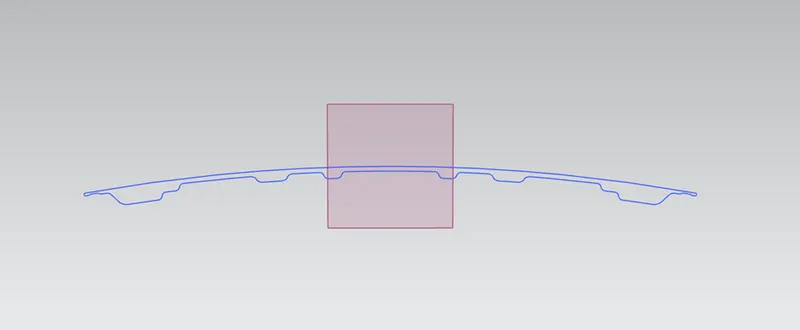
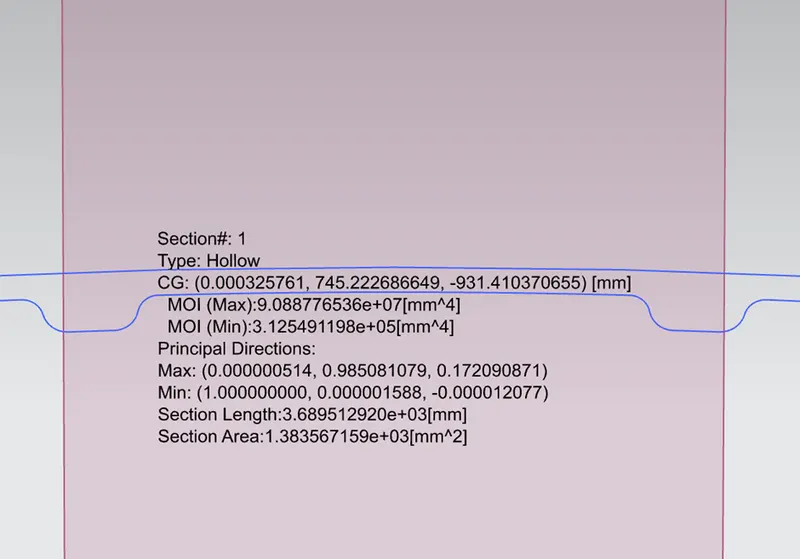
I2 = 3.125491198 X 105 mm4
Y2= 438.27 mm
|
S2 = I2/Y2 => 713.2 mm3 |
S2 > S1
Conclusion:
We have designed the Hood before and now we did inertia analysis, if we increased the cross-sectional area correspondingly inertia is alsoincreasing. So, moment of inertia is proportional to the Section modulus.I f we considered cross section.