Section Modulus calculation and optimization
Section Modulus:
Simply put, section modulus is a geometric property of a beam or structural member that measures its ability to resist bending or flexing. It is a measure of the member's strength and stiffness.
Technically, the section modulus is defined as the ratio of the moment of inertia of a cross-section of a structural member to the distance from the center of gravity of the cross-section to the farthest point from that center. Mathematically, it can be expressed as:
Z = I / y
Where: Z = section modulus; I = moment of inertia; y = distance from the center of gravity to the farthest point of the cross-section
The section modulus is an important factor in the design of structural members, such as beams and columns & in our case the hood inner panel design, as it determines their load-carrying capacity and resistance to bending. The higher the section modulus, the stronger and stiffer the member.
Snap of the section:
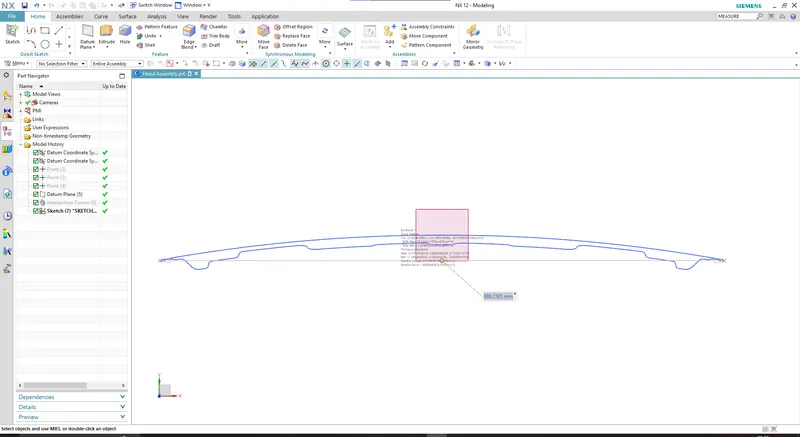
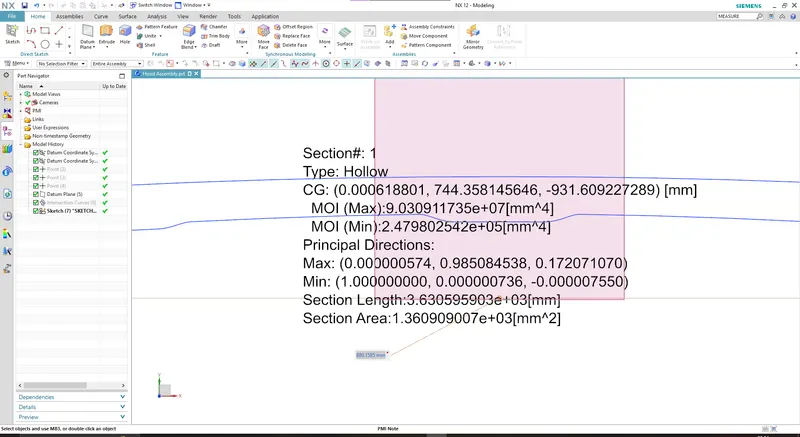
Minimum MOI: 
Maximum distance from section center = 880.1585/2 mm = 440.07925mm
Hence, Section Modulus = (Min. MOI) / (Max. distance from center) = 563.49 mm^3
Improved Section Modulus:
By increasing the draft for the embosses which results in the net increase of the area of the section thus increasing the MOI resulting in increase of section modulus.
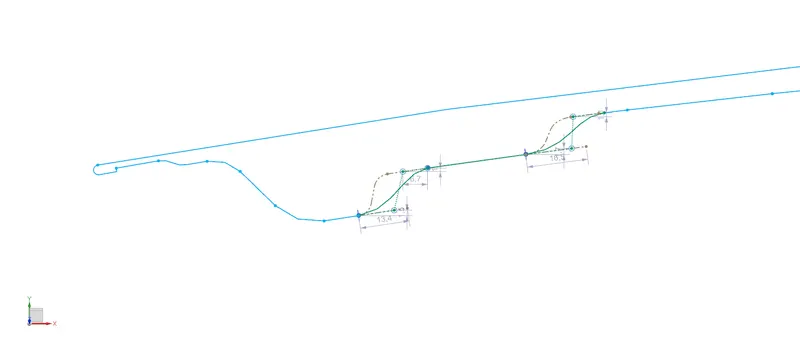
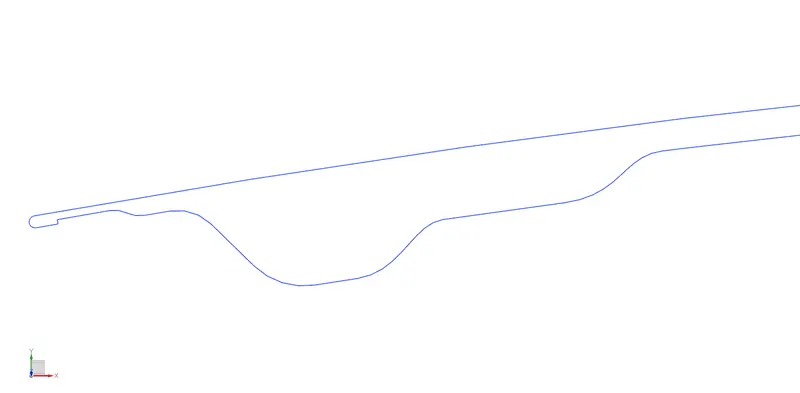
This results in the increase in area of the section at the correspondent regions, the farther which is the greater the moment of inertia, ther greater it's section modulus.
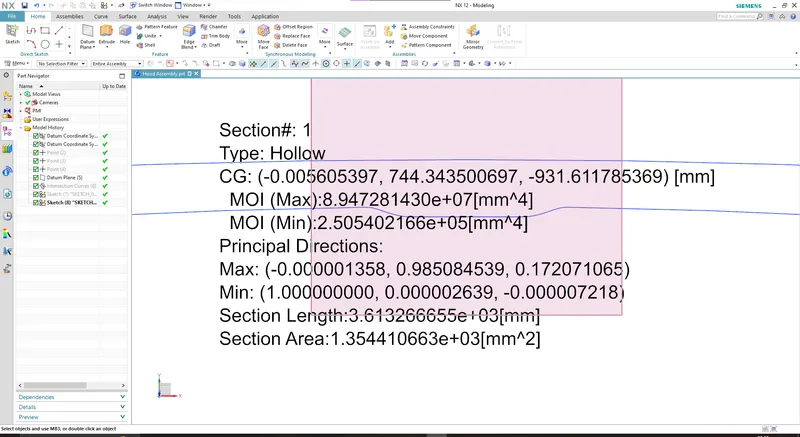
New Section Modulus = 250540.21 / 440.07925 = 569.31 mm^3
Hence, an increase in it's section modulus reulting in increased strength. For further increments in strength, more embosses can be introduced in the design.