Section Modulus calculation and optimization
To calculate the section modulus of a hood using the formula S = I/y, we will need to know the moment of inertia (I) and the distance between the neutral axis and the extreme end of the object (y).
The moment of inertia is a measure of the resistance of an object to bending or deformation. It is calculated based on the shape, size, and distribution of mass in the object. To calculate the moment of inertia of a hood, you will need to know the dimensions of the hood and the material it is made of.
The neutral axis is an imaginary line that divides the cross-section of an object into two equal halves. The distance between the neutral axis and the extreme end of the object (y) is called the section modulus.
To calculate the section modulus of a hood, we will need to measure the dimensions of the hood and use the appropriate formulas to calculate the moment of inertia and the distance between the neutral axis and the extreme end of the object. Once you have these values, you can plug them into the formula S = I/y to calculate the section modulus.
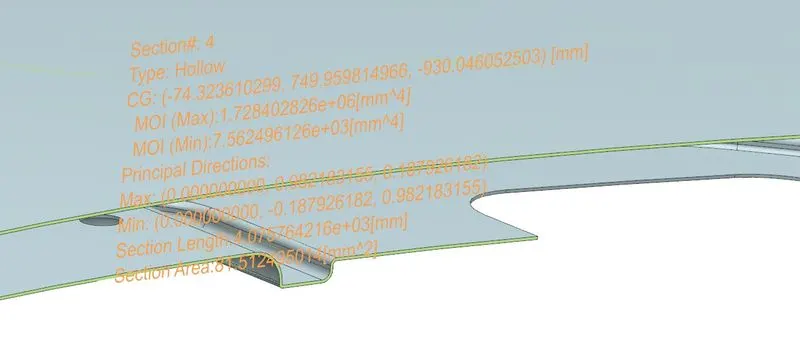
Imax –1.7284x 10^6 (mm^4)
Imin – 7.5624 x 10^3 (mm^4)
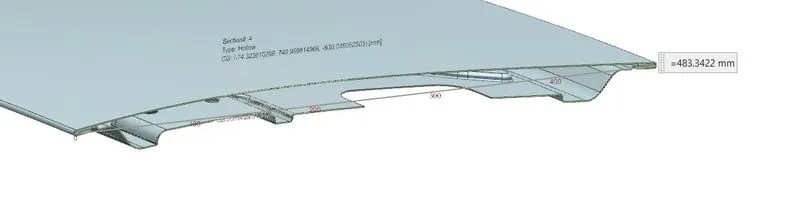
Y = Total length / 2
= 486.3422/2
=243.1711 mm
section modulus for max. = 1.7284x 10^6 /243.1711
= 7.1782x 10^3 mm^3
section modulus for min. = 7.5624 x 10^3/ 243.1711
= 31.07 mm^3
So for this hood design section modulus range from 7.1782x 10^3 mm^3 to 31.07 mm^3
Design optimisation:
There are several ways to improve the sectional modulus of a structure:
-
Increase the size or thickness of the structural members. This will increase the amount of material available to resist bending forces, resulting in a higher sectional modulus.
-
Use materials with a higher modulus of elasticity. Materials with a higher modulus of elasticity, such as steel, will have a higher sectional modulus for a given size and shape of member.
-
Use a more efficient cross-sectional shape. Some cross-sectional shapes, such as circular or I-shaped beams, have a higher sectional modulus than others, such as rectangular or square beams.
-
Increase the number of structural members. Adding additional members can increase the overall stiffness of the structure and increase the sectional modulus.
-
Use a combination of these methods. By combining multiple approaches, it may be possible to significantly increase the sectional modulus of a structure.
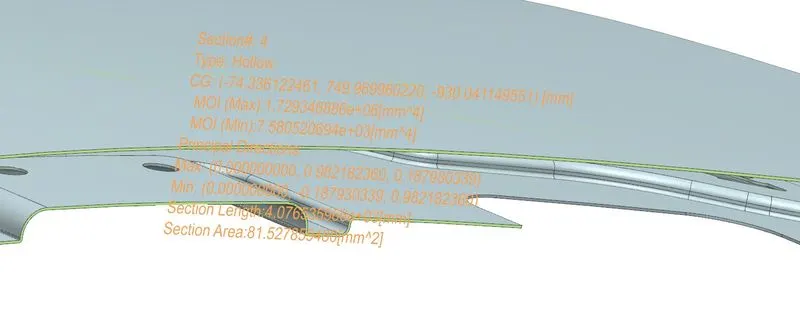
Imax – 1.729346886 x 10^6 (mm^4)
Imin – 7.580520 x 10^3(mm^4)
Y = Total length / 2
= 486.3422/2
= 243.1711 mm
section modulus for max. = 1.729346886 x 10^6 / 243.1711
= 7.129 x 10^3 mm^3
section modulus for min. = 7.580520 x 10^3 / 243.1711
= 31.22 mm^3
So for this hood design section modulus range from 7.129 x 10^3 mm^3 to 31.22 mm^3