Roof Design
Aim:
Design car roof using the provide roof skin data and design of bow roof rails, front and rear roof rails as per the given master section and reinforcement roof center. And perform bow position analysis using the formulas of heat distortion and snow load conditions.
Car roof,
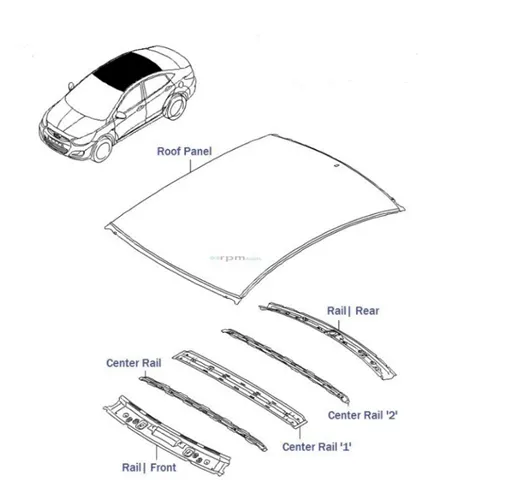
A car roof is the top part of a vehicle that provides protection and enclosure for the occupants. It serves as a structural component of the car's body and helps to maintain the overall shape and integrity of the vehicle. The car roof can be made of various materials, such as steel, aluminum, or composite materials, depending on the design and construction of the car.The car roof typically consists of a solid, rigid surface that covers the passenger compartment and protects occupants from external elements like rain, snow, and sunlight.
The car roof may have various features depending on the car model and design. Some cars have a fixed roof that does not open or move, while others have sunroofs or moonroofs, which are panels that can be opened or tilted to allow fresh air and natural light into the cabin. Convertible cars have retractable roofs that can be folded down or removed entirely to convert the car into an open-top vehicle.
Types of car roofs,
Hardtop roof,
Sedan roof,
Sunroof/Moonroof,
Convertible Roof,
Targa Top,
Panoramic Roof,
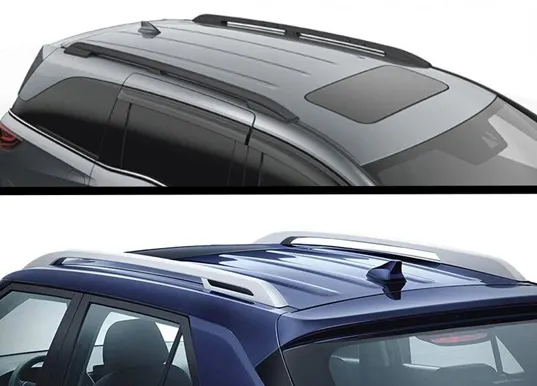
Front roof rail,
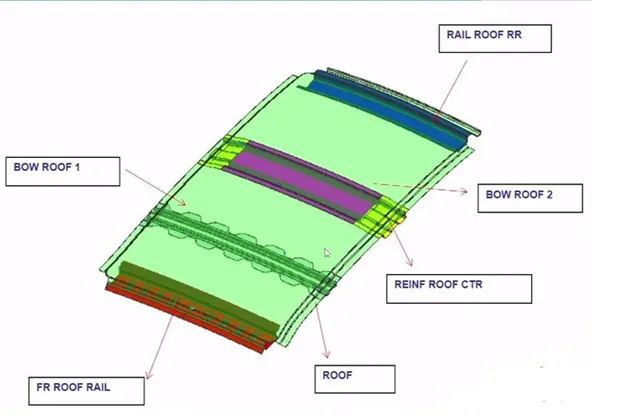
In most cars, this area is typically a continuation of the main roof structure. It provides protection and enclosure for the front passengers, along with the rest of the car roof. It is usually connected to the A-pillars. The front roof area often incorporates features such as a sun visor, interior lighting, grab handles, and possibly a roof-mounted console for controls like interior lights, sunroof operation, or other features specific to the car model.
Rear roof rail,
The rear roof is typically a continuation of the main roof structure and is connected to the B-pillars on either side of the car. It forms the upper boundary of the rear passenger compartment and contributes to the overall structural integrity of the vehicle.
Bow roof rail,
A Roof Bow is a sheet metal part, usually spot welded to the BIW inner frame, forming the inner structure of the vehicle body. Its primary function is to supporting the roof panel loads, such as Oil Canning and local stiffness.
Mastic area,
Mastic area is the area where the mastic sealant is applied to Unite the outer panel and the ball roof. If we do weld to combine both these components it may cause the overall visual and mechanical properties on the roof.
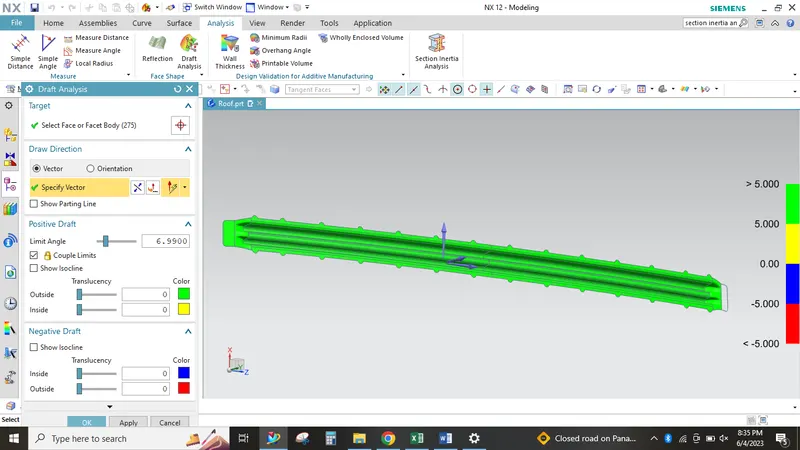
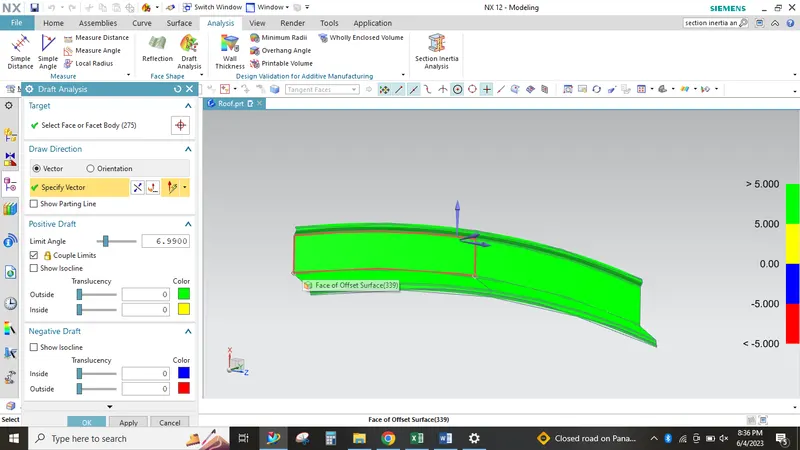
Draft analysis,
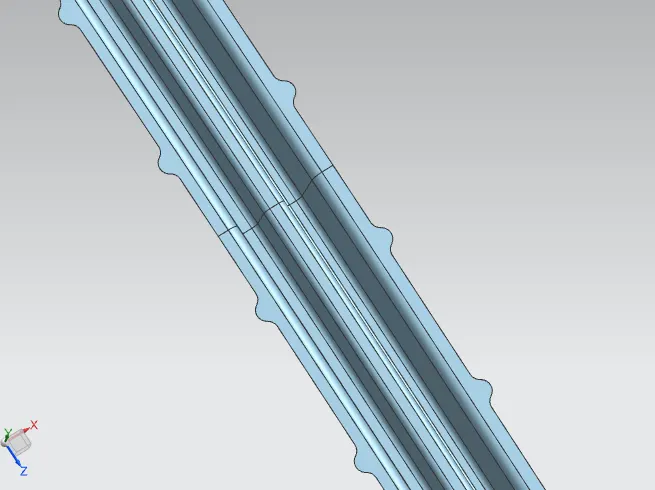
Draft is an angle provided to the plastic part, which is used to eject or removes the material from the mold easily without any damages. Draft is a taper applied to the faces of the part that prevent them from being parallel to the motion of the mold opening. Draft analysis, which is used to find out the proper tooling axis of a plastic component. it is a technique used to analyze whether our part model created in CAD is manufacturable based on the draft condition applied.
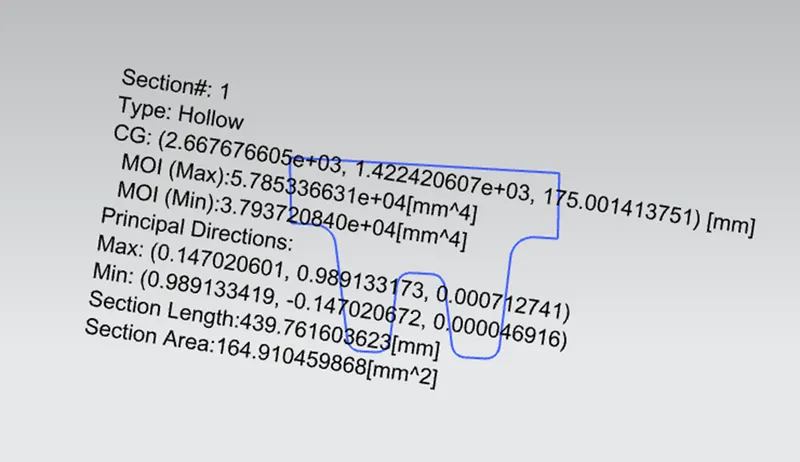
Section modulus,
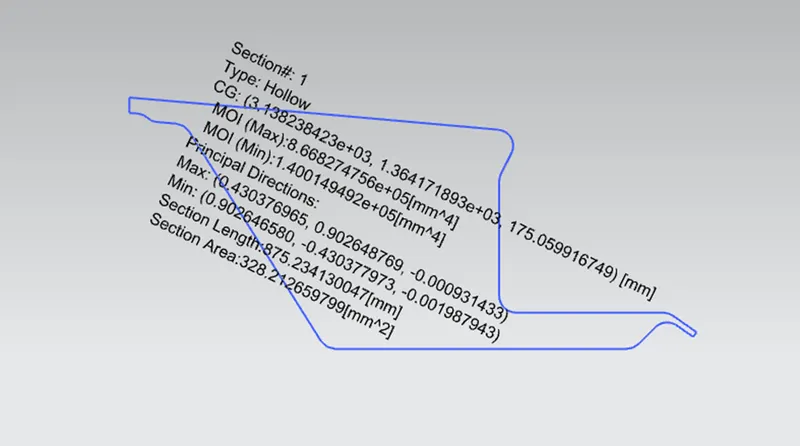
Section modulus is a geometric property for a given cross-section used in the design of beams or any component with flexural properties. Other geometric properties used in the design include an area for tension and shear, the radius of gyration for compression, and moment of inertia and polar moment of inertia for stiffness. The section modulus analysis made to check the elastic properties or the deformation properties on the component.
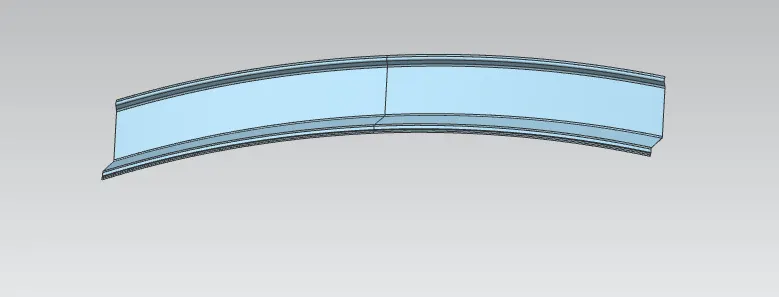
Draft analysis and section modulus,
Upper roof,
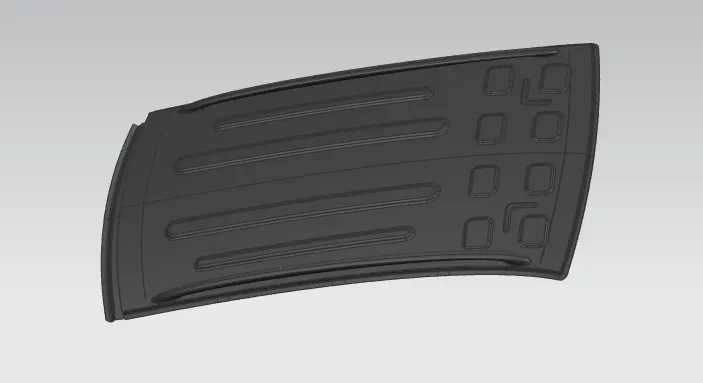
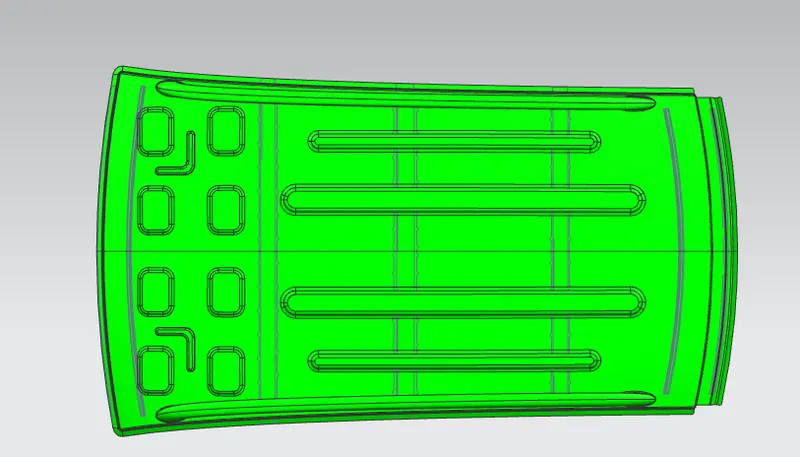
Front roof,
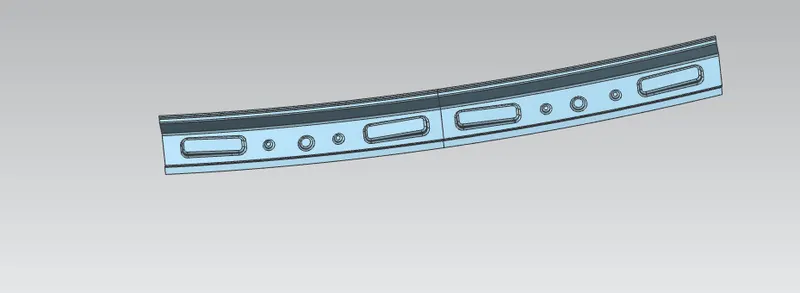
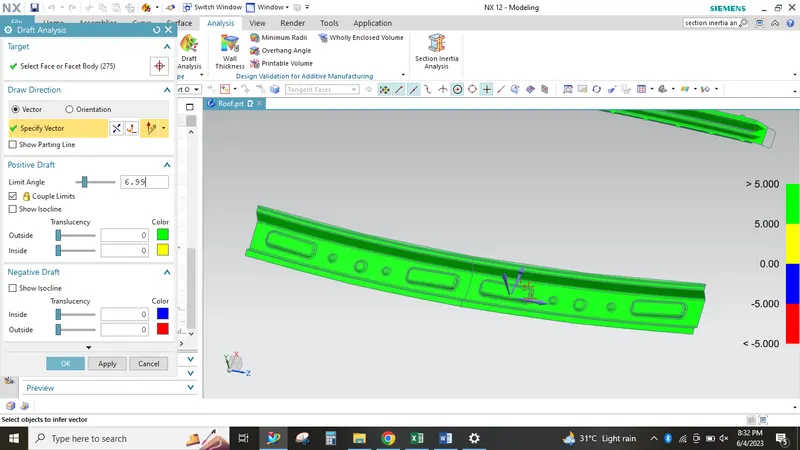
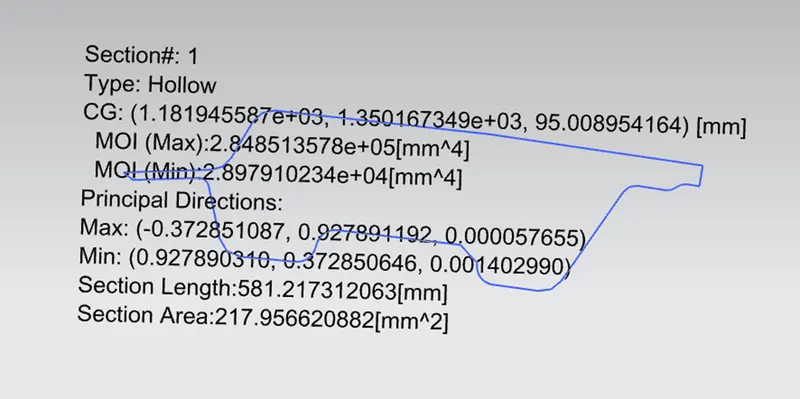
Bow roof 1,
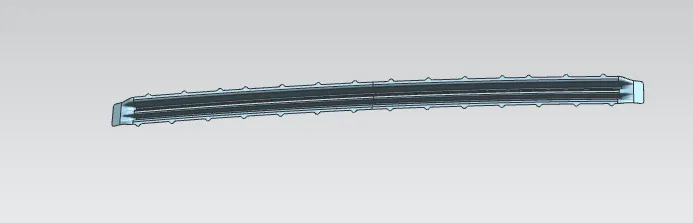
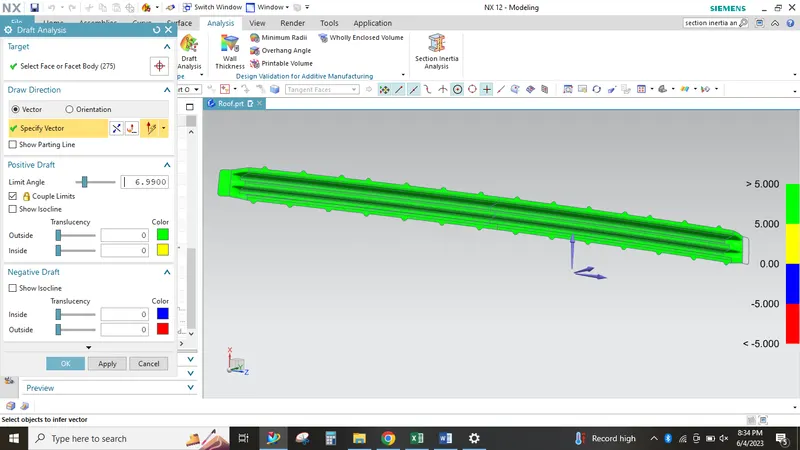
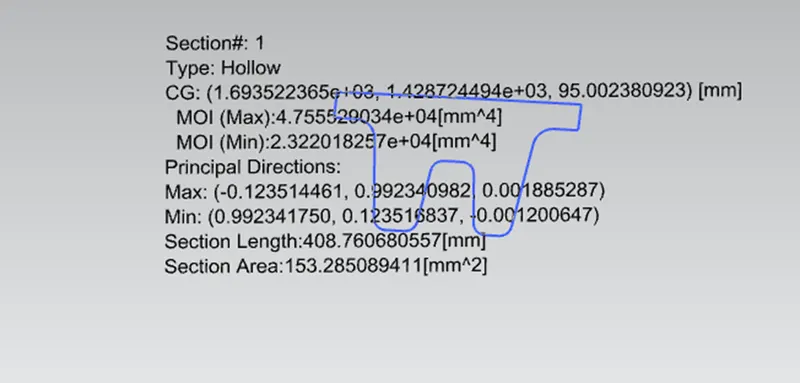
Center roof,
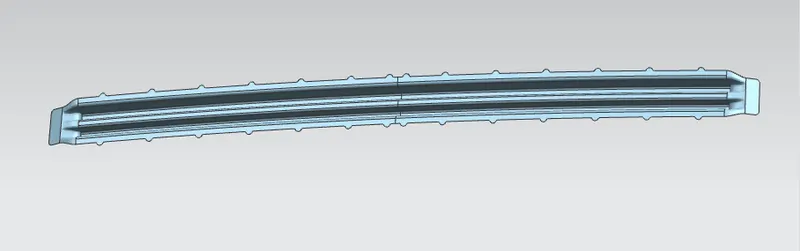
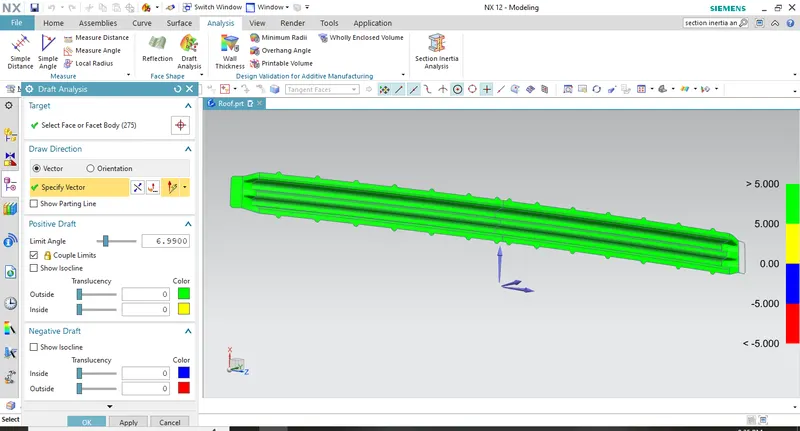
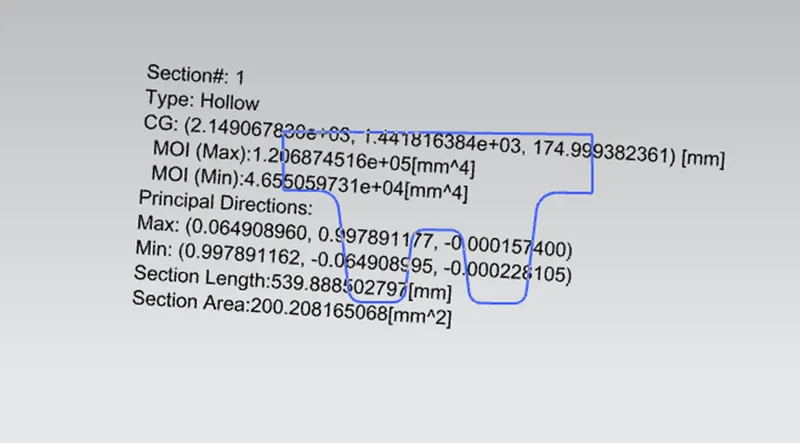
Bow roof 2,
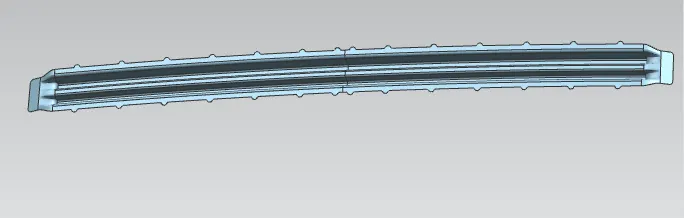
Rear roof,
Heat Distortion,
Heat Distortion is the temperature at which the metal softens and deforms under a specific load. This study is done to check the ability of the roof to withstand high temperature with respect to the positioning of the reinforcements which contributes to increase the strength.
Bow–Roof Prediction Formula
W = [1.73 x 10^(-3) x L] + [1.85 x 10^(-8) x (R^2)/t] + [ 1.10x10^(-3) x l] - 2.68
Where,
L = Roof Length in X-Direction[mm](Roof dimension in 0-Y)
R = Roof curvature
R = 2(Rx*Ry)/(Rx+Ry)
Rx = X curvature
Ry = Y curvature
t = Roof plate thickness [mm]
l = Bow Roof Span [mm]
Judgment Condition
OK< 2.7
| S.NO | BOWs | Rx | Ry | R | I | L | t | R^2/t | W | OK / NG |
| 1 | FR-BR1 | 1316.9 | 1039.79 | 1162.05 | 431.34 | 2033.71 | 0.75 | 1800489.85 | 1.35 | OK |
| 2 | BR1-CR | 5626.95 | 6331.96 | 5958.67 | 389.95 | 2033.71 | 0.75 | 47341059.20 | 2.14 | OK |
| 3 | CR-BR2 | 4450.53 | 10619.35 | 6272.34 | 448.76 | 2033.71 | 0.75 | 52456399.13 | 2.30 | OK |
| 4 | BR2-RR | 3840.76 | 14732.99 | 6093.10 | 365.3 | 2033.71 | 0.75 | 49501192.87 | 2.16 | OK |
Snow Load Prediction Formula,
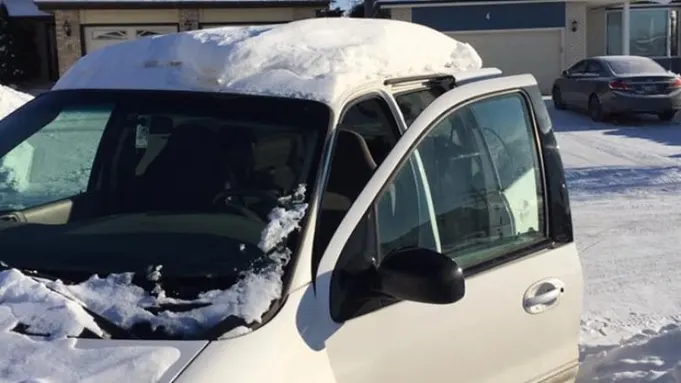
Snow load is the downward force on a building's roof by the weight of accumulated snow and ice. The roof or the entire structure can fail if the snow load exceeds the weight the building was designed to shoulder. Or if the building was poorly designed or constructed.
Qr = [Iy x t2] / [α x s x [(Rx + Ry)/2]2 x 10-8]
Where,
α = My x Lx2 x 10-12 , My = Y(Ly-Y)
t = Roof plate thickness [mm]
Ly = Distance between the front and rear roof Rails on the Vehicle along with 0Y[mm]
Length of Roof panel with the center point between Roof rail Front /Rear as the front and rear reference point.
Lx = Distance between the Left and Right end of the roof on the Roof BOW [mm]
The width of the roof panel is exposed on the surface.
Y = Distance front Front Roof Rail to Roof BOW[mm]
s = Distance for which Roof BOW bears divided load [mm]
s = L1/2 + L2/2
Iy = Geometrical moment of inertia of Roof BOW (Y cross-section )[mm4]
Rx = Lateral direction curvature radius of roof panel Y cross-section on Roof BOW [mm]
Roof panel curvature Radius of the Length Lx in Front view
Ry = Longitudinal Direction curvature radius of the Roof panel X cross-section on Roof BOW [mm]
Roof panel X curvature radius of length s in Side view
Judgment condition
Qr ≥ 3.1
250 ≤ s ≤ 380
| S.NO | BOWs | Iy | My | Alpha | Lx | Ly | y | s | Qr | Qr OK cond. |
| 1 | FR-BR1 | 28979 | 778509 | 1.03 | 1150.51 | 2033.71 | 511.4 | 484.28 | 254.5367889 | OK |
| 2 | BR1-CR | 23220 | 720736 | 0.83 | 1074.08 | 2033.71 | 457.16 | 486.895 | 128.2813484 | OK |
| 3 | CR-BR2 | 46550 | 783769 | 0.90 | 1074.08 | 2033.71 | 516.63 | 506.97 | 97.12518779 | OK |
| 4 | BR2-RR | 37937 | 764067 | 0.83 | 1042.24 | 2033.71 | 497.31 | 248.655 | 99.0465342 | OK |
| 5 | RR | 140014 | 0 | 0.00 | 1042.24 | 2033.71 | 0 | 0 |
Conclusion,
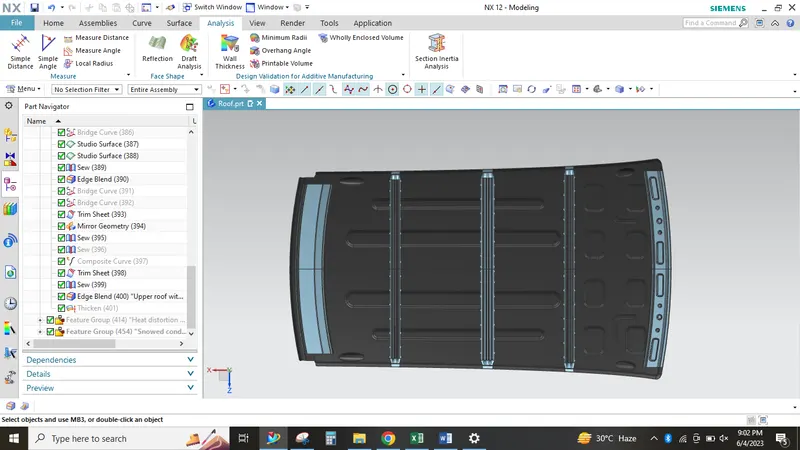
Thus the car roof has been designed with the BIW support roofs and the section modulus, heat distortion and the snowed condition were performed and to strengthen the roof embosses has given.