Roof Design
REPORT -
First we need to understand why we need a bow roof? Bow roof is needed to strengthen the roof outer panel from being collapse or deformed under load. Bow roof rails are designed in such a way that without increasing weight of vehicle maximum strength can be provided. These Roof rails are placed and joined to roof by calculating its position an load bearing capacity of each bow roof.
Where this roof bow's are required? in case of small car additional bow's are not required but small car already has smaller roof curvature, this roof curvature acts as natural bow which gives strength to the roof. But in case of large roof curvature or has flat surface then bow roof are required for additional strength. As flat surface tends to bend/defromed under minute load then bow roof rails are joined as an reinforcement to roof outer panel.
For prediction the position of bow roof first identify the plane on which roof surface is lying. Create a sketch on that plane, draw line horizontal (0-Y)and coincide with H axis. Take 300mm (3-Y)offset of created line and take another offset of 100mm from (3-Y) line on both side. Now split the roof into 4 equal parts horizontally. Take the first section of equally divided roof create a center point on the horizontal axis (0-Y). Create a vertical line on center point and then again offset this line by 100mm on both side. After creating all this lines select the points on which all the offsets, horizontal (3-Y) and vertical line is intersecting. Project all these points on surface and draw arc on surface. Measure them horizontal arc parallel to (0-Y) will give Ry and vertical arc will give the value of Rx. This is how curvature is measure of surface.
For snow load same procedure needs to be follow but here offset of 100mm is taken from (0-Y) line and same procedure needs to follow.
Formula for calculating bow roof -
W = [1.73 x 10^(-3) x L] + [1.85 x 10^(-8) x (R^2)/t] + [ 1.10x10^(-3) x l] - 2.68
Where,
L = Roof Length in X-Direction[mm](Roof dimension in 0-Y)
R = Roof curvature
R = 2(Rx*Ry)/(Rx+Ry)
Rx = X curvature
Ry = Y curvature
t = Roof plate thickness [mm]
l = Bow Roof Span [mm]
while the value of W should be less than 2.7
Formula for calculating snow load -
Qr = [Iy x t2] / [α x s x [(Rx + Ry)/2]2 x 10-8]
Where,
α = My x Lx2 x 10-12 , My = Y(Ly-Y)
t = Roof plate thickness [mm]
Ly = Distance between the front and rear roof Rails on the Vehicle along with 0Y[mm]
Length of Roof panel with the center point between Roof rail Front /Rear as the front and rear reference point.
Lx = Distance between the Left and Right end of the roof on the Roof BOW [mm]
The width of the roof panel is exposed on the surface.
Y = Distance front Front Roof Rail to Roof BOW[mm]
s = Distance for which Roof BOW bears divided load [mm]
s = L1/2 + L2/2
Iy = Geometrical moment of inertia of Roof BOW (Y cross-section )[mm4]
Rx = Lateral direction curvature radius of roof panel Y cross-section on Roof BOW [mm]
Roof panel curvature Radius of the Length Lx in Front view
Ry = Longitudinal Direction curvature radius of the Roof panel X cross-section on Roof BOW [mm]
Roof panel X curvature radius of length s in Side view
where value of must be greater than 3.1; where value of "s" lies between 250mm to 380mm if value does not lies between these values then adjust the distance between two consecutive Bow's.
CALCULATIONS -
Below table shows the calculations about heat disorientation for ROOF ASSY the value of W is calculated for every roof rail where for FRR-BR1 is 1.7, BR1-CRR is 2.1, CRR-BR2 is 2.0 AND BR2-RRR is 1.9 which comes under 2.7 which is acceptable so no need to change in value of Rx and Ry.
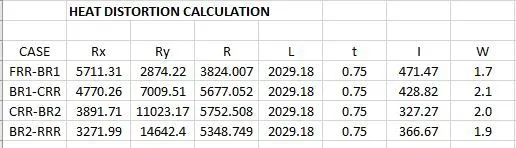
Below table shows the calculations about snow loading for ROOF ASSY the value of Qr is calculated for every roof rail where for FRR-BR1 is 17.17, BR1-CRR is 11.95, CRR-BR2 is 5.79 AND BR2-RRR is 0 as value of My in formula of Qr becomes "Zero". All the value of calculated Qr satisfied this condition "Qr >= 3.1" which fullfill and meets the standard so no need to change in value of Rx and Ry.
