Roof Design
Purpose:
The main purpose of this project is to create the roof sheet design as well as the front roof rail, rear roof rail, front arch roof, rear arch roof, roof rail intermediate and reinforcement structure, to build a solid roof.
Performs curvature studies on roofs and performs performance calculations based on thermal deformation and snow load criteria to determine locations for arched roofs.
Calculate the section modulus and moment of inertia of each steel bar at the center of the arched roof, front and rear roof beams, and perform tensile analysis.
Description:
The roof or
roof is the part of a car that sits above the passenger compartment and protects the occupants from the sun, wind, rain and other external elements.
When he looks at the car from the outside, he only closes the roof.
But from a design point of view, it is difficult to create a design. Because you don't need to create support rails to get enough strength to support the load. Vaulted roofs are mostly anchored in flatter areas for added strength.
The front roof and rear roof rails are attached to the trench area using spot welds. But the front and rear roofs and the center roof rails are held to the roof using a sealant.
We don't want as much space between the roof rails and the arched roof area. Therefore, we reduce NVH issues.
- Moonroof and Sunroof are the two Types of Roof Panels and their Differences.
- They really aren't that different from one another, despite having names that range from day to night.
- The first automobiles had absolutely no roofs when they were first created.
Various Forms Of Reinforcement In Roof Top:
- Front Roof Rail
- Bow Roof Rail
- Center Roof Rail
- Rear Roof Rail
Front Roof Rail:
- The front roof rail is nothing that connects the body side outer and inner panels as well as the windshield glass. Here, the front roof rail is created using the provided master section.
Bow Roof Rail:
- The purpose of bow roof rails is to increase the roof structure's torsional rigidity and load-carrying capacity.
- The amount of bow roofs that are present depends on the size of the roof as a whole, this project is adding two bow roofs.
Center Roof Rail:
- The flat portion of the roof is more prone to failure due to the action of stress, hence a central roof rail aids in properly supporting it.
- The B-pillar support structure is connected to the central roof rail, which is typically located at the center of the roof.
- During the roll-over test, this central roof rail contributes to the strength of the roof.
- The main roof rail is 1.25 millimeters thick.
Rear Roof Rail:
- The rear roof rail is the piece that connects the back door to the exterior body side.
Roof Design Consideration:
- Visibility standards.
- Maximum headroom.
- Bow roof placement.
- Criteria for Heat Distortion and Snow Load Prediction.
- Draft evaluation.
The roof crush test:
- Crash Test for Roof illustration is a government initiative tasked with assessing the performance of new automotive designs in relation to numerous safety hazards.
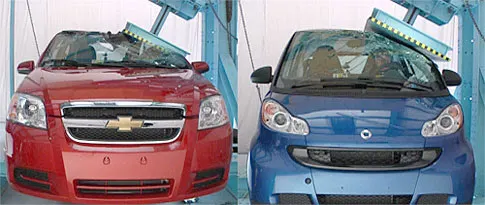
- specifies evaluating a car's roof on one side excludes the headroom requirement and outlines testing to a specified displacement rather than a specified force level.
- Outlines to adjust the vehicle's pitch angle during testing based on the on-road pitch angle that was measured.
- Peak strength-to-weight ratio (SWR) measurements taken within 127 mm of plate displacement are used to get an overall rating.
Design Requirements For The Roof Design Components:
- Data from the master section for the reinforcement, Front and Rear Roof Rails, and 2-Bow Roof Rails and Given Reinforcements.
- Master portions should only be used as a guide.
Formula Given For Heat-Distortion & Snow Load Prediction:
Heat-Distortion Formula:
W = [1.73 x 10^(-3) x L] + [1.85 x 10^(-8) x (R^2)/t] + [ 1.10x10^(-3) x l] - 2.68
Where,
L = Roof Length in X-Direction[mm](Roof dimension in 0-Y)
R = Roof curvature
R = 2(Rx*Ry)/(Rx+Ry)
Rx = X curvature
Ry = Y curvature
t = Roof plate thickness [mm]
l = Bow Roof Span [mm]
Judgment Condition:
- OK< 2.7
Snow Load Prediction Formula:
Qr = [Iy x t2] / [α x s x [(Rx + Ry)/2]2 x 10-8]
Where,
α = My x Lx2 x 10-12 , My = Y(Ly-Y)
t = Roof plate thickness [mm]
Ly = Distance between the front and rear roof Rails on the Vehicle along with 0Y[mm]
Length of Roof panel with the center point between Roof rail Front /Rear as the front and rear reference point.
Lx = Distance between the Left and Right end of the roof on the Roof BOW [mm]
The width of the roof panel is exposed on the surface.
Y = Distance front Front Roof Rail to Roof BOW[mm]
s = Distance for which Roof BOW bears divided load [mm]
s = L1/2 + L2/2
Iy = Geometrical moment of inertia of Roof BOW (Y cross-section )[mm4]
Rx = Lateral direction curvature radius of roof panel Y cross-section on Roof BOW [mm]
Roof panel curvature Radius of the Length Lx in Front view
Ry = Longitudinal Direction curvature radius of the Roof panel X cross-section on Roof BOW [mm]
Note:
Roof panel X curvature radius of length s in Side view
Judgment condition:
- Qr ≥ 3.1
Procedure To Create a Roof Design:
Given Input:
- With the desgin consideration the renforcement will be removed to futher proceed to desgin
- To conceal the reinforcements and only remove the surface.
- After extracting the surface, we should divide it in half and move on.
Tooling Axis:
Draft Analysis:
Spot Weld Area:
Front Roof Rail:
Bow Roof Rail 1:
Center Roof Rail:
Bow Roof Rail 2:
Rear Roof Rail:
Ditch Area:
Calculation For Heat Distortion:
- The temperature at which a metal softens and deforms when subjected to a particular load is known as heat distortion.
- This study examines the roof's ability to tolerate high temperatures in relation to where the reinforcements are placed, which increases the strength
| Data | X Curvature (Rx) | Y Curvature (Ry) | 2(Rx * Ry) | Rx+Ry | Roof Curvature | Length I | Thickness | Total Span | W |
| Span1_Rear_BR1 | 14545.66 | 3323.34 | 96680347.41 | 17869 | 5410.506878 | 336.272 | 0.75 | 2039.05 | 1.939537455 |
| Span2_Center_BR1 | 104117.24 | 4024.23 | 837983441.5 | 108141.47 | 7748.955525 | 427.897 | 0.75 | 2039.05 | 2.799385556 |
| Span3_Center_BR | 6121.89 | 4995.03 | 61158048.41 | 11116.92 | 5501.348252 | 433.287 | 0.75 | 2039.05 | 2.070704737 |
| Span4_Front_BR2 | 2588.02 | 5795.31 | 29996756.37 | 8383.33 | 3578.143336 | 292.726 | 0.75 | 2039.05 | 1.48536514 |
Calculation For Snow Load Prediction:
- This evaluation is carried out in cold climates with snowfall.
- These calculations must be run on the roof design to verify that it has enough stiffness to sustain the load caused by accommodating snow on the roof.
| Iy | t^2 | Y | Ly | My | Lx^2 | α = My x Lx^2 x 10^-12 | L1 | L2 | s = (L1+ L2)/2 | Rx | Ry | (Rx+Ry)/2 | [(Rx+Ry)/2]^2 | (Iy*t^2) | [α x s x [(Rx + Ry)/2]2 x 10-8] | Qr | |
| Snow Load Prediction 1 | 1333 | 1.5 | 365.44 | 2035.741 | 610394.7974 | 1046211.894 | 0.6386022971 | 365.44 | 441.83 | 403.635 | 2628.24 | 4552.45 | 3590.345 | 12890577.22 | 1999.5 | 33.22704036 | 60.17689143 |
| Snow Load Prediction 2 | 2200 | 1.5 | 880.7 | 2035.741 | 1017244.609 | 972347.8499 | 0.9891156081 | 441.83 | 392.31 | 417.07 | 6048.79 | 3734.39 | 4891.59 | 23927652.73 | 3300 | 98.70885268 | 33.43165188 |
| Snow Load Prediction 3 | 1453 | 1.5 | 1512.02 | 2035.741 | 791876.6264 | 934445.0889 | 0.7399652246 | 392.31 | 392.19 | 392.25 | 10833.44 | 4258.32 | 7545.88 | 56940304.97 | 2179.5 | 165.2700092 | 13.18751061 |
Assembeled View:
Conclution:
- Since it comes under condition the judge ment is great
- To support, One center roof and two Bow roof is enough.
- The condition Qr>3.1 is satisfied
- It may face bend due to snow load
- Or embose can be added to make the roof strong.
- Increasing the embose distance Due to changing the shape of roof, the inertia value wil be greater and increaing the thickness of the bow roof.In this way the condition can be staisfied