Roof Design
ROOF CHALLENGE
OBJECTIVE:
- For the Given Roof styling, develop the essential flanges and reinforcements.
- Creation of Roof ditch area with tool opening angle of 3 degree. min
- Provide appropriate dimensions and validate for Draft analysis.
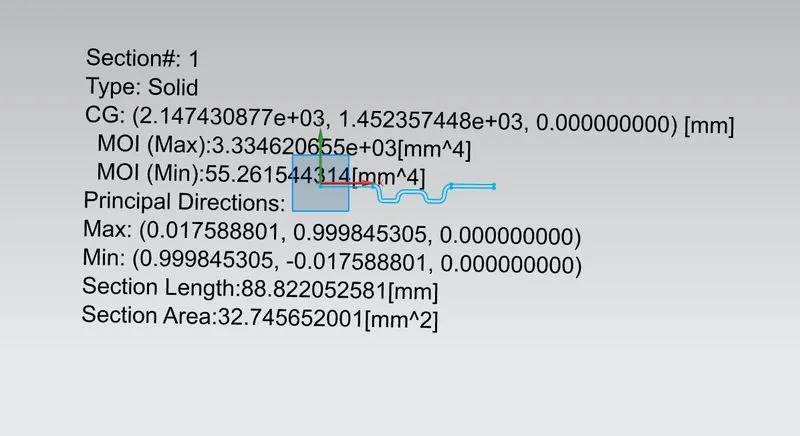
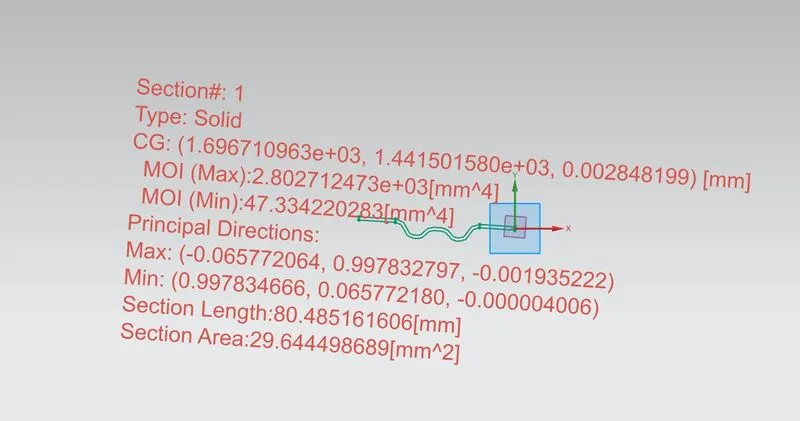
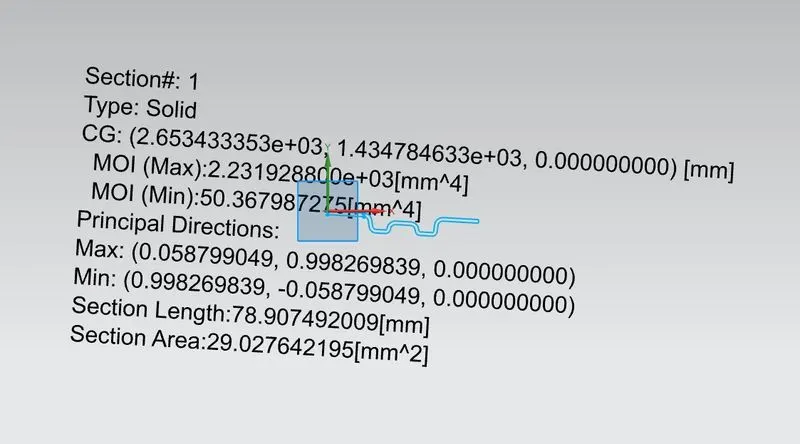
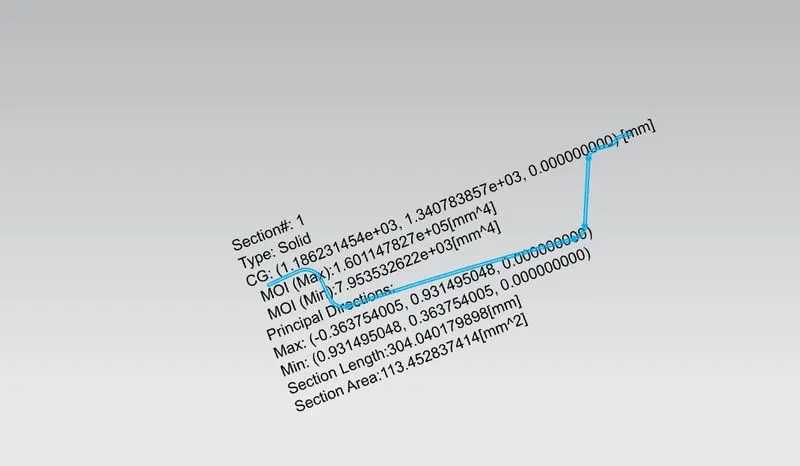
- Section modulus study on 0-Y section for the Master sections created for Front roof rail, Rear roof rail, and Bow Roof Rails.
- Perform curvature study on the roof and calculations to determine the position of the Bow-roof.
THEORY:
Roof or car top is the portion of an automobile that sits above the passenger compartment, protecting the vehicle occupants from sun, wind, rain, and other external elements. Car Roof consists of Roof panel with reinforcements like front Roof rail, Rear Roof rail, Bow roof rails.
Front Roof rail joins the roof panel with Windshield glass and body side panel and also this Front roof rail used for the bracket map lamp and room lamp mountings where as Rear Roof rail joins the Backdoor and body side panel of the car.
BELOW MENTIONED ARE SOME OF THE FAMOUS ROOF TYPES IN THE MARKET:
- Hard Tops: A rigid form of Roof, typically constructed from metal.
- Sunroofs: An operable window in a Roof, which allows light or fresh air into the car compartment.
- Convertible: Allows an open-air driving experience, with the ability to provide a roof when required.
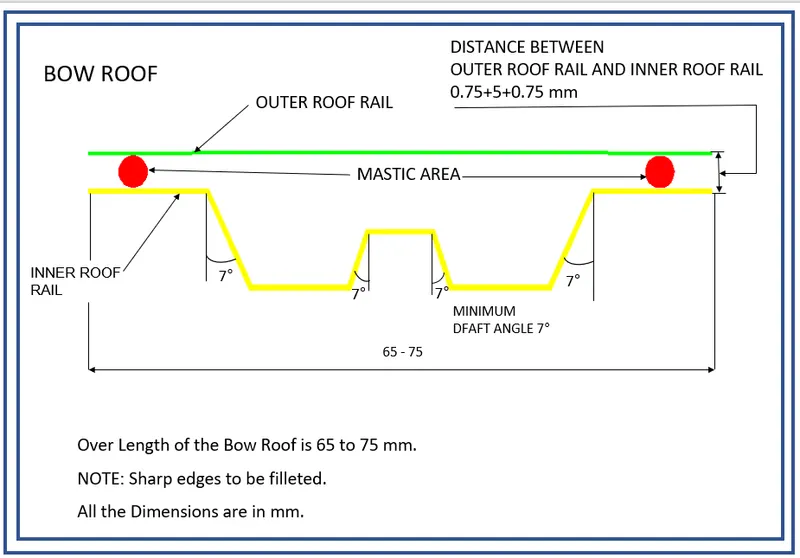
Master section of Bow Roof
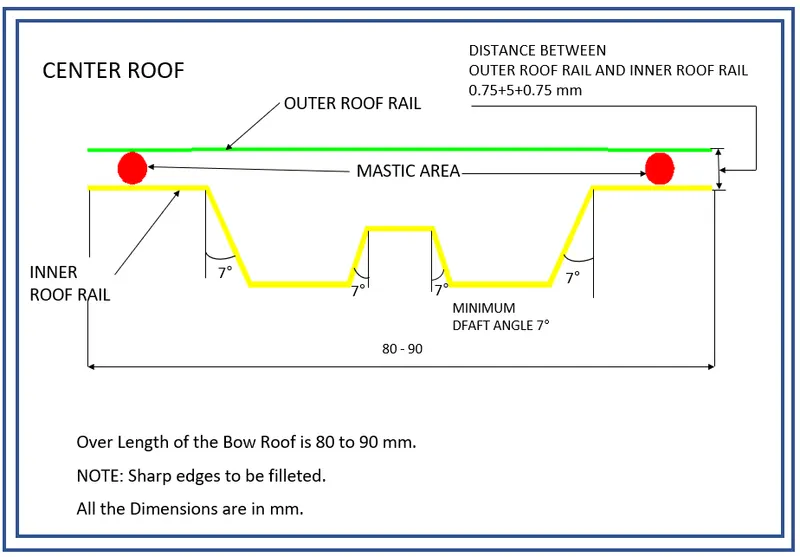
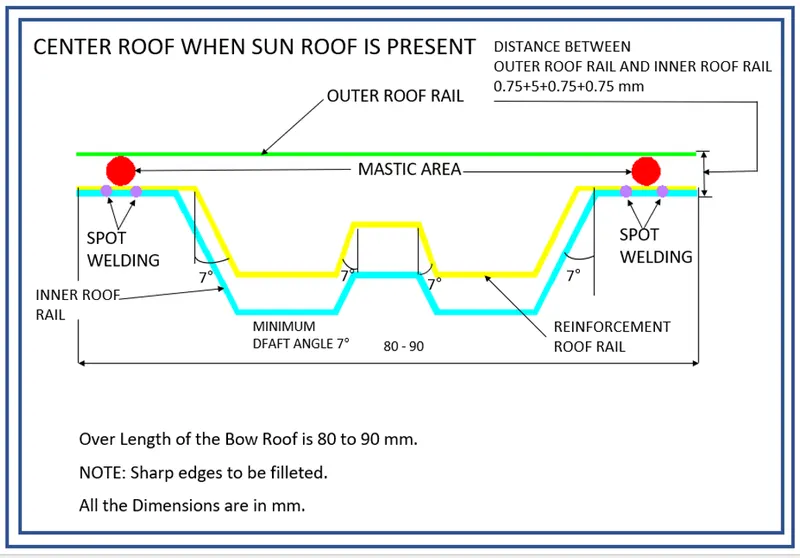
Master section of Center Reinforcement Rail
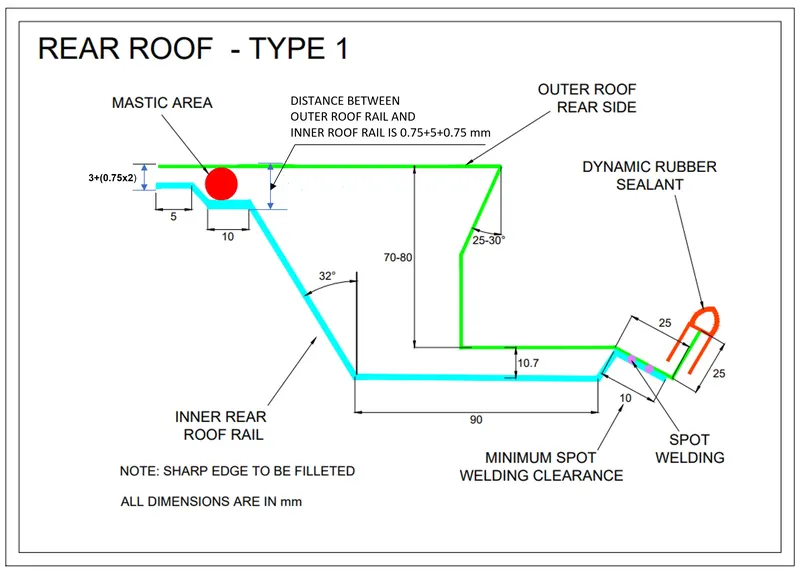
Master section of the Rear Roof Rail
Additional help Images. these images are just to give you a brief idea about the design.
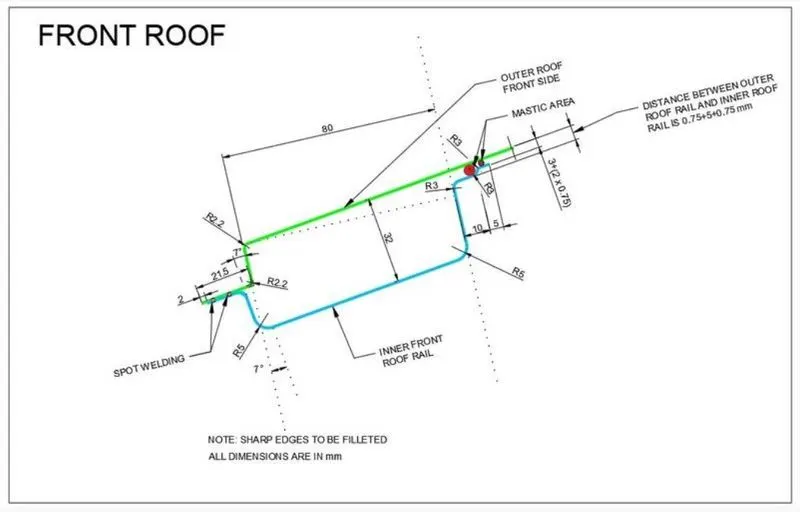
Front Roof Rail Master section Reference Image
Design Considerations:
THICKNESS AND MANUFACTURING REQUIREMENTS:
- Thickness of Roof panel: 0.75mm
- Reinforcement Thickness = 0.75mm
- Tool opening angle 3 degree min
- Emboss depth should not exceed 6mm.
- Minimum filet radius should be more than the 3+thickness
- No sharp corners inside the component
FUNCTIONAL REQUIREMENTS:
- Provide adequate clearance for the windshield glass joining for joining with Roof at Front
- Visibility criteria of windshield glass at front Roof rail
- Rear visibility criteria for Rear Roof Rail
- Head impact zone or head room clearance based on the trim parts.
- Mastic clearance to join the reinforcements.
PROCEDURE:
- Roof Outer Panel:
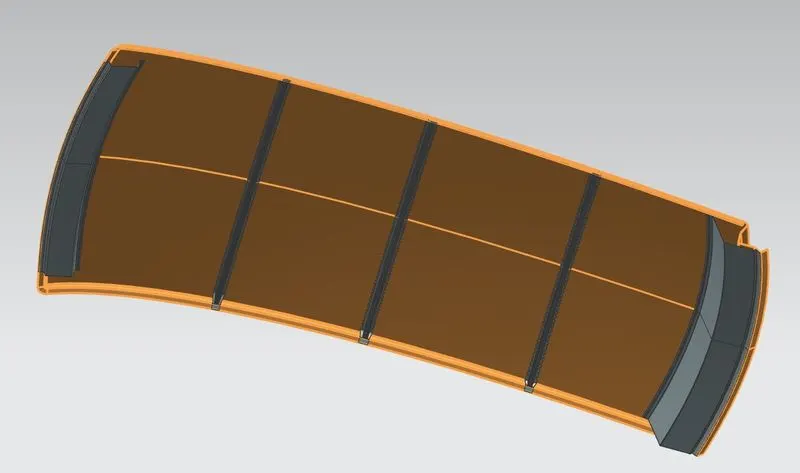
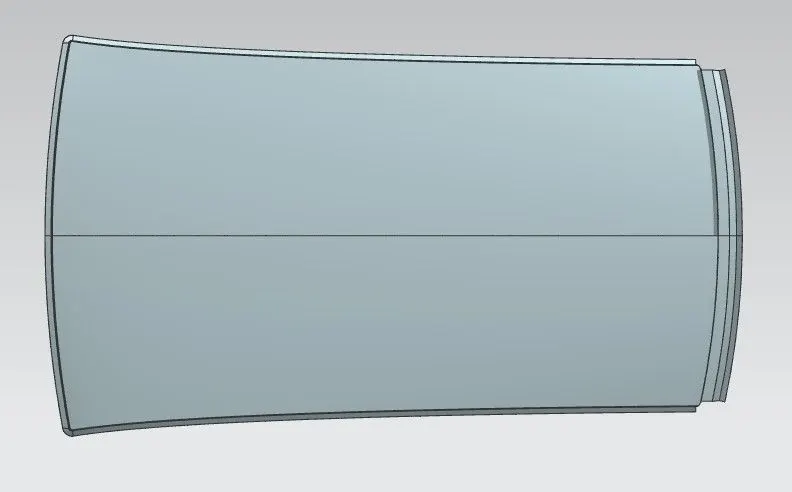
By taking the input styling surface of roof panel then first created the flanges or the ditch area at the four sides with the required open angle of 3 degree min. At the front end of the roof panel we have given the flange length of 21.5mm to provide the enough clearance for the windshield and its associated components like rubber sealant. The rear end also created the flanges with the required length and opening angle to allow the joining for the backdoor .Additional beads created on the top of roof panel to increase the strength of the panel.
See the below image of Roof panel which is developed from the styling data.
THICKNESS AND MANUFACTURING REQUIREMENTS:
Thickness of Roof panel: 0.75mm
Reinforcement Thickness = 0.75mm
Tool opening angle 3 degree min
Emboss depth should not exceed 6mm.
Minimum filet radius should be more than the 3+thickness
No sharp corners inside the componet
FUNCTIONAL REQUIREMENTS:
- Provide adequate clearance for the windshield glass joining for joining with Roof at Front
- Visibility criteria of windshield glass at front Roof rail
- Rear visibility criteria for Rear Roof Rail
- Head impact zone or head room clearance based on the trim parts.
- Mastic clearance to join the reinforcements.
PROCEDURE:
- Roof Outer Panel:
By taking the input styling surface of roof panel then first created the flanges or the ditch area at the four sides with the required open angle of 3 degree. At the front end of the roof panel we have given the flange length of 21.5mm to provide the enough clearance for the windshield and its associated components like rubber sealant. The rear end also created the flanges with the required length and opening angle to allow the joining for the backdoor .Additional beads created on the top of roof panel to increase the strength of the panel.
See the below image of Roof panel which is developed from the styling data.
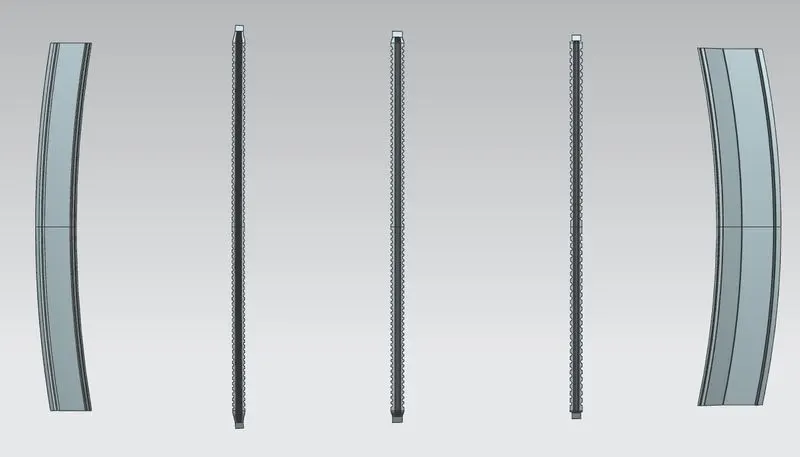
1.Front Roof Rail-
The front roof rail is located on the front of the roof where the wind shield joins with the roof. The visibility criteria and the head room clearance of the passenger are taken into consideration for the bottom flange. One end of the rail is joined using spot welding while the other end is joined with the roof using mastic sealants for increased strength.
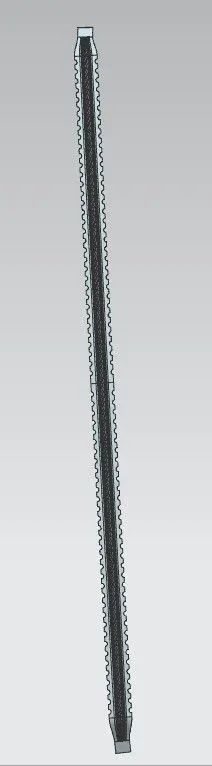
2.Bow roof 1-
Bow roof is an additional siffening member for the roof to increase the strength and so that it can satisfy the norms. Both the ends are joined together using mastic sealants to increase strenght and also since this would not affect the styling of the roof.
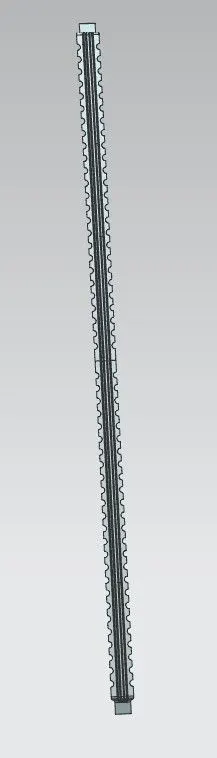
3.Centre Roof Rail-
Centre Roof rail or the reinforcement centre is located at the centre of the roof . The cross section of this is more since it needs to provide more strength to the roof. Here both are ends are joined together using mastic sealants.
4.Bow roof 2-
This bow roof also have the same purpose as that of the first one. This one is located between the centre bow roof and rear roof rail.
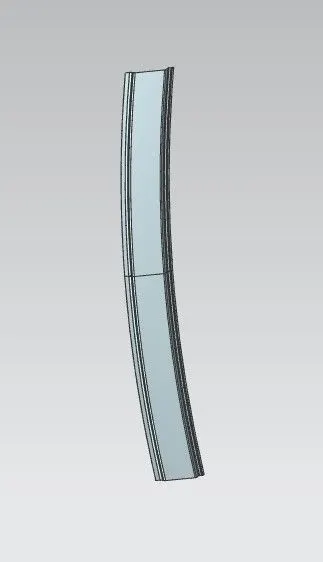
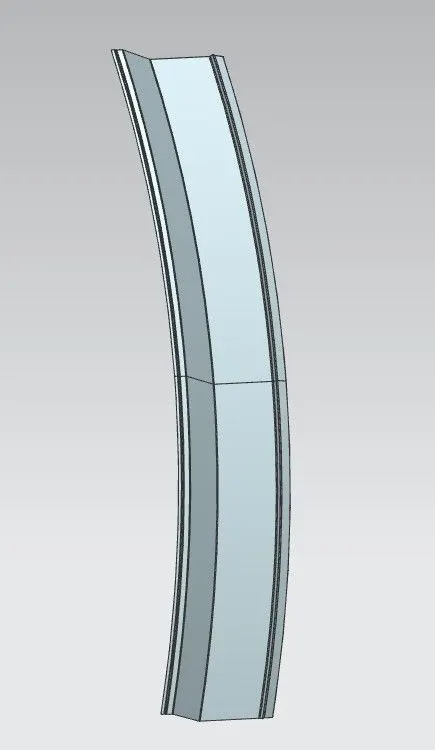
5.Rear Roof Rail.
This roof rail joins with the back door and the roof. Inputs from the backdoor are taken into consideration for designing this roof rail.
Here one end is joined using spot welding while the other end is joined using mastic sealants.
We then also make the ditch area around the roof.
Section Modulus
Section modulus calculation is done for all the individual parts and the whole roof part.
HEAT DISTORTION CRITERIA
The heat distortion criteria give the bow placement position on the roof. The formula to calculate heat distortion criteria is
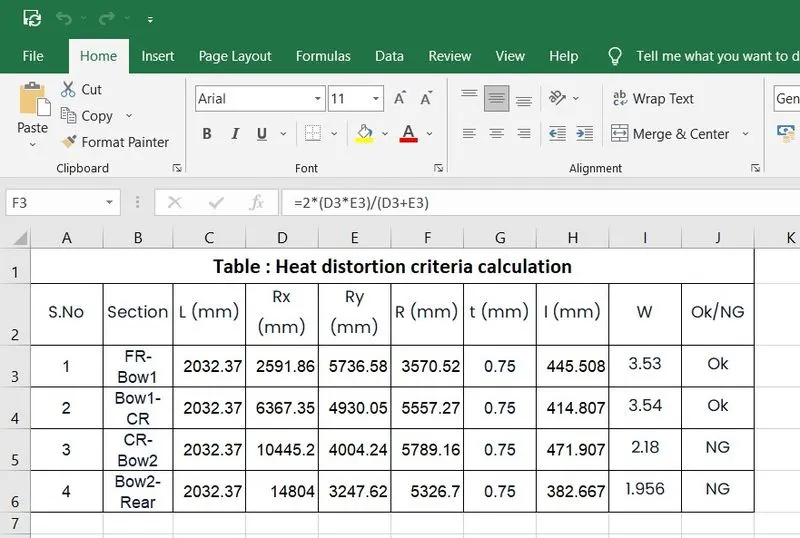
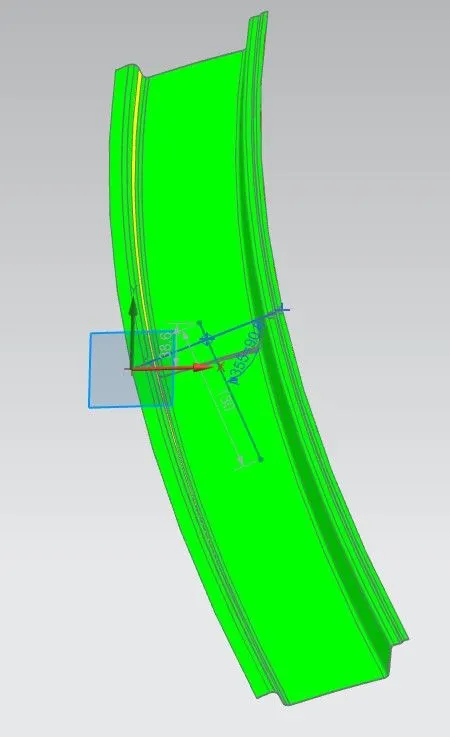
- Roof curvature (Rx & Ry) radius is measured by creating a 'Three point arc'
-
W = [1.73 x 10^(-3) x L] + [1.85 x 10^(-8) x (R^2)/t] + [ 1.10x10^(-3) x l] - 2.68
Judgemental condition: OK< 2.7> 3.1
Where,
L = Roof Length in X-Direction[mm](Roof dimension in 0-Y)
R = Roof curvature
R = 2(Rx*Ry)/(Rx+Ry)
Rx = X curvature
Ry = Y curvature
t = Roof plate thickness [mm]
l = Bow Roof Span [mm]
-
Formula-
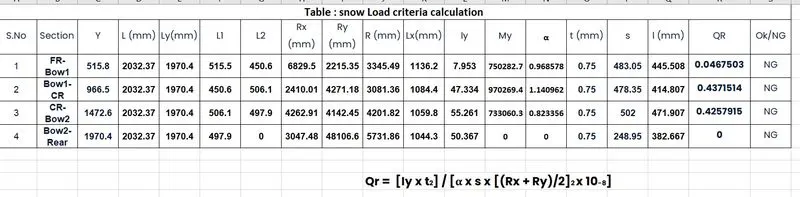
Qr =[Iy x t2] / [α x s x [(Rx + Ry)/2]2 x 10-8]
Note: The Qr value given over here is correct. There was a typo error in the formula given in the video.
Where
α = My x Lx2 x 10-12 , My = Y(Ly-Y)
Judgement condition = Qr ≥ 3.1
250 ≤ s ≤ 380
WHERE,
t = Roof plate thickness [mm]
Ly = Distance between the front and rear roof Rails on the Vehicle along with 0Y[mm]
Length of Roof panel with the center point between Roof rail Front /Rear as the reference point of the front and the rear.
Lx= Distance between the Left and Right end of the roof on the Roof BOW [mm]
Width of the roof panel exposed on the surface.
Y = Distance front Front Roof Rail to Roof BOW[mm]
s= Distance for which Roof BOW bears divided load [mm]
s = L1/2 + L2/2
Iy = Geometrical moment of inertia of Roof BOW (Y cross-section )[mm4]
Rx = Lateral direction curvature radius of roof panel Y cross-section on Roof BOW [mm]
Roof panel curvature Radius of the Length Lx in Front view
Ry = Longitudinal Direction curvature radius of the Roof panel X cross-section on Roof BOW [mm]
Draft analysis-
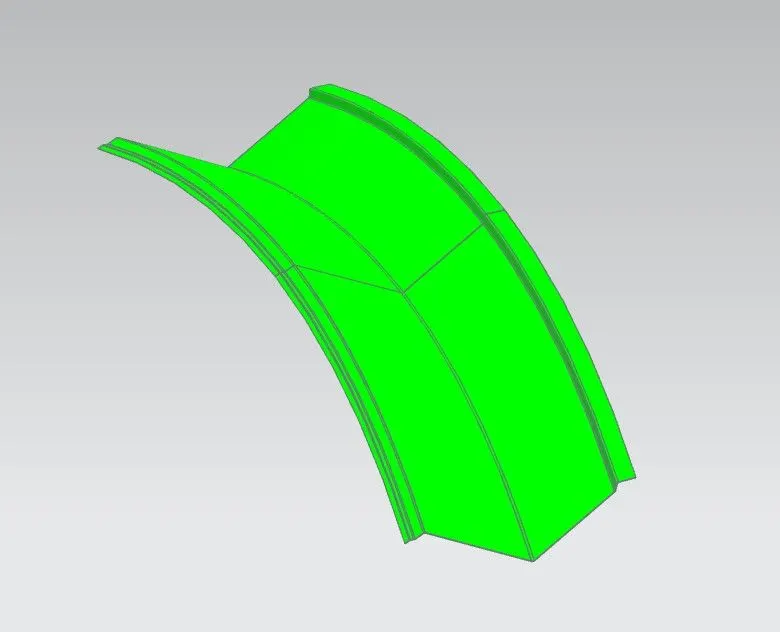
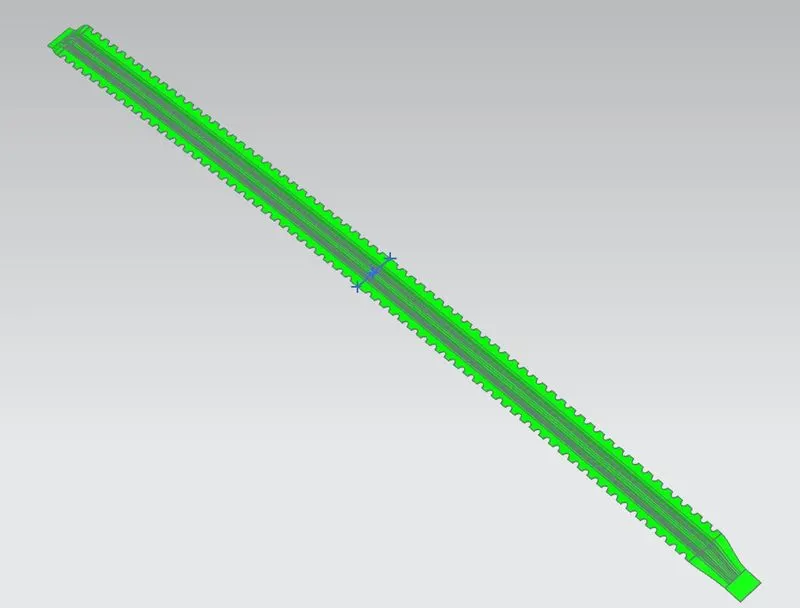
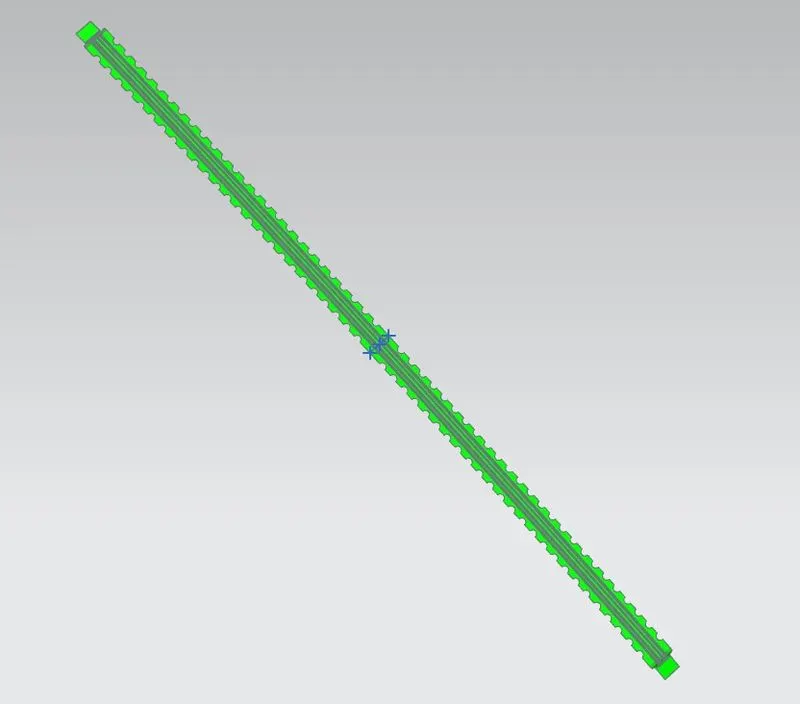
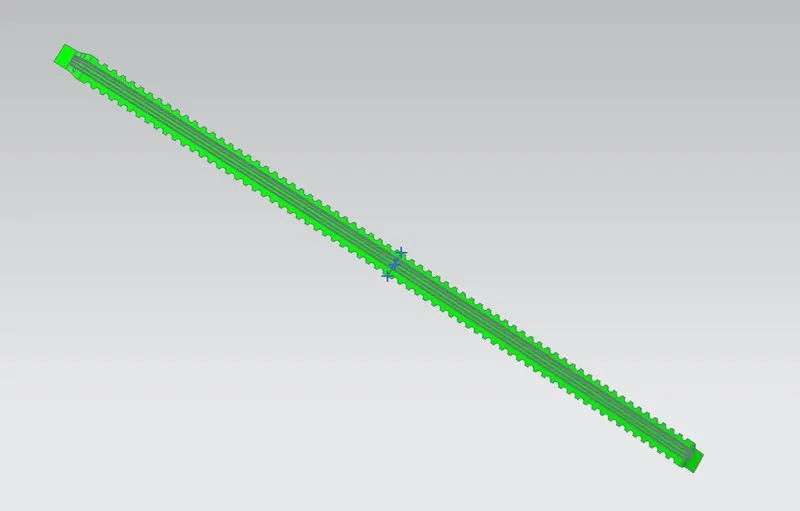
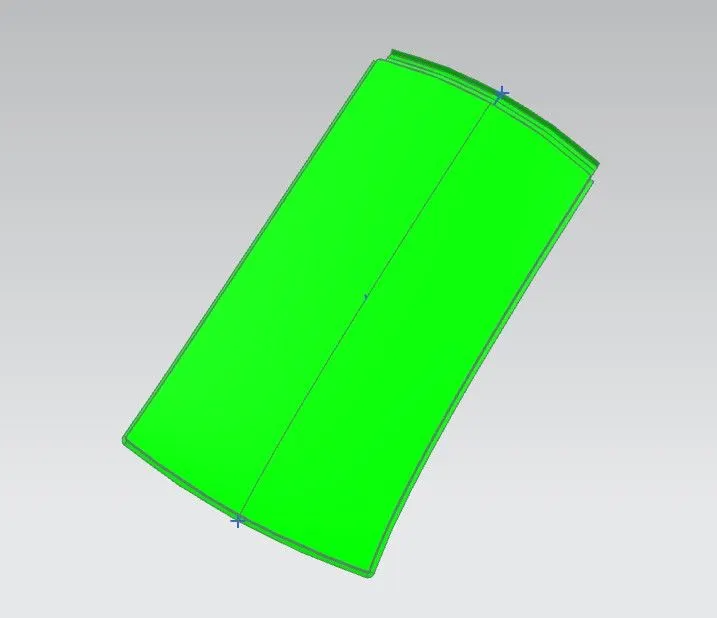
Before we give the part for manufacturing we have to some analysis ourself to check all the constraints and to check if we have any negative draft on a part .
We have a tool called draft analysis in NX Cad to check the following
Conclusion:
- Essential roof components such as bow and center rails required with flanges and reinforcements are designed.
- Curvature study on roof was analysied with heat distortion and snow load standards
- Draft analysis was done to check tool ablilty