Roof Design
ROOF DESIGN
AIM:
To create an assembly by developing the essential flanges for the outer roof and creating reinforcements.
DEFINITION:
A roof is the top covering of a building, including all materials and constructions necessary to support it on the walls of the building or on uprights, providing protection against rain, snow, sunlight, extremes of temperature, and wind. A roof is part of the building envelope.
There are 6 types of roofs,
Convertible roofs.
Hardtops
Sunroofs
T-tops
Targa tops
Vinyl roofs.
Convertible roof:
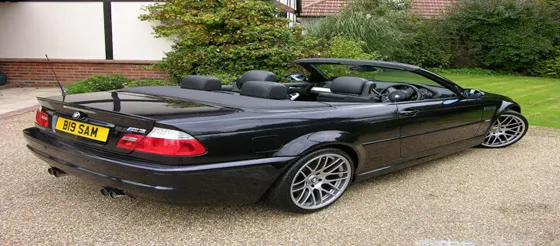
A convertible car's design allows an open-air driving experience, with the ability to provide a roof when required. A potential drawback of convertibles is their reduce structural rigidity requiring significant engineering and modification to counteract the effects of removing a car's roof.
Hardtops:
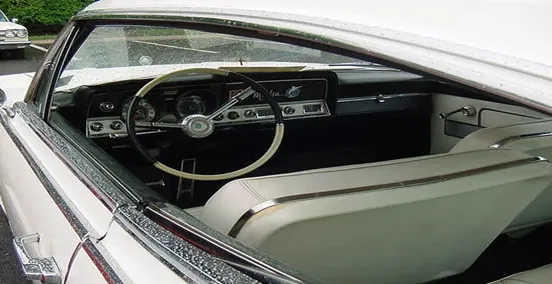
A hardtop is a rigid form of automobile roof, which for modern cars is typically constructed from metal. A hardtop roof can be either fixed (i.e. not removable), detachable for separate storing or retractable within the vehicle itself.
Sunroof:
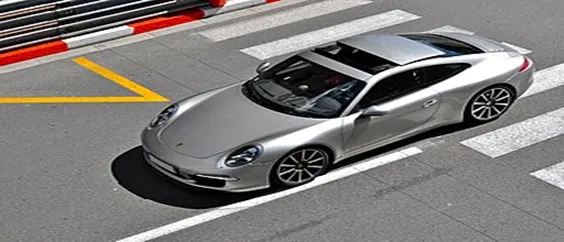
A sunroof is a movable panel that opens to uncover a window in automobile roof , allowing light and fresh air to enter the passenger compartment. Sunroofs can be manually operated or motor driven, and are available in many shapes, sizes and styles. While the term "sunroof" is now used generically to describe any glass panel in the roof, the term "moonroof" was historically used to describe stationary glass panes rigidly mounted in the roof panel over the passenger compartment. A moonroof has a glass panel that is transparent and usually tinted. Previous terms include Sunshine Roof, Sliding Head and Sliding Roof.
T-tops:
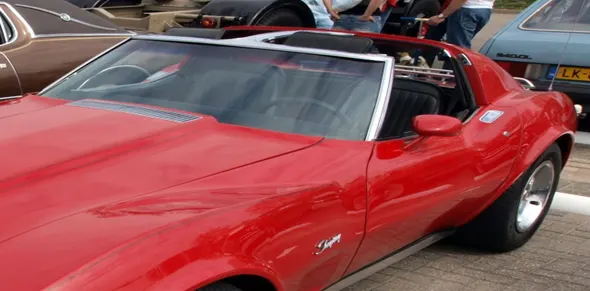
A T-top is an automobile roof with a removable panel on each side of a rigid bar running from the center of one structural bar between pillars to the center of the next structural bar. The panels of a traditional T-top are usually made of auto grade safety glass.
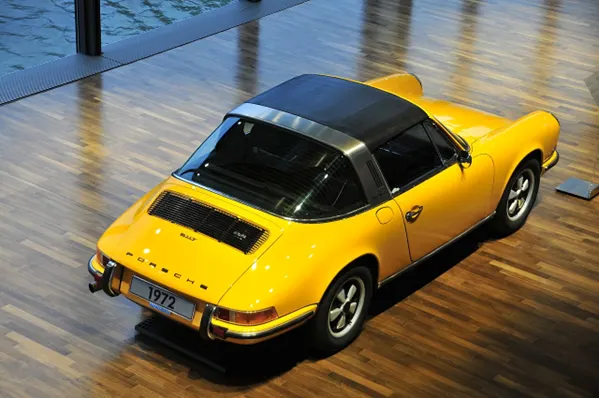
Targa tops:
- Targa top is a semi- convertible body top with a removable roof section and a full width roll bar behind the seats. The term was first used on the 1966.
- The rear window is normally fixed, but on some Targa models, it is a removable plastic foldable window, making it a convertible-type vehicle
- Targa tops are different from T-tops, which have a solid, non-removable bar running between the top of the windscreen and the rear roll-bar, and generally have two separate roof panels above the seats that fit between the window and central T-bar.
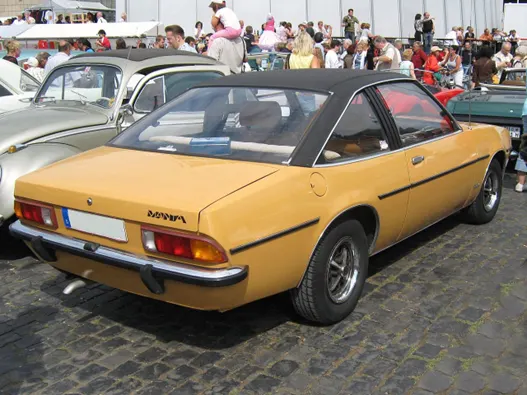
Vinyl roof:
This covering was originally designed to give the appearance of a convertible to models with a fixed roof and eventually evolved into a styling statement in its own right. Vinyl roofs were most popular in the American market, and they are considered one of the period hallmarks of the 1970s domestic cars.
PROCEDURE:
Make folder as roof assembly and start the styling by given master sections.
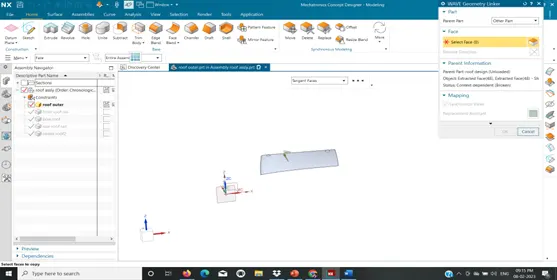
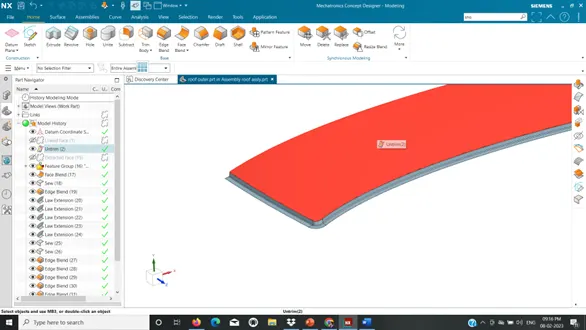
Roof outer is done By following the master section dimensions.
Front roof rail:
front roof is done by given master sections.
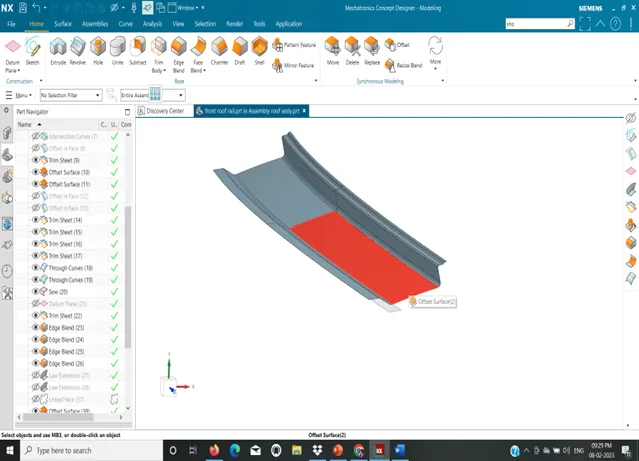
Bow roof:
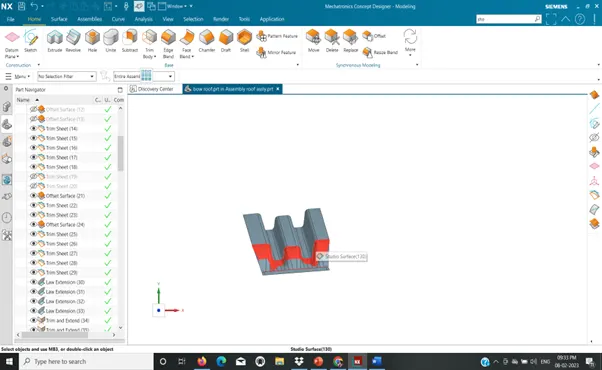
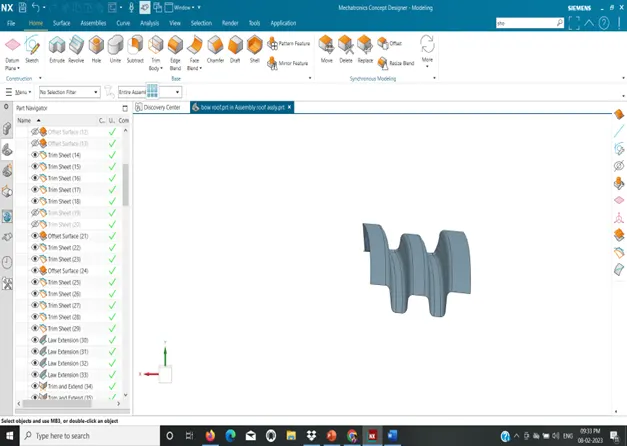
Centre roof:
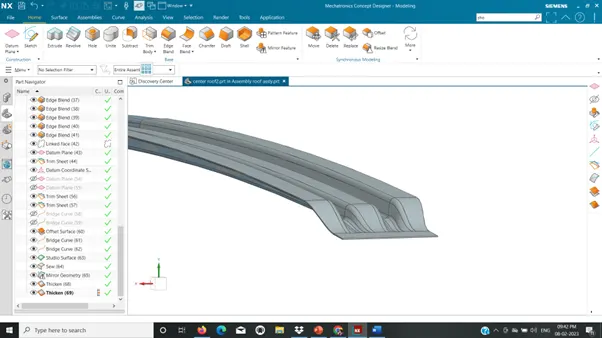
Rear roof rail:
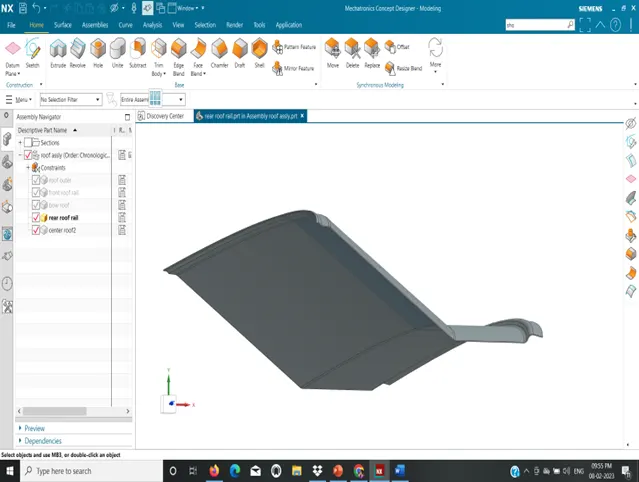
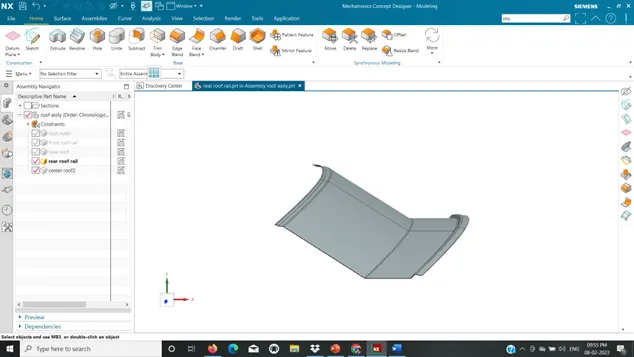
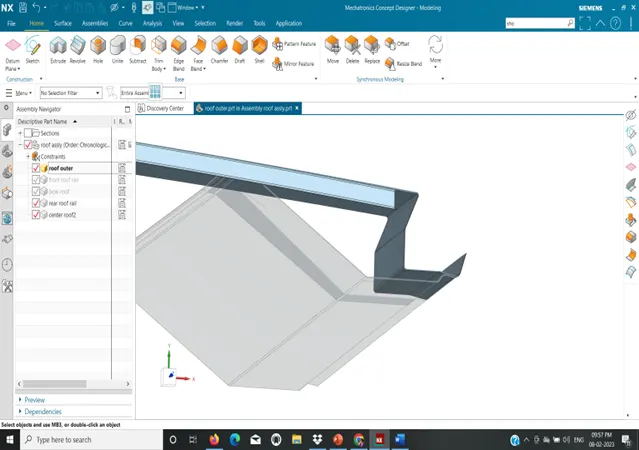
After complete the design by using master section. Make calculation by using given equations, bow roof prediction and snow load prediction.
BOW ROOF PREDICTION:
W = [1.73 x 10^(-3) x L] + [1.85 x 10^(-8) x (R^2)/t] + [ 1.10x10^(-3) x l] -2.68
Where,
L = Roof Length in X-Direction[mm](Roof dimension in 0-Y)
R = Roof curvature
R = 2(Rx*Ry)/ (Rx+ Ry)
Rx = X curvature
Ry = Y curvature
t = Roof plate thickness [mm]
l = Bow Roof Span [mm]
JUDGEMENT CODITIONS:0k<2.7
|
S.no |
bows |
RX |
RY |
R |
I |
L |
T |
R^2/T |
W |
OK/NG |
|
1 |
FR&1st |
5737.9005 |
2544.3112 |
3525.38 |
364.6 |
2026.6 |
0.75 |
16571072.19 |
1.065 |
OK |
|
2 |
1st & centre |
4981.1098 |
6157.6630 |
5507.24 |
439.4 |
2026.6 |
0.75 |
40439589.89 |
2.05 |
OK |
|
3 |
Centre &2nd |
3878.8063 |
11085.2624 |
5746.77 |
551 |
2026.6 |
0.75 |
44033820.57 |
2.24 |
OK |
|
4 |
2nd& RR |
3293.2873 |
14520.1462 |
5368.87 |
123.4 |
2026.6 |
0.75 |
38433020.10 |
1.67 |
OK |
SNOW LOAD PREDICTION:
Qr = [Iy x t2] / [α x s x [(Rx + Ry)/2]2 x 10-8]
Note: The Qr value given over here is correct. There was a typo error in the formula given in the video.
Where, α = My x Lx2 x 10-12 ,My = Y(Ly-Y)
t = Roof plate thickness [mm]
Ly = Distance between the front and rear roof Rails on the Vehicle along with 0Y[mm]
Length of Roof panel with the center point between Roof rail Front /Rear as the front and rear reference point.
Lx = Distance between the Left and Right end of the roof on the Roof BOW [mm]
The width of the roof panel is exposed on the surface.
Y = Distance front Front Roof Rail to Roof BOW[mm]
s = Distance for which Roof BOW bears divided load [mm]
s = L1/2 + L2/2
Iy = Geometrical moment of inertia of Roof BOW (Y cross-section )[mm4]
Rx = Lateral direction curvature radius of roof panel Y cross-section on Roof BOW [mm]
Roof panel curvature Radius of the Length Lx in Front view
Ry = Longitudinal Direction curvature radius of the Roof panel X cross-section on Roof BOW [mm]
Roof panel X curvature radius of length s in Side view
JUDGEMENT CONDITION: QR >= 3.1
|
S.no |
bows |
iy |
a |
lx |
ly |
y |
s |
RX |
RY |
t |
Qr |
Determination(QR) |
|
1 |
Fr& 1st |
0.879 |
0.78 |
1082 |
1908.2 |
463.1 |
489.75 |
4567.5928 |
2546.682 |
0.75 |
13.5 |
OK |
|
2 |
1st¢er |
0.987 |
1.14 |
1120.7 |
1908.2 |
979.5 |
569.1 |
3761.7969 |
6053.0777 |
0.75 |
14.6 |
OK |
|
3 |
Center&2nd |
0.997 |
0.54 |
1057.7 |
1908.2 |
1601.4 |
464.3 |
4312.3368 |
11687.3777 |
0.75 |
15.5 |
OK |
|
4 |
2nd&RR |
- |
- |
- |
1908.2 |
- |
- |
- |
- |
0.75 |
- |
- |
conclusion:
hence the roof styling done by given master sections.