Roof Design
AIM :
For the Given Roof styling, create an ASSEMBLY by developing the essential flanges for the outer roof and creating the reinforcements.
Provide appropriate dimensions and check for Draft analysis.
Do a curvature study on the roof and perform calculations to determine the position of the Bow-roofs.
Suggest and implement remedies in the design if the criterion is not full-filling
Start with the creation of a roof ditch area with a tool opening angle of 7 degrees.
Develop the reinforcements as separate parts
ROOF DESIGN
OBJECTIVE-
For the given ROOF DESIGN we need to create an assembly by developing the essential figures for the outer roof and creating the reinforcements and providing the appropriate dimensions and we have to check the draft analysis study whether we give the draft in correct manner or not. we have to do curvature study on the roof and perform calculations to determine the positions of BOW ROOF. And we have to develop the reinforcements of ROOF RAILS.
By this we design the assembly to know the how roof structure design and it has roof rails to acts as a pillars whenever it needs protection and we know the postions of that BOW ROOFS.
INTRODUCTION :
An automobile roof or car top is the portion of an automobile that sits above the passenger compartment, protecting the vehicle occupants from sun, wind, rain, and other external elements. Because the earliest automobiles were designed in an era of horse drawn barraiges, early automobile roofs used similar materials and designs.
DESIGN CONSIDERATION:-
- Visibility criteria
- Head clearance
- Curvature study
- Hear distortion and snow load criteria
- Draft analysis.
Car roof types:
- Hard top
- Sun roof
- Panoramic roof
- Moon Roof
- T-top
- Targa top
- Vinyl’s toP
HARD TOP
Hardtop is a rigid form of automobile roof, which for modern cars is typically constructed from metal. A hardtop roof can be either fixed (i.e. not removable), detachable for separate storing or retractable within the vehicle itself.
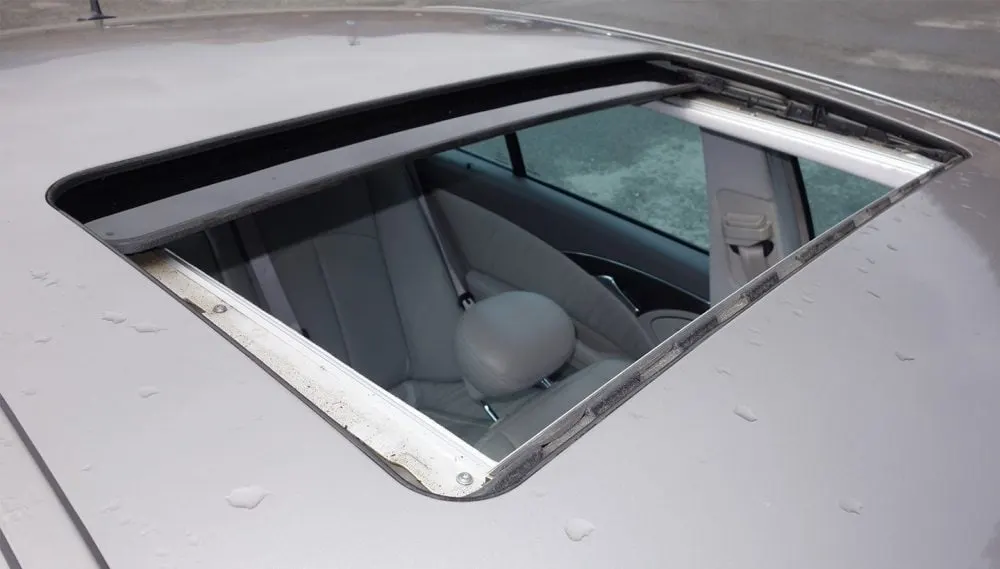
- Sunroof
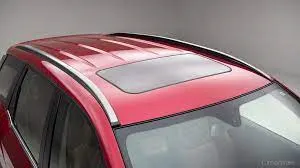
Sunroof is a movable panel that opens to uncover a window in an automobile roof, allowing light and fresh air to enter the passenger compartment. Sunroofs can be manually operated or motor driven, and are available in many shapes, sizes and styles.
- MOON ROOF
Moonroofs are actually one type of sunroofs. However, the material and uses are different. Moonroofs are made to allow the car driver and passengers to enjoy the outside view at night without having to get out of the car or open the car roof.
Moonroofs have colored glass panels that allow light and air to enter without having to shift the visor. However, lately, moonroofs are also equipped with a metal coating to keep the sunlight from entering directly into the cabin during the day.
- PANORAMIC ROOF
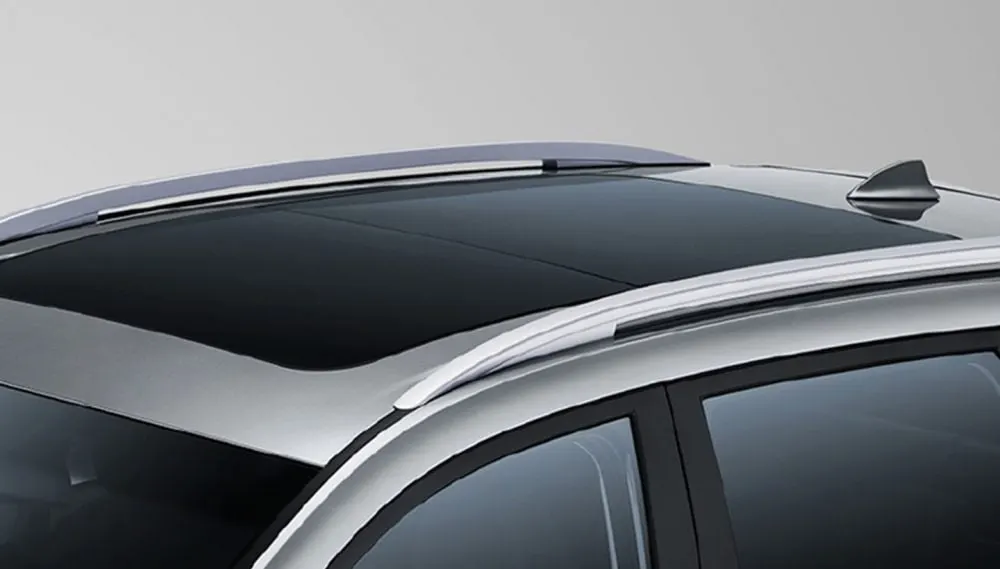
In the last couple of years, the different kind of roofs, namely panoramic roofs is embedded in luxurious cars. Recently, the panoramic roofs have become increasingly popular in premium SUV's.
This type of car roof is generally similar to the moonroofs, which has a large glass panel stretching across the roof, right above the first to the second rows. The panoramic roofs can open wider compared to the moonroofs in general. Panoramic roofs also have coating blinds to keep the cabin cool when the glass layer is closed, but the view in the sky is still visible.
- T top
T-top (UK: T-bar) is an automobile roof with a removable panel on each side of a rigid bar running from the center of one structural bar between pillars to the center of the next structural bar. The panels of a traditional T-top are usually made of auto grade safety glass.
- Targa top
Targa top, or targa for short, is a semi-convertible car body style with a removable roof section and a full width roll bar behind the seats.The rear window is normally fixed, but on some targa models, it is a removable plastic foldable window, making it a convertible-type vehicle.
- Vinyls
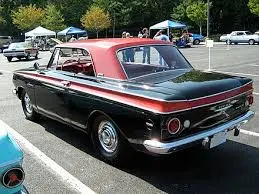
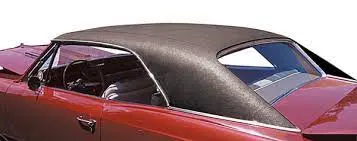
Vinyl roof refers to a vinyl covering for an automobile's top.This covering was originally designed to give the appearance of a convertible to models with a fixed roof and eventually evolved into a styling statement in its own right.
Why Roof will use?
Roof is the most important aspect in the home since it protects you and your family from many things. Roof block the rain wind hail and, snow.. They also catch most of the sunlight and provide you the insulation to keep the house warm in the winter and cool in the summer.
Roof is made up of ?
The roof itself may be constructed of soft or rigid material. Soft-tops are made of vinyl, canvas or other textile material; hard-top convertibles have roofs made from steel, aluminium, plastic or carbon fibre composites.
What is the use of black roof in car?
Because Black absorbs heat better than any other color. You, see using the same old glasses won't help in the case of sunroofs. The light will directly on the driver and cause inconvenience while driving. Hence these sunroofs are colored black, so as to absorb any light that might cause disturbance while driving.
What is MUV and SUV ?
- What Does The Car Manufacturing Process Involve? ...
- Obtaining And Reworking Raw Materials. ...
- Design, Engineering And Car Manufacturing. ...
- Stamping Or Press Shop. ...
- Welding Or Body Shop. ...
- Paint Shop As Part Of The Assembly Line. ...
- Engine Fitment and Assembly. ...
- Final Inspection and Testing.
PROCEDURE:
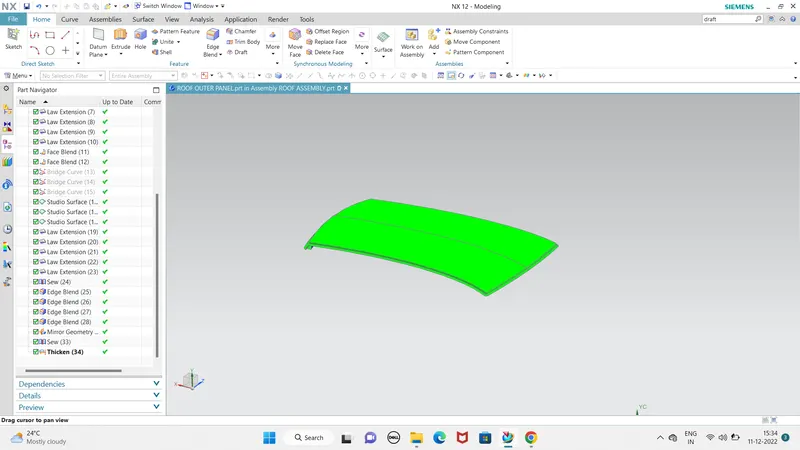
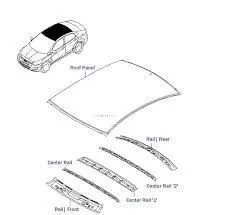
1. we create the assembly file and add the model files and name it as ROOF PANEL, FRONT RAIL ROOF, REAR RAIL ROOF, BOW ROOFS and CENTER ROOF.
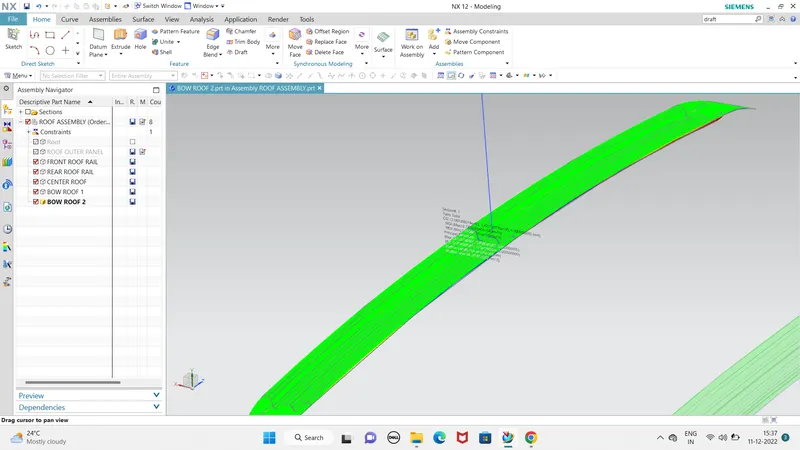
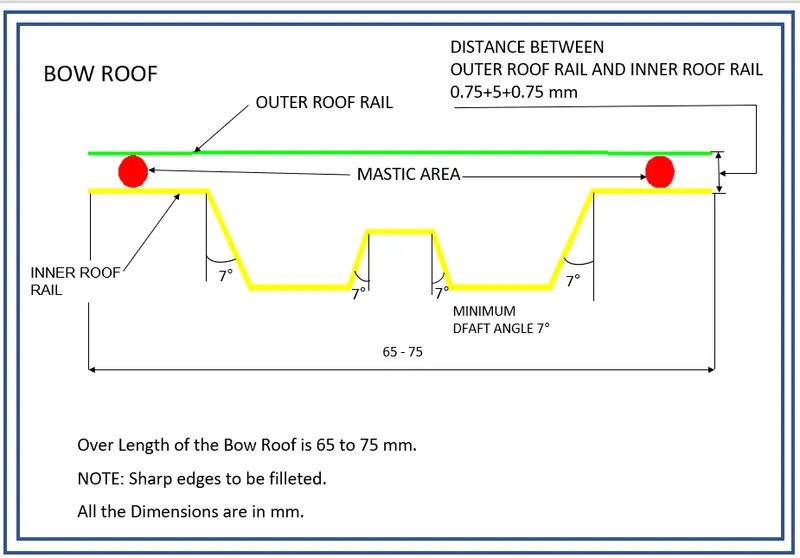
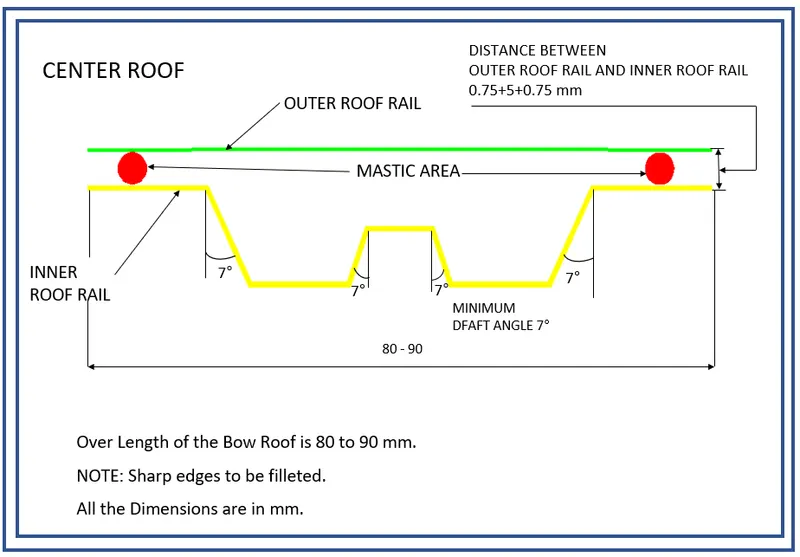
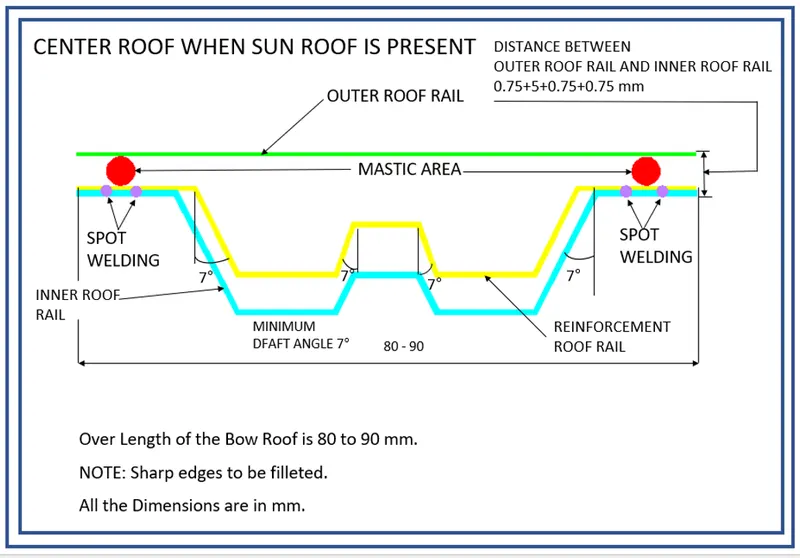
2. We have to follow the given master section and we design the ROOF OUTER PANEL with appropriate dimensions and provide draft angle also 7degree at the styling point.
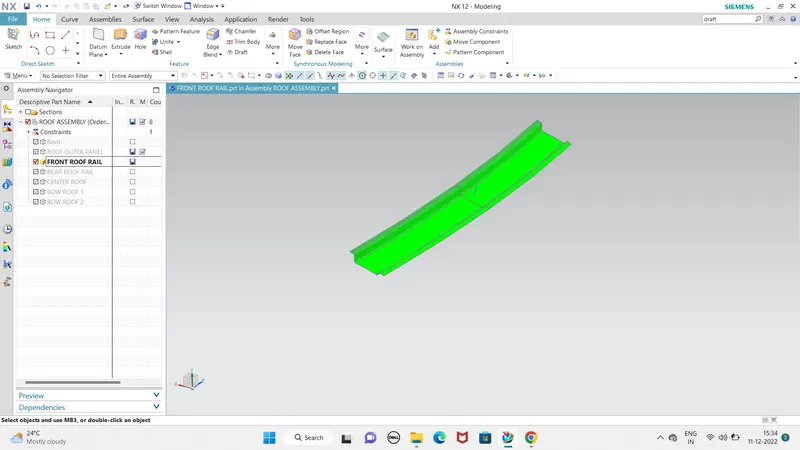
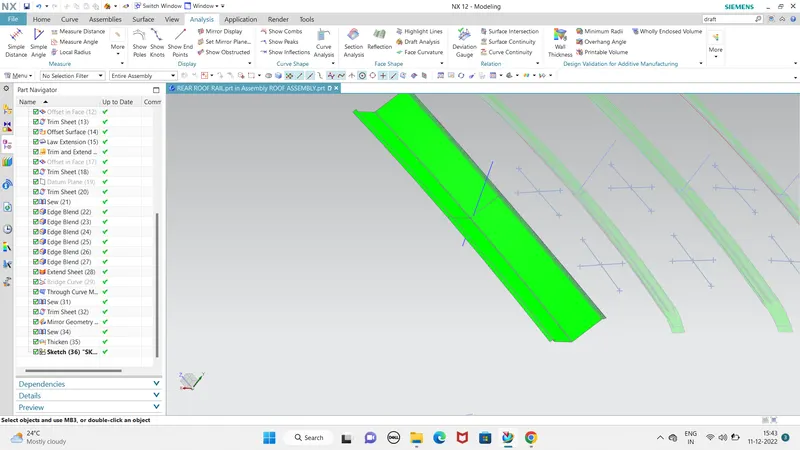
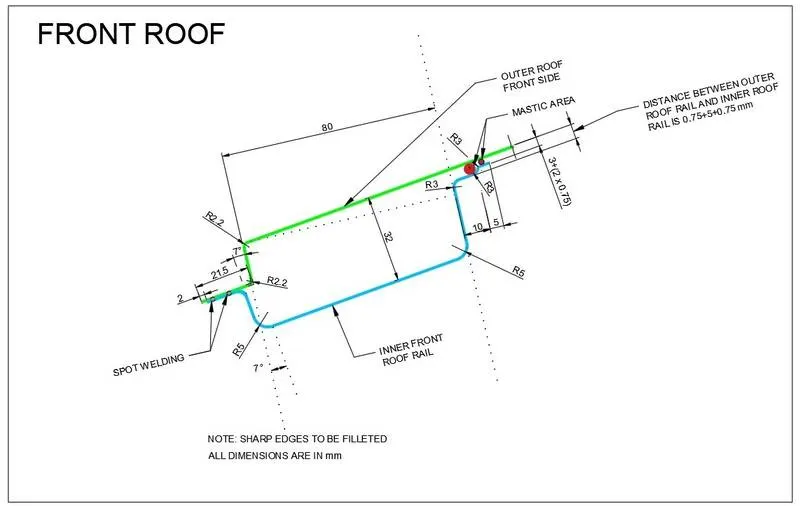
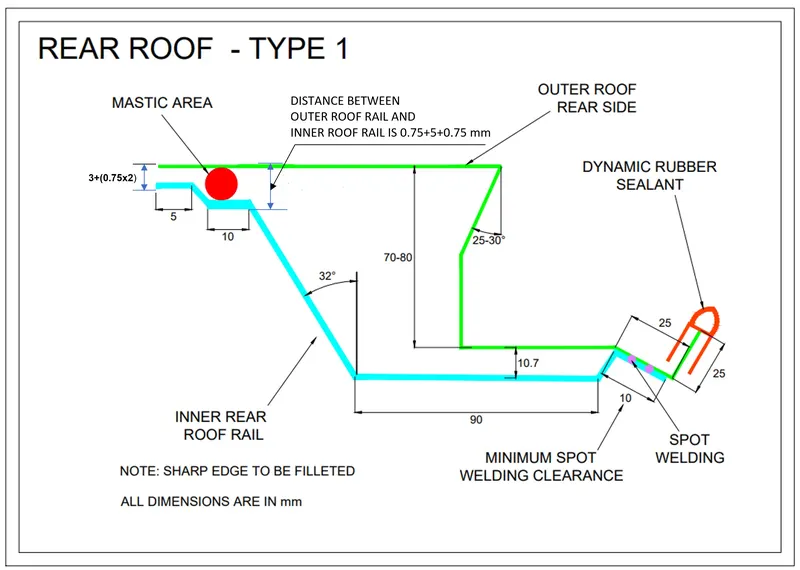
3. After we had to create the FRONT ROOF RAIL, REAR ROOF RAIL within the appropriate dimensions provided in the master section and we trim the some portion in nearby of outer panel because we add some attachments.
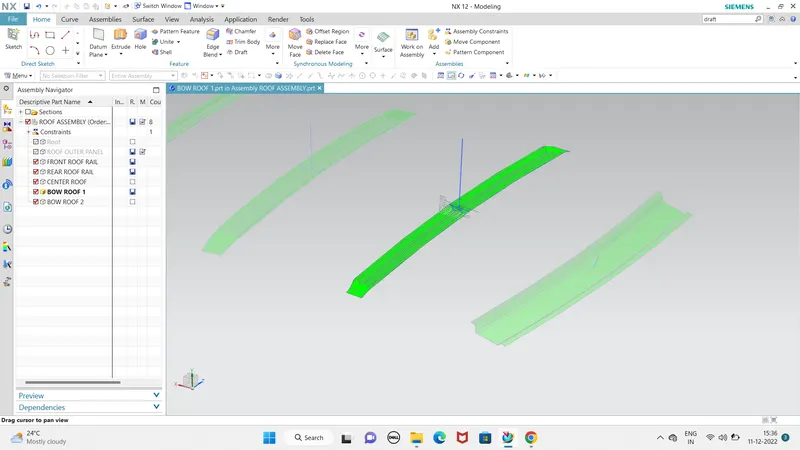
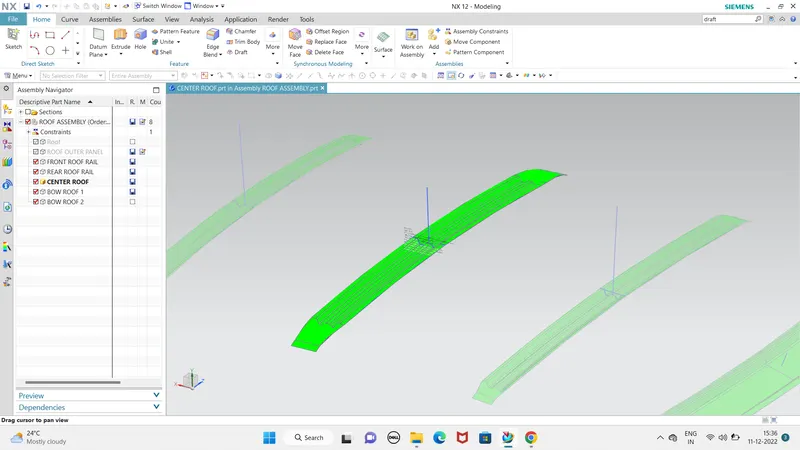
4. same we have to design the 2 BOW ROOF and CENTER ROOF by following the master section and we have to join the roofs and outer panel by forming the curves and with through curve mesh.
5. we give the mirror geometry and project the surface and sew it and perform thicken of 0.75mm.
6. Draft analysis must be 7.
7.Here we need to understand the strength of the material by using the calculation.
8.Here we need to perform the two calculations one is based on HEAT DISTROACTION and another is SNOW LOAD PREDICTION.
9.These are the steps we need to falow the while designing the roof components.
MASTER SECTIONS:
Front Roof Rail Master section
Master section of the Rear Roof Rail
Master section of Bow Roof
Master section of Center Reinforcement Rail
ROOF COMPONENTS:
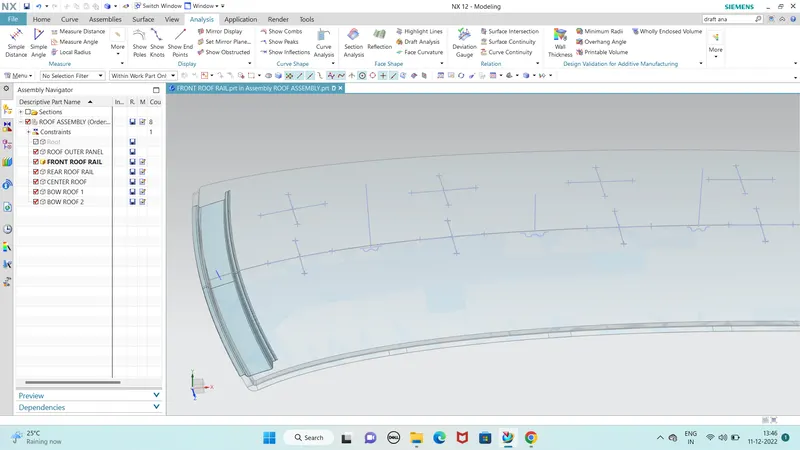
FRONT ROOF RAIL
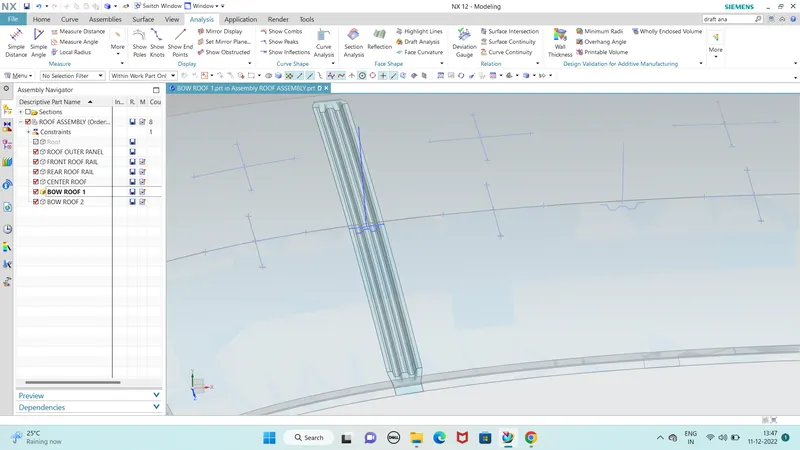
BOW ROOF1
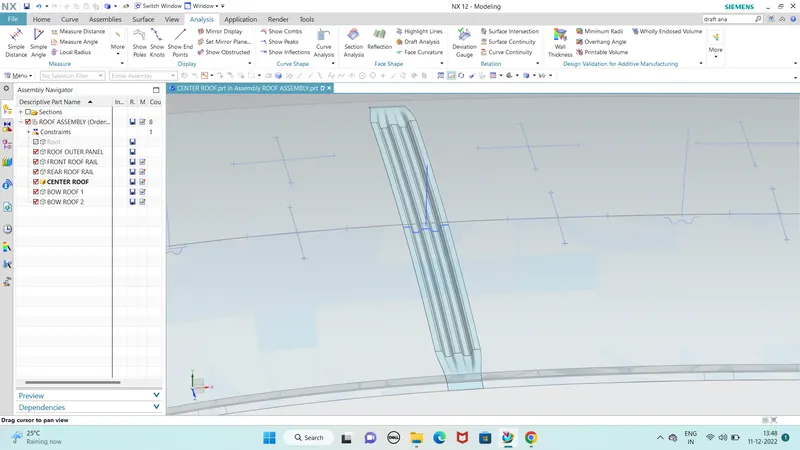
CENTER ROOF
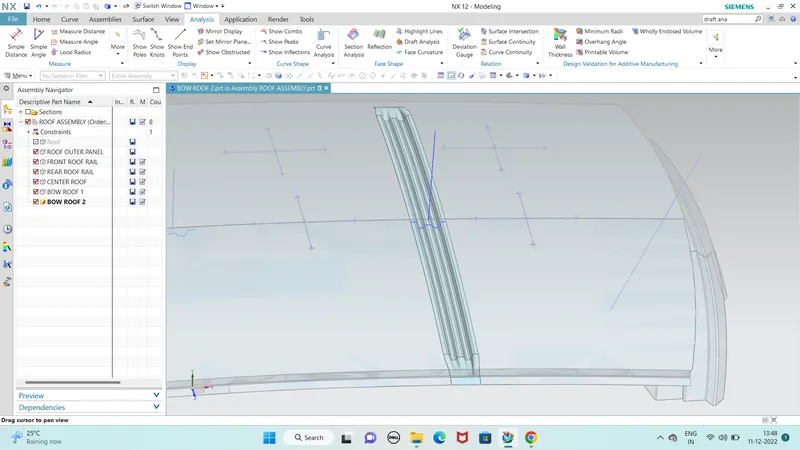
BOW ROOF 2
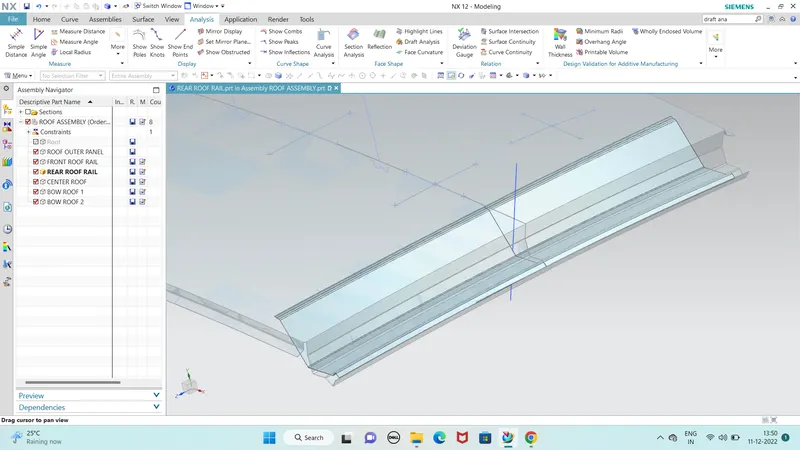
REAR ROOF RAIL
ROOF VIEWS
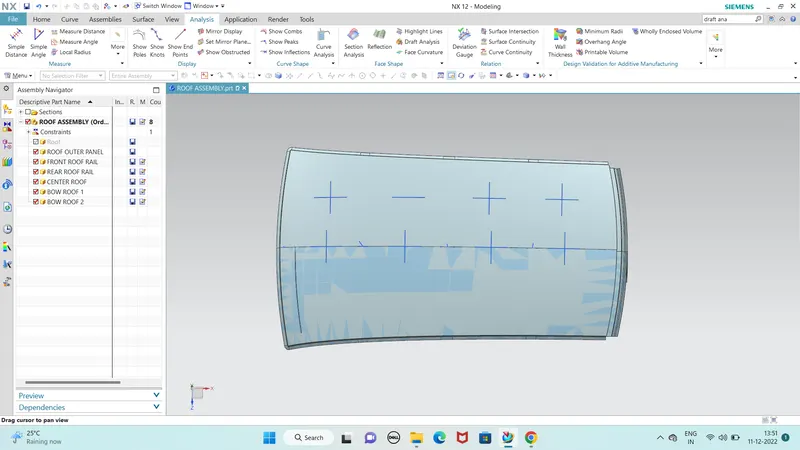
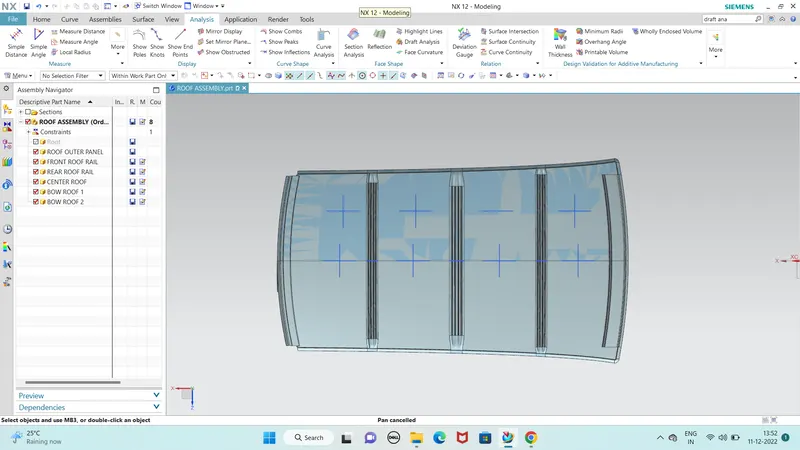
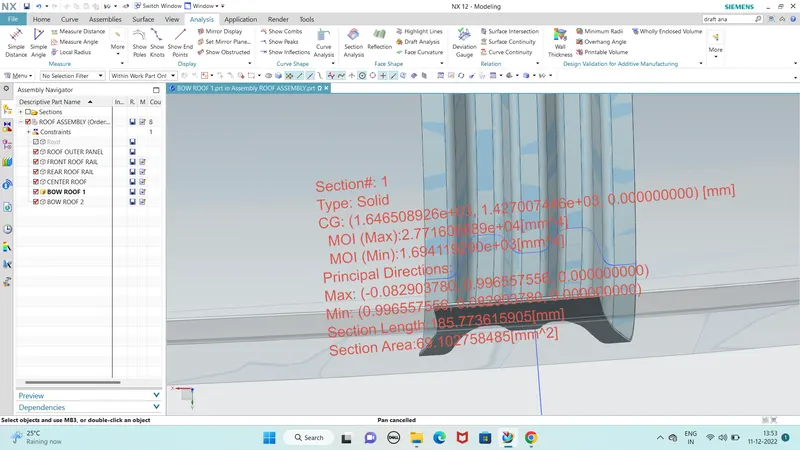
SECTIOM MODULUS
Section modulus for BOW ROOF 1
Section modulus for CENTER ROOF 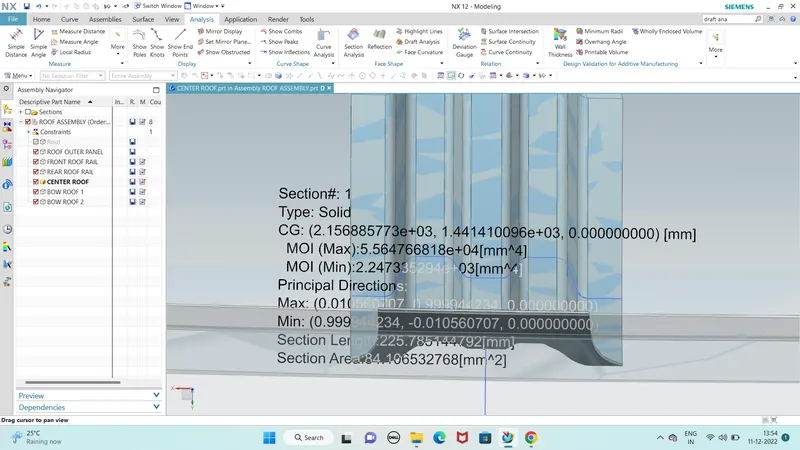
Section modulus for BOW ROOF 2
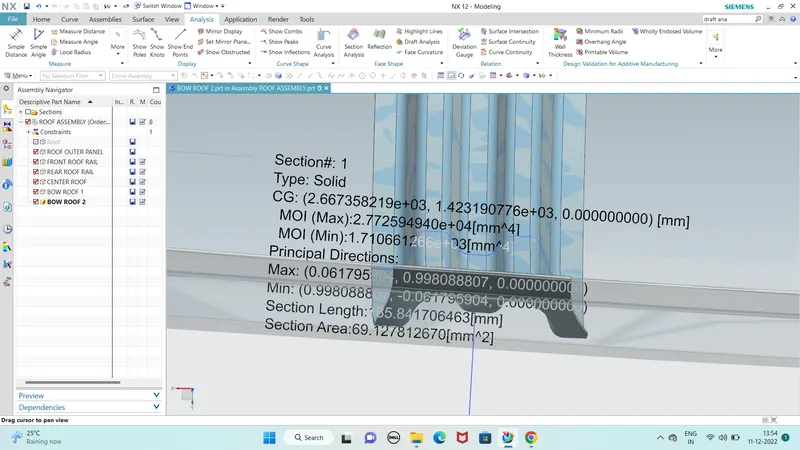
CALCULATIONS:
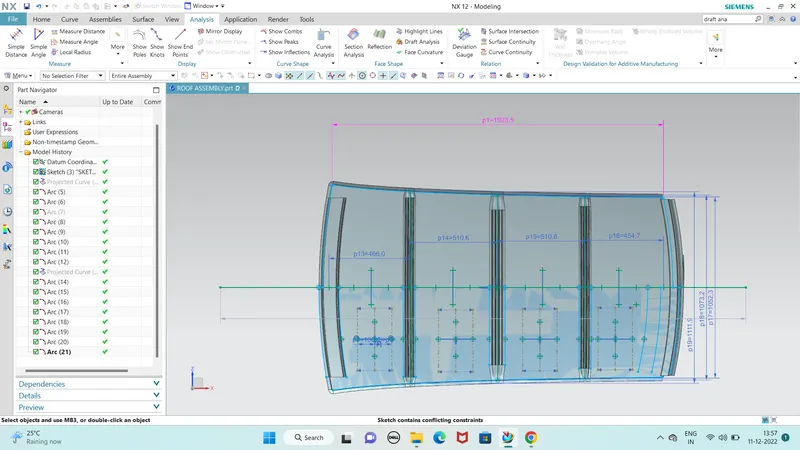
In the assembly we’re going to calculate heat distortion criteria and snow load criteria. Heat distribution criteria is the calculation of how the roof will stand the heat capacity. And also measure the draft analysis after roof assembly. In snow load criteria we’re going to calculate snow load with stand capacity of roof. In the foreign countries in the rainy season there is a snowfall in that kind of situation roof must withstand the snow load that is why we calculate this
Heat Distortion Criteria:
Predicting heat distortion for the roof is important since it is exposed to the heat for a long time and high temperature will affect the roof structure if the designing does not confirm with the heat distortion criteria. the study helps to determine the position of roof to provide strength to the route to avoid bending and deflection of the roof due to heat. bow curvature study you see following formula will help best check whether the boardroom potion important required strength of roof.
Bow–Roof Prediction Formula,
W = [1.73 x 10^ (-3) x L] + [1.85 x 10^ (-8) x (R^2)/t] + [ 1.10x10^ (-3) x l] - 2.68
Were,
L = Roof Length in X-Direction[mm](Roof dimension in 0-Y)
R = Roof curvature
R = 2(Rx*Ry)/(Rx+Ry)
Rx = X curvature
Ry = Y curvature
t = Roof plate thickness [mm]
l = Bow Roof Span [mm]
Judgment Condition
OK< 2.7
|
S.no |
Bow’s |
Rx |
Ry |
R |
L |
L |
t |
w |
OK |
remark |
|
1. |
FR&1st |
5733.69 |
2639.37 |
3614.29 |
2033.5 |
372.99 |
0.75 |
1.57 |
Ok<2.7 |
Pass |
|
2. |
1st & Cntr |
4942.45 |
6317.51 |
5546.01 |
2033.5 |
430.7 |
0.75 |
2.07 |
Ok<2.7 |
Pass |
|
3. |
Cntr&2nd |
3997.27 |
10480.45 |
5787.26 |
2033.5 |
430.65 |
0.75 |
2.13 |
Ok<2.7 |
Pass |
|
4. |
2nd& RR |
3327.65 |
13788.45 |
5361.4 |
2033.5 |
328.25 |
0.75 |
1.91 |
Ok<2.7 |
Pass |
Conclusion:
As per the standard acting load were w < 2.7. In that case above the diagram are all pass the requirement of the manufacturing standard.
Snow load prediction formula:
This evolution is performed in cold regions where snow a occurs. roof design must pass through the calculation to ensure that it has sufficient stiffness to withstand the load due to the accumulation of snow over the roof.
Qr = [Iyxt2] / [α x s x [(Rx + Ry)/2]2 x 10-8]
Were,
α = My x Lx2 x 10-12, My = Y(Ly-Y)
Judgement condition = Qr ≥ 3.1
250 ≤ s ≤ 380
(S varies depends on the Input)
t = Roof plate thickness [mm]
Ly= Distance between the Front and rear roof Rails on the Vehicle along 0Y [mm]
Length of Roof panel with the centre point between Roof rails Front /Rear as the reference point of the front and the rear.
Lx= Distance between the Left and Right end of the roof on the Roof BOW [mm]
Width of the roof panel exposed on the surface.
Y = Distance front Roof Rail to Roof BOW [mm]
s= Distance for which Roof BOW bears divided load [mm] s = L1/2 + L2/2
Iy = Geometrical moment of inertia of Roof BOW (Y cross section) [mm4]
Rx = Lateral direction curvature radius of roof panel Y cross section on Roof BOW [mm]
Roof panel curvature Radius of the Length Lx in Front view
Ry = Longitudinal Direction curvature radius of the Roof panel X cross section on Roof BOW [mm]
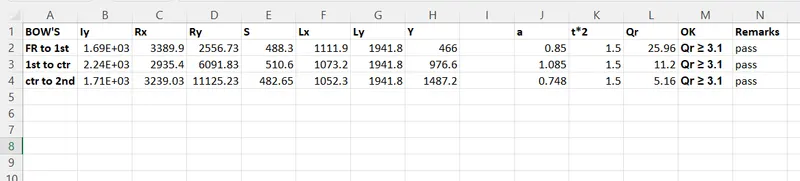
Conclusion:
As per the standard acting load were Qr >= 3.1. In that case above the diagram are all pass the requirement of the manufacturing standard.
Draft analysis:
Draft analysis is the command enable you to detect if the part you draft will be easily removed. This type of analysis performs based on colour rains identification zones on the analysis element where the deviation from draft direction at any point corresponding to the specific value. This value is from both negative from positive direction. When the negative value represents good rating and positive value more than 5 will be risk high. That represent the smoothness of the part. In parts smoother more good design. In our design we going to perform this analysis to roof, front rail, rear rail, bow rails and centre rail. And check whether the roof is smoother and less in rating