Roof Design
OBJECTIVE
We need to design the required reinforcment and flanges for the given Class A surface of Roof.Required reinforcments are Front Roof Rail,Rear Roof Rail,Bow Roof 1,Bow Roof 2.After designing the roof assembly completely we need to perform the Heat distortion analysis and the Snow Load Analysis.
ABSTRACT
Safety point of view the roof plays vital role,specially on accident where cars roll overs.Roll over accidents are the causes of many fatalities and several head,neck and spinetrauma around the world.Therefore passenger safety is also very important parameter in front of OEMs now a days.It is not only a marketing strategy but also a obligation stipulated by many governments.For this reason the strength of the roof is very crucial while designing the Vehicle roof.
Roof Assembly
The conventional task of the roof is to provide protection against hard local contact.In case of roll over,compartment integrity is provided by the compartment frames.
Material Used-:There are wide range of materials are available for making Roofs Vehicle.That are-Steel,Alluminium,Thermosetting Plastic sheet.In case of steel the usuall thickness is in the range of 0.65-0.85mm.In all cases any roof panel material requires braces to prevent panel flexing and vertical waivness,commonly known as oil canning.This is the main purpose of introducing the light weight bow roofs which are welded to the body side and bounded to roof panel by smooth flexible adhesive such as MASTIC.Another task of bow roofs is to support the interior roof liner which requires a number of fittings both in central and boundary areas to avoid deflections.
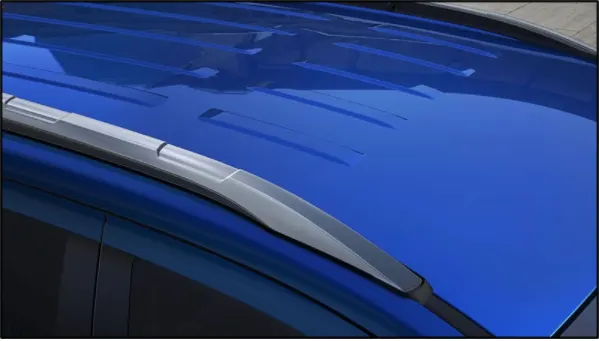
Car roof
Test your knowledge: What was the first car sold with a retractable hardtop roof?
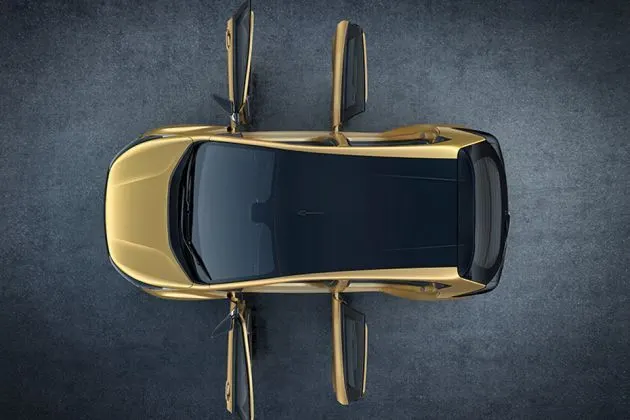
- Hardtops - A hardtop is a rigid form of automobile roof, which for modern cars is typically constructed from metal.

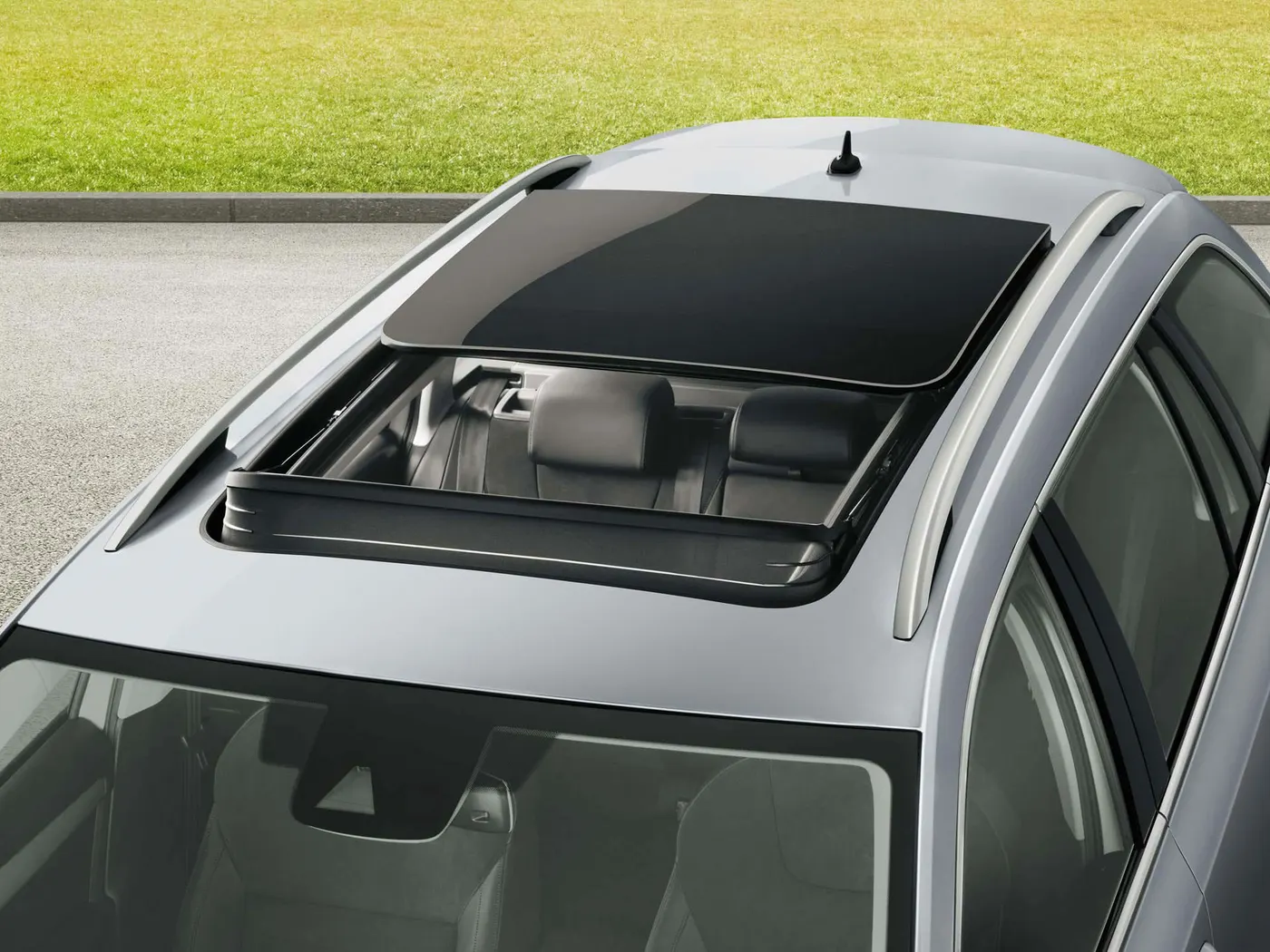
- Sunroofs - A sunroof is a movable panel that opens to uncover a window in an automobile roof, allowing light and/or fresh air to enter the passenger compartment. Sunroofs can be manually operated or motor driven, and are available in many shapes, sizes and styles. While the term sunroof is now used generically to describe any glass panel in the roof, the term "moonroof" was historically used to describe stationary glass panes rigidly mounted in the roof panel over the passenger compartment. A moonroof has a glass panel that is transparent and usually tinted. Previous terms include Sunshine Roof, Sliding Head and Sliding Roof.

- T-Tops - A T-top is an automobile roof with a removable panel on each side of a rigid bar running from the center of one structural bar between pillars to the center of the next structural bar. The panels of a traditional T-top are usually made of auto grade safety glass.
- Targa Tops - Targa top, or targa for short, is a semi-convertible car body style with a removable roof section and a full width roll bar behind the seats. The rear window is normally fixed, but on some targa models, it is a removable plastic foldable window, making it a convertible-type vehicle. Any piece of normally fixed metal or trim which rises up from one side, over the roof and down the other side is sometimes called a targa band, targa bar, or a wrapover band.
- Targa tops are different from T-tops, which have a solid, non-removable bar running between the top of the windscreen and the rear roll-bar, and generally have two separate roof panels above the seats that fit between the window and central t-bar.
- Vinyl Roofs - This covering was originally designed to give the appearance of a convertible to models with a fixed roof, but eventually it evolved into a styling statement in its own right. When leather, canvas and vinyl were sometimes used along with landau bars, to give a fairly accurate reproduction of a horse-drawn carriage's movable top.
- Oper Manta with Vinyl Roof
- Nissan Laurel with Vinyl Roof
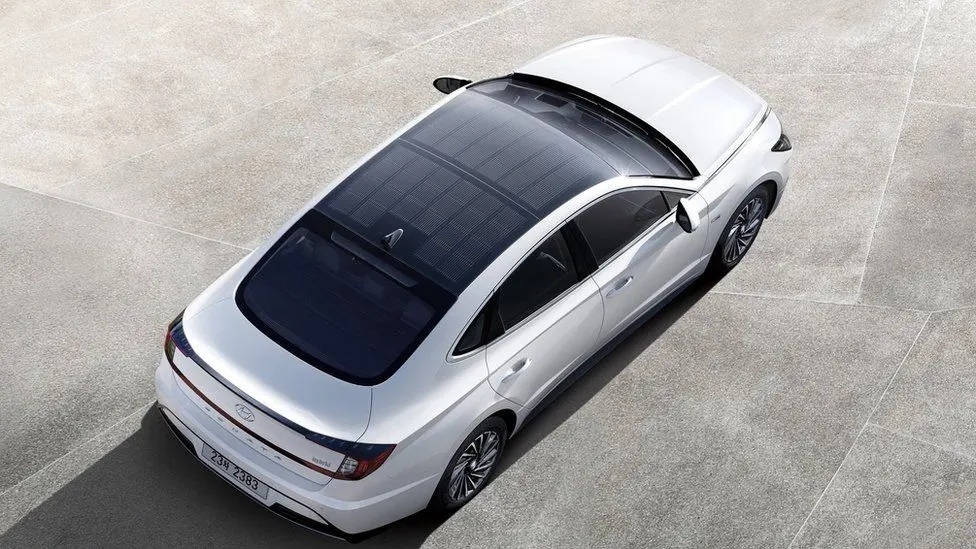
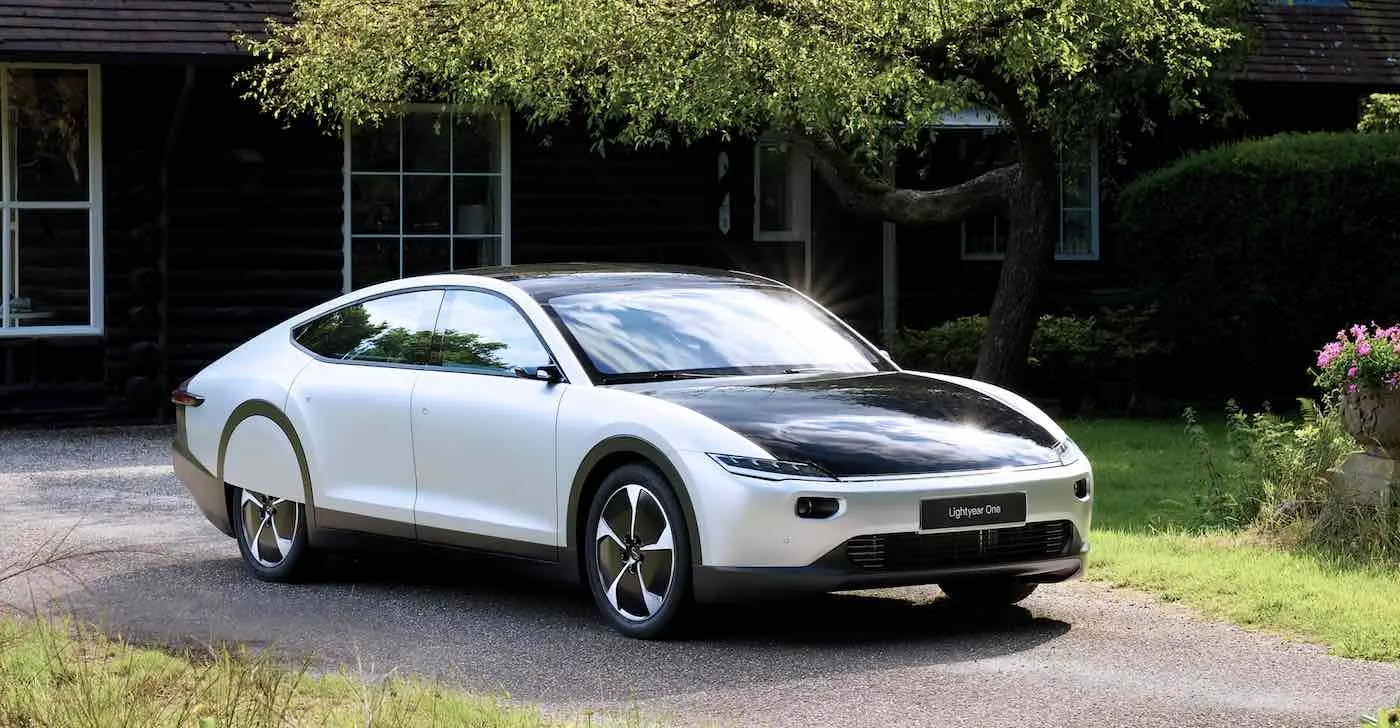
- Solar Panel Roof- The Solar panel roofs are newly developed for electric cars, to charge the batteries by using sunlight without stopping at charging stations which consumes a good time to recharge the batteries. So that the solar panel roofs were developed for on going recharging of batteries.
Design Of Roof Includes
- FRONT ROOF RAIL
- BOW ROOF 1
- CENTER ROOF RAIL
- BOW ROOF 2
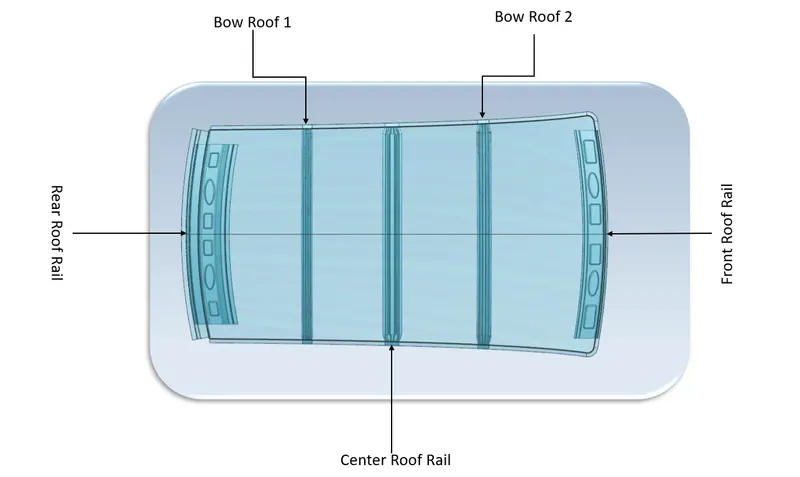
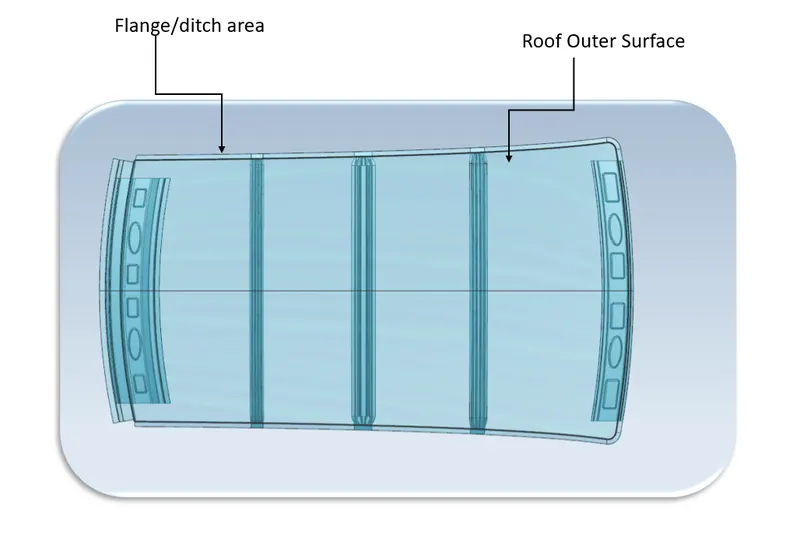
Designing of the Parts of the Roof Assembly
Front Roof rail
Front roof rail is an additional part attached to the roof which gives the reinforcement and also having certain features in it which helps in attaching the bracket map lamp and the room lamp.
The inputs for the Front roof
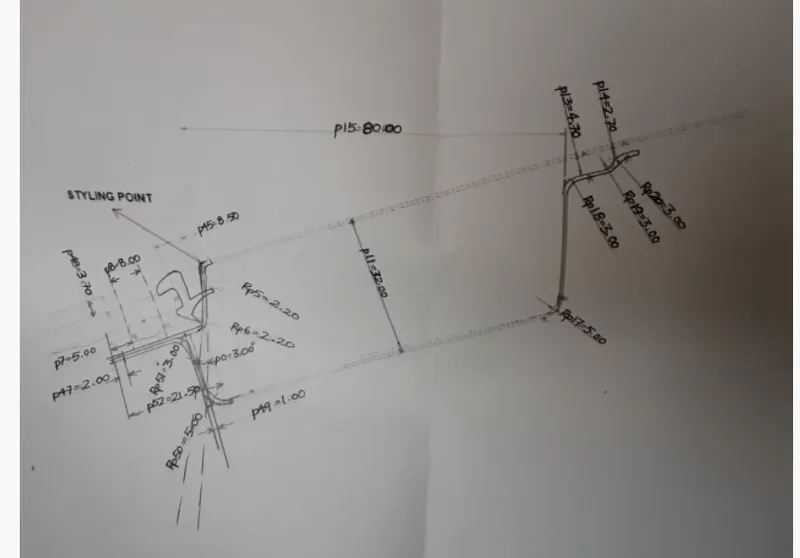
the physical shape that came out of these inputs that are given by the styling team is shown below.
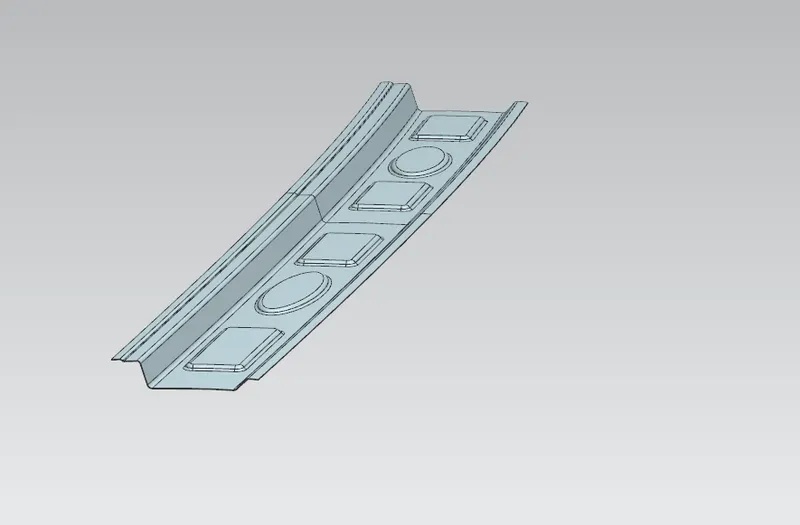
Rear Roof Rail
While designing the rear roof rail we need to take care of the head clearance of the passenger & the Rear Visibility Criteria.
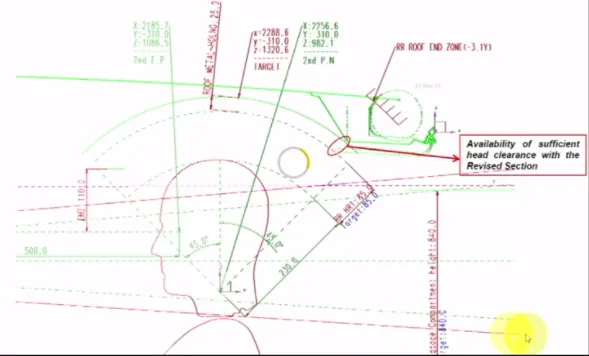
Center Roof Rail
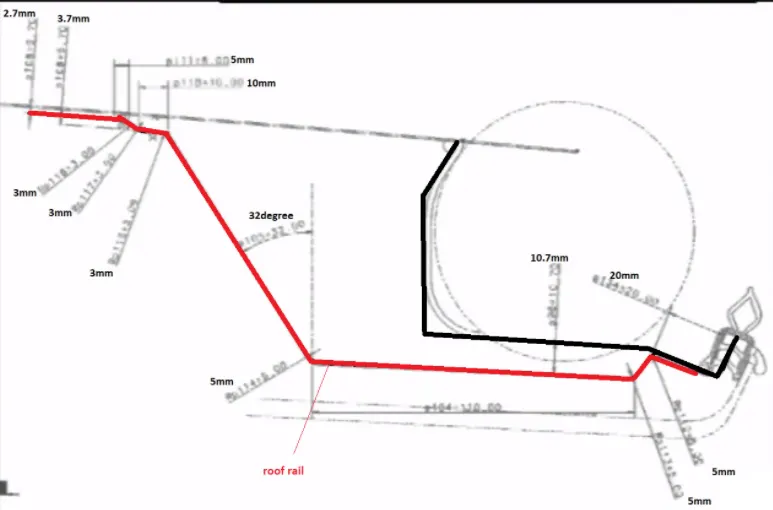
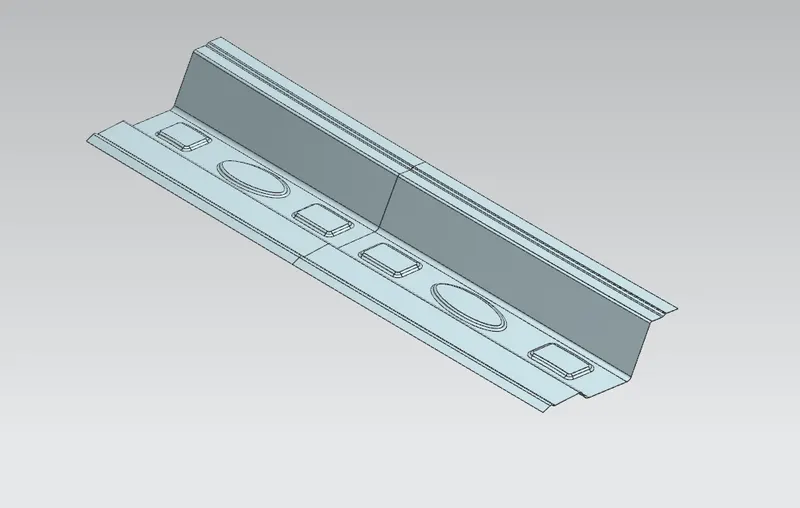
Here the minimum thing we need to take care is the width of the Center Roof Rail should be between 80-110.By following the master section by styling team the physical shape shown below.
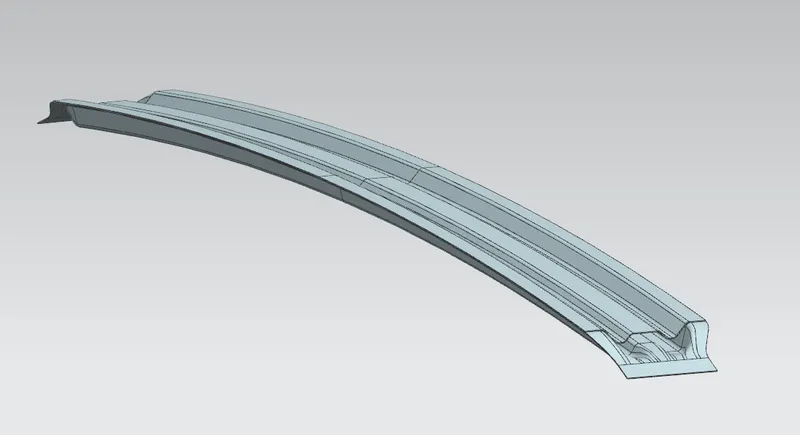
BOW ROOFS
- Mastics are applied between roof and the roof rail and bow roof.When the mastic gooses out it joins the roof rail and bow roof with the Roof.
- As we have curvature in front and more flat in the back side of the roof,it is sufficient to have reinforcement in the center of the roof.
- If the roof was small with better curvature we need to use only one reinforcement (center) that wiil act as bow roof.
- No.of bow roof increases if the car size becomes longer and taller.If flat region increases bow roofs also increases.
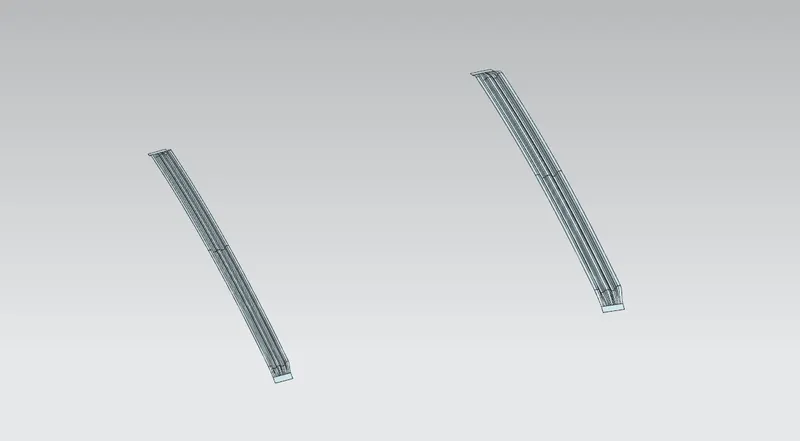
(above pic shows both the bow roofs)
Places to add Mastics
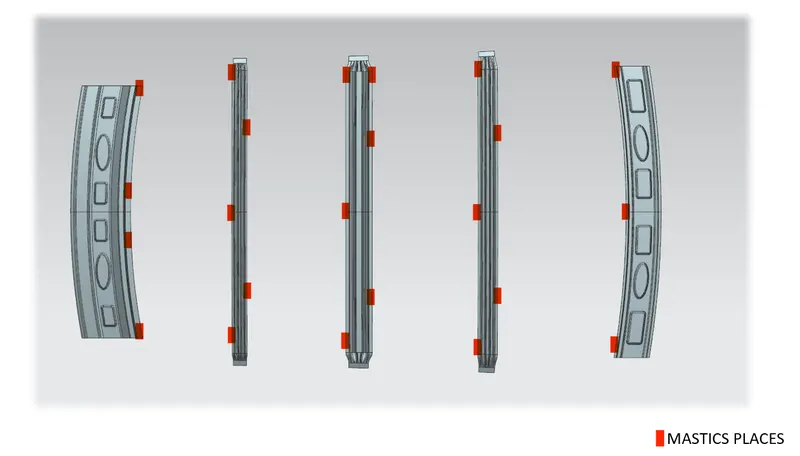
Spot Weld Places
SECTION MODULUS :
Section modulus is a geometric property for a given cross-sect ion used in the design of beams or flexural members. Other geometric properties used in design include area for tension and shear, radius of gyrat ion for compression, and moment of inertia and polar moment of inertia for stiffness. Any relationship between these properties is highly dependent on the shape in question.Equations for the section moduliof common shapes are given below.
There are two types of section moduli :
The elastic section modulus and The plastic section modulus.
The elastic section modulus is defined as,
s= 1/ y
where :
S= Section modulus
I = second moment of inertia (or area moment of inertia,not to be conf used with moment of inertia)
y = the distance from the neutral axis to any given fibre.It is often reported using y = c,where c is the distance f rom the neutral axis to the most extreme fibre.
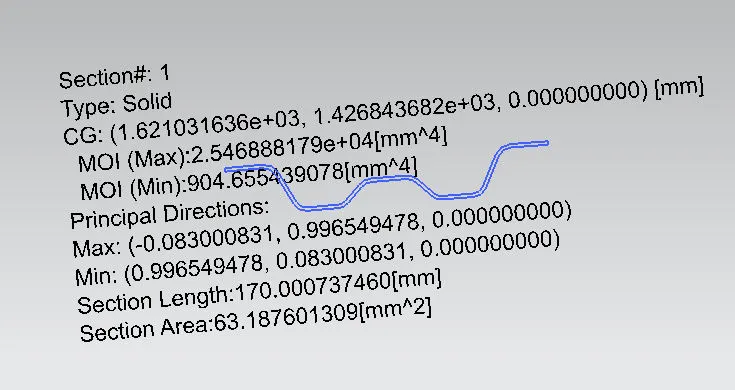
Bow Roof Rail 1 :-
- The minimum Moment Of inertia of the Bow Roof Section is 904.65 mm4
Center Roof Rail :-
- The minimum Moment Of inertia of the Bow Roof Section is 1.06 mm4
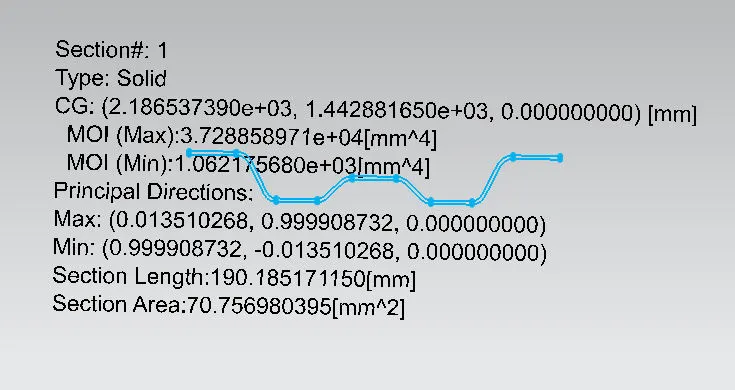
Bow Roof Rail 2 : -
- The minimum Moment Of inertia of the Bow Roof Section is 143.754 mm4
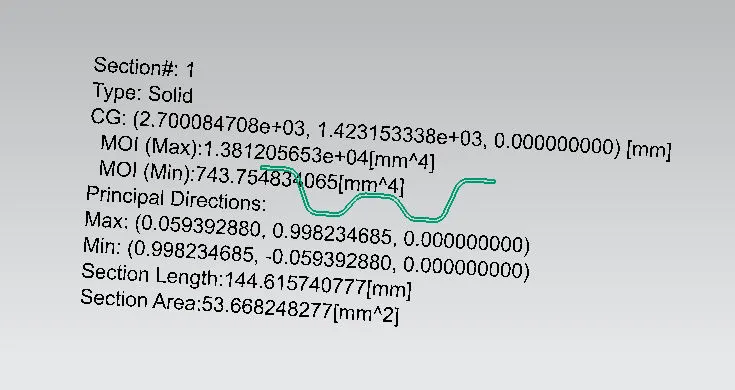
Heat Distortion Analysis :-
- Heat distortion analysis plays a pivotal role in the strength of the roof panel. It is the temperature above which material cannot be used for structural applications.
- This study is used to predict the heat distortion temperature where the material starts to soften when exposed to a fixed load at elevated temperature.
- In order to avoid any bending or damages on the roof, heat distortion temperature can be recalculated using the trial and error method by changing the position of bow roofs. In this way, it can come in the range which is shown below.
Formula
W = [1.73 x 10^(-3) x L] + [1.85 x 10^(-8) x (R^2)/t] + [ 1.10x10^(-3) x l] - 2.68
Judgement Condition using w : OK< 2.7> 3.1
Where
L = Roof Length in X-Direction[mm](Roof dimension in 0-Y)
R = Roof curvature
R = 2(Rx*Ry)/(Rx+Ry)
Rx = X curvature
Ry = Y curvature
t = Roof plate thickness [mm]
l = Bow Roof Span [mm]
Annotations :-
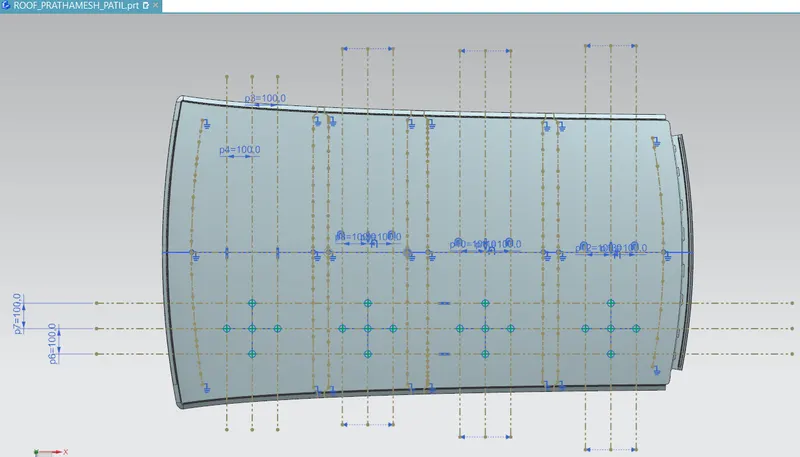
Drawing of Arcs to find out Values for Rx and Ry.
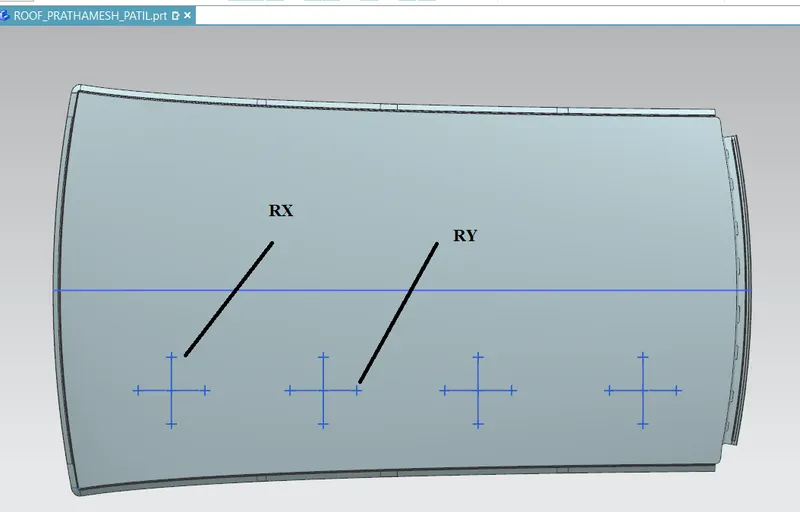
Calculation of "W":-
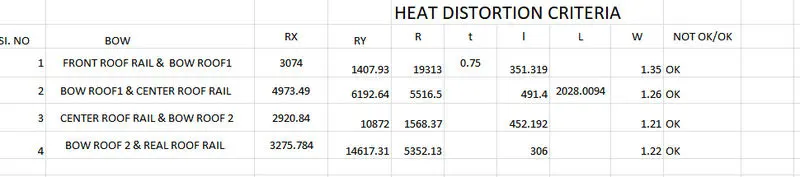
Snowload Analysis :-
- The purpose behind this analysis is to check the strength of the roof when snow is present on it acting as a load.
- A roof should be designed in such a way that it should rebound to its original shape after the removal of snow.
Formula
Qr = [Iy x t2] / [α x s x [(Rx + Ry)/2]2 x 10-8]
Where
α = My x Lx2 x 10-12 , My = Y(Ly-Y)
Judgement condition = Qr ≥ 3.1
250 ≤ s ≤ 380
t = Roof plate thickness [mm]
Ly = Distance between the front and rear roof Rails on the Vehicle along with 0Y[mm]
Length of Roof panel with the center point between Roof rail Front /Rear as the front and rear reference point.
Lx = Distance between the Left and Right end of the roof on the Roof BOW [mm]
Width of the roof panel exposed on the surface.
Y = Distance front Front Roof Rail to Roof BOW[mm]
s = Distance for which Roof BOW bears divided load [mm]
s = L1/2 + L2/2
Iy = Geometrical moment of inertia of Roof BOW (Y cross-section )[mm4]
Rx = Lateral direction curvature radius of roof panel Y cross-section on Roof BOW [mm]
Roof panel curvature Radius of the Length Lx in Front view
Ry = Longitudinal Direction curvature radius of the Roof panel X cross-section on Roof BOW [mm]
Roof panel X curvature radius of length s in Side view
Annotations :-
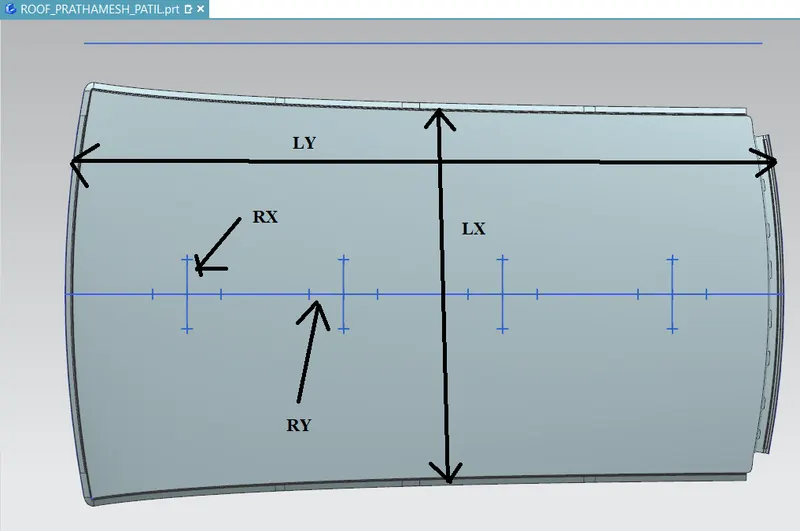
Drawing of Arcs to find out Values for Rx and Ry
Calculations :-
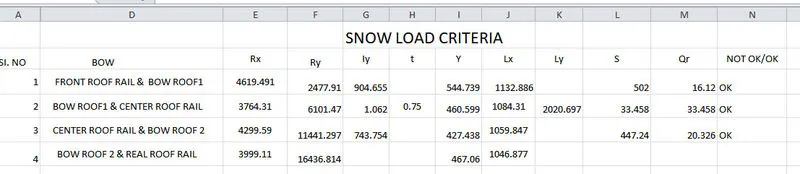
It is observed that the roof is satisfying the condition that are given. One last condition is not satisfying then creating the emboses in outer panel because the increasing the strength of the outer panel.
Conclusion
The Roof design is pass all the test that is Heat Distortion & Snow Load and ready to manufacture for all weather conditions.