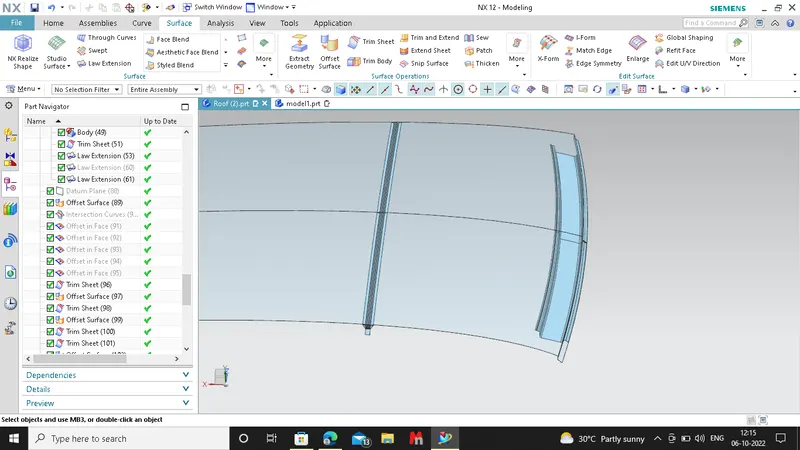
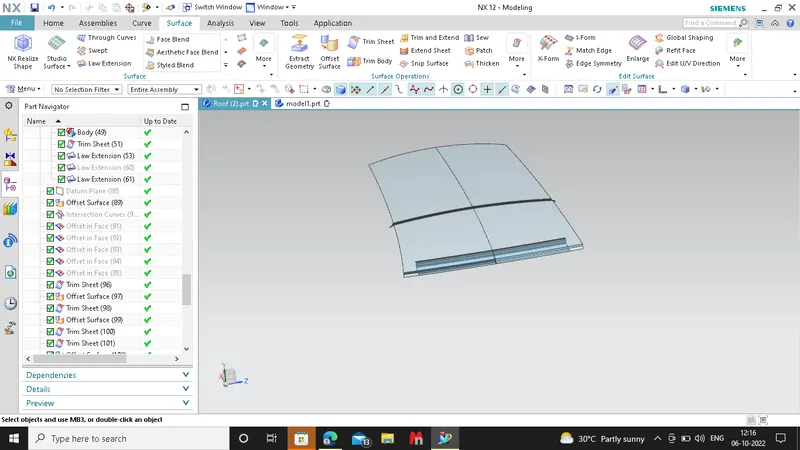
Roof Design
Types of Metal Roofing
Copper - Extremely long-lasting, very soft with low melting temperature
Aluminum - Long-lasting, resistant to salt water corrosion
Zinc - Extremely long-lasting, resistant to corrosion and lowest melting point
Steel - Three variations: galvanized, galvalume, and weathering steel (corten)
Tin - Often referring to steel, used prior to World War II. No longer commonly applied.
Objectives:
The main objective of this project is to come up with a new design for CAR ROOF from styling surfaces that satisfies,
The design requirements for the roof and its components.
Functional requirements.
Roll over test regulations & requirements.
Bow Row position justification.
Joining techniques like welding and masting.
Data for Roof design:
Roof panel thickness = 0.75mm.
Front roof rail thickness = 1.2mm.
Rear roof rail thickness = 1.2mm.
Bow roof rail thickness = 1.2mm.
Centre roof rail thickness = 1.2mm.
Roof Design:
First thing to consider while designing the roof is the opening angle, of the flanges such that there is no negative draft.
If the roof rail is flat it is weak and if it is tilted or curved then it has more strength.
As the roof is large so to increase the strength of the roof where it appears flat due to its long distance Roof Bow are given to increase the strength of the roof.
Section Modulus calculation of the Roof
Section modulus is a geometric property for a given cross-section used in the design of beams or flexural members. The elastic section modulus is define d as S = I / y, where I is the second moment of area (or area moment of inertia) and y is the distance from the neutral axis to any given fibre.
We have,
S = I / y
where I - second moment of area (or area moment of inertia)
Y - the distance from the neutral axis to any given fibre.
I – for the above section
Section modulus for various sections are given in the table below,
Roof Curvature Study
Bow–Roof Prediction Formula
W = [1.73 x 10^(-3) x L] + [1.85 x 10^(-8) x (R^2)/t] + [ 1.10x10^(-3) x l] - 2.68
Where,
L = Roof Length in X-Direction[mm](Roof dimension in 0-Y)
R = Roof curvature
R = 2(Rx*Ry)/(Rx+Ry)
Rx = X curvature
Ry = Y curvature
t = Roof plate thickness [mm]
l = Bow Roof Span [mm]
Judgment Condition
OK< 2.7
Snow Load Prediction Formula
Qr = [Iy x t2] / [α x s x [(Rx + Ry)/2]2 x 10-8]
Note: The Qr value given over here is correct. There was a typo error in the formula given in the video.
Where,
α = My x Lx2 x 10-12 , My = Y(Ly-Y)
t = Roof plate thickness [mm]
Ly = Distance between the front and rear roof Rails on the Vehicle along with 0Y[mm]
Length of Roof panel with the center point between Roof rail Front /Rear as the front and rear reference point.
Lx = Distance between the Left and Right end of the roof on the Roof BOW [mm]
The width of the roof panel is exposed on the surface.
Y = Distance front Front Roof Rail to Roof BOW[mm]
s = Distance for which Roof BOW bears divided load [mm]
s = L1/2 + L2/2
Iy = Geometrical moment of inertia of Roof BOW (Y cross-section )[mm4]
Rx = Lateral direction curvature radius of roof panel Y cross-section on Roof BOW [mm]
Roof panel curvature Radius of the Length Lx in Front view
Ry = Longitudinal Direction curvature radius of the Roof panel X cross-section on Roof BOW [mm]
Roof panel X curvature radius of length s in Side view
Judgment condition
Qr ≥ 3.1
250 ≤ s ≤ 380