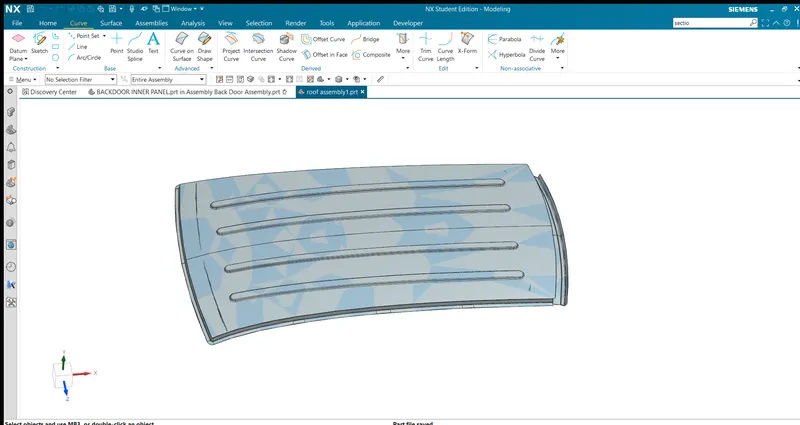
Roof challenge
Roof Design Challenge:
Objectives:
- Perform Curvature study to figure out appropriate position for the roof bows using Heat distortion criteria
- Perform Section modulus study for Front roof rail, Rear roof rail, Roof reinforcement, Bow roofs.
- Write a detailed report on the same.
Roof Design:
A roof of a car consists a outer skin panel which is designed with aesthetics and aerodynamics in mind and the support structure of the panel. In case of passenger cars the roof is designed to be flexible enough to regain its original shape after smaller loads due to snow of light impacts are applied to it. At the same time the roof needs to withstand all the impact forces and self weight in a roll over incident. Hence the support structure is a vital part of the roof design. Usually it consists of a Front roof rail, a rear roof rail, roof reinforcement, and 1 or more bow rails.
The front and rear roof rails are used to join the roof with the rest of the BIW of the car along with front windshield, dampening components, sealants etc. Roof reinforcement panel is provided where the roof is flatter usually in the middle along the length of the car again to provide strength to the roof. Bow roof rails are provided as and when necessary, and are attached to the roof panel using mastic sealants. The longer the roof, more the number of bow rails. The dimensions of the support structure like the depth and length which will affect the front and rear visibility, interior design and material required, headroom and overall space it will occupy is governed by ergonomics and region specific regulations where the car is to be sold.
Curvature study of the roof: By Heat distortion criteria
Done to predict where the bow rails should be placed as per the given loading conditions or criteria. Heat distortion criteria is predicting weather for a given fixed loading will the component undergo failure due to buckling or bending. The heat distortion or deflection temperature of the material is the temperature above which the component cannot be used for structural application as it softens and fails due to elevated temperatures and load. The failure may cause cracking of welds, bending etc.
From the formula you can see that the ‘W’ value and hence weather the design is good or not depends on the values or ‘R’ and ‘I’ as ‘L’ and ‘t’ are constant. Hence for a given curvature the roof design’s validation can be altered by varying ‘I’ or Bow roof span that is the bow roof placement.
in our case the calculations come out to be as follows:
Sr.No.
Bow
Rx(mm)
Ry(mm)
R(mm)
I(mm)
t(mm)
W
Judgment
1.
FRR and 1st Bow
5732.030
2663.049
3636.577
410.487
0.75
1.68
OK
2.
1st Bow & CRR
4945.080
6306.95
5543.599
395.8452
0.75
2.022
OK
3.
CRR & 2nd Bow
4006.758
10432.448
5789.832
395.980
0.75
2.09
OK
4.
2nd Bow & RRR
3331.017
14255.822
5400.210
367.329
0.75
1.98
OK
Hence, the design is safe as per Heat distortion criteria for the current position of Roof Bows.
- By Snowed Criteria:
A crucial design criteria which is very important in the usable life of a vehicle. In the colder regions of the world where it snows heavily during winters and are prone to storms, the snow accumulated on the roof of a standing/parked vehicle may cause permanent damage. The support structure of the roof that is the roof bows and centre roof reinforcement should be placed suitably such that it could withstand the weight of the snow. Instead of making the roof rigid and heavy which will cost more and would make the vehicle less fuel efficient, it is allowed to flex up to a limit which absorbs a bit of the energy similar to a spring. When the snow is cleared and there is no more load on the roof by design it should regain its original position.
Qr = (Iy * t2 ) / (α * s * ((Rx + Ry)/2)2) * 10-8
Where, α = My * Lx2 * 10-12 , My = Y (Ly – Y)
and,
t : Roof plate thickness (mm).
Ly : Distance between FRR and RRR at 0Y (mm).
Lx : Distance between Left and Right end of the roof (Width) (mm).
Y: Distance Between FRR centre and BOW centre (mm).
s : Distance for which roof Bow bears divided load (mm)
s = (L1 / L2 )+ (L2 / 2).
Ln = Centre to centre distance between consecutive Bows.
Iy : Geometric moment of inertia of roof BOW (Y Section) (mm4).
Rx : X Curvature.
Ry : Y Curvature.
Judgment Criteria: Qr ≥ 3.1 , 250 ≤ s ≤ 380.
As we can see, the terms Rx ,Ry, Ly, t, are constant for both the criteria or all the bows, the difference is made by the terms Ln, Lx, Iy. Hence, the design’s validation can be altered by varying ‘I’ or Bow roof span that is the bow roof placement just like heat distortion criteria.
Sr.No.
Iy (mm4)
t (mm)
α (mm4)
s (mm)
Rx (mm)
Ry (mm)
Qr
Judgment
1
1.169*10^3
0.75
0.989
489.393
4458.040
2707.6653
10.58
OK
2
2.238*10^3
0.75
1.211
475.269
3769.797
6219.612
8.767
OK
3
1.183*10^3
0.75
0.936
488.107
4261.680
10898.907
2.53
NOT OK
the 3rd one is not satisfying the judgment
Section Modulus study:
The area moment of inertia for each section of rails and bows alongs 0Y is as follows:
1.Outer roof:
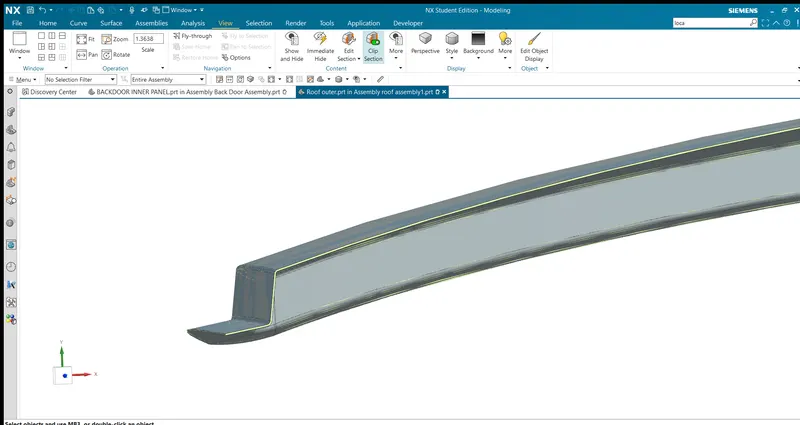
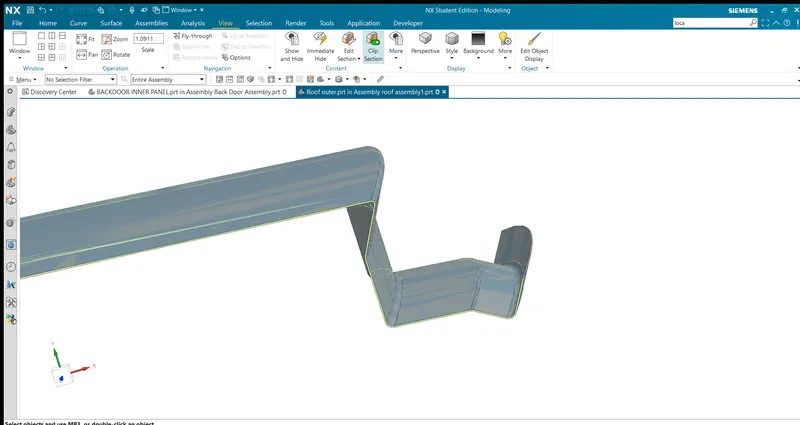
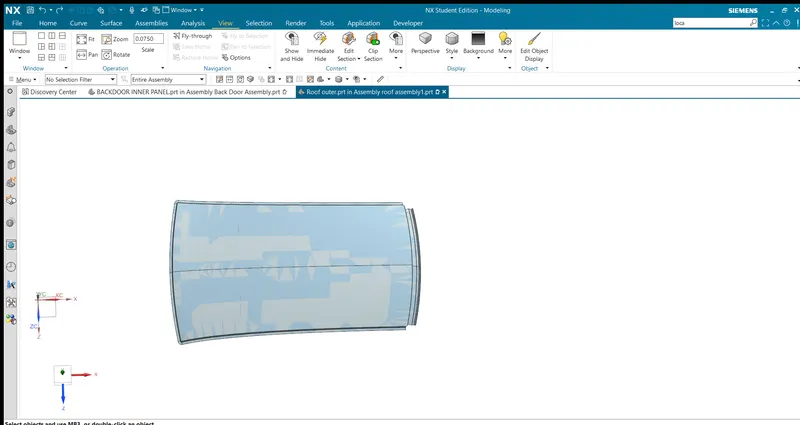
Front Roof:
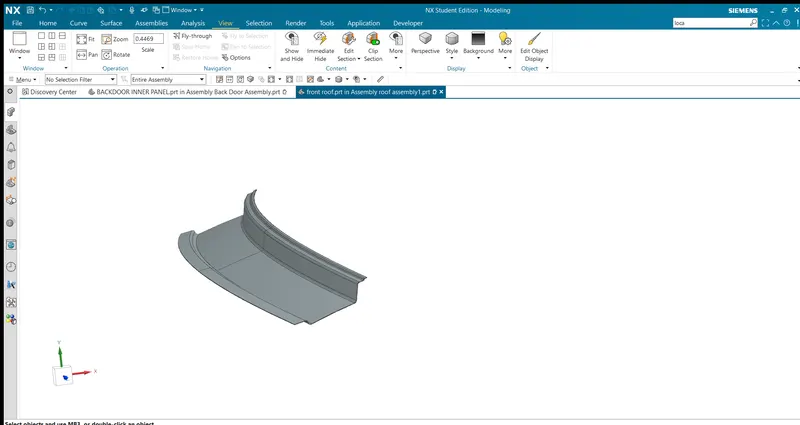
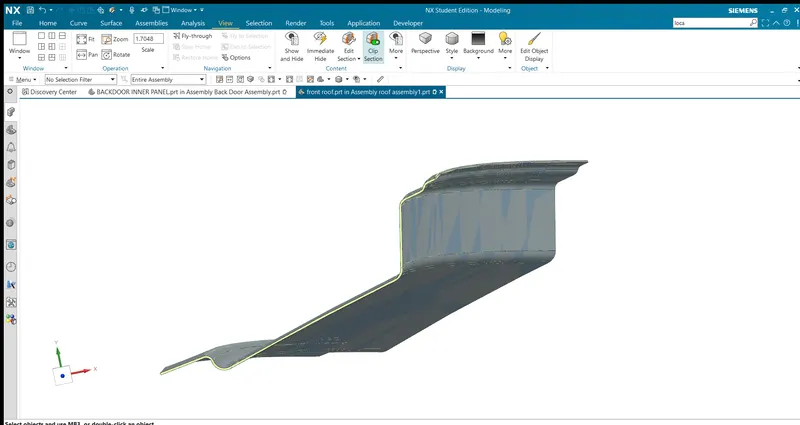
1st Roof Bow:
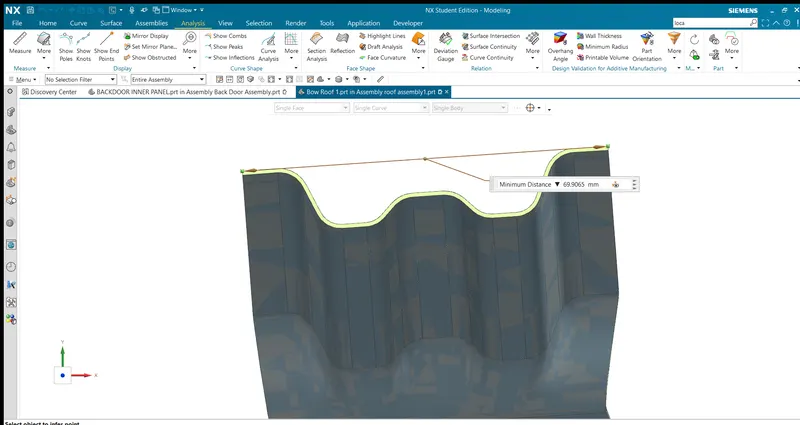
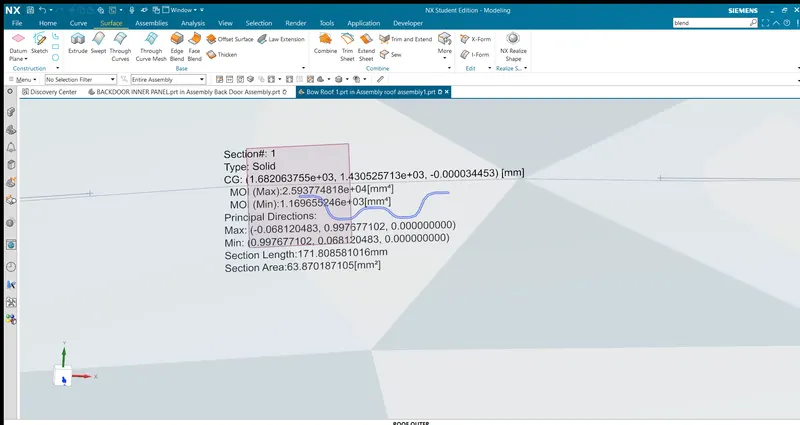
Centre Roof Reinforcement:
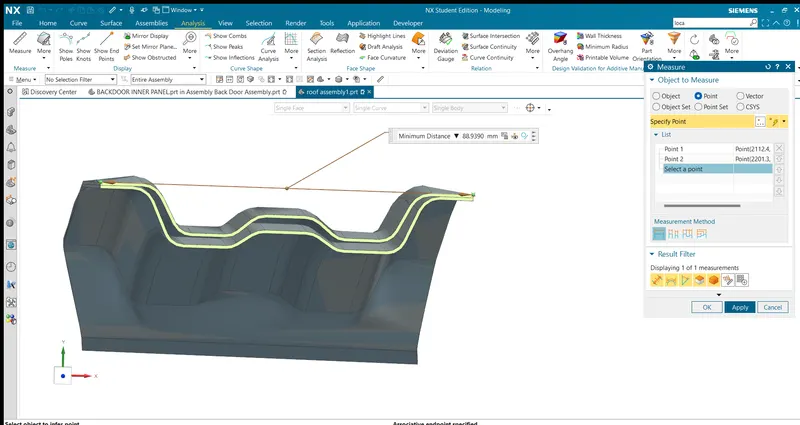
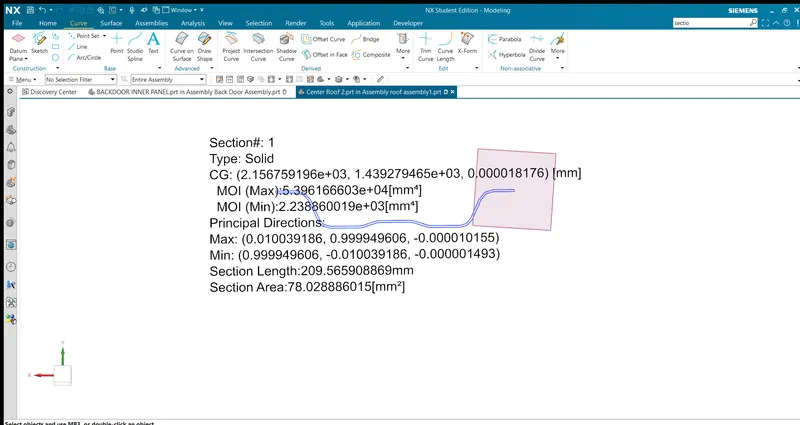
2nd Roof Bow:
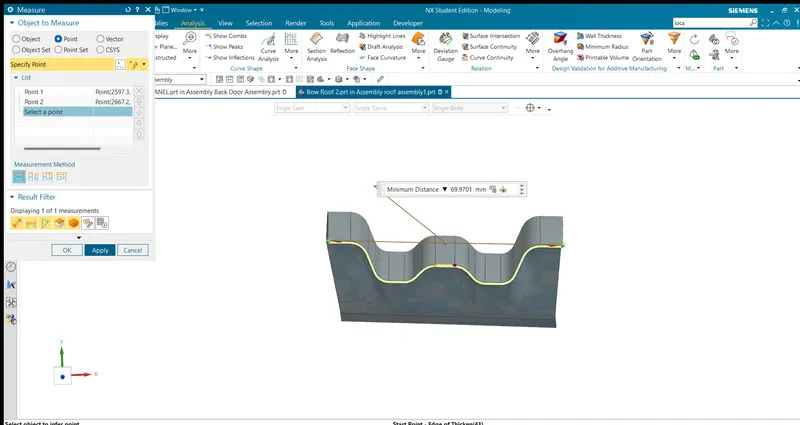
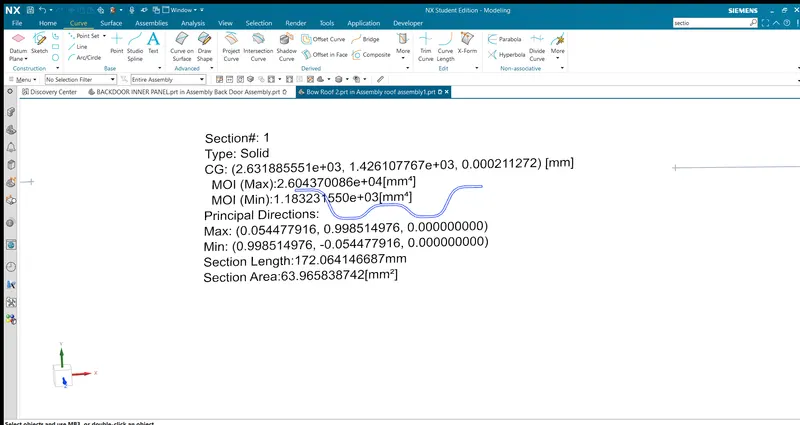
Rear Roof Rail:
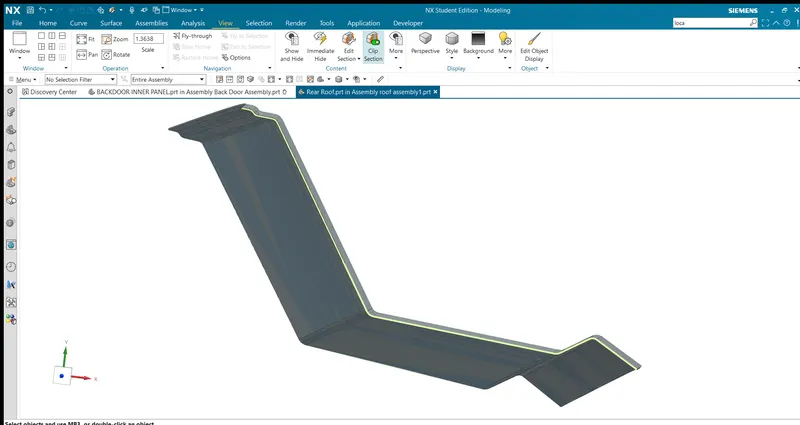
Total Cross section :
hence,in snow load condition,the value is not satisfying the judgement value. that why i created an emboss on the roof outer panel for increasing the strength to roof outer.