Roof challenge
OBJECTIVE :
The priliminary objective is to devolop the essential flanges and reinforcements for the given roof styling and to provide dimensions , check for draft analysis and to create section inertia report on the 0-Y section , then do a curvature study on the roof and perform calculations to determine the position of bow rails
ROOF OF AN AUTOMOBILE :
An automobile roof is primarily considered as an intergral part of BIW .
An automobile roof or car top is the portion of an automobile that sits above the passenger compartment, protecting the vehicle occupants from sun, wind, rain, and other external elements and its main purpose is to protect the passengers in case of rollover accidents and direct impact on the roof
Weight reduction in the roof (i.e. lowering the centre of gravity) has always been a high priority topic in automotive design. However, the roof is generally an integral part of the body-in-white. Therefore, the integration of structural aluminium components into the roof of a steel body structure requires an in-depth consideration of different aspects (as outlined below)
Roof rails are placed on the top of the vehicle and are used to carry additional luggage and equipment. Aluminium extrusions are used for manufacturing roof rails because they enable visually attractive, low
weight and high strength designs.
The length of aluminium roof rails can vary significantly, they are found on small cars as well as on station wagons and MPV's (Multi Purpose Vehicles).
Roof rails have two principle functions; to enhance the design features of the vehicle and to carry extra loads placed on the
roof, often with the help of another structure, e.g. transverse load bars or a roof box.
There are diffrent types of roofs can be seen in this devoloped automobile world and some of them are ,
* Convertible roofs
* Hardtops
* Sunroofs
* Targa tops
* Vinyl roofs , etc ..
+ Roof is just not a single part , it consists of several strengthening parts which are all assembled to roof to make the roof attached rigidly to the automobile
+ The main part is the visible outer panel which provides covering to the passengers and also provides aesthitic characteristics to the automobile and strength to the vehicle
+ There are various components under the outer panel which gives support to the roof and adds strength ultimately ,and these commodities are the reason for the roof not caved inside in case of accidents
structural parts of roof :
* outer panel
* Front roof rail
* Rear roof rail
* Bow roof rail 1
* Bow roof rail 2
* Centre bow roof rail
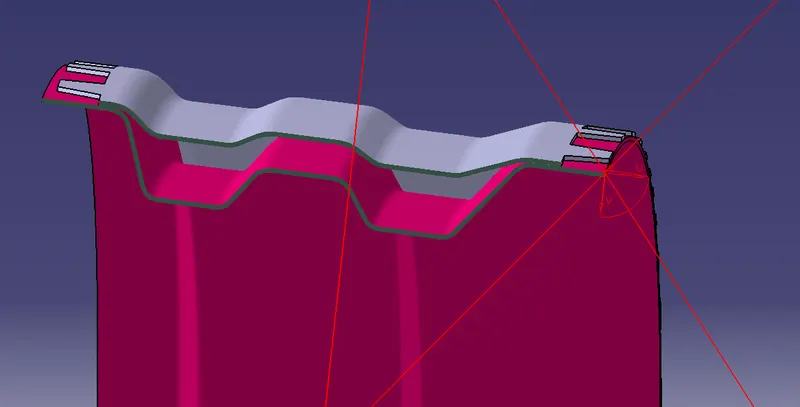
* reinforcement
OUTER PANEL
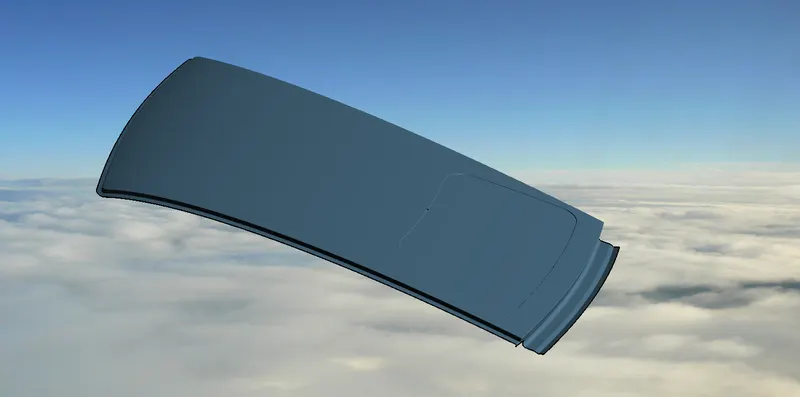
BOWS INSIDE THE OUTER PANEL
FRONT ROOF RAIL
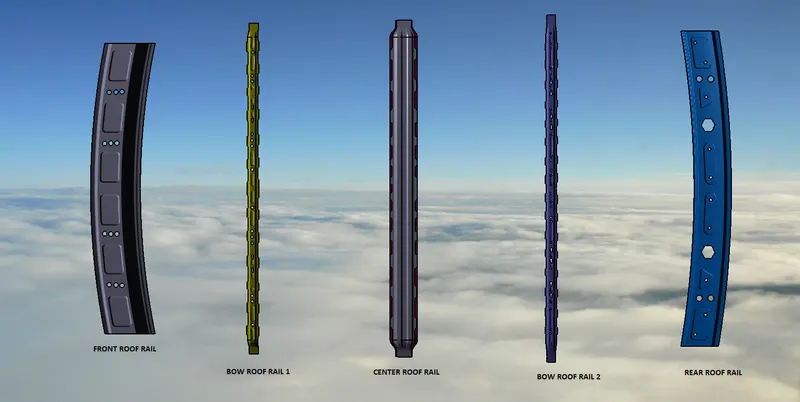
front roof rail is an additional commodity to the roof which gives reinforcement to the roof and also have some of the features in it like , bracket map lamp and room lamp mounting , which will be directly get connected to the front roof rail
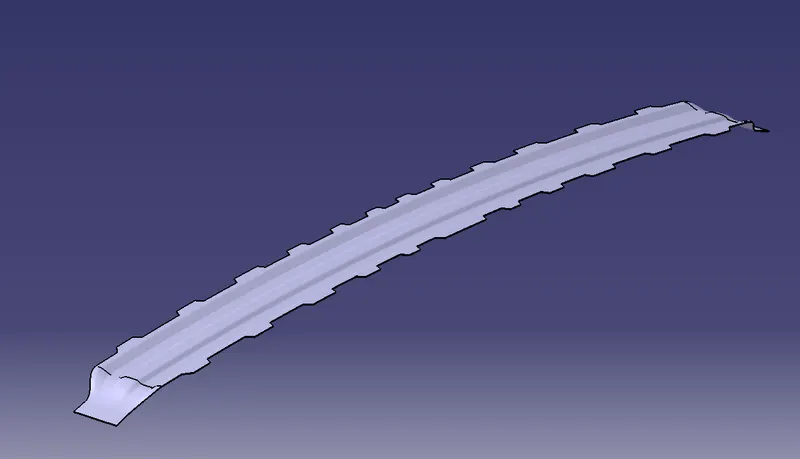
BOW ROOF RAIL 1
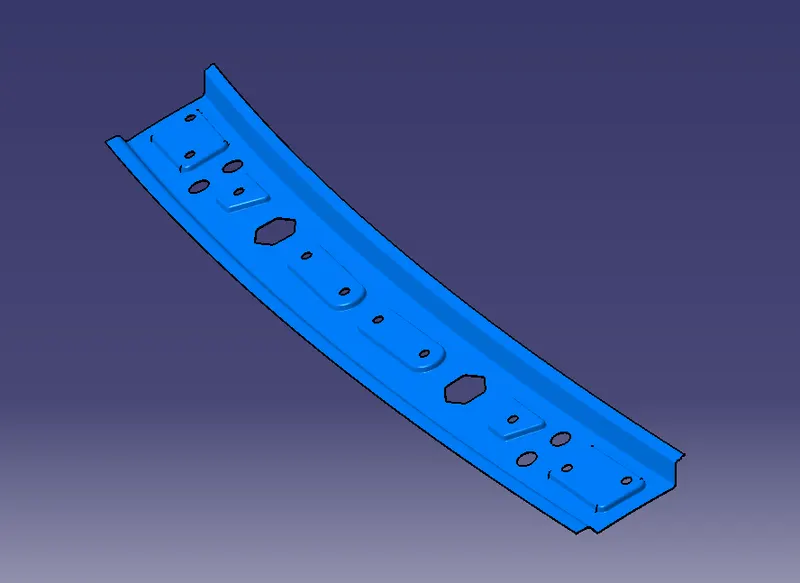
mastics are applied between the roof and bow roof rail , when the mastics gooses out in and attaches the roof and the bow roof rail .
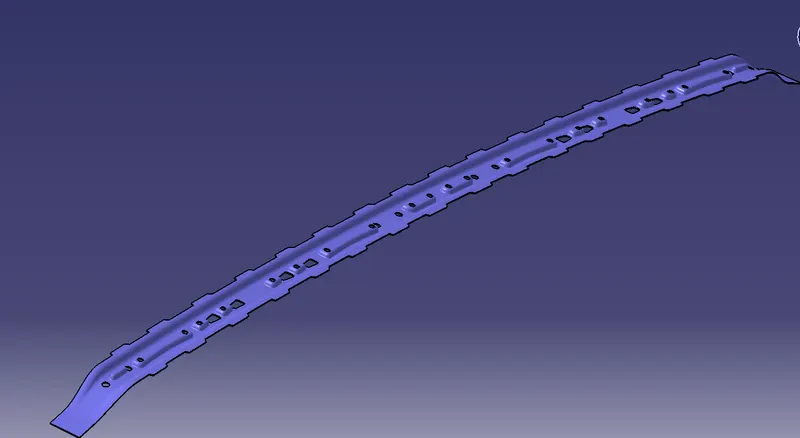
these are the intermediate components used to increase the strenght of the roof to withstand load and temperatures , the bow roof rails are the supporting commodities for the front roof rail , rear roof rail and center roof rail .
For large cars like limosuine and mini vans , the curvy nature of the roof will be very less , so it needs proper reinforcemnt to withstand the obstacles , the more large the car is the more number of bows it demands .
Incase the styling team refuses to maximize the curvy nature of the roof in point of aesthetic perception if still it degrades the snow load criteria and roof distortion criteria , the design engineer must do embosses in that paticular area to increase the strenth of the roof .
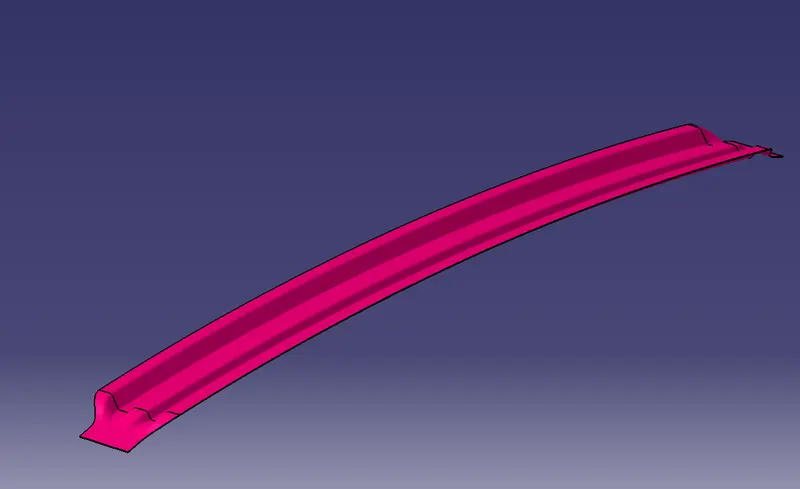
CENTER ROOF RAIL
REINFORCEMENT
BOW ROOF RAIL 2
REAR ROOF RAIL
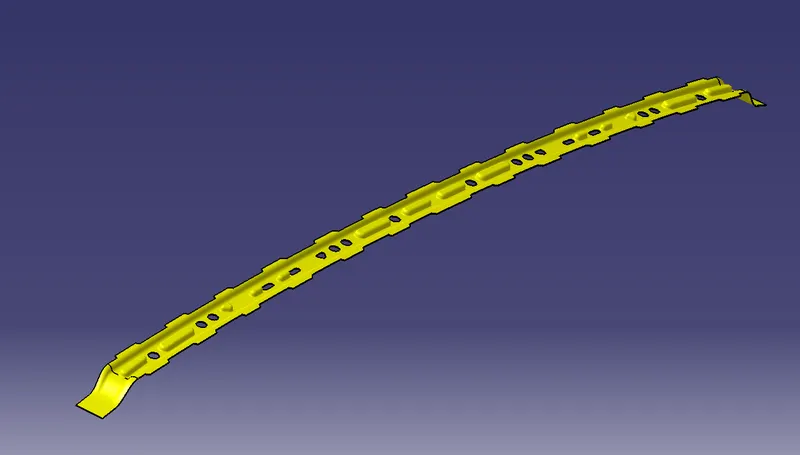
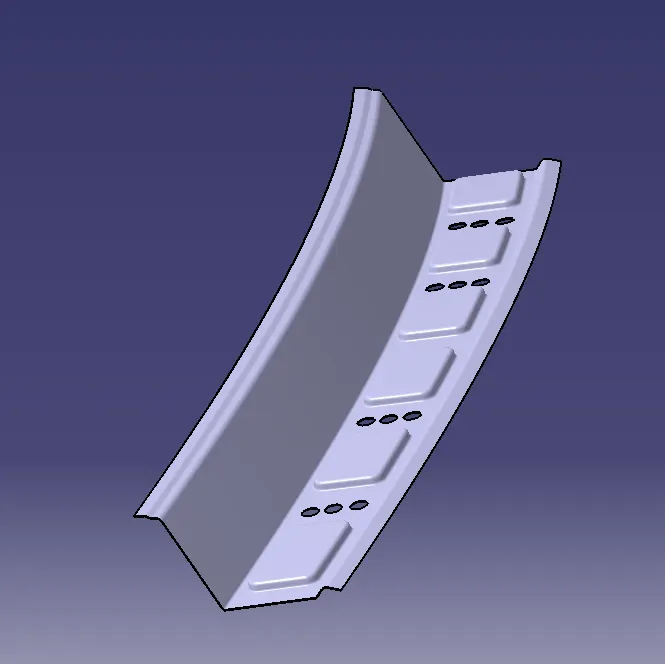
rear roof rail is a complex area because while desiging that commodity we have to consider many criteria's like rear head room clearance and rear visibility check , it also provides strength to the roof
roof mastic information :
it is basically and NVH topic as mastics plays a very good role in lowering the vibration noise created when the vehicle is at movement ,
the mastics can provide strength to an area of about 80 mm radially , so its must me positioned in this way effectively , mastics are used to join the outer and inner panels
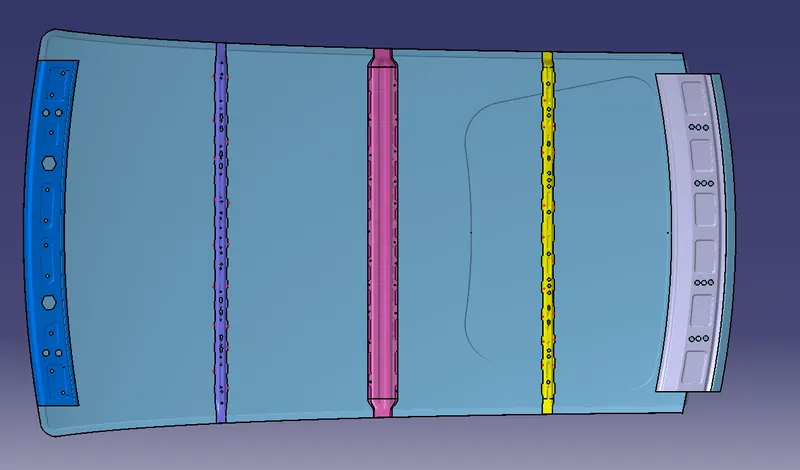
The dotted areas are thew ares in which the mastic sealing is going to be done , the sealents are placed in the spotted areas and then it is made to go through a hot bath where the sealents get strong and attaches the mates perfectely
SPOT WELDING INFORMATION
spot weld is done in the invisible part of the roof as the spot weld might degrades the aesthetic nature of the roof so its done on the rear boundaries of the outer panel ,
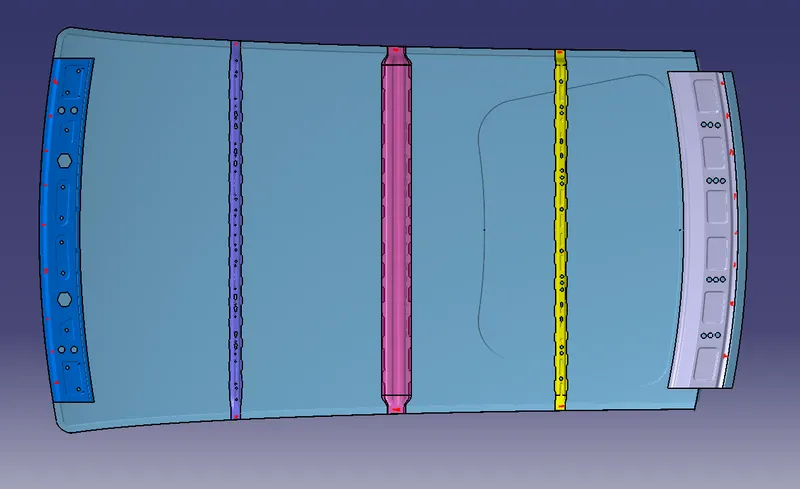
these are the ares in which the spot weld is going to be done
COMPLETE DESIGN OF THE ROOF
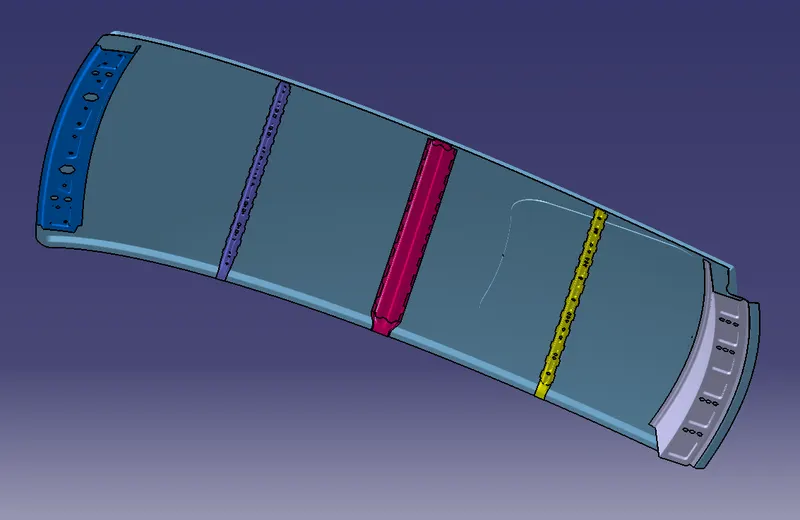
CALCULATION FOR DETERMINING THE POSITION OF THE BOW ROOFS UNDER THE OUTER ROOF PANEL
HEAT DISTORTION CRITERIA
HEAT DISTORTION CRITERIA IS USED TO DETERMINE THE ABILITY OF THE ROOF TO WITHSTAND HIGH TEMPERATURE WITH RESPECT TO THE POSITIONING OF THE REINFORCEMENTS WHICH CONTRIBUTE THE INCREASED STRENGTH . HEAT DISTORTION TEMPERATURE IS THE TEMPERATURE AT WHICH THE METAL SOFTENS AND DEFORMS UNDER A SPECIFIC LOAD
Bow–roof prediction Formula
W = [1.73 x 10^(-3) x L] + [1.85 x 10^(-8) x (R^2)/t] + [ 1.10x10^(-3) x l] - 2.68
Judgement Condition : OK< 2.7> 3.1
Where
L = Roof Length in X-Direction[mm](Roof dimension in 0-Y)
R = Roof curvature
R = 2(Rx*Ry)/(Rx+Ry)
Rx = X curvature
Ry = Y curvature
t = Roof plate thickness [mm]
l = Bow Roof Span [mm]
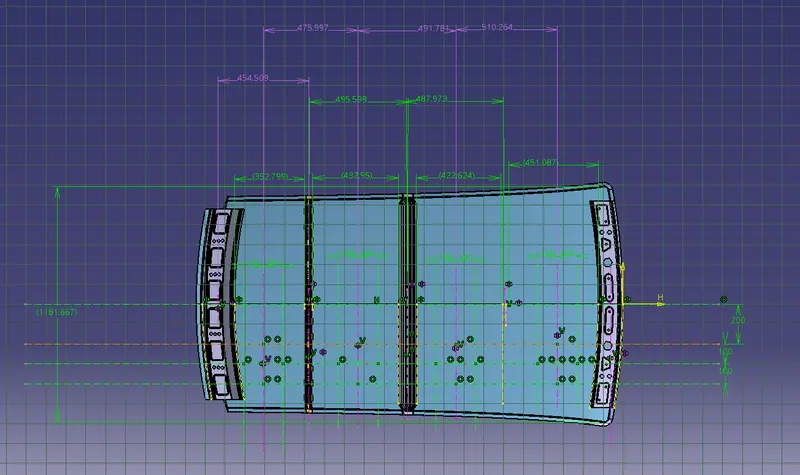
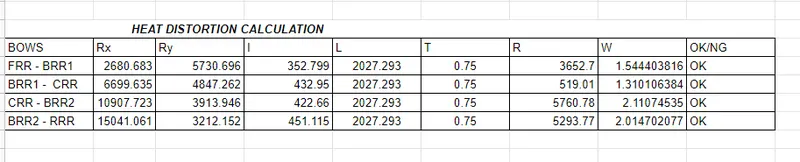
from the above calculation , the bow roof position was good enough to withstand high
CALCULATION FOR DETERMINING THE SNOW LOAD CRITERIA
Snow load criteria is done to analyse the ability of the roof to withstand heavy load of snow in winterfall countries .The roof must also come to its original position to maintain the its former shape when the load is removed
Snow load Prediction formula
Qr = [Iy x t2] / [α x s x [(Rx + Ry)/2]2 x 10-8]
Note: The Qr value given over here is correct. There was a typo error in the formula given in the video.
Where
α = My x Lx2 x 10-12 , My = Y(Ly-Y)
Judgement condition = Qr ≥ 3.1
250 ≤ s ≤ 380
t = Roof plate thickness [mm]
Ly = Distance between the front and rear roof Rails on the Vehicle along with 0Y[mm]
Length of Roof panel with the center point between Roof rail Front /Rear as the front and rear reference point.
Lx = Distance between the Left and Right end of the roof on the Roof BOW [mm]
Width of the roof panel exposed on the surface.
Y = Distance front Front Roof Rail to Roof BOW[mm]
s = Distance for which Roof BOW bears divided load [mm]
s = L1/2 + L2/2
Iy = Geometrical moment of inertia of Roof BOW (Y cross-section )[mm4]
Rx = Lateral direction curvature radius of roof panel Y cross-section on Roof BOW [mm]
Roof panel curvature Radius of the Length Lx in Front view
Ry = Longitudinal Direction curvature radius of the Roof panel X cross-section on Roof BOW [mm]
Roof panel X curvature radius of length s in Side view
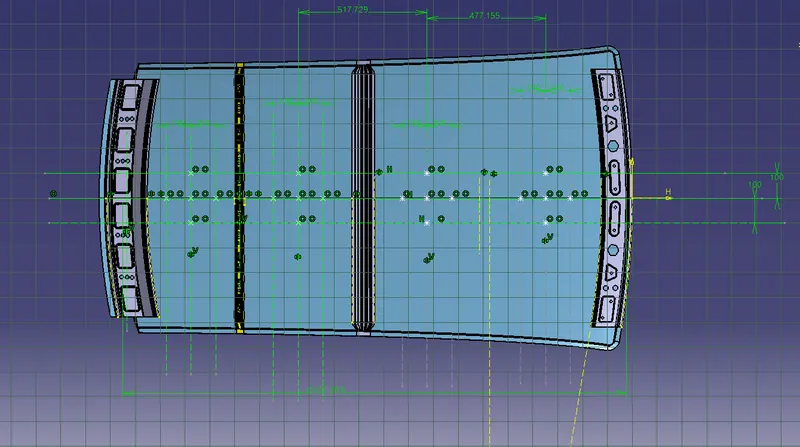

From the above calculation , we can note that the bow roofs positioned in the roof holds the load only at the bow roof rail 1 area and center roof rail area , but at the area where my bow roof rail 2 is located have less load withstanding capability , we need to increase the strength over that area for the roof to hold snow and also to retain its original position rather than failing to do its purpose
The reason for the weakness in that paticular area is due to the flat nature of the surface in the rear end of the roof .We can see that the front end of the roof area will be more curvy than the rear end of the roof . so that that paticular area is weak , to improve the strengthness over there we can increase the number of bows or we can do some embosses on the roof outer panel to strengthen the roof .
Here i have done an emboss in the rear mid and rear end of the roof , so that it somewhat satisfies the condition .