Project - Vehicular Crash safety Systems
Project - Vehicular Crash safety Systems
- THE PREMISE OF THE CASE STUDY
- TESLA VEHICLE SAFETY REPORT
Experts in Tesla think that technology can aid in the improvement of safety. That's why Tesla automobiles are designed to be the safest vehicles on the road. Designers believe that the unique combination of passive safety, active safety, and automated driving assistance is critical for keeping all drivers on the road safe, not only Tesla drivers and passengers but also pedestrians. Every decision, designers make is based on this principle, from the design of the cars to the software designers implement to the benefits they provide to every Tesla owner.
The Model S, Model X, and Model 3 have the lowest overall chance of injury of any vehicle ever tested by the New Car Assessment Program of the United States government. Much of this is due to the robust, reinforced structure of the battery pack affixed to the car's floor, which gives the vehicle tremendous strength, wide crumple zones, and a low centre of gravity. In the exceedingly unlikely case of a fire, the state-of-the-art architecture of our battery packs guarantees that the safety system functions as intended, isolating a fire to specific locations within the battery while simultaneously venting heat away from the passenger compartment and the vehicle.
While no car can avoid every collision, designers strive to make them substantially less likely every day. For an added layer of safety beyond the physical structure of each car, active safety measures are standard on all Tesla vehicles built after September 2014. Designers can leverage the billions of miles of real-world data from our worldwide fleet – of which more than 1 billion have been driven with Autopilot activated – to study the numerous ways accidents happen since every Tesla is connected. Then designers create tools that can assist Tesla drivers in avoiding or minimising accidents. Manufacturers can add safety features and advancements long after a car has been delivered, as well as distribute new versions of software, using over-the-air software updates.
- ACCIDENTS DATA
(4th Quater 2021)
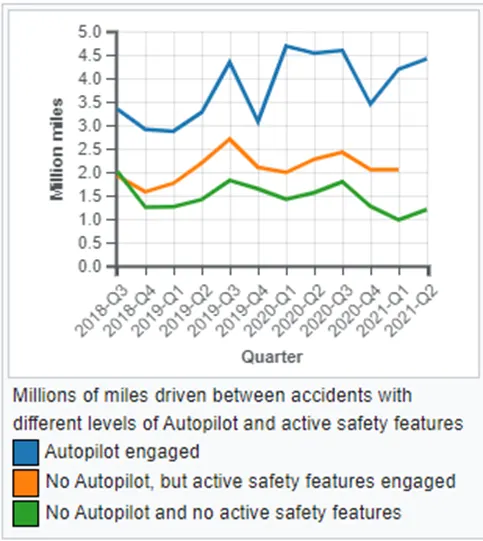
Researchers recorded one crash for every 4.31 million kilometres driven in the fourth quarter in which drivers were utilising Autopilot technology (Autosteer and active safety features). Researchers found one crash for every 1.59 million miles driven by drivers who did not use Autopilot technology (no Autosteer or active safety features). According to the most recent data from the National Highway Traffic Safety Administration, a vehicle crash occurs every 484,000 miles in the United States.
(3rd Quater 2021)
Researchers recorded one crash for every 4.97 million kilometres driven in the third quarter in which drivers were utilising Autopilot technology (Autosteer and active safety features). Researchers found one crash for every 1.6 million miles driven by drivers who did not use Autopilot technology (no Autosteer or active safety features). According to the most recent data from the National Highway Traffic Safety Administration, a vehicle crash occurs every 484,000 miles in the United States.
(2nd Quater 2021)
Researchers recorded one crash for every 4.41 million miles driven in the second quarter in which drivers were using Autopilot technology (Autosteer and active safety features). Researchers found one crash for every 1.2 million miles driven by drivers who did not use Autopilot technology (no Autosteer or active safety features). According to the most recent data from the National Highway Traffic Safety Administration, a vehicle crash occurs every 484,000 miles in the United States.
(1st Quater 2021)
Researchers recorded one collision for every 4.19 million kilometres driven in the first quarter, with drivers using Autopilot. Researchers recorded one collision for every 2.05 million miles driven by individuals driving without Autopilot but with our active safety measures. Researchers recorded one collision for every 978 thousand kilometres driven by people driving without Autopilot and our active safety systems. According to the most recent data from the National Highway Traffic Safety Administration, a vehicle crash occurs every 484,000 miles in the United States.
- VEHICLE FIRE DATA
Between 2012 and 2020, about one Tesla vehicle caught fire for every 205 million miles driven. According to data from the National Fire Protection Association (NFPA) and the United States Department of Transportation, one vehicle fire occurs per 19 million miles driven in the United States.
Between 2012 and 2019, about one Tesla vehicle caught fire for every 175 million miles driven. According to data from the National Fire Protection Association (NFPA) and the United States Department of Transportation, one vehicle fire occurs per 19 million miles driven in the United States.
Between 2012 and 2018, about one Tesla vehicle caught fire for every 170 million miles driven. According to data from the National Fire Protection Association (NFPA) and the United States Department of Transportation, there is a car fire per 19 million miles driven in the United States.
- METHODOLOGY USED
Based on available data from the fleet, researchers collect the number of miles driven by each car with Autopilot turned on or in manual mode, and they do so without identifying specific vehicles to safeguard privacy. Every time the fleet reports an incident, researchers receive a crash alert, which may contain information about whether Autopilot was enabled at the time of impact. They count every event in which Autopilot was deactivated within 5 seconds of contact and also count any crashes in which the incident alert showed an airbag or other active restraint deployed to ensure their safety. (All crash statistics aren't based on estimates or sample data sets.
In actuality, depending on the collision forces generated, this corresponds to practically any crash at roughly 12 mph (20 kph) or higher. On the other hand, police-reported crashes in government databases are notoriously under-reported, by as much as 50% according to some estimates, in large part because most small crashes (such as "fender benders") are not investigated. They also don't make any distinctions based on the sort of crash or failure. (For example, the Tesla vehicle is rear-ended by another vehicle in more than 35% of all Autopilot crashes.)
- Engineering judgement
- BATTERY PACK---The position and weight reduce rollover risk and improve emergency avoidance handling.
- Impact Protection---A patented side sill structure supports the chassis to absorb impact energy and protect occupants and battery
- Structural Integrity---The rigid body and fortified battery help to reduce and prevent cabin intrusion
- Crumple Zones---Large empty spaces in the front and rear soften the impact, reducing the risk of occupant injury
- Advanced Airbags---Less cabin intrusion helps preserve space for airbags to fully inflate and protect passengers
- EXCEPTION HARDWARE COMPONENTS---Eight cameras provide 360 degrees of visibility while twelve ultrasonic sensors can detect both hard and soft objects, including surrounding vehicles.
- Forward Collision Warning---Provides visual and audible warnings of impending collisions with vehicles or obstacles.
- Blind Spot Collision Warning---Warns when a possible collision is detected with a vehicle or obstacle in your blind spot.
- Lane Departure Avoidance---Applies corrective lane-centring steering if a potential collision or unintended lane departure is detected
- Software Safer overtime---Every mile a user drives, it can help researched and others drivers to stay safer. We can analyse real-world scenarios from our worldwide fleet of over a million Tesla vehicles and billions of kilometres driven on Autopilot to learn how crashes happen and how to help lessen or prevent them in the future. The most recent additions and enhancements are available immediately via over-the-air software updates.
- Fire Safety protection---Tesla battery packs are engineered to disperse heat away from the occupant cabin and battery in the event of damage, helping to prevent fires and protect occupants. Tesla vehicles were nearly 10 times less likely to catch fire per mile driven in the United States from 2012 to 2020 than average gas vehicles.
- SAFETY CONCERNS
Tesla was criticized by the National Transportation Safety Board (NTSB) for failing to foresee and prevent "predictable abuse" of Autopilot in a fatal 2018 Autopilot crash in California. An autopilot and Tesla's marketing of the technology, according to the Center for Auto Safety and Consumer Watchdog, is "dangerously misleading and deceptive," giving buyers the mistaken impression that their vehicles are self-driving or autonomous. Tesla's Autopilot, according to UK safety experts, is "particularly misleading. In comparison to a similar level, 2 driver-assistance systems from other automobile manufacturers, a 2019 IIHS study found that the word "Autopilot" causes more drivers to misperceive behaviours like texting or napping to be safe.
-
Driver monitoring
With Autopilot turned on, drivers have been caught dozing at the wheel, driving under the influence of alcohol, and performing other inappropriate behaviours. Tesla initially decided against employing driver monitoring features to curb such behaviour. It wasn't until late May 2021 that a new version of the OTA software-enabled inside cameras to monitor drivers using Autopilot in new Model 3 and Model Y cars (i.e. the first cars as part of the changeover to Tesla Vision). Model S and Model X vehicles built before 2021 lack an interior camera and hence are unable to provide such capabilities, while the upgraded models are planned to include one.
-
Detecting stationary vehicles at speed
The manual warns that Autopilot may not identify stationary vehicles "Congestion-aware''.When driver drives at 50 mph (80 km/h) and a vehicle you're following moves out of your driving path and a stationary vehicle or item is in front of you instead, Cruise Control may not identify all objects and may not stop or decelerate for stationary cars." This has resulted in several collisions with emergency vehicles that have come to a halt. Any automobile with only adaptive cruise control or automated emergency braking suffers from the same issue (for example, Volvo Pilot Assist)
-
Dangerous and unexpected behaviour
Hundreds of Tesla customers reported unsafe behaviours with Autopilot in a 2019 Bloomberg survey, including phantom braking, drifting out of lane, and failing to stop for road hazards. Users have also reported the software crashing and turning off unexpectedly, off-ramp barrier collisions, radar failures, unexpected swerving, tailgating, and uneven speed adjustments. The brake mechanism tends to activate later than some drivers expect
-
Court cases
In 2017, a class-action lawsuit was filed against Tesla, alleging that the second-generation Enhanced Autopilot technology was "dangerously flawed." Owners who paid US$5,000 (equivalent to $5,392 in 2020) to equip their cars with the updated Autopilot software in 2016 and 2017 were rewarded between $20 and $280 for the delay in activating Autopilot 2.0 in 2018. A German court found in July 2020 that Tesla made misleading promises about its Autopilot system and that the word "Autopilot" gave the idea that the car could drive itself. The US auto safety regulators started an official safety examination against Tesla's driver on August 16, 2021, after reports of 17 injuries and one death in car incidents involving emergency vehicles.
-
Safety statistics
In 2016, data collected after 47 million miles of driving in Autopilot mode revealed that the risk of an accident was reduced by at least half when using Autopilot. During the investigation into the tragic crash in Williston, Florida in May 2016, the National Highway Traffic Safety Administration (NHTSA) released a preliminary report in January 2017 claiming that "the Tesla vehicles' crash rate fell by nearly 40% after Autosteer installation. In 2019, Quality Control Systems, a private company, produced a report evaluating the same data, claiming the NHTSA conclusion was "not well-founded."After the installation of Autosteer, the crash rate (measured in the rate of airbag deployments per million miles of travel) increased from 0.76 to 1.21, according to Quality Control Systems' examination of the data.
-
NHTSA investigations
According to a document issued in June 2021, the NHTSA has launched at least 30 investigations into Tesla collisions employing Autopilot, some of which have resulted in fatalities. The National Highway Traffic Safety Administration's Office of Defects Investigation (ODI) opened a preliminary evaluation (PE 21-020) in August 2021 and released a list of eleven crashes involving Tesla vehicles colliding with emergency vehicles in each case, NHTSA confirmed that Autopilot or Traffic-Aware Aware Cruise Control was active during the approach to the crashes. Seven of the eleven collisions resulted in seventeen injuries, including one fatality. The National Highway Traffic Safety Administration (NHTSA) planned to assess the Autopilot system, specifically the systems that monitor and enforce driver engagement. The National Highway Traffic Safety Administration (NHTSA) added the twelfth accident to its inquiry list in September.
National Highway Traffic Safety Administration (NHTSA) has given TESLA car models as 5-Star Safety Rating overall and in every category.
- CONCLUSION ARRIVED
Tesla Autopilot is a set of advanced driver-assistance system (ADAS) technologies that amounts to Level 2 vehicle automation and is supplied by Tesla. Lane centring, traffic-aware cruise control, automatic lane changes, semi-autonomous navigation on limited-access highways, self-parking, and the option to summon the car from a garage or parking spot are some of its features. In all of these aspects, the driver is in charge, and the vehicle must be constantly monitored. The features, according to the business, decrease accidents caused by driver error and exhaustion from long-distance driving. Although it was placed #1 in the "Capabilities and Performance".
The company's stated plan is to offer SAE Level 5 (complete autonomous driving) as an update to the standard Autopilot features at a later date, noting that regulatory and technical challenges must be overcome to achieve this goal. Most experts estimate that Tesla vehicles would lack the requisite hardware for fully autonomous driving by April 2020. Tesla launched and commissioned consumers for a Full Self-Driving beta programme in the United States in October 202 It is now being tested by a few thousand Tesla employees and owners as of May 2021.
- PERSONAL THOUGHTS ON THIS CONTENT
The design, lack of a dealership, fuel savings, low depreciation, supercharger stations, vehicle safety, self-driving technology, superior entertainment systems, and software are all advantages of Tesla cars.
The pricing, high maintenance costs, lengthier repair times, lack of service centres, construction quality, dull interior, limited towing capabilities, and battery deterioration are all disadvantages of Tesla cars.
But gradually TESLA will dominate the automotive industries in the 21st-century replacing conventional IC engines.