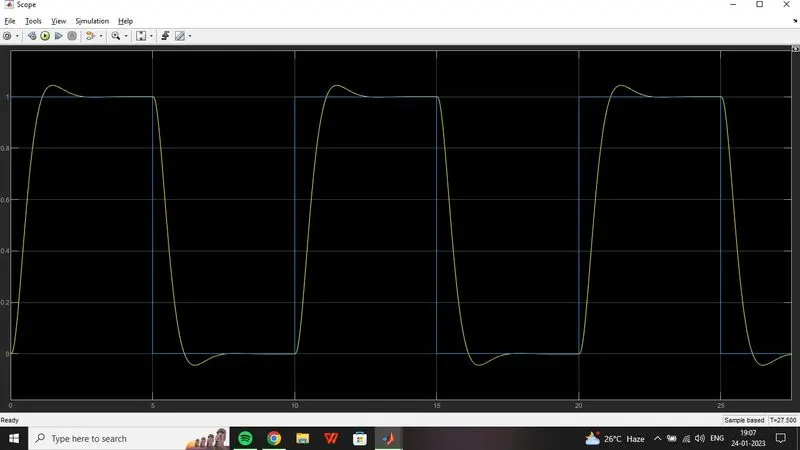
Project - Position control of mass spring damper system
>> s=tf('s');
>> G=(1/m)/(s^2+2*zeta*wn*s+wn^2)
G =
0.2778
---------------------
s^2 + 27.78 s + 111.1
Continuous-time transfer function.
>> A
A =
0 1.0000
-111.1111 -27.7778
>> B
B =
0
0.2778
>> p1
p1 =
-4.8451
>> p2
p2 =
-22.9327
>> P
P =
-4.8451
-22.9327
>> K
K =
1.0e-13 *
0 -0.1279
>> K(1)
ans =
0
>> K(2)
ans =
-1.2790e-14
BLOCKS USED:
GAIN: The Gain block multiplies the input by a constant value (gain). The input and the gain can each be a scalar, vector, or matrix.
INTEGRATOR: The Integrator block outputs the value of the integral of its input signal with respect to time.
SCOPE: The Simulink Scope block displays time domain signals.
PULSE GENERATOR: The Pulse Generator block generates square wave pulses at regular intervals. The block waveform parameters, Amplitude, Pulse Width, Period, and Phase delay, determine the shape of the output waveform.
SUM: The Sum block performs addition or subtraction on its inputs. The Add, Subtract, Sum of Elements, and Sum blocks are identical blocks. This block can add or subtract scalar, vector, or matrix inputs.
TRANSFER FUNCTION: The Transfer Fcn block models a linear system by a transfer function of the Laplace-domain variable s. The block can model single-input single-output (SISO) and single-input multiple-output (SIMO) systems.
DERIVATIVE: The Derivative block approximates the derivative of the input signal u with respect to the simulation time t.
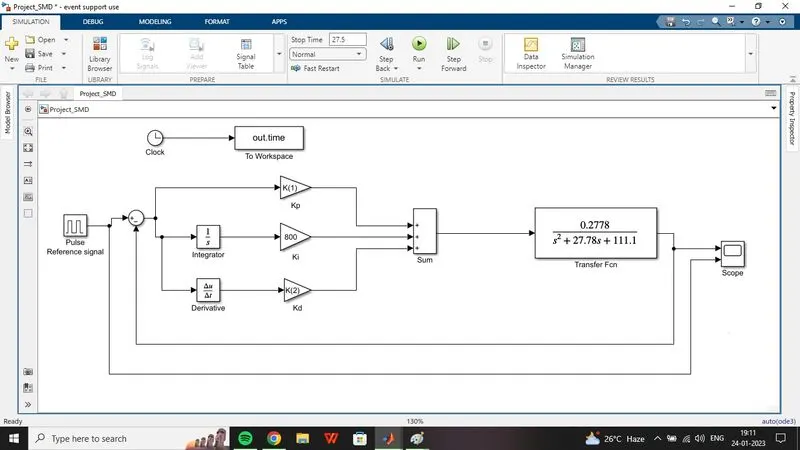
Pulse Signal:
Amplitue=1
Period=10sec
Pulse width=50
Integral input:
For Ki=800 best response of the output signal matched with the input signal