Project - Position control of mass spring damper system
--:SOLUTION:--
The state space equations are:------
Equations for controlling a Spring mass damper system:----
x1_dot=x2
x2_dot= -k/m*x1 -c/m*x2+ 1/m*u
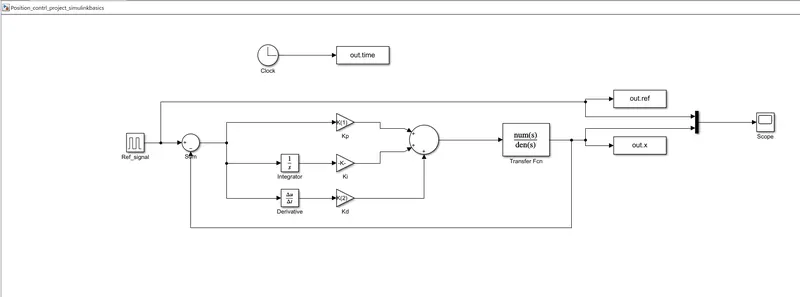
Here the simulink model is presented for the state equation with PID control:-----
(i) Proportional gain (Kp)
(ii) Integral Gain (Ki)
(iii) Derivative gain (Kd) & having the 'zeta' value 0.7 (Consider Under_Damped case)
In this model , pulse signal having magnitude 1 for 10.0 sec is taken as a refrence signal(Xref). (According to the Question.)
Position control system is a closed loop control system whose output is the desired angular position of the spring mass damper. The system whose position is to be controlled is connected in a closed loop system in which the system forms the plant.
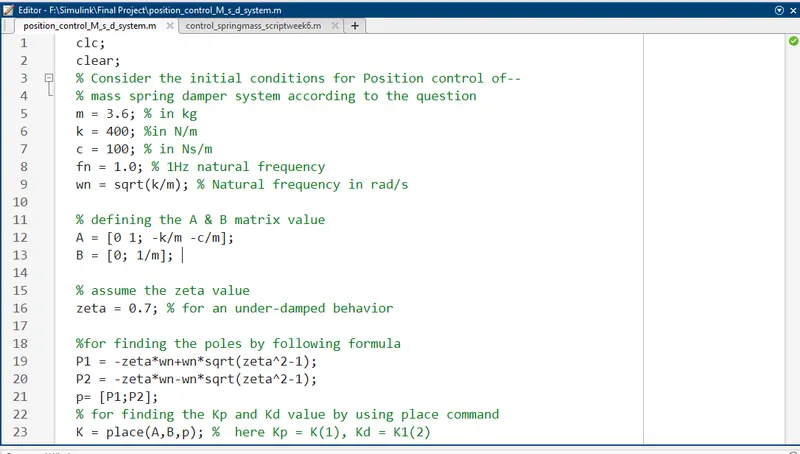
1...... Firstly taking the values of mass (m), damping coefficient (c) & Spring constant (k):--
(i) m=3.6 kg (ii) k=400 N/m (iii) c=100 Ns/m
2...... Build the equation in matrix form like [A] & [B]
(i) A = [0 1; -k/m -c/m];
(ii) B = [0; 1/m];
This is the spring mass damper system so that the frequency can't be assumed as Natural Frequency......
then we have to find the Frequency by using the formula:--
wn=sqrt(k/m) in rad/sec
3...... Here for find the poles (p) of the system, the formula is used:----
P1=-zeta*wn+wn*sqrt(zeta^2-1)
P2=-zeta*wn-wn*sqrt(zeta^2-1)
4...... write the values of the poles in matrix form like p=[P1;P2]
5...... for finding the PD gains (Kp,Kd), the Matlab 'place' command is required----
K=place(A,B,p)
then finally the gains K(1)=Kp & K(2)=Kd of the system will obtained.
6...... then by using the values of m,k&c the Transfer function will be--------
Denominator polynomial ---- ms^2+cs+k
--:Result:--
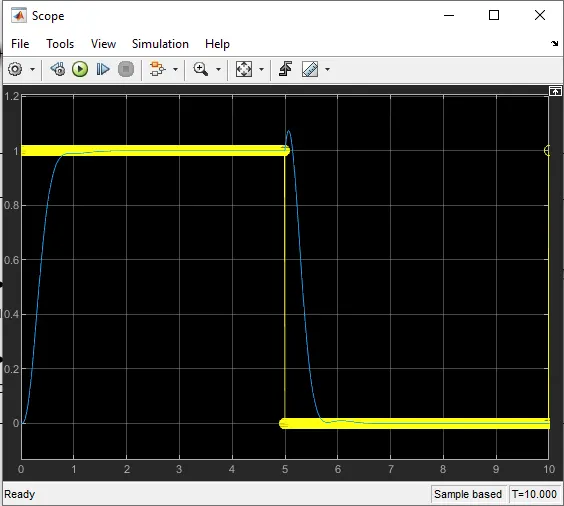
1..... Overshoot and Undershoot == 0%
2..... Settling time == 0.9 sec. It is less then 3 sec.
3..... Steady State Error= 0
4..... Rise time is under limit.
the output signal is constant and follows the refrence input after reached to steady state condition.
--:CONCLUSION:--
I observed from this project is that as the increment in Ki value, system goes towards stability. In this challenge, firstly I chose Zeta=1.001 that is critically damped system in which I observed NO oscillations, but the rise time exceeding it's limit so that I choose zeta value zeta=0.7 that is Under-damping, results zero overshoot and also critical time and rise time obtained are good and under there limits.
----------------------------------**-------------------------------------------**------------------------------
**Script File**
**Model**
**Result**