Project on Concrete Mix Design for various grades of Concrete
AIM:- To calculate the Concrete Mix Design for M35 grade concrete with Fly ash and M50 grade concrete without Fly ash.
INTRODUCTION:- Concrete is a complex material and has the right mix of constituents of concrete, which if not done properly then it will have adverse effect on properties of concrete. Concrete mix design is a systematic process of choosing economical relative proportion of various ingredients like Cement, Coarse aggregete, Fine aggregate, Water, Admixture, etc. from available material that gives the concrete of desired workabilty. The design is done according to the requirements of concrete strength. So we can achieve the desirable properties either it is in fresh state or in the hardened stage.
The project is consisting of two parts, In first part we have to design of M35 grade cement concrete with flyash and In second part we have to design M50 grade cement concrete without Flyash.
OBJECTIVES:- The main objective of this project is,
- To make concrete mix design for M35 grade concrete with Flyash and M50 grade concrete without Flyash.
- To achieve the desired workability of Freash concrete.in the plastic stage.
- To achieve the desired minimum strength in the hardened stage.
- To achieve the desired durability in the specified environmental condition.
- To produce concrete as economically as possible.
Concrete mix will prepared as per IS Code Method. Concrete mix proportioning guidelines from IS 10262:2009 and recommented guide lines from IS 10262:1982.
EQUATIONS USED FOR THE MIX DESIGN OF CONCRETE
Target mean strength of concrete
f'ck = fck + 1.65S
- f'ck = taget average compressive strength of concrete at 28 days.
- fck = characteristics compressive strength at 28 days.
- S = standard deviation.
Cement Content
cement content= water content/ water-cement ratio
Volume calculations
volume of concrete assumed 1m3 for calculation.(A)
volume of cement(B) = (mass of cement/specific gravity of cement)x( 1/1000)
volume of water(C) = (mass of water/specific gravity of water)x( 1/1000)
volume of chemical admixture(D) = (mass of chemical admixture/specific gravity of admixture )x( 1/1000)
Volume of Flyash(E) = (mass of Flyash/specific gravity of Flyash)x( 1/1000)
volume of aggregates(Fine aggregates and Coarse aggregates)[F] = A-(B+C+D+E)
If Fca is coarse aggregate fraction that is selected from IS CODE.
Volume of Coarse aggergete(Vca) = FxFca
Volume of Fine aggregate(Vfa) = Fx(1-Fca)
Mass calculations
Mass of Coarse aggregate = Vca x Specific gravity of Coarse aggregete x 1000
Mass of Fine aggregate = Vfa x Specific gravity of Fine aggregete x 1000
PART - 1.Concrete Mix Design for M35 grade concrete with fly ash:
Stipulations for M35 grade :
| 1 | Grade of concrete | 35 | |
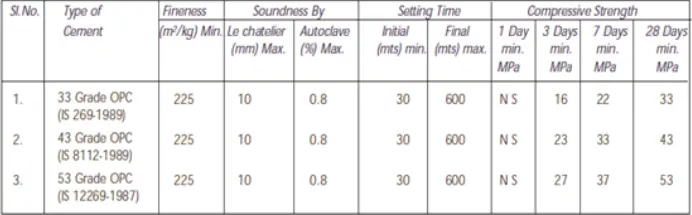
| 2 | Type of cement | OPC 43 | Conforming to IS:8112 |
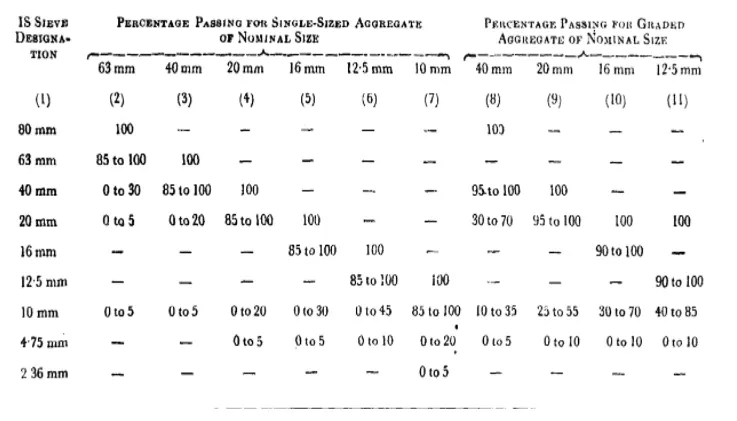
| 3 | Maximum nominal size of aggregate | 20mm | By sieve analsis |
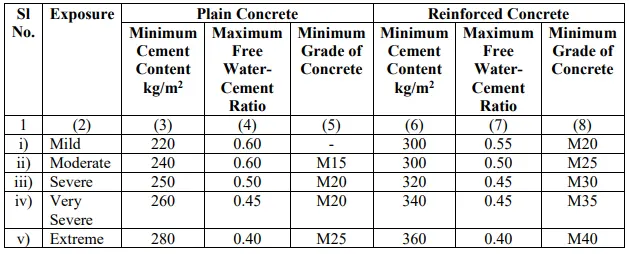
| 4 | Exposure condition | Severe | For Reinforcement concrete |
| 5 | Method of concrete placing | Pumping | |
| 6 | Workability | 100mm | Slump value |
| 7 | Maximum water cement ratio | 0.45 | As per IS:456-2000 Tb.-5 |
| 8 | Minimum cement content | 320kg/m3 | As per IS:456-2000 Tb.-5 |
| 9 | Partial replacement of cement by Flyash | 30% | As per requirements |
| 10 | Chemical admixture type | Superplastizer | |
| 11 | Type of aggregate | Crushed angular aggregate |
Test Data for Materials:
- Materials should be tested in the laboratory as per tests given in the codebook and their properties should be found.
- The values of the materials properties will be used in the design process and to check the quality of the material with the help of codebook standards.
- Standard values are taken here for calculation purposes.
| 1 | Cement Used | OPC 43 | Confirming to IS:8112 |
| 2 | Specific Gravity of Cement | 3.15 | Test – IS:2720 |
| 3 | Mineral Admixture | Fly ash | Confirming to IS:12089 |
| 4 | Specific Gravity of Fly ash | 2.90 | |
| 5 | Chemical Admixture | 2% | IS9103 |
| 6 | Specific Gravity of | Test – IS 2386 | |
| Coarse Aggregate | 2.74 | ||
| Fine Aggregate | 2.74 | ||
| Admixture PCE based | 1.12 | ||
| 7 | Water Absorption | Test – IS 2386 | |
| Coarse aggregate | 0.5 % | ||
| Fine aggregate | 1 % | ||
| 8 | Sieve Analysis | Test – IS 2386 | |
| Coarse aggregate | Confirming to Table 2-IS383 | ||
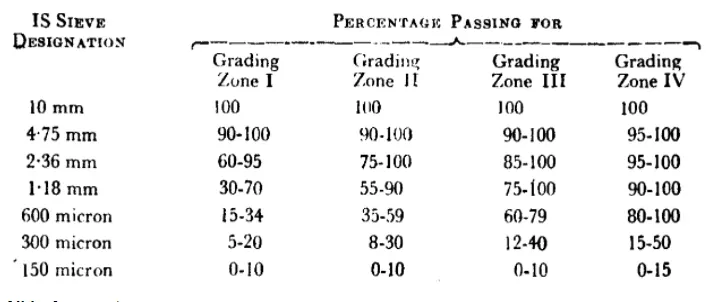
| Fine aggregate | Zone II | Confirming to Table 4-IS383 |
The strength of the concrete may deviate slightly depends on the quality of the material, method of mixing, and construction practices. Hence target strength (f'ck) should be higher than the required strength of the concrete (fck).
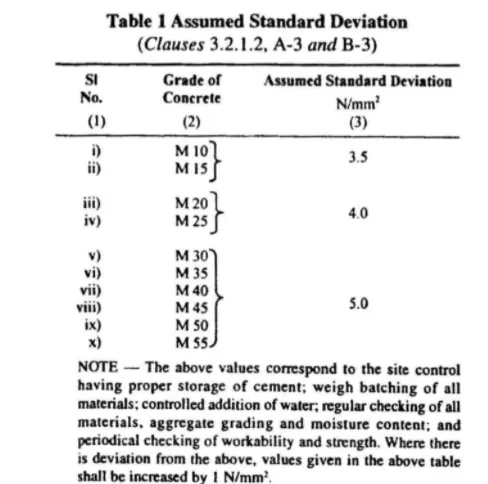
The value of standard deviation(S) for different grades of concrete is given in Table 1 of IS:10262-2009. That depends on grade of concrete and material storage supervision etc.
so, Target strength, f'ck = ( fck + 1.65S )N/mm2
= ( 35 + 1.65*5 )N/mm2 ( S = 5, IS:10262-2009)
Target strength,f'ck = 43.25N/mm2
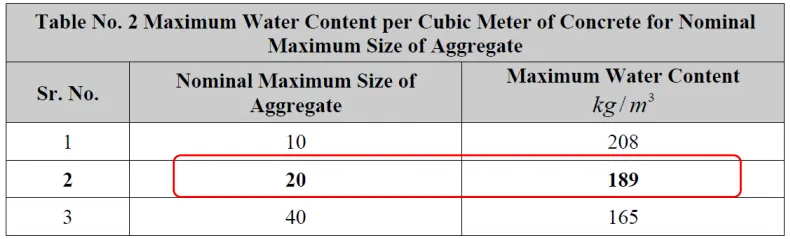
Maximum water content from the table-2 of IS:10262-2009 is 186kg or 186L. But this water-content is for 25 to 50mm slump but the slump we require is 100mm, hence we need to increase the water content to get the required slump for good workability. Clause 4.2 of IS:1026 suggests an increase of 3% of water content from its original value for every increase of 25mm. Here we have a 50mm increase in the water content so we have to increase the water content by 6%.
so, Water content for 100mm Slump = 186L + 6% of 186L
= ( 186 + 0.06*186 )L
Water content for 100mm Slump = 197.16L
Since superplasticizers is used so, water content can be reduced to get good strength of concrete.The percentage of reduction of water depends on the type of superplasticizers used in the concrete. Based on trials water content could be reduced upto 29%.
so, Water content after application of superplastizer = 197L - 29% of 197L
= ( 197 - 0.29*197 )L
Water content after application of superplastizer = 140L
Cement and fly ash content :
Adopted Water-cement ratio = 0.40
Total cementitious material( cement + flyash) = (water content)/(water-cement ratio)kg
= 140/0.4kg
= 350kg > 320kg
since, total cementitious material 350kg is greater than minimum cement content 320kg as per IS:456-2000 for severe exposure condition. hence our data is correct.
As we have to use Fly ash also in cementitious material so it was suggested to increase more 10% in cementitious material to get good workability and strength.
The percentage of increase depending on experience and research.
now, Total cementitious material = 350kg + 10% of 350kg
= ( 350 + 0.1*350 )kg
Total cementitious material = 385kg > 320kg hence, OK
Water content = 140kg
New water-cement ratio = ( water ontent / cementitious material )
= ( 140/385 )
New water-cement ratio = 0.36
Let we add 30% cementitious material as Flyash then,
Fly ash content = 30% of total cementitious material
= 0.30*385kg
Fly ash content = 115.5kg = 115kg
Cement content(OPC 43) = Total cementitious material - Flyash content
= 385kg - 115kg
Cement content(OPC 43) = 270kg
Chemical admixture content:
We generally add admixture 2% of total cementitious material,
so, Chemical admixture content(superplastizer) = 2% of total cementitious material
= 0.02*385kg
Chemical admixture content(superplastizer) = 7.7kg
Coarse aggregate and Fine aggregate content:
As par code IS:10262-2009 table-3, volume of coarse aggregate corrosponding to 20mm size aggregate and Fine aggregate zone-II for water-cement ratio 0.5 is 0.62 times of total volume of aggregate.
But in our case Water-Cement ratio is 0.4 which is 0.10 less than 0.5 so we have to increase coarse aggregate volume by 0.02 because as per code we have to increase and decrease coarse aggregate content by 0.01 for every 0.05 difference when w/c ratio is less and more than 0.5.
so, Coarse aggregate volume proportion(Fca) = 0.62+0.02 = 0.64 times of total volume of aggregate.
Fine aggergate volume proportion(Ffa) = (1-Fca) = 1-0.64 = 0.36 times of total volume of aggregate.
But in our case concrete is pumpable is we have to coarse aggergate volume by 10%.
now, Fca = 0.64 - 10% 0f 0.64 = 0.64 - 0.064 = 0.576 = 0.58(let)
Fca = 0.58 times of total volume of aggregate.
Ffa = 1- Fca = 1 - 0.58 = 0.42 times of total volume of aggregate.
Let volume of concrete(A) is 1m3, Volume of total aggregate(Coarse aggregate and Fine aggregate) is F per 1m3 of concrete.
Volume of cement(B) = cement content/(Specific gravity of cement*1000)m3
= 270/(3.15*1000)m3 = 0.0857m3 = 0.086m3 per 1m3 of concrete.
Volume of cement(B) = 0.086m3 per 1m3 of concrete.
Volume of Flyash(C) = Flyash content/(Specific gravity of Flyash*1000)m3
= 115/(2.90*1000)m3 = 0.0396m3 per 1m3 of concrete.
Volume of Flyash(C) =0.0396m3 per 1m3 of concrete.
Volume of Water(D) = Water content/(Specific gravity of water*1000)m3
= 140/(1*1000)m3 = 0.14m3 per 1m3 of concrete.
Volume of Water(D) = 0.14m3 per 1m3 of concrete.
Volume of Superplastizer(E) = Superplastizer content/(Specific gravity of superplastizer*1000)m3
= 7.7/(1.12*1000)m3 = 0.0068m3 per 1m3 of concrete.
Volume of Superplastizer(E) = 0.0068m3 per 1m3 of concrete.
so, A =( B + C + D + E + F )
F = [A - ( B + C + D + E )]m3 per 1m3
= 1 - ( 0.086 + 0.0396 + 0.14 + 0.0068 )
F = 0.7276m3 per 1m3 of concrete.
So, Total volume of aggregate( coarse aggregate and fine aggregate ) = 0.7276m3 per 1m3 of concrete mix.
Now, Coarse aggregate content = ( F*Fca*specific gravity of coarse aggregate*1000 )
= ( 0.7276*0.58*2.74*1000 )kg
= 1156.3kg = 1156kg.
Coarse aggregate content = 1156kg.
Fine aggregate content = ( F*Ffa*specific gravity of Fine aggregate*1000 )
= ( 0.7276*0.42*2.74*1000 )kg
= 837.32kg = 838kg.
Fine aggregate content = 838kg.
Results of mix design :
| S.No. | Material | Quantity |
| 1 | Cement | 270kg/m3 |
| 2 | Fly ash | 115kg/m3 |
| 3 | Coarse Aggregate | 1156kg/m3 |
| 4 | Fine aggregete | 838kg/m3 |
| 5 | Water | 140kg/m3 |
| 6 | Superplastizer | 7.7kg/m3 |
| 7 | Water-Cement ratio | 0.36 |
To find the design mix ratio we have to divide the calculated value of all materials by the weight of cement.
Therefore Mix Ratio of M35 Grade concrete by weight is ,
Cement : Flyash: F.A: C.A: Water = 1 : 0.42 : 3.1 : 4.28 : 0.51
PART - 2.Concrete Mix Design for M50 grade concrete without Fly ash:
Stipulations for M50 grade :
| 1 | Grade of concrete | 50 | |
| 2 | Type of cement | OPC 43 | Conforming to IS:8112 |
| 3 | Maximum nominal size of aggregate | 20mm | By sieve analsis |
| 4 | Exposure condition | Very severe | For Reinforcement concrete |
| 5 | Method of concrete placing | Pumping | |
| 6 | Workability | 100mm | Slump value |
| 7 | Maximum water cement ratio | 0.45 | As per IS:456-2000 Tb.-5 |
| 8 | Minimum cement content | 340kg/m3 | As per IS:456-2000 Tb.-5 |
| 9 | Chemical admixture type | Superplastizer | |
| 10 | Type of aggregate | Crushed angular aggregate |
Test Data for Materials:
- Materials should be tested in the laboratory as per tests given in the codebook and their properties should be found.
- The values of the materials properties will be used in the design process and to check the quality of the material with the help of codebook standards.
- Standard values are taken here for calculation purposes.
| 1 | Cement Used | OPC 43 | Confirming to IS:8112 |
| 2 | Specific Gravity of Cement | 3.15 | Test – IS:2720 |
| 3 | Chemical Admixture | 2% | IS9103 |
| 4 | Specific Gravity of | Test – IS 2386 | |
| Coarse Aggregate | 2.74 | ||
| Fine Aggregate | 2.74 | ||
| Admixture PCE based | 1.12 | ||
| 5 | Water Absorption | Test – IS 2386 | |
| Coarse aggregate | 0.5 % | ||
| Fine aggregate | 1 % | ||
| 6 | Sieve Analysis | Test – IS 2386 | |
| Coarse aggregate | Confirming to Table 2-IS383 | ||
| Fine aggregate | Zone II | Confirming to Table 4-IS383 |
The strength of the concrete may deviate slightly depends on the quality of the material, method of mixing, and construction practices. Hence target strength (f'ck) should be higher than the required strength of the concrete (fck).
The value of standard deviation(S) for different grades of concrete is given in Table 1 of IS:10262-2009. That depends on grade of concrete and material storage supervision etc.
so, Target strength, f'ck = ( fck + 1.65S )N/mm2
= ( 50 + 1.65*5 )N/mm2 ( S = 5, IS:10262-2009)
Target strength,f'ck = 58.25N/mm2
Maximum water content from the table-2 of IS:10262-2009 is 186kg or 186L. But this water-content is for 25 to 50mm slump but the slump we require is 100mm, hence we need to increase the water content to get the required slump for good workability. Clause 4.2 of IS:1026 suggests an increase of 3% of water content from its original value for every increase of 25mm slump. Here we have a 50mm increase in slump value so we have to increase the water content by 6%.
so, Water content for 100mm Slump = 186L + 6% of 186L
= ( 186 + 0.06*186 )L
Water content for 100mm Slump = 197.16L
Since superplasticizers is used so, water content can be reduced to get good strength of concrete.The percentage of reduction of water depends on the type of superplasticizers used in the concrete. Based on trials water content could be reduced upto 29%.
so, Water content after application of superplastizer = 197L - 29% of 197L
= ( 197 - 0.29*197 )L
Water content after application of superplastizer = 140L
Cement and fly ash content :
Adopted Water-cement ratio = 0.35
Total cementitious material( cement + flyash) = (water content)/(water-cement ratio)kg
= 140/0.35kg
= 400kg > 340kg
since, total cementitious material 400kg is greater than minimum cement content 340kg as per IS:456-2000 for Very severe exposure condition. hence our data is correct.
Water content = 140kg
New water-cement ratio = ( water ontent / cementitious material )
= ( 140/400 )
New water-cement ratio = 0.4
Cement content(OPC 43) = 400kg
Chemical admixture content:
We generally add admixture 2% of total cementitious material,
so, Chemical admixture content(superplastizer) = 2% of total cementitious material
= 0.02*400kg
Chemical admixture content(superplastizer) = 8kg
Coarse aggregate and Fine aggregate content:
As par code IS:10262-2009 table-3, volume of coarse aggregate corrosponding to 20mm size aggregate and Fine aggregate zone-II for water-cement ratio 0.5 is 0.62 times of total volume of aggregate.
But in our case Water-Cement ratio is 0.4 which is 0.10 less than 0.5 so we have to increase coarse aggregate volume by 0.02 because as per code we have to increase and decrease coarse aggregate content by 0.01 for every 0.05 difference when w/c ratio is less and more than 0.5.
so, Coarse aggregate volume proportion(Fca) = 0.62+0.02 = 0.64 times of total volume of aggregate.
Fine aggergate volume proportion(Ffa) = (1-Fca) = 1-0.64 = 0.36 times of total volume of aggregate.
But in our case concrete is pumpable is we have to coarse aggergate volume by 10%.
now, Fca = 0.64 - 10% 0f 0.64 = 0.64 - 0.064 = 0.576 = 0.58(let)
Fca = 0.58 times of total volume of aggregate.
Ffa = 1- Fca = 1 - 0.58 = 0.42 times of total volume of aggregate.
Let volume of concrete(A) is 1m3, Volume of total aggregate(Coarse aggregate and Fine aggregate) is 'E' per 1m3 of concrete.
Volume of cement(B) = cement content/(Specific gravity of cement*1000)m3
= 400/(3.15*1000)m3 = 0.127m3 = 0.127m3 per 1m3 of concrete.
Volume of cement(B) = 0.127m3 per 1m3 of concrete.
Volume of Water(C) = Water content/(Specific gravity of water*1000)m3
= 140/(1*1000)m3 = 0.14m3 per 1m3 of concrete.
Volume of Water(C) = 0.14m3 per 1m3 of concrete.
Volume of Superplastizer(D) = Superplastizer content/(Specific gravity of superplastizer*1000)m3
= 8/(1.12*1000)m3 = 0.0071m3 per 1m3 of concrete.
Volume of Superplastizer(D) = 0.0071m3 per 1m3 of concrete.
so, A =( B + C + D + E )
E = [A - ( B + C + D )]m3 per 1m3
= 1 - ( 0.127 + 0.14 + 0.0071 )
E = 0.7259m3 per 1m3 of concrete.
So, Total volume of aggregate( coarse aggregate and fine aggregate ) = 0.7259m3 per 1m3 of concrete mix.
Now, Coarse aggregate content = ( F*Fca*specific gravity of coarse aggregate*1000 )
= ( 0.7259*0.58*2.74*1000 )kg
= 1154kg
Coarse aggregate content = 1154kg.
Fine aggregate content = ( F*Ffa*specific gravity of Fine aggregate*1000 )
= ( 0.7259*0.42*2.74*1000 )kg
= 835kg
Fine aggregate content = 835kg.
Results of mix design :
| S.No. | Material | Quantity |
| 1 | Cement | 400kg/m3 |
| 2 | Coarse Aggregate | 1154kg/m3 |
| 3 | Fine aggregete | 835kg/m3 |
| 4 | Water | 140kg/m3 |
| 5 | Superplastizer | 8kg/m3 |
| 6 | Water-Cement ratio | 0.35 |
To find the design mix ratio we have to divide the calculated value of all materials by the weight of cement.
Therefore Mix Ratio of M35 Grade concrete by weight is ,
Cement : F.A : C.A : Water = 1 : 2.08 : 2.88 : 0.35
APPENDIX
1) PHYSICAL CHARACTERSTICS OF DIFFERENT TYPES OF OPC CEMENT
2) Table – 5 Minimum Cement Content, Maximum Water-Cement Ratio and Minimum Grade of Concrete for Different Exposures with Normal Weight Aggregate of 20 mm Nominal Maximum Size IS: 456-2000
3) Table 2 of IS 383: Grade size distribution for different nominal sizes of coarse aggregate
4) Table 4 of IS 383: Grading of fine aggregate
5) Table I of IS 10262:2009: Assumed standard deviations
6) Table 2 of IS 10262:2009: maximum water content for 20 mm aggregate
Leave a comment