Project on Concrete Mix Design for various grades of Concrete
Aim and Introduction :
- Here the main aim of the project is to determine the mix design calculation of M35 concrete grade by using IS CODE - 456 , 10262 and for test - 2720.
- This mix design calculation procedure is the same when either GGBS or Fly ash is used, the only change will be the specific gravity of the admixture
- The specific gravity of fly ash ranges from 2.1 to 3 whereas the specific gravity of GGBS is 2.85.
- Superplasticizers are required for all high strength concrete to get good workability and good strength in concrete.
Objective:
- The objective of this project is to produce a mix design for M35 grade concrete containing fly ash and M50 grade concrete.
- The mix will be prepared as per IS METHOD: Concrete mix proportioning guidelines from IS 10262:2009 and recommented guide lines from IS 10262:1982.
Equations used :
1)Target mean strength
f’ck =fck + 1.65s
Where
- f’ck = target average compressive strength at 28 days
- fck = characteristics compressive strength at 28 days, and
- s = standard deviation
2)Cement content
- Cement content = water content / water-cement ratio
3) Volume Calculations
- (a) Volume of concrete
- (b) Volume of cement = [Mass of cement] / [Specific Gravity of Cement] x 1/1000
- (c) Volume of water = [Mass of water] / [Specific Gravity of water] x 1/1000
- (d)Volume of chemical admixture = [Mass of admixture] / [Specific Gravity of admixture] x 1/1000
- (e) Volume of all in aggregate =[a-(b+c+d)]
- (f) Mass of coarse aggregate= e x Volume of Coarse Aggregate x Specific Gravity of Fine Aggregate x 1000
- (g) Mass of fine aggregate= e x Volume of Fine Aggregate x Specific Gravity of Fine Aggregate x 1000
Concrete Mix Design for M35 grade concrete with fly ash:
Proportioning of M35 grade :
| 1 | Grade Designation | M35 | |
| 2 | Type of Cement | OPC 53 | |
| 3 | Type of Admixture | Fly ash | |
| 4 | Maximum Nominal Size of Aggregate |
20mm | |
| 5 | Minimum Cement Content | 340kg | Table 5-IS456 |
| 6 | Maximum Cement Content | 450kg | As per code |
| 7 | Partial replacement of cement by Fly ash |
30% | as per requirement |
| 8 | Maximum W/C ratio | 0.45 | Table 5-IS456 |
| 9 | Workability | 100mm | |
| 10 | Chemical admixtures | PCS type |
- Materials should be tested in the laboratory as per tests given in the codebook and their properties should be found.
- The values of the material properties will be used in the design process and to check the quality of the material with the help of codebook standards.
- Standard values are taken here for calculation purposes.
| 1 | Cement Used | OPC 53 | Confirming to IS8112 |
| 2 | Specific Gravity of Cement | 3.15 | Test – IS: 2720 |
| 3 | Mineral Admixture | Fly ash | Confirming to IS12089 |
| 4 | Specific Gravity of Fly ash | 2.90 | |
| 5 | Chemical Admixture | @0.6% | IS9103 |
| 6 | Specific Gravity of | Test – IS 2386 | |
| Coarse Aggregate | 2.74 | ||
| Fine Aggregate | 2.74 | ||
| Admixture PCE based | 1.12 | ||
| 7 | Water Absorption | Test – IS 2386 | |
| Coarse aggregate | 0.5 % | ||
| Fine aggregate | 1 % | ||
| 8 | Sieve Analysis | Test – IS 2386 | |
| Coarse aggregate | Confirming to Table 2-IS383 | ||
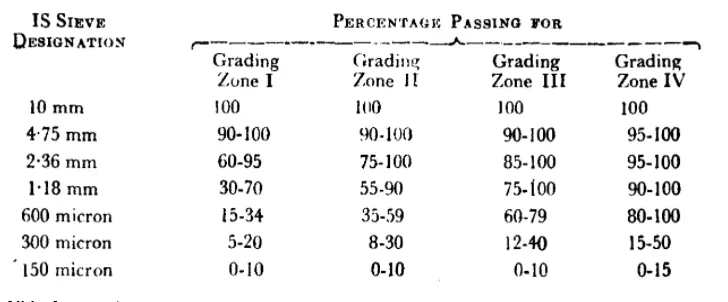
| Fine aggregate | Zone II | Confirming to Table 4-IS383 |
- The strength of the concrete may deviate slightly depends on the quality of the material, method of mixing, and construction practices.
- Hence target strength (Fck) should be higher than the required strength of the concrete (fck).
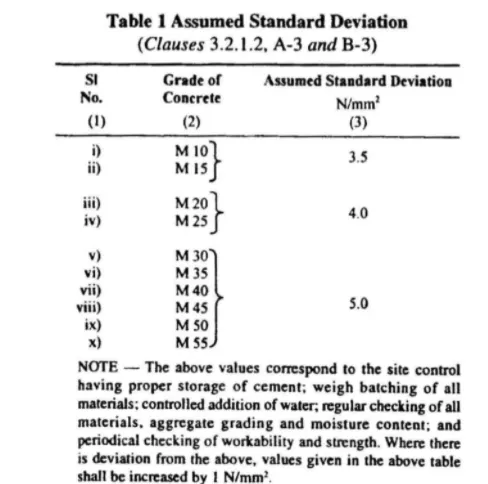
- The value of standard deviation(s) for different grades of concrete is given in Table 1 of IS456.
| Fck | = fck+1.65s | “S” from Table1-IS10262 |
| Fck | = 35+1.65×5 | |
| Fck | = 43.25 N/mm2 |
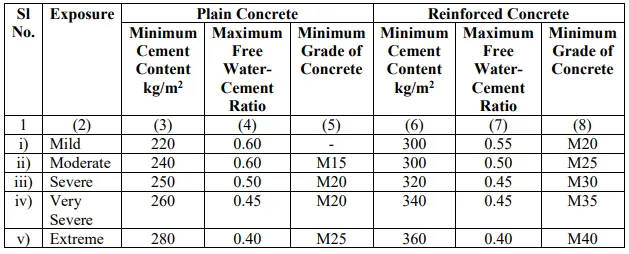
- The maximum water-cement ratio for different grades of concrete is given in Table 5-IS456.
- You can reduce the water-cement ratio based on your requirements.
- The Water-cement ratio directly affects the strength of the concrete
| Maximum W/C ratio | =0.45 | Table 5-IS456 |
| Adopted W/C ratio | =0.45 |
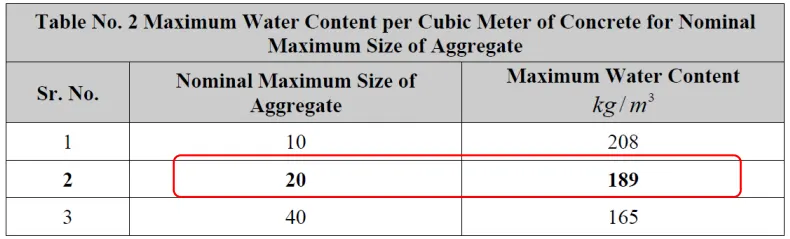
- Maximum water content from the table 186lt
- Above water-content is for 25 to 50mm slump but the slump we require is 100mm.
- hence we need to increase the water content to get the required slump for good workability.
- Clause 4.2 of IS1026 suggests an increase of 3% of water content from its original value for every increase of 25mm.
- Here we have a 50mm increase in the water content so we have to increase the water content by 6 %.
| Water-content for 100mm Slump | =186+(0.06*186) |
| =197.16 L |
- Since superplasticizers are used water content can be reduced to get good strength of concrete.
- The percentage of reduction of water depends on the type of superplasticizers used in the concrete.
| Percentage of Reduction in water content | =20% |
| Water content requirement after SP | =198 – (0.20*198) |
| =157.73 | |
| Adopted Water Content | =160 L |
Cement and fly ash content :
| Adopted Water Cement Ratio | =0.45 |
| Total Cementitious (Cement +Fly ash) requirement | = Water Content / WaterCement ratio |
| =160/0.45 | |
| =355.55 kg |
- Since Fly ash is used the amount of Cementitious content (Cement+Fly ash) shall be increased to get good workability and strength.
- The percentage of increase depending on experience and research.
- Here we increased the cementitious content by 1.1 %.
| Final Cementitious Content (Cement+Fly ash) |
= 356*1.1 | |
| =391.6 kg | ||
| Minimum Cement Content required for ‘severe’ exposure |
=340kg | Table 5-IS456 |
| Adopted Cementious content | =391.6 kg | > 340kg |
| Fly ash content requirement | = 391.6 * 0.30 | 30% replacement |
| = 117.48 ~ 118 kg | ||
| Cement Content requirement | =Cementious content – Fly ash | |
| =391.6-117.48 | ||
| = 274.12 |
- Calculation of Super Plasticiers @ 0.6 percent to the mass of cementitious content
- 391.6*(0.6/100) = 2.35 kg
Coarse and Fine aggregates:
| Coarse Aggregate ratio | = 0.62 | Table3-IS10262 (For W/C =0.5) |
| Coarse Aggregate ratio for 0.45 w/c ratio |
= 0.63 | (adding 0.01 for every decrease .05 and vice versa) |
| Final Fine Aggregate ratio | = 0.37 | (1-0.63) = 0.37 |
Mix design calculation:
| A | Volume of Concrete | = 1 cu.m |
| B | Total Volume of Cement | = Cement/(S.G*1000) |
| = 275/(3.15*1000) | ||
| = 0.087 cu.m | ||
| C | Total Volume of Fly ash | = Flyash/(S.G*1000) |
| = 118/(2.5*1000) | ||
| = 0.041 cu.m | ||
| D | Volume of Water | =Water /(S.G*1000) |
| = 160/(1*1000) | ||
| = 0.160 cu.m | ||
| E | Volume of Superplasticizers | = Superplasticizers /(S.G*1000) |
| = 2.35/(1.12*1000) | ||
| = 0.002 cu.m | ||
| F | Total Aggregates requirement | = A – (B+C+D+E) |
| =1 -(0.087 +0.041+0.160+0.002) | ||
| =0.71 cu.m | ||
| 7 | Coarse Aggregate (C.A) | = F * C.A ratio * S.G * 1000 |
| = 0.71*0.63 *2.74 *1000 | ||
| = 1225.6 kg | ||
| 8 | Fine Aggregate (F.A) | = F * F.A ratio * S.G * 1000 |
| = 0.71*0.37*2.74 *1000 | ||
| =719.8 kg |
Results of mix design :
| S.No. | MATERIALS | QUANTITY |
| 1 | Cement | 275 kg |
| 2 | Fly ash | 118 kg |
| 3 | Fine Aggregate | 720 kg |
| 4 | Coarse Aggregate (20mm) | 1226 kg |
| 5 | WATER | 160 L |
| 6 | PCE based SuperPlasticizer | 2 L |
- To find the design mix ratio divide the calculated value of all materials by the weight of cement.
- Therefore Mix Ratio of M35 Grade concrete by weight is ,
- Cement : Flyash: F.A: C.A: Water = 1:0.4:2.6:4.46:0.58
Part 2- Concrete Mix Design for M50 grade concrete:
Proportioning of M35 grade :
| 1 | Grade Designation | M50 | |
| 2 | Type of Cement | OPC 53 | |
| 3 | Maximum Nominal Size of Aggregate |
20mm | |
| 4 | Minimum Cement Content | 340kg | Table 5-IS456 |
| 5 | Maximum Cement Content | 450kg | As per code |
| 6 | Maximum W/C ratio | 0.45 | Table 5-IS456 |
| 7 | Workability | 100mm | |
| 8 | Chemical admixtures | Super platizers |
- Materials should be tested in the laboratory as per tests given in the codebook and their properties should be found.
- The values of the material properties will be used in the design process and to check the quality of the material with the help of codebook standards.
- Standard values are taken here for calculation purposes.
| 1 | Cement Used | OPC 53 | Confirming to IS8112 |
| 2 | Specific Gravity of Cement | 3.15 | Test – IS: 2720 |
| 3 | Chemical Admixture | @0.6% | IS9103 |
| 4 | Specific Gravity of | Test – IS 2386 | |
| Coarse Aggregate | 2.74 | ||
| Fine Aggregate | 2.64 | ||
| Admixture PCE based | 1.12 | ||
| 5 | Water Absorption | Test – IS 2386 | |
| Coarse aggregate | 0.5 % | ||
| Fine aggregate | 1 % | ||
| 6 | Sieve Analysis | Test – IS 2386 | |
| Coarse aggregate | Confirming to Table 2-IS383 | ||
| Fine aggregate | Zone II | Confirming to Table 4-IS383 |
- The strength of the concrete may deviate slightly depends on the quality of the material, method of mixing, and construction practices.
- Hence target strength (Fck) should be higher than the required strength of the concrete (fck).
- The value of standard deviation(s) for different grades of concrete is given in Table 1 of IS456.
| Fck | = fck+1.65s | “S” from Table1-IS10262 |
| Fck | = 50+1.65×5 | |
| Fck | = 58.25 N/mm2 |
- The maximum water-cement ratio for different grades of concrete is given in Table 5-IS456.
- You can reduce the water-cement ratio based on your requirements.
- The Water-cement ratio directly affects the strength of the concrete
| Maximum W/C ratio | =0.45 | Table 5-IS456 |
| Adopted W/C ratio | =0.45 |
- Maximum water content from the table 186lt
- Above water-content is for 25 to 50mm slump but the slump we require is 100mm.
- hence we need to increase the water content to get the required slump for good workability.
- Clause 4.2 of IS1026 suggests an increase of 3% of water content from its original value for every increase of 25mm.
- Here we have a 50mm increase in the water content so we have to increase the water content by 6 %.
| Water-content for 100mm Slump | =186+(0.06*186) |
| =197.16 L |
- Since superplasticizers are used water content can be reduced to get good strength of concrete.
- The percentage of reduction of water depends on the type of superplasticizers used in the concrete.
| Percentage of Reduction in water content | =20% |
| Water content requirement after SP | =198 *0.8 |
| =158 | |
| Adopted Water Content | =158 L |
Cement content :
| Adopted Water Cement Ratio | =0.45 |
| Total Cementitious requirement | = Water Content / WaterCement ratio |
| =158/0.45 | |
| =351.44 kg |
Coarse and Fine aggregates:
| Coarse Aggregate ratio | = 0.62 | Table3-IS10262 (For W/C =0.5) |
| Coarse Aggregate ratio for 0.45 w/c ratio |
= 0.63 | (adding 0.01 for every decrease .05 and vice versa) |
| Final Fine Aggregate ratio | = 0.37 | (1-0.63) = 0.37 |
Mix design calculation:
| 1 | Volume of Concrete | = 1 cu.m |
| 2 | Total Volume of Cement | = Cement/(S.G*1000) |
| = 351.44/(3.15*1000) | ||
| = 0.1128 cu.m | ||
| 3 | Volume of Water | =Water /(S.G*1000) |
| = 158/(1*1000) | ||
| = 0.158 cu.m | ||
| 4 | Volume of Superplasticizers | = Superplasticizers /(S.G*1000) |
| = 2.35/(1.12*1000) | ||
| = 0.002 cu.m | ||
| 5 | Total Aggregates requirement | = 1 – (2+3+4) |
| =1 -(0.1128+0.160+0.002) | ||
| =0.72 cu.m | ||
| 7 | Coarse Aggregate (C.A) | = F * C.A ratio * S.G * 1000 |
| = 0.72*0.63 *2.74 *1000 | ||
| = 1242.8 kg | ||
| 8 | Fine Aggregate (F.A) | = F * F.A ratio * S.G * 1000 |
| = 0.72*0.37*2.74 *1000 | ||
| =729.8 kg |
Results of mix design :
| S.No. | MATERIALS | QUANTITY |
| 1 | Cement | 351 kg |
| 2 | Fine Aggregate | 730 kg |
| 3 | Coarse Aggregate (20mm) | 1243 kg |
| 4 | WATER | 158 L |
| 5 | PCE based SuperPlasticizer | 2 L |
- To find the design mix ratio divide the calculated value of all materials by the weight of cement.
- Therefore Mix Ratio of M35 Grade concrete by weight is ,
- Cement :F.A: C.A: Water = 1:2.28:3.12:0.5
APPENDIX
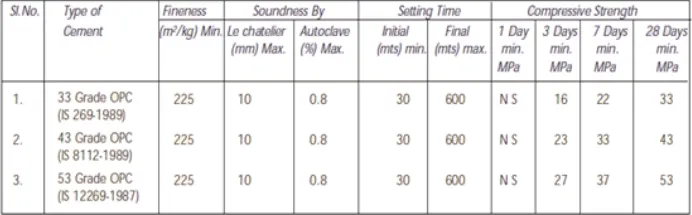
1) PHYSICAL CHARACTERSTICS OF DIFFERENT TYPES OF OPC CEMENT
2) Table – 5 Minimum Cement Content, Maximum Water-Cement Ratio and Minimum Grade of Concrete for Different Exposures with Normal Weight Aggregate of 20 mm Nominal Maximum Size IS: 456-2000
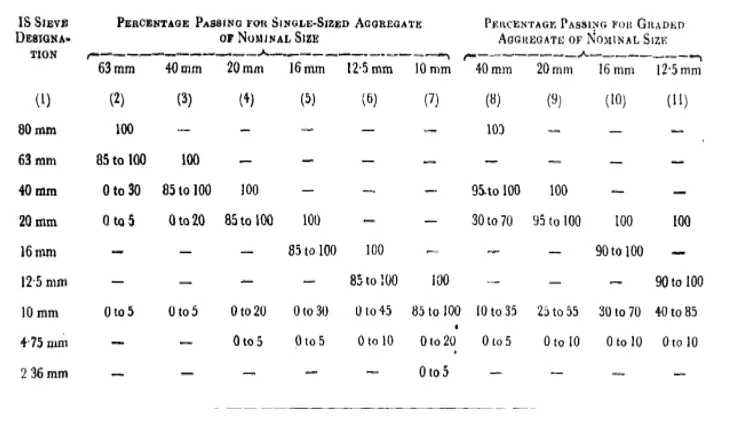
3) Table 2 of IS 383: Grade size distribution for different nominal sizes of coarse aggregate
4) Table 4 of IS 383: Grading of fine aggregate
5) Table I of IS 10262:2009: Assumed standard deviations
6) Table 2 of IS 10262:2009: maximum water content for 20 mm aggregate