Project on Concrete Mix Design for various grades of Concrete
AIM: The aim of the project is to design a mix design for M35 Grade concrete with fly ash and also M50 grade concrete without Fly Ash.
INTRODUCTION :
A good concrete mix design creates the foundation of a sound infrastructure.
Concrete mix design involves a process of preparation in which a mix of ingredients creates the required strength and durability for the concrete structure. Because every ingredient in the mix consists of different properties, it’s not an easy task to create a great concrete mix. It is imperative that all ingredients be tested to determine their physical properties and the bearing capacity of the project location.
The ingredients to be tested: water, fine aggregate (sand), coarse aggregate, cement, chemicals, reinforcement, and soil.
The values of the physical properties obtained after testing will be used as the basis for all concrete mix design considerations. This will ensure the structure will be sound and prevent failure of the mix. It is important to note that the ingredients for the mix might vary from one project location to another, so the physical properties must be tested for the requirements specified for each location.
The two types of concrete mix are normal performance concrete and high-performance concrete, and they’re characterized by their compressive strength:
Normal Performance Concrete
A normal performance concrete mix has a performance strength ranging between 20 and 40 MPa. It is the more used mix of the two. Normal performance concrete has good workability if all of the mix ingredients are in accurate proportions. When freshly mixed, the concrete must be plastic or semi-fluid so that it can be molded.
High-Performance Concrete
A high-performance concrete mix has a performance strength above 40 MPa. The main purpose of using high-performance concrete is to reduce the weight, creep or permeability issues, and to improve the durability of the structure. Like the normal performance concrete mix, this mix must be plastic or semi-fluid when freshly mixed so that it can be molded.
Because high-performance concrete has a high cement content, it is often sticky and hard to be handled and placed. However, this does not cause the cement to bleed, an issue that normal performance concrete might run into.
Strength and durability of the concrete mix design are dependent upon the following factors:
Grade designation: Concrete’s strength is measured in N/mm2 when subject to test after curing in any curing medium. The choice of concrete grade depends on its usage.
Choice of cement: Cement choice varies depending on usage. The cement should be tested for performance required by their usage before being tested in the design mix.
Choice of aggregate size: Aggregates needed for each mix is dependent upon the physical properties needed for the design. All aggregates must be quality sized before use.
Type of water: Any water used for concrete mix design should be tested before use to ensure it is within the range of water required for concrete. Most all consumable water is good for concrete work, but should still be tested.
Water to cement ratio: The ratio of water to cement should be tested for consistency, initial and final setting, soundness of the cement, workability, slump of the concrete and compacting factor.
Workability: This is the measure of ease of mixing concrete without segregation or bleeding. It mostly depends on the designed slump of the concrete.
Durability: This is the measure of the required strength (N/mm2) of any concrete grade after 28 days of curing. Durability should be control tested on site.
PROCEDURE:
CONCRETE MIX DESIGN WITH FLY ASH FOR M35 GRADE
STEP 1: TARGET MEAN STRENGTH
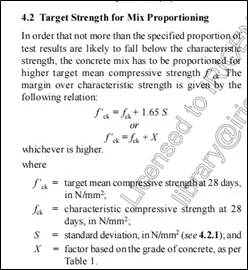
From IS 10262:2019, clause 4.2
- Target mean strength = Characteristic strength + 1.65(S)
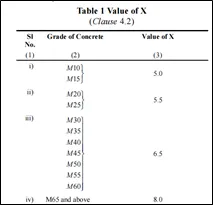
- Target mean strength = Characteristic strength + X
*whichever is greater from above two values
Characteristic strength = 35 Mpa
A) Target mean strength =
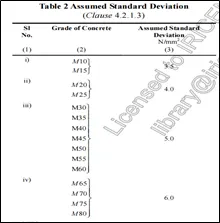
S=5 from table 2,IS 10262:2019
Therefore,
Target mean strength = 35+1.65(5)
= 43.25 Mpa
B) Target mean strength =
X = 6.5 from table 1, IS 10262:2019
Therefore,
Target mean strength =35+6.5
= 41.5 Mpa
43.25 > 41.5
Consider Target mean strength as 43.25 Mpa
STEP 2: APPROXIMATE AIR CONTENT
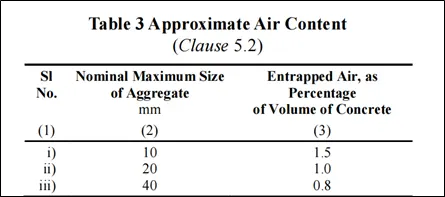
From IS 10262:2019, Table 3, clause 5.2
Considering the Nominal maximum size of aggregate as 20mm,
Entrapped air is 1% of volume of concrete
STEP 3: WATER-CEMENT RATIO
From IS 10262:2019, Fig 1,
Considering the cement as Ordinary Portland cement of 43 grade
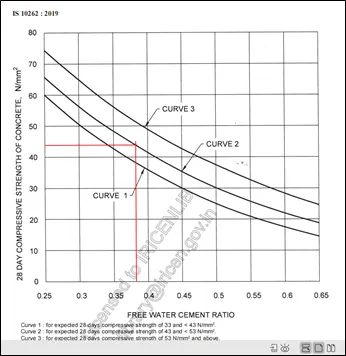
From graph,
Water cement ratio is 0.38
Considering the exposure condition as Moderate,
According to IS 456:2000, Table 5, Maximum water cement ratio for Moderate exposure = 0.50
0.50 > 0.38
Therefore
Consider water cement ratio as 0.38
STEP 4: SELECTION OF WATER CONTENT
Considering slum as 50mm,
From IS 10262:2019, clause 5.3, table 4
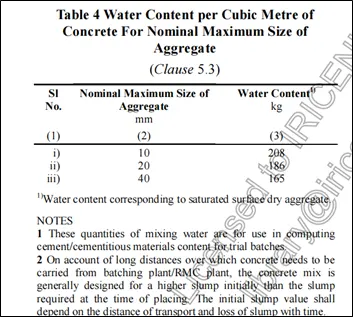
From the table, for nominal maximum size of aggregate 20mm, the water content for 50mm slump is 186kg
Considering the use of 1% superplasticizer, reduce thewater content by 23% (as per IS 9103)
Water content = 0.77 x 186 = 143.22
Consider water content as 144 kg
STEP 5: CALCULATION OF CEMENTITIOUS CONTENT
Cementitious content = Water content / (w/c ratio)
= 144/0.38 = 379 kg/m3
From IS 456:2000, table 5
For Moderate exposure, minimum cementitious content is 300 kg/m3
379 > 300
Therefore, cementitious content = 379 kg/m3
Considering the Fly ash content to be 30% of cementitious content,
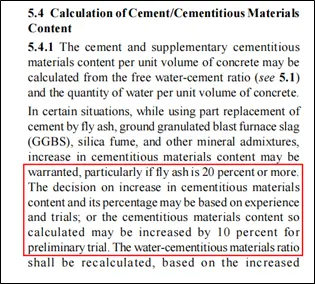
From IS 10262:2019, clause 5.4.1,
We need to increase the above value of cementitious content by 10% as the fly ash content is more than 20%
Cementitious content =
1.1 x 379 = 417 kg/m3
Now we need to calculate new w/c ratio for the above value of cementitious content
Revised w/c ratio =
144/417 = 0.35
Fly ash = 30% of 477
= 0.3 x 417 = 125 kg/m3
Cement content = 417-125
= 292 kg/m3
From IS 456:2000, clause 8.2.4.2,
Maximum cement content should be 450 kg/m3
292 < 450, Hence OK
Fly ash content = 125 kg/m3
Cement content = 292 kg/m3
STEP 6: PROPORTION OF VOLUME OF COARSE AGGREGATE & FINE AGGREGATE
Considering Zone-2 of the fine aggregate,
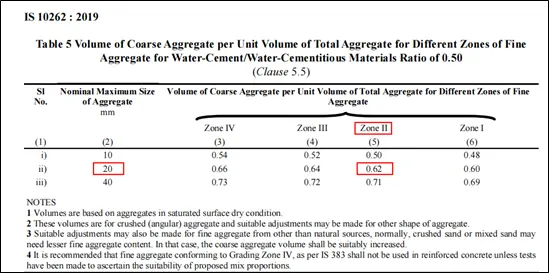
From IS 10262:2019, Table 5, clause 5.5
For water-cementitious ratio of 0.5,
The volume of coarse aggregate per unit volume of total aggregate for Zone-2 of fine aggregate = 0.62 for nominal maximum size of aggregate being 20mm
For water cementitious ratio of 0.35, the volume of coarse aggregate (V[email protected]) =
(V[email protected]) + ((0.5-w)/0.05) x 0.01 = 0.62 + ((0.5-0.35)/0.05) x 0.01 = 0.65
65% of total aggregate is coarse aggregate
The percentage of fine aggregate = 100 - 65 = 35%
STEP 7: MIX CALCULATIONS
Specific gravity of different materials
|
MATERIAL |
SPECIFIC GRAVITY |
|
Cement |
3.15 |
|
Fly ash |
2.2 |
|
Superplasticizer |
1.14 |
|
Coarse aggregate |
2.74 |
|
Fine aggregate |
2.65 |
|
Total volume |
1 m3 |
|||
|
Quantities |
Mass |
Sp. Gravity |
Volume |
|
|
Volume of entrapped air (a) |
- |
- |
1% x 1 = 0.01 m3 |
|
|
Volume of water (b) |
144 kg |
1 |
144/(1x1000) = 0.144 m3 |
|
|
Volume of cement (c) |
292 kg |
3.15 |
292/ (3.15x1000) = 0.092 m3 |
|
|
Volume of fly ash (d) |
125 kg |
2.2 |
125/ (2.2x1000) = 0.056 m3 |
|
|
Volume of chem.adm (e) |
1% of (292+125) =4.17 kg |
1.145 |
4.17/ (1.145x1000) = 0.00362 m3 |
|
|
Total volume of aggregate (f) |
1-(a+b+c+d+e) = 0.6943 m3 |
|||
|
|
Total volume (f) |
% of aggregate |
Sp. Gravity |
Mass of aggregate |
|
Mass of coarse aggregate |
0.6943 m3 |
65% |
2.74 |
0.6943x0.65x2.74x1000= 1236.5 kg/m3 |
|
Mass of fine aggregate |
0.6943 m3 |
35% |
2.65 |
0.6943x0.35x2.65x1000= 643 kg/m3 |
STEP 8: MIX PROPORTION
|
REQUIRED QUANTITIES |
|
|
CEMENT |
292 kg/m3 |
|
WATER |
144 kg/m3 |
|
WATER/CEMENTITIOUS RATIO |
0.35 kg/m3 |
|
FLY ASH |
125 kg/m3 |
|
SUPER PLASTICIZER |
4.17 kg/m3 |
|
COARSE AGGREGATES |
1236.5 kg/m3 |
|
FINE AGGREGATES |
643 kg/m3 |
Mix proportion
1: 2.2: 4.2
CONCRETE MIX DESIGN WITHOUT FLY ASH FOR M50 GRADE
Parameters for mix design M50
Grade Designation = M-50
Type of cement = O.P.C-43 grade
Brand of cement = Vikram ( Grasim )
Admixture = Sika [Sikament 170 ( H ) ]
Fine Aggregate = Zone-II
Sp. Gravity
Cement = 3.15
Fine Aggregate = 2.61
Coarse Aggregate (20mm) = 2.65
Coarse Aggregate (10mm) = 2.66
Minimum Cement (As per contract) =400 kg / m3
Maximum water cement ratio (As per contract) = 0.45
1. Target Mean Strength = 50 + ( 5 X 1.65 ) = 58.25 Mpa
2. Selection of water cement ratio:-
Assume water cement ratio = 0.35
3. Calculation of water: –
Approximate water content for 20mm max. Size of aggregate = 180 kg /m3 (As per Table No. 5 , IS : 10262 ). As plasticizer is proposed we can reduce water content by 20%.
Now water content = 180 X 0.8 = 144 kg /m3
4. Calculation of cement content:-
Water cement ratio = 0.35
Water content per cum of concrete = 144 kg
Cement content = 144/0.35 = 411.4 kg / m3
Say cement content = 412 kg / m3 (As per contract Minimum cement content 400 kg / m3 )
Hence O.K.
5. Calculation for C.A. & F.A.: [ Formula’s can be seen in earlier posts]-
Volume of concrete = 1 m3
Volume of cement = 412 / ( 3.15 X 1000 ) = 0.1308 m3
Volume of water = 144 / ( 1 X 1000 ) = 0.1440 m3
Volume of Admixture = 4.994 / (1.145 X 1000 ) = 0.0043 m3
Total weight of other materials except coarse aggregate = 0.1308 + 0.1440 +0.0043 = 0.2791 m3
Volume of coarse and fine aggregate = 1 – 0.2791 = 0.7209 m3
Volume of F.A. = 0.7209 X 0.33 = 0.2379 m3 (Assuming 33% by volume of total aggregate )
Volume of C.A. = 0.7209 – 0.2379 = 0.4830 m3
Therefore weight of F.A. = 0.2379 X 2.61 X 1000 = 620.919 kg/ m3
Say weight of F.A. = 621 kg/ m3
Therefore weight of C.A. = 0.4830 X 2.655 X 1000 = 1282.365 kg/ m3
Say weight of C.A. = 1284 kg/ m3
Considering 20 mm: 10mm = 0.55: 0.45
20mm = 706 kg .
10mm = 578 kg .
Hence Mix details per m3
Increasing cement, water, admixture by 2.5% for this trial
Cement = 412 X 1.025 = 422 kg
Water = 144 X 1.025 = 147.6 kg
Fine aggregate = 621 kg
Coarse aggregate 20 mm = 706 kg
Coarse aggregate 10 mm = 578 kg
Admixture = 1.2 % by weight of cement = 5.064 kg.
Water: cement: F.A.: C.A. = 0.35: 1: 1.472: 3.043