Project on Concrete Mix Design for various grades of Concrete
Aim: To calculate the concrete mix design for M35 grade concrete with fly ash and M50 grade concrete without fly ash by using IS codes like IS 10262: 2009 and IS 456: 2000.
Procedure:
1. Calculation of the concrete mix design for M35 grade concrete with fly ash:
Step I :- Data for proportioning
- Grade of mix- M35
- Type of cement - OPC 43
- Type of mineral admixture - Fly ash confirming to IS 3812 Part 2
- Max. nominal size of aggregate - 20mm
- Environmental condition for RCC - Severe
- Minimum cement content - 320 Kg/m^3 (for severe exposure condition From table 5 of IS 456-2000)
- Maximum W/C ratio = 0.45
- Method of concrete placing = Pumping
- Workability = 100mm (for pumpable concrete)
- Degree of supervision = Good
- Type of Aggregate = Crushed angular
- Maximum cement content = 450 Kg/m^3 (As per clause 8.2.4.2 of IS 456-2000)
- Admixture used= Superplasticizer
Step II :- Test data for design mix
- Cement used = OPC 43 confirming to IS 8112
- Mineral admixture = Fly ash confirming IS 3812 Part 2
- Specific gravity of cement = 3.15
- Chemical admixture used= Super plasticizer confirming IS 9130
- Specific Gravity of Coarse aggregate and Fine aggregate = 2.74
- Water absorption for Coarse aggregate is 0.5% and for Fine aggregate 1.0%
- Free moisture content for Coarse aggregate and Fine aggregate = Nil
Step III :- Target mean strength
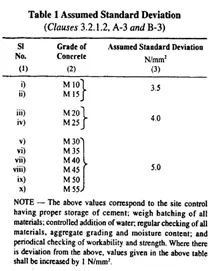
F'ck= fck + 1.65 S
= 35+ (1.65*5)....................................(S=5 as per IS Table 1 10262-2009 )
= 43.25 N/mm^2
Step VI :- Selection of water cement ratio
W/C ratio = 0.45 .........................................(From table no 5 IS 456-2000 for severe exposure condition as shown below)
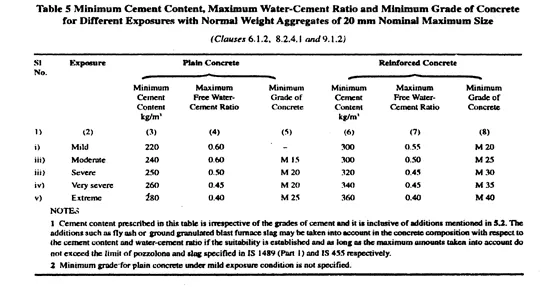
So as per the experience we will adopt W/C ratio = 0.40
Step V: Selection of Water content
Water content = 186 litre for slump of 50-25mm slump .................(From table 2 IS 10262-2009 as shown below)
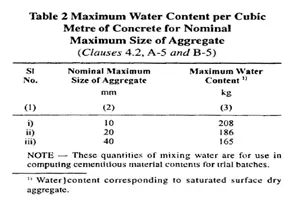
For 100mm slump we will add 3% for every 25mm increase
Water Content = `186 + 6/100*186`
= 197 litres
Addition of superplasticizer can reduce water upto 20% and now assume based on trial water content reduction of 28%
Now, Water content = `197 * 72/100`
= 141.84 litre Say 142 litres
Step VI : Calculation of cement content
W/C ratio = 0.40
Cementitious material content = `142/0.40`
= 355 `(Kg)/m^3`
From table 5 of IS 456 minimum cement content for severe exposure condition = 320Kg
Where , `355 `(Kg)/m^3` > 320 `(Kg)/m^3``
`therefore` 355 `(Kg)/m^3` is Ok`
Percentage of addition of fly ash is based on project requirement and quality of material.
In some cases increase in cementitious material can be warned. increase in cementitious material and its percentage may be based on experience and trials. Here we will assume 10% increase in cementitious material.
Cementitious material content = `355+355 * (10/100)`
= 390.50 say 391 `(Kg)/m^3`
Now Water cement ratio = `(Water content) / (Cement content )`
= `140/391`
= 0.358 say 0.36
Consider addition of fly ash @ 30% of total cementitious material = `391*30/100`
= 117.3 say 118 `(Kg)/m^3`
Cement content = 391 - 118 = 273 `(Kg)/m^3`
Total Saving in Cement content = 355 - 273= 82 `(Kg)/m^3`
Step VII: Volume of coarse and fine aggregate
from table 3 IS 10262 - 2009 Volume of coarse aggregate corresponding to 20mm size and zone I aggregate and fine aggregate for water cement ratio = 0.6
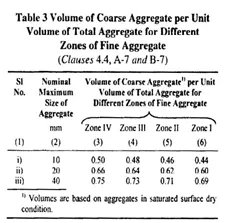
and we have calculated water cement ratio = 0.40
`therefore` volume of coarse aggregate needs to be increased to reduce fine aggreggate volume
As water cement ratio is less than 1.0 Volume of coarse aggregate is increased by 0.02 ........................(as per +/- 0.01 for every +/- 0.05 change in water cement ratio)
`therefore`Volume of coarse aggregate for water cement ratio of 0.40 = 0.62
For pumpable concrete these values are reduced by 10%
`therefore` Volume of coarse aggregate = `0.62*90/100`
= 0.56
Volume of fine aggregate = 1-0.56
= 0.44
Step VIII: Mix calculation
a = Volume of concrete = 1 `m^3`
b = Volume of cement = `(mass of cement )/(Specific gravity of cement )*(1/1000)`
=`273/3.15*1/1000`
= 0.0867 `m^3`
c= Volume of fly ash = `(mass of fly ash )/(Specific gravity of fly ash )*(1/1000)`
=`118/2.2*1/1000`
= 0.0536 `m^3`
d = Volume of water = `(mass of water )/(Specific gravity of water )*(1/1000)`
= `140/1*1/1000`
= 0.140 `m^3`
Mass of admixture = 2% of mass of cementitious material
= `391*2/100`
= 7.82 `(Kg)/m^3`
e = Volume of admixture = `(mass of admixture )/(Specific gravity of admixture )*(1/1000)`
= `7.82/1.145*1/1000`
= 0.0068 `m^3`
f = Volume of aggregate = a - (b+c+d+e)
= 1- (0.0867+0.0536+0.140+0.0068)
= 0.713 `m^3`
Mass of coarse aggregate = e * volume of coarse aggregate* specific gravity of coarse aggregate * 1000
= `0.713 * 0.56 * 2.74 * 1000`
= 1094 `(Kg)/m^3`
Mass of fine aggregate = e * volume of fine aggregate* specific gravity of fine aggregate * 1000
= `0.713 * 0.44 * 2.74 * 1000`
= 859.59 say 860 `(Kg)/m^3`
Step IX : Mix proportioning
Mass of cement = 273 `(Kg)/m^3`
Mass of Fly Ash = 118 `(Kg)/m^3`
Mass of water = 140 `(Kg)/m^3`
Mass of Coarse aggregate = 1094 `(Kg)/m^3`
Mass of fine aggregate = 860 `(Kg)/m^3`
Mass of chemical admixture = 7.82 `(Kg)/m^3`
Water cement ratio = 0.36
`therefore`mix proportion = 1: 2.20 : 2.79`
2. Calculation of the concrete mix design for M50 grade concrete without fly ash
Following are the detailed steps for mix design for M50 grade concrete:-
Step I :- Data for proportioning
- Grade of mix- M50
- Type of cement - OPC 43
- Max. nominal size of aggregate - 20mm
- Environmental condition for RCC - Severe
- Minimum cement content - 320 Kg/m^3 (From table 5 of IS 456-2000)
- Maximum W/C ratio = 0.45
- Method of concrete placing = Pumping
- Workability = 100mm (for pumpable concrete)
- Degree of supervision = Good
- Type of Aggregate = Crushed angular
- Maximum cement content = 450 Kg/m^3 (As per clause 8.2.4.2 of IS 456-2000)
- Admixture used= Superplasticizer
Step II :- Test data for design mix
- Cement used = OPC 43 confirming to IS 8112
- Specific gravity of cement = 3.15
- Chemical admixture used= Super plasticizer confirming IS 9130
- Specific Gravity of Coarse aggregate and Fine aggregate = 2.74
- Water absorption for Coarse aggregate is 0.5% and for Fine aggregate 1.0%
- Free moisture content for Coarse aggregate and Fine aggregate = Nil
Step III :- Target mean strength
F'ck= fck + 1.65 S
= 50+ (1.65*5)....................................(S=5 as per IS Table 8 10262-2009 as shown below)
= 58.25 N/mm^2
Step VI :- Selection of water cement ratio
W/C ratio = 0.45 .........................................(From table no 5 IS 456-2000 for severe exposure condition as shown below)
So as per the experience we will adopt W/C ratio = 0.40
Step V: Selection of Water content
Water content = 186 litre for slump of 50-25mm slump .................(From table 2 IS 10262-2009 as shown below)
For 100mm slump we will add 3% for every 25mm increase
Water Content = `186 + 6/100*186`
= 197 litres
Addition of superplasticizer can reduce water upto 20% and now assume based on trial water content reduction of 29%
Now, Water content = `197 * 71/100`
= 140 litre
Step VI : Calculation of cement content
W/C ratio = 0.40
Cement Content = `140/0.40`
= 350 `(Kg)/m^3`
From table 5 of IS 456 minimum cement content for severe exposure condition = 320Kg
Where , `350 `(Kg)/m^3` > 320 `(Kg)/m^3``
`therefore` 350 `(Kg)/m^3` is OK
Step VII: Volume of coarse and fine aggregate
`rom table 3 IS 10262 - 2009 Volume of coarse aggregate corresponding to 20mm size aggregate and fine aggregate of zone I for water cement ratio = 0.6 (As shown below)`
and we have calculated water cement ratio = 0.40
`therefore` volume of coarse aggregate needs to be increased to reduce fine aggreggate volume
As water cement ratio is less than 1.0 Volume of coarse aggregate is increased by 0.02 ........................(as per +/- 0.01 for every +/- 0.05 change in water cement ratio)
`therefore`Volume of coarse aggregate for water cement ratio of 0.40 = 0.62
For pumpable concrete these values are reduced by 10%
`therefore` Volume of coarse aggregate = `0.62*90/100`
= 0.56
Volume of fine aggregate = 1-0.56
= 0.44
Step VIII: Mix calculation
a = Volume of concrete = 1 `m^3`
b = Volume of cement = `(mass of cement )/(Specific gravity of cement )*(1/1000)`
=`350/3.15*1/1000`
= 0.111 `m^3`
c = Volume of water = `(mass of water )/(Specific gravity of water )*(1/1000)`
= `140/1*1/1000`
= 0.140 `m^3`
Mass of admixture = 2% of mass of cementitious material
= `350*2/100`
= 7 `(Kg)/m^3`
d = Volume of admixture = `(mass of admixture )/(Specific gravity of admixture )*(1/1000)`
= `7/1.145*1/1000`
= 0.006 `m^3`
e = Volume of aggregate = a - (b+c+d)
= 1- (0.111+0.140+0.006)
= 0.743 `m^3`
Mass of coarse aggregate = e * volume of coarse aggregate* specific gravity of coarse aggregate * 1000
= `0.743 * 0.56 * 2.74 * 1000`
= 1140 `(Kg)/m^3`
Mass of fine aggregate = e * volume of fine aggregate* specific gravity of fine aggregate * 1000
= `0.743 * 0.44 * 2.74 * 1000`
= 896 `(Kg)/m^3`
Step IX : Mix proportioning
Mass of cement = 350 `(Kg)/m^3`
Mass of water = 140 `(Kg)/m^3`
Mass of Coarse aggregate = 1140 `(Kg)/m^3`
Mass of fine aggregate = 896 `(Kg)/m^3`
Mass of chemical admixture = 7 `(Kg)/m^3`
Water cement ratio = 0.40
`therefore`mix proportion = 1: 2.56 : 3.26
Results: The concrete mix proportion for M35 grade concrete with fly ash by using IS codes like IS 10262: 2009 and IS 456: 2000 = 1: 2.20 : 2.79
and mix proportion for M50 grade concrete without fly ash by using IS codes like IS 10262: 2009 and IS 456: 2000 = 1: 2.56 : 3.26