Project - Analysis of mobile or Wifi network using an android app
Connected to a WiFi network “Akash’s_WiFi_2.4 GHz
Downloaded the application
WiFi Analyzer(version)- 3.0.11
WiFi Heatmap(version)- 5.11.1
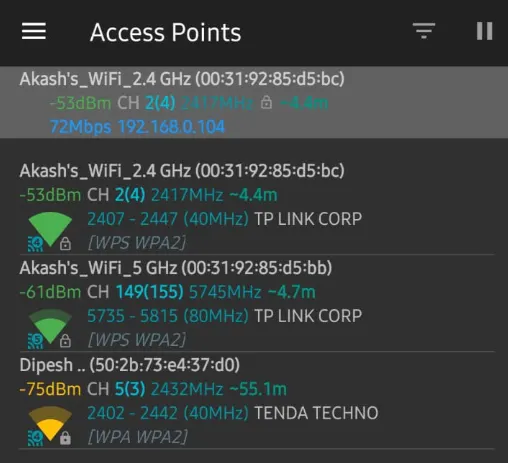
I am calculating the FSPL for 2.4 GHz with a Tx power as per the configuration done in the router. Usually, the Tx power in the router is 100mW or 20dBM.
Therefore:-
FSPL= 20 log10(2400) + 20 log10(4.4) – 27.55
= 67.6 + 12.86 – 27.55
= 52.91 dBm
Now,
Rx Power = Tx Power – FSPL – other losses
- 53 = 20 - 52.91 – x ; x = 20 + 53 - 52.91
X = 20.09
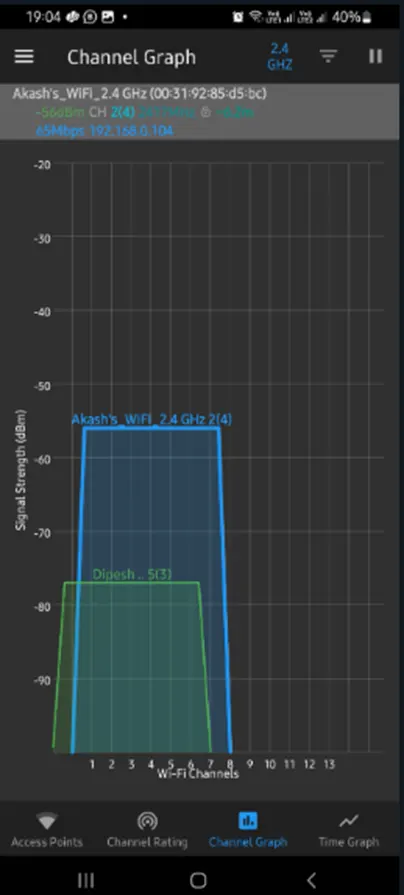
The optimum channel for which my AP would perform best is channel 8 hence there is no interference.
WiFi Heat Map:
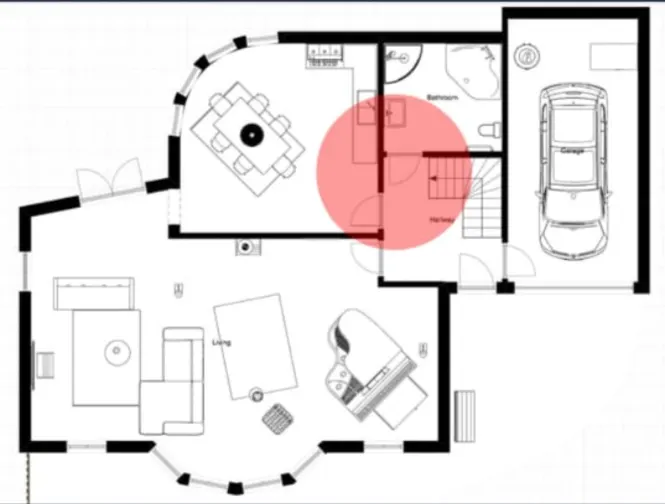
No coverage of black holes was found. But at the far corner WiFi connection gets disconnected when the Signal strength goes >= -95 dBm
FSPL at the worst point coverage is: -
FSPL= 20 log10(2400) + 20 log10(54.4) – 27.55
FSPL= 67.6 + 34.71 – 27.55
FSPL = 74.76
Rx Power = Tx Power – FSPL – other losses
-96 = 20 – 74.76 – x
x = 96 + 20 – 74.76
x = 41.24 dBm these are other losses due to interference of other sites, walls, trees and natural water bodies
The channel number cannot be modified. If the router can be moved to the centre location of the home (open space) where signals have to face less obstruction, it may help to increase the signal strength at the far region.
Throughput at the worst point signal coverage is: -
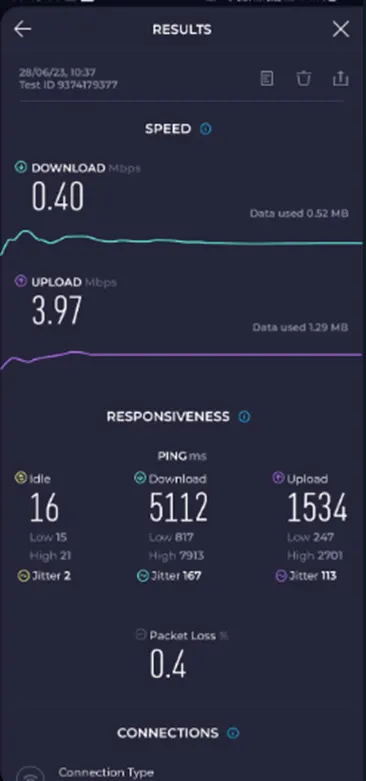
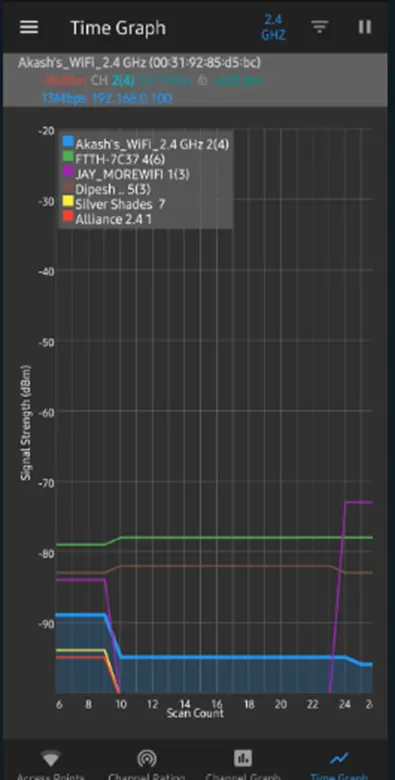
In the best channel condition, the wireless channel goes through minimal interference, noise, and fading. Thus provides a robust and reliable signal with a high signal-to-noise ratio (SNR) and low bit error rate (BER). Therefore, it maximizes the throughput as the data is transmitted at higher data rates with fewer errors. The channel capacity, which represents the maximum achievable throughput, is effectively utilized in the best channel condition.
In the worst channel condition, the wireless channel suffers from various impairments such as high interference, noise, fading, and shadowing. This weakens the signal, increases the noise level, and introduces significant errors in the received data. Therefore, the throughput recorded will be less due to the need for error correction and retransmissions. Lower data rates must be used to maintain a reliable connection, leading to decreased throughput.
Link Adaptation techniques which will help to optimize the network are: -
Modulation Coding Scheme (MCS), Adaptive Modulation and Coding (AMC), Channel aware scheduling and Beamforming and MIMO Techniques