Project - Analysis of a practical automotive wiring circuit
1)
MAJOR COMPONENTS OF AUTOMOTIVE WIRING SYSTEMS ARE GIVEN BELOW;
1- BATTERY
2-STARTER
3-WIRING CONNECTIONS/SWITCHES
4-GENERATORS
5-SENSORS
6-IGNITION COIL
7-REGULATORS
8-BRAKE SYSTEM
9-FUEL SYSTEM
10-ENGINE
11-EXHAUST SYSTEM
12- ALTERNATORS
This are the major components of automotive system daigram given above.
2)
IGNITION SYSTEM PURPOSE & WORKING ;
A) PURPOSE -
* To create a spark strong enough to ignite the fuel air mixture.
*Maintain spark long enough to allow the combustion of all the air and fuel in the cylinder.
*Deliver the spark at right time during the compression stroke of each cylinder.
*maximum pressure should be 25 degree after tdc.
B) WORKING-
*Method of turning a spark ignition engine on & off.
*Operates on batter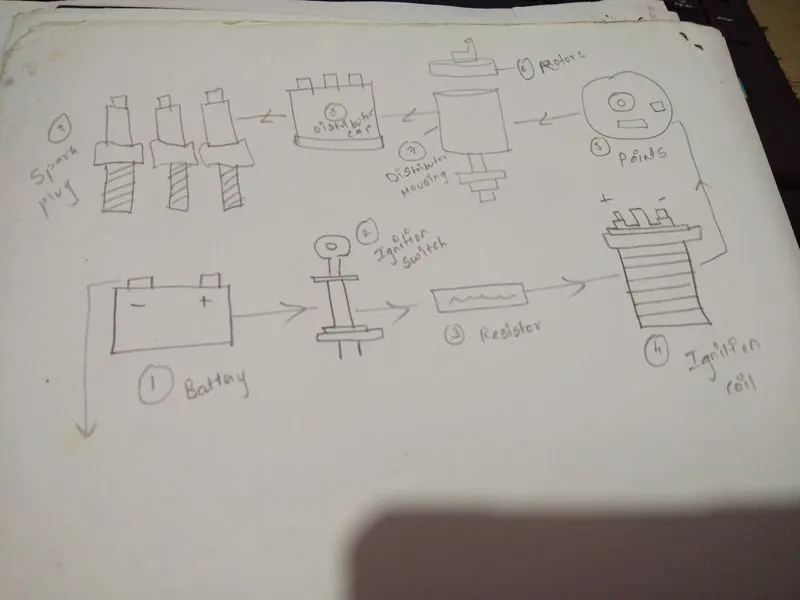 y & alternator.
*High voltage spark
*Distribute spark to each plugs
*Varies ignition timingas engine speed,load,etc.
ALTERNATORS-
A) PURPOSE -An alternator, as an integral part of every combustion engine vehicle, its main responsibility is to convert chemical energy to electric energy.
the alternator keeps your car alive when the engine is running. The alternator powers most car's electronic components while you're driving around or idling, including your headlights, electric steering, power windows, windshield wipers, heated seats, dashboard instruments, and radio. The alternator supplies all of them with direct current (DC) power. Your alternator is also responsible for charging your car battery while driving.
B) WORKING-
What does an alternator do? the alternator provides your car with the bulk of its electricity and helps recharge the battery. But to do all of that, the alternator must first turn mechanical energy into electricity.
The process of producing electricity begins with the engine. For most modern vehicles, alternators are driven by the engine’s crankshaft via a serpentine belt, though older vehicles may have a separate pulley going from the crankshaft.
REGULATOR
A)PURPOSE -
The voltage regulator in your vehicle is in charge of keeping the right amount of electric current flowing throughy parts of cars. This means if the voltage regulator is broken, the components in your electrical system might only work erratically or not at all.
An automobile voltage regulator controls the voltage produced by the car's alternator to recharge the battery. The regulator forces the alternator to maintain a voltage of between 13.5 volts and 14.5 volts. This is sufficient to recharge the battery safely while protecting the electrical circuits and components of the car, including the wiring system, lights, motors that drive power accessories and stereo.
B) WORKING -
The voltage regulator rapidly switches alternator in and out of charging circuit toprovide voltage to car.The thing most likely to strand you is the alternator not charging the battery, which causes the battery to run down.
3) GIVEN -
Load -10A
Voltage-12v
TO FIND -
Fuse rating
SOLUTION -
P=I*V
10=I*12
I=0.83A
4) GIVEN -
q=500W
V=12V
SOLUTION -
q=cv
C=42F
5)
Parallel circuits are commonly used in automotive lighting circuits. A parallel circuit has several unique characteristics:
- There is more than one path for electric current.
- The total amount of electric current is equal to the sum of the individual branch currents.
- The source voltage will be dropped across all of the electrical loads in each branch of the circuit. There can be more than one load in each branch.
- An open anywhere in a branch will stop the current in that branch, but leave the other branch unaffected.
- Advantages-
- Consistent voltage
- Independent component
- Simple, safe,reliable
- Allow additional components
6)-Series circuits are commonly used in on-board sensor and actuator circuits. A series circuit has several unique characteristics:
- There is only one path for electric current.
- The amount of electric current is the same at all points in the circuit.
- Advantages -
- Cells connected in series give a greater resultant voltage than individual cells.
- Voltage increases if the number of cells increases.
- Series circuits do not overheat easily.