Project - Analysis of a practical automotive wiring circuit
Fundamentals of Electrical Systems and Electrical Architecture
Project - Analysis of a practical automotive wiring circuit
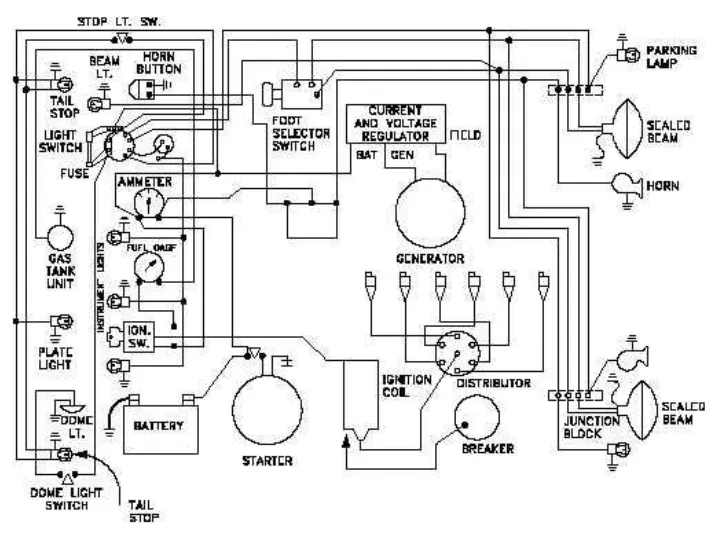
1.Identify each of the major elements in the above automotive wiring diagram.
ANS:
- Genarator
- Junction Block
- Battery
- Starter
- Ignition coil
- Ignitation switch
- Distributor
- Ammeter
- Foot selector switch
- Breaker
- Fuse
- Current and voltage regulator
- Gas tank unit
2.Explain the purpose and working of any three elements briefly
1,Battery:
Battery is a collection of cells used to store energy.
The chemical reactions occuring in the cells of a battery result in the flow of electricity in a circuit.
The battery supplies DC voltage.
Battery is classified in Two types
1,Primary (Non Rechargeable) battery
Zinc Carbon batteries (REMOTE Batteries)
2,Secondary (Rechargeable) batteries
Secondary (Rechargeable) batteries are used in automotive systems.
Lithium-ion batteries are mainly used in eletric vehicles.
These batteries are commercially superior with superior performance and more cost-effective in terms of battery life and maintanance.
2,Motor;
It converts electrical energy to mechanical energy.
It can provides power up to Mega-Watt ranges.
The main parts of electric motor are Armature, Field, Brushes and commutators.
Armature generates torque and Fields generate the magnetic field.
The commutator and brushes are used to change the direction of electric current.
The working principle of motor is, When a current carrying conductor is placed in a magnetic field , some torque is experienced on the conductor.
Brushless direct current motor and electronically commutated DC motor are used in 2- wheeler- 3 - wheeler electric vehicle.
For high power vehicles, permanent magnet synchronous motor, 3-phase induction motor and switched reluctance motor are used.
3,Generator;
A device that is identical to a motor mechanically but generator converts mechanical energy to electrical energy.The purpose behind this conversion is to produce power for domestic and industrial purpose.There are three types of generators mainly they are inverter, standby and portable generators.
A generator converts mechanical energy into electrical energy by passing electrons from external source through a circuit.The generators working near the dams will provide high amount of energy creating power from the water.This is done by the use of turbines. The generators used in homes depend on deisel or gas to generate power.
Generator is also called a dynamo, it converts mechanical energy into electricity for transmission and distribution over power lines to domestic, commercial, and industrial customers. Generators also produce the electrical power required for
- automobiles
- aircraft
- ships
- trains
3.If the total load is 10A from battery, what should be the fuse rating?
Given data :
Total load - 10A
Voltage - 12 V
we know -
P = V*I = 300 kw
Fuse Rating= (P*1.5)/V = (120*1.5)/12
=15 A
The fuse rating should be 15A.
We can use a fuse of 13 A or 15 A . which is about 1.3% or 1.5% more than total load.
4.If 500W is the load, what is the voltage and capacity of battery you recommend?
Ans: Given data -
I = 10A
P = 500W
we know -
V = P/I = 500/10 = 50V
C = I*T =10*1 = 10Ah
Voltage and Capacity for this battery should be 50V and 10Ah.
5.Identify any two elements which are connected parallel to each other. Why they are connected in parallel?
Headlight and other lights : are connected in parallel with the battery.They are connected in parallel to avoid voltage drop across each connection and also if they are connected in series if any one light fails the others in the grid will not glow.
Horn : They are connected in parallel to avoide voltage drop, if any voltage drop occurs it will effect the sound or loudness of the horn.
6.Identify any two elements which are connected in series. Why they are connected in series?.
Battery:connected in series with high voltage to improve the drivability and energy efficiency
Ammeter:An ammeter is a device which measures the amount of current flowing in a circuit. It is a very low resistance(nearly zero) device. If it will be connected in parallel, it would draw most of the current and would get damaged.