Project - Analysis of a practical automotive wiring circuit
1. First of all, there is no minor element in the above automotive wiring diagram because every minor element plays a mojor role in an automotive. For example if we take lights as a minor element but without lights we cann't drive the vhiecle in night therefore every element plays a major role. So the major element in the automotive wiring diagram as follows- 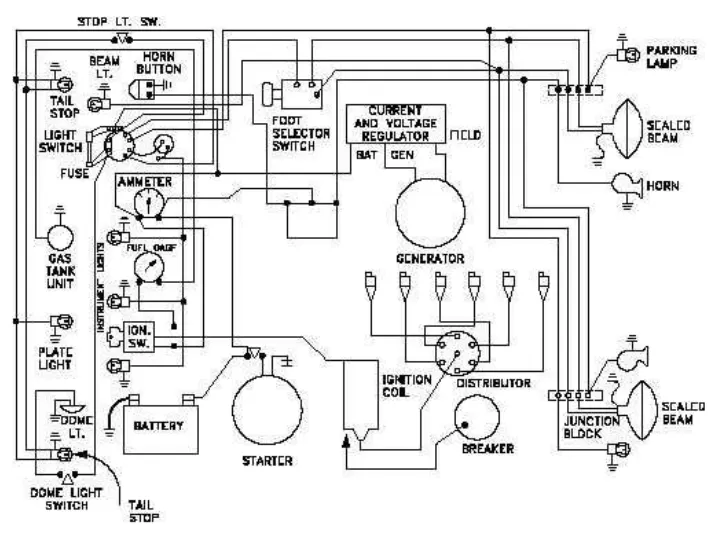
- Battery
- Generator
- Current and voltage regulator
- Distributor
- starter
- Ignition coil and switch
- Instrument and beam light
- Horn & its button
- Gas tank unit
- Parking lamp
- Scaled beam
- Junction block
- Foot selector switch
- Ammeter
- Fuel guage
- Fuse
- Tail stop
- plate light
- Dome light and its switch
2. Purpose and working of three elments as below-
- Battery:- main purpose is to provide an electric current to the electric-powered starting motor, which in turn starts the chemically-powered internal combustion engine that actually propels the vehicle. Once the engine is running, power for the car's electrical systems is still supplied by the battery, with the alternator charging the battery as demands increase or decrease.
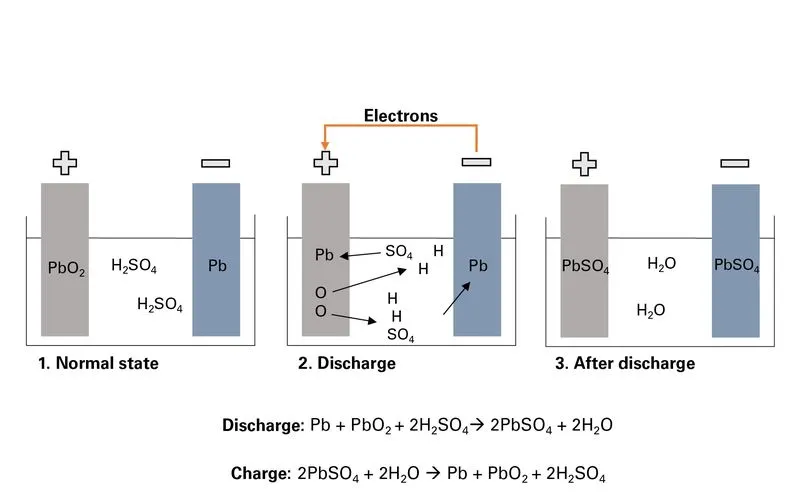
working- Most car batteries rely on a lead-acid chemical reaction to get things moving and grooving. These batteries fall into the "SLI" category. SLI stands for "starting, lighting, and ignition." This type of battery provides short bursts of energy in order to power your lights, accessories, and engine. Once the battery jolts the engine to life, power for the car is supplied by the alternator. Most vehicles come with a generic SLI battery from the factory.
A typical SLI battery has six cells. Each cell has two plates, or grids: one is made of lead, the other of lead dioxide. Each cell is able to produce about 2-volts of energy. In most car batteries you have six cells, and therefore a 12-volt battery.
- The plates are submerged in sulphuric acid that triggers a reaction between the two plates. In scientific terms, the acid acts as a catalyst.
- This acid will trigger a reaction on the lead dioxide plate, causing the plate to produce two things: ions and lead sulphate.
- The ions produced by the lead dioxide plate react to the adjacent plate to produce hydrogen and lead sulphate.
- The result is a chemical reaction that produces electrons. The electrons race around the plates and generate electricity. The electricity flows out of the battery terminals to start your engine, turn on your headlights, and play the radio.
- This chemical reaction is entirely reversible, which is why you can jumpstart your battery and continue to charge it throughout the duration of its life. By applying current to the battery at just the right voltage, lead and lead dioxide will form on the plates and you can reuse your battery, over and over again!
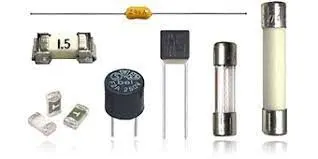
b. Fuse:- Automotive fuses are a class of fuses used to protect the wiring and electrical equipment for vehicles. They are generally rated for circuits no higher than 32 volts direct current, but some types are rated for 42-volt electrical system. They are occasionally used in non-automotive electrical products.
working- A fuse consists of a piece of wire made of a metal or an alloy of an appropriate melting point, for example, aluminum, copper, iron, lead etc. If a current larger than the specified value flows through the circuit, the temperature of the fuse wire increases. This melts the fuse wire and breaks the circuit.
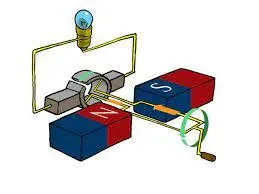
c.Generator:- The function of the generator is to supply current for the operation of the ignition system, the lighting system, and all other electrical parts when the engine is running and to replenish the battery after it has supplied current for starting and other purposes when the engine is at rest.
working- Electric generators work on the principle of electromagnetic induction. A conductor coil (a copper coil tightly wound onto a metal core) is rotated rapidly between the poles of a horseshoe type magnet.
3. Fuse rating:- fuse rating is the amount of power that fuse can handle before it melts down.
The fuse rating can be calculated by dividing the power used by the appliance by the voltage going into the appliance.
i.e. I = P/V where, P-power, V-voltage
We have to be given that total load is 10A from battery. So our fuse rating should be 10A.
4. Given:- load or power=500W,
we have to find:- a) voltage of battery b) capacity of the battery
a) so, we have to be given an automotive wiring diagram, and we generally preffered a 12V battery in an automotive therefore voltage(V) of battery should be = 12V
which is sufficient for the load of 500W.
b) Capacity:- It is defind as the amount of energy, a battery can deliver in single charge. It is expressed in ampere-hour(Ah).
we know that rate of doing work is defing as power i.e.,
power(P)= (work or energy) / time = voltage*current
let be assume, battery gives power for an hour or 1hr .
Than, we recommend the battery,
capacity or amount of energy = (power(P)*time)/voltage = (500*1)/12
= 41.67Ah or 42Ah (answer)
5. Elements in parallel can be recognized in two ways:-
- If multiple elements are connected to the same pair of nodes, the elements are in parallel.
- If applying KVL around a loop results in the conclusion that the voltages in two elements are identical, the elements are in parallel.
- All the appliances get their rated voltage so that they function efficiently.
- All the components can have their independent switch to control them.
- If one appliance gets faulty, it doesn't affect the other appliances.
6. When two elements are connected end to end are said to be connected in series. In a series connection, the same current physically flows through both elements.
From the diagram, it is clearly visible that "Fuel gage" and "gas tank unit" are connect in series.
The reason of 'fuel gage and gas tank unit' connection in series is that any changes comes in gas tank unit will be shown to us directly in the fuel gage by means of mechanically or electronically arrangement so that we can refuel our vhiecle for continous driving.