Project - Analysis of a practical automotive wiring circuit
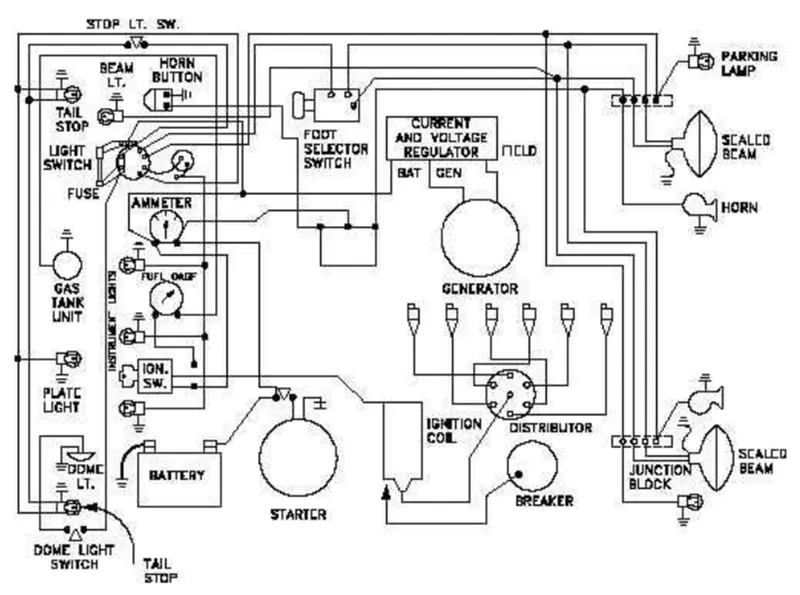
Q1 ] Identify each of the major elements in the above automotive wiring diagram.
- Generator
- Battery
- Starter
- Ignition coil
- Current and voltage regulator
- Distributer
- Ammeter
- Junction box
- Breaker
- Fuse
- Foot selector switch
Q2 ] Explain the purpose and working of any three elements briefly.
Battery :
The battery element is made up of negative plates, positive plates, separators, and straps . Each cell compartment contains two kinds of chemically active lead plates, known as positive and negative plates. The battery plates are made of GRID coated with porous lead. These plates are insulated from each other by suitable separators and are submerged in a sulfuric acid solution . Charged negative plates contain spongy ( lead which is gray in colour. Charged positive plates contain lead peroxide which has a chocolate brown colour. These substances are known as the active materials of the plates. Calcium or antimony is normally added to the lead to increase battery performance and to decrease gassing . Since the lead on the plates is porous like a sponge, the battery acid easily penetrates into the material. This aids the chemical reaction and the production of electricity. Lead battery straps or connectors run along the upper portion of the case to connect the plates. The battery terminals are constructed as part of one end of each strap. To prevent the plates from touching each other and causing a short circuit, sheets of insulating material called separators, are inserted between the plates. These separators are thin and porous so the electrolyte will flow easily between the plates. The side of the separator that is placed against the positive plate is grooved so the gas that forms during charging will rise to the surface more readily. These grooves also provide room for any material that flakes from the plates to drop to the sediment space below.
As automotive engines require an electrical power to rotate its starter motor, the battery must be employed. it is a rechargeable battery that is used to supply electrical current to a vehicle’s electrical components. apart from starting the engine, it’s one of the major components of an automobile charging system, as it stores currently for further usage.An automotive battery is of different kinds but there are common ones used in vehicles. Wet cell battery is used. it contains six-cell, which each of it is lead storage consisting of alternate plates. The plate is made of a lead grid filled with sponge lead.
Modern vehicles including the gasoline and diesel type make good use of a battery. Their starting power use at least 3 per cent of the battery power, which is why the automotive battery is designed to deliver maximum current for a short period of time. Though electric and hybrid cars also make good use of a battery, but of a different type.
GENERATORS
The generator is a machine that applies the principle of electromagnetic induction to convert mechanical energy, supplied by the engine, into electrical energy. The generator restores to the battery the energy that has been used up in cranking the engine. Whether the energy required for the rest of the electrical system is supplied directly by the generator, by the battery, or by a combination of both depends on the conditions under which the generator is operating.
Generators don’t actually create electricity. Instead, they convert mechanical or chemical energy into electrical energy. They do this by capturing the power of motion and turning it into electrical energy by forcing electrons from the external source through an electrical circuit. A generator is essentially an electrical motor working in reverse.
Some electrical generators, such as those at Hoover Dam, for example, are huge and provide enormous amounts of energy by transferring the power created by water turning turbines into electricity. Residential and commercial generators, however, are much smaller and rely on more traditional fuel sources like diesel, gas, and propane to create mechanical power that can then be forced into a circuit and induce an electrical current.
Once an electrical current has been established, it is directed through copper wires to power external machines, devices, or entire electrical systems.
Modern generators can be attributed to Michael Faraday’s principle of electromagnetic induction. Faraday discovered that when a conductor moves in a magnetic field, electrical charges could be created and directed to create a flow of current. At its most basic, an electrical generator is nothing more than an electromagnet – moving wire near a magnet to direct the flow of electricity. It’s similar to how a pump pushes water through a pipe.
Fuse:
- An electrical fuse is a safety device that operates to provide protection against the overflow of current in an electrical circuit.
- An important component of an electrical fuse is a metal wire or strip that melts when excess current flows through it.
- It helps to protect the device by stopping or interrupting the current.
- In this article, let us know in detail about the Working Principle of the electrical fuse and its functions and types.
Working Principle of Fuse :
- The primary use of an electric fuse is to protect electrical equipment from excessive current and to prevent short circuits or mismatched loads.
- Electrical fuses play the role of miniature circuit breakers.
- Apart from protecting equipment, they are also used as safety measures to prevent any safety hazards to humans.
- The fuse wire in an electrical fuse is selected in such a way that it does not face any damage when the normally stipulated amount of current flows through the circuit.
- Under normal conditions, the fuse wire is a part of the circuitry, contributing to a complete loop for charges to flow through it.
- However, when an excessive amount of current flows through the fuse wire, the heating effect of the current causes the fuse wire to melt.
Purpose :
- Acts as a barrier between the electric circuit and the human body
- Prevents device failure due to faulty circuit operation
- Fuse prevents short-circuits
- Prevents overload and blackouts
- Prevents damage that is caused due to mismatched load
Q3 ] If the total load is 10A from battery, what should be the fuse rating?
Given data:
Total Load = 10A
Fuse rating = ?
take battery voltage = 12V
Formula :
Power = V * I
= 12 * 10
Power =120 kw
Fuse rating = F = (P * 1.5 ) / V
= (120 * 1.5) / 12
= 15
Fuse rating value is 15.
Q4 ] If 500W is the load, what is the voltage and capacity of battery you recommend?
Given:
Assume I = 25A
Power (P) = 500 W
Time = 24 hours
Voltage (V) = ?
Capacity (C) = ?
Formula:
Power (P) = Voltage(V) * Current (I)
Voltage = 500 / 25
Voltage = 20V
Capacity (C) = Current (I) * Voltage (v)
=25A * 20A
Capacity = 500Wh
Q5 ]Identify any two elements which are connected parallel to each other. Why they are connected in parallel?
- Generator
- current voltage and regulater
There are connected in parallel the same differential of potential voltage across their ends.
Q6]Identify any two elements which are connected in series. Why they are connected in series?
- Battery
- Starter
there are in series to each other because same current flows