Project 9

Rolls-Royce is the world’s leading supplier of marine propulsion equipment. Its products and services range from complete ship design to integrated propulsion, maneuvering, and positioning systems and deck machinery. Other nonaerospace products include aerospace-derived gas turbines for the oil and gas industries and power-generation plants and nuclear power systems for the Royal Navy.
Two-thirds of our investment is aimed at improving the environmental performance of our products, for example investing in low-carbon technologies like nuclear energy.
A key element in our approach to technology acquisition is our three-phase Vision Programme. Developing the right technologies means looking far into the future and generating a vision of what the needs of our customers will be. Technology acquisition is therefore planned over three time horizons:
Vision 5 - applying technology
Vision 5 describes the technologies that we currently have available 'off-the-shelf'. They will be incorporated into new products, such as the aero Trent XWB gas turbine, while some existing engines will be modified to incorporate these proven technologies. Vision5 will ensure that current products remain market leaders in every aspect of performance, reliability and cost.
Vision 10 - the next generation
Vision 10 embodies technologies currently at the validation stage which are due to be commercially available in the medium-term to up to ten years from now. The next generation of our market-leading products will rely largely on Vision10 technologies.
Vision 20 - exploring new ideas
Vision 20 technologies target future generations of products in a 20-year timeframe. These are at the strategic research stage – emerging or as yet unproven – but will ensure that we are prepared for future market developments by focusing our extensive research base (including universities and institutions) on the technology requirements of future generations of products.
MOOD BOARD
Mood boards are physical or digital collages that arrange images, materials, text, and other design elements into a format that’s representative of the final design’s style. Sometimes called inspiration boards, mood boards can be used for creating brand designs, product designs, website designs, and pretty much any other type of design project. I’ll share an overview of how to use them in your work, along with inspiring mood board examples.
Purpose of a Mood Board
Mood boards can serve many purposes, starting with organizing the inspiration around a project. They can be a valuable resource throughout the design project, to help keep the style and aesthetic consistent and on track with a client’s goals and expectations.
Mood boards are also an excellent way to refine a project’s style before diving into the actual design process. They’re a much lower investment than mockups and prototypes in terms of resources and time and can convey a lot about the look and feel of the final design.
Mood boards are also an excellent way to convey design ideas to clients. When a web designer says “minimalist” or “Grotesk fonts” or “realism,” a lot of clients will be completely clueless as to what that means. But show them a mood board that incorporates those things and they immediately understand and can express whether they love or hate the ideas.
Finally, mood boards can also ensure that design teams are all on the same page when working on a project together. One designer’s idea of minimalist might be a lot more maximalist than their colleague’s.
How to Create a Mood Board
There isn’t just one way to make a mood board. They come in all different formats, shapes, and styles. Some designers create them digitally while others create physical collages. For those who create mood boards digitally, there are a number of options available, from Photoshop templates to dedicated apps.
What to Include on a Mood Board
Every mood board is different, and what a designer chooses to include will vary based on the project. A brand mood board might include a lot more elements than one for a package or website design. The important thing is to include as many elements as needed to convey the look and feel of the design being created.
Here are some ideas for things to include in a mood board:
Images: These can include brand images, stock photography, product images, photos found on Instagram or other photo sharing sites, illustrations, and even things like logos.
Colors: Incorporating the design’s color palette is an important part of most mood boards and can be included as swatches or incorporated into images and other design elements.
Visual Metaphors: Visual metaphors are an important part of modern advertising and branding, and can be included if appropriate.
Words: Words that tie into the brand or message that should be conveyed can be an important part of any mood board.
Fonts: Designers should include specific fonts (or at least general font styles) into their mood boards for any design where the text will be prominent.
Textures: Any textures or patterns a design will incorporate should be included in the mood board.
Explanations: As needed, explanations for elements included in the mood board can add context and make it easier to see how all of the different parts will work together toward the end design.
Settling on a theme can bring cohesiveness to the mood board as well as to the final design based on it. The theme should be closely tied to the goals of the design or brand, though it can be abstract. For example, a kids’ clothing site might have a jungle or carnival theme, but that doesn’t mean it needs to have tigers or clowns incorporated. Instead, its theme board could include things like natural textures or primary colors.
Collecting Mood Board Inspiration
Mood board ideas can come from virtually anywhere. Designers often keep swipe files of inspiration, which is a great place to start. Otherwise, look to places like stock photo sites, design galleries, color palette sites like Coolors.co or Design Seeds, the physical environment and physical objects, typography galleries like Typewolf, and even social media (Instagram and Pinterest can be particularly ripe grounds for finding design inspiration).
When collecting inspiration for a mood board, designers should keep the goals of the finished project in mind. They should also keep in mind things like brand values and who the target user will be. These all have a significant impact on the types of inspiration collected.
For example, a website design for a corporate law firm will likely have a significantly different tone and style than one for a street fashion site aimed at teenagers. If designers don’t keep these differences in mind when they begin working on a mood board, the finished board likely won’t resonate with their client.
Not every element on the mood board has to relate directly or literally to the finished design. Finding images that evoke a feeling or general style are just as important as specific fonts, colors, and design elements.
Mood Board Formats
Mood boards can be created in physical or digital formats. There are pros and cons to either one.
Physical mood boards can help digital designers think outside the confines of a screen. These can be excellent for projects taking a lot of inspiration from the physical world. But it can also require a lot of printing and a bit more mess to create. Physical mood boards can also be harder to archive or share with clients or other team members (the best sharing option is often to take photos of them).
Digital mood boards, on the other hand, can sometimes limit a designer’s creativity, in the sense that they’re going to be using the same tools they use on a daily basis, which may mean they’re using the same mindset they always use. In some cases that won’t be a bad thing, but when trying to come up with a truly unique design, it can be a hindrance. Digital mood boards are really easy to share, though, as they can simply be exported as an image file and shared (and some programs allow sharing directly).
Mood Board Software
There are a number of software options for creating mood boards. You can use virtually any design program you’re already using (there are templates available for most of them, too). Other options include:
- Pinterest. Creating a board for each project is a great way to organize ideas found online. Boards can be made public or private (and shared with specific individuals).
- Moodboard. Create free mood boards with no account needed. There are templates to help get started or create one from a blank design.
- Moodzer. Moodzer is new to the scene (currently a beta app) but appears to have all the features needed to create stunning mood boards that are easy to share.
- Adobe Express. Adobe Express makes it easy to create mood boards in formats that play nicely with other Adobe products. They offer plenty of flexibility for creating mood boards in various shapes and sizes, with a library of stock photos, fonts, and design elements.
- Canva. Canva offers mood board templates and a variety of built-in fonts, design elements, and stock photos.
The software used for creating mood boards isn’t important. What is important is that it’s done in a format that sparks creativity and is easy to share with clients or other decision-makers.
Mood Boards as Communication Tools
One of the biggest advantages of creating a mood board before diving into mockups and prototypes is that it’s a valuable tool for communicating with clients and other team members. When designers create mockups and prototypes first, if the client isn’t happy with the design, it can result in not only wasted time and resources but also a loss of trust if the client feels it’s totally different from what they wanted.
Creating a mood board can also prevent the dreaded “I’ll know it when I see it” syndrome with clients. Showing them a mood board gives them something to see that’s still relatively low-fi and easy to create. Designers can even create multiple mood boards if they’re entirely unsure of what the client might want.
Showing clients a mood board early in the process can also mean fewer revisions to the finished designs since it can put the designer and client on the same page from the beginning of the design process. And when designers meet client expectations from the beginning (even when those expectations aren’t well articulated), the client puts more faith in the designer’s abilities.
AUTOMOTIVE TECHNOLOGIES
Today's vehicles include more technology than ever, such as self-driving and parking abilities and automatic braking, and that technology needs qualified professionals to build, maintain and repair it. Because of the changing technology, there are a variety of automotive technology jobs if you are interested in working in the industry. In this article, we explain what automotive technology is, some of the required skills to work in the industry and list 13 jobs that may interest you. Automotive technology is the study of how self-propelled vehicles move and refers to the creation or design of vehicle technology and the remediation or repairs required. This can involve the engine and other systems, engineering, mechanics and computer technology. Besides consumer vehicles, public transportation, heavy machinery and heavy trucks also require automotive technicians and related careers, and those who work in the field must continue to learn new technology, software and equipment as the industry grows.
TREND ANALYSIS
1. Autonomous Vehicles (AVs)
Self-driving or autonomous vehicles minimize the need for human drivers and look poised to transform everyday transportation. Fleets of AVs expand the scope of last-mile deliveries, reduce downtime, and aim to make public transportation relatively safer. For example, by reducing accidents caused due to driver fatigue or negligence. AVs are equipped with advanced recognition technologies, such as AI-enhanced computer vision to identify obstacles along the route.
Intvo increases Autonomous Vehicle Safety
The US-based startup Intvo develops a pedestrian behavior prediction technology. Unlike two-dimensional (2D) and three-dimensional (3D) object detection technologies that consider limited parameters, their solution checks for head position, eye contact, and leg movements of the pedestrians, weather conditions, and assigns a risk level. This reduces false positives in pedestrian detection and enhances the safety of autonomous vehicles.
Udelv builds Autonomous Vehicles for Las Mile Delivery
The US-based startup Udelv provides autonomous vehicles for last-mile deliveries. It combines advanced AI algorithms and hyper-speed teleoperations for human-assisted guidance in unique situations. The startup’s vans have a payload capacity of approx. 360 kg (800+ lbs) and reach speeds up to approx 100 km/h (60 mi/h). The vans deliver groceries from nearby stores and send out a push notification when the order arrives.
2. Vehicle Connectivity
Nowadays, vehicles come with a tamper-proof digital identity that differentiates them from other vehicles in the network. This enables easy tracking of vehicular data for various use cases such as insurance, driver safety, predictive maintenance, and fleet management. Sharing vehicular data helps not just the individual customer, but overhauls the entire mobility ecosystem. Startups and scaleups develop vehicle connectivity solutions that enable them to connect and exchange data with other vehicles (V2V), an electric vehicle grid (V2G), public infrastructure (V2I), as well as with new and emerging ways to utilize vehicle data (V2X).
V2X Network offers a Connected Vehicle Data Platform
British startup V2X Network offers a vehicle-to-everything (V2X) platform for autonomous transactions that combines geo-networking and caching to enable low latency real-time communication. The platform runs on distributed ledger technologies (DLTs) and allows for a high degree of scalability. The startup uses enterprise-grade encryption in order to provide users control over their data to enhance security and privacy measures.
NoTraffic facilitates Digital Road Infrastructure Management
Israeli startup NoTraffic develops an AI-powered traffic signal platform that digitizes road infrastructure management and connects drivers to the city roadways to manage various traffic-related challenges. The data of all road users is streamed and processed in real-time to empower smart mobility. The solution also serves as the base for additional services such as micropayments and micro-mobility.
3. Electrification
The depleting fossil fuel reserves and the harm to the environment caused by their use call for promoting the use of electric mobility solutions. For greater adoption, EVs need to address issues such as high price, poor battery, inadequate charging infrastructure, fleet electrification, as well as powering renewable energy-based charging grids. These challenges, along with the need to tackle increasing greenhouse gas emissions across the world, startups are working on electrification solutions.
Lordstown Motors builds an Electric Pick-up Truck
The US-based Startup Lordstown Motors Corps makes an all-electric pickup truck. The truck, EnduranceTM, is designed to be a sturdy work vehicle and comes with fewer moving parts compared to traditional commercial vehicles, thus enabling easier maintenance. It features 4 hub electric motors to provide a four-wheel drive and is capable of traveling more than 250 miles (400 km) on a single charge.
ChargeX specializes in Modular Electric Vehicle Charging Solutions
German startup ChargeX offers a modular EV charging solution that converts parking spaces into charging stations. The startup’s platform, Aqueduct, is easy to install, has 4 charging modules with up to 22kW, provides monthly reports, and uses a Typ2 charging cable. The solution recognizes the power requirements of every car and automatically controls the charging speed for each vehicle.
4. Shared Mobility
With connected vehicles, new business models have come up that focus on shared mobility as an alternative to traditional vehicle ownership. This enables mobility-as-a-service (MaaS) and discourages unused vehicles. Such solutions meet the requirements of a city or a business without adding new vehicles, thus reducing waiting time for fleets and pollution caused by petrol or diesel vehicles.
Launch Mobility combines Shared Mobility Solutions in a Single Platform
The US-based startup Launch Mobility develops a platform for a range of shared mobility solutions. The platform LM Mission ControlTM offers free-floating or station-based car sharing, advanced shuttle services, shared dockless scooters, keyless rental programs, and peer-to-peer shared mobility. The LM Misszon ControlTM dashboard allows business users to manage their fleets. Further, their drivers use out-of-the-box or white-labeled apps to manage reservations or remotely access vehicles.
Beam develops Electric Scooters for Urban Mobility
Singapore-based startup Beam focuses on e-scooters to promote shared mobility in the Asia-Pacific region. Their scooters use an aviation-grade aluminum frame and are customized for sharing, safety, reliability, and durability. Users discover the nearest Beam scooter on the app and park it in visible public spots after the ride. Further, the micro-mobility platform offers a sustainable alternative to short-distance rides and helps regulate traffic flow in cities.
5. Artificial Intelligence
Artificial intelligence technologies such as machine learning, deep learning, and computer vision find applications in robotic automation within the automotive industry. These guide self-driving cars, manage fleets, assist drivers to improve safety, and improve services such as vehicle inspection or insurance. AI also finds applications in automotive manufacturing, where it accelerates the rate of production and reduces costs.
RevitsOne provides AI-based Fleet Management Solutions
Indian startup RevitsOne offers an AI-powered fleet-management software that is suitable for fleets of varying sizes. The startup’s vehicle management system provides insights into speed, running vitals, and health information. Drivers benefit from Voicera ID, a voice-based virtual assistant that helps them keep track of the information they need. Additionally, the onboard speed recorder limits the speed to discourage dangerous driving behaviors.
Apex AI offers an Integrated Automotive Data Management Platform
The US-based startup Apex AI enables automotive companies to implement complex AI solutions. Apex.OS runs on automotive electronic control units (ECUs) and offers robust, reliable, and secure APIs to develop autonomous mobility solutions. ApexAutonomy offers modules to build 3D perception, localization, and control to enable autonomous vehicles. Lastly, MARV.Automotive is a configurable and extensible data management platform that reliably transmits data from the vehicle to the cloud.
6. Big Data & Analytics
The age of big data and advanced analytics informs various decisions throughout the lifecycle of a vehicle. Data gathered from vehicles enables predictive maintenance, informs managers about their fleets, and alerts concerned authorities in case of accidents. Moreover, customer automotive data finds applications in driving sales, optimizing supply chains, and enhancing product design for newer vehicles. Startups and emerging companies develop big data solutions to help automotive manufacturers, as well as ancillary industries, streamline their operations to maximize their margins.
Procon Analytics delivers Automotive Finance Solutions
The US-based startup Procon Analytics leverages big data to offer a solution for automotive finance. The solution captures millions of data points in real-time and analyzes them to enable lenders to instantly assess and reduce risk. This allows Buy Here Pay Here (BHPH) dealers to expand their businesses and extend credit to high-risk customers. Further, this also offers software solutions for fleet and asset tracking as well as connected cars.
Unit8 offers Automotive Big Data Solutions
Swiss startup Unit8 uses big data and analytics to offer digital solutions for various industries. For the automobile sector, the startup develops predictive models that encourage car companies to improve marketing or operations and increase their revenue. These models provide insights into product build, price, as well as after-sales service.
7. Human-Machine Interfaces (HMI)
As self-driving cars and connected cars transform the automotive landscape, it will fundamentally change how drivers interact with vehicles. Human-machine interfaces use voice-based or haptic feedback to operate vehicles. These expand the scope of how and what aspects of a car that users control. Consequently, such interfaces make the driving experience safer and more enjoyable. Another form of HMI includes smart virtual assistants who help drivers and riders interact with the vehicles and other service providers.
Awayr creates Advanced HMI Solutions for Connected Cars & Autonomous Vehicles
The US-based startup Awayr develops human-machine interfaces for vehicles, unmanned aerial vehicles (UAVs), and robots. The startup works with automotive original equipment manufacturers (OEMs) to decrease HMI development cycle time and enhance the safety of interfaces. Awayr also builds solutions to manage driver attention in unconventional situations, such as autonomous vehicles that may occasionally need human intervention.
Apostera specializes in Advanced Driver Assistance Systems (ADAS)
German startup Apostera offers an advanced driver-assistance system (ADAS). The startup’s platform combines augmented reality (AR), smart camera, and surround-view monitoring to illuminate the route on turns, curves, slopes as well as complex junctions. This assists the drivers in keeping lanes, prevents collisions, and enables autonomous driving options. Moreover, the solution is customizable to any car model or specific OEM requirements.
8. Blockchain
Blockchain enables multiple applications in the automotive industry. These include sharing vehicle data over a secure network for connectivity and shared mobility solutions such as ride-hailing, urban transportation, and deliveries. Moreover, blockchain finds application in verifying the supply chain of spare parts or making sure that the raw materials and spare parts are sourced exclusively from legal and trusted sources.
Cube Intelligence builds Blockchains for Autonomous Vehicles
British startup Cube Intelligence develops a blockchain-based security platform for autonomous vehicles. The startup’s technology utilizes hash codes to block malicious attacks or hacking attempts on autonomous cars and connected cars. The hardware used gathers real-time data on mobility and emissions. Additionally, Cube Intelligence offers ride-hailing and valet parking services for AVs, as well as smart parking management systems.
DAV offers a Decentralized Autonomous Vehicle Platform
Israeli startup DAV offers a decentralized autonomous vehicles platform based on blockchain technology. The platform allows autonomous vehicles to discover AVs, service providers, or clients around them. The vehicle-to-vehicle (V2V) communication is either on-blockchain, with smart contracts, or off-blockchain using DAV’s protocols. The startup develops protocols for drone charging networks, drone flight planning, and open mobility.
9. 3D Printing
3D printing helps the automotive industry in three primary ways. Firstly, it enables rapid prototyping with 3D printed models that accelerate the design and testing phases of production. Secondly, it allows manufacturers to print spare parts to match their requirements. Lastly, additive manufacturing of composite materials leads to automotive parts that are lighter, stronger, and more durable.
9T Labs develops Carbon Composites for Automotive Applications
Swiss startup 9T Labs employs additive manufacturing to produce carbon composites for use in the automotive industry. The startup’s design software Fibrify optimizes fiber placement and automates equipment production with additive fusion technology to mass-produce carbon fiber products. The 3D printed composites are more affordable, lightweight, dimensionally stable, corrosion-resistant, and also offer increased strength and stiffness.
Moi manufactures 3D Printed Automotive Parts
Italian startup Moi combines thermosetting composite materials and 3D printing to manufacture high-performance parts for the automotive industry. Moi uses continuous fiber manufacturing (CFM) technology, robotic intelligence, and digital fabrication to deposit fibers. As a result, the solution is easily scalable for producing composites for panels, frames, and interior components. The startup also serves other industries, such as aerospace, construction, and biomedical.
10. Internet of Things
In the automotive industry, as well as vehicles and infrastructure components. The technology improves road safety, solves traffic congestion, and reduces pollution and energy expenditure with better fleet management. Startups and emerging companies develop advanced sensing technologies to gather more data about the vehicle as well as allow the vehicle to understand its surroundings. The technology also automates payments for fuel and tolls.
EcoG builds an Electric Vehicle Charging Platform
Operating from Germany and the US, EcoG is a startup offering an IoT-based operating system and platform for EV charging. The startup provides manufacturers with tools that make the development and maintenance of EV charging infrastructure simple, fast, and scalable. It also allows operators to integrate services and microservices in the chargers to make the charging process profitable. In addition, the solution works with any EV charger and enables new features to be shipped throughout the network.
KonnectShift develops IoT-based Fleet Optimization Solutions
Canadian startup konnectshift provides IoT solutions to optimize fleet and asset management. The startup develops Konnect – GS01, an automatic electronic logging device (ELD) to continuously track vehicular health. The solution includes route planning and optimization for real-time dispatch, advanced analytics to enable alerts regarding driving, vehicles, and fuel, predictive maintenance alerts to reduce downtime, as well as developing driver management apps.
FORCASTING REPORT
Automotive Predictive Technology Market Analysis
The automotive predictive technology market was valued at USD 59.09 billion in 2021 and is anticipated to reach USD 94.85 billion by 2027, registering a CAGR of 8.21% during the forecast period (2022-2027).
The outbreak of COVID-19 has negatively impacted the automotive predictive technology market. Several vehicles and component manufacturing facilities worldwide were temporarily shut down, resulting in disturbances in the supply chain. However, the automotive industry started recovering slightly and is expected to continue during the forecast period.
The growing trend of technologically advanced features in the vehicles, such as artificial intelligence and machine learning to enhance safety features like ADAS and predictive maintenance focused on reducing vehicle downtime and increasing vehicle performance cost-effectively, is driving the market growth.
Autonomous vehicles and self-driving technologies also use several predictive features to alert drivers about obstacles and produce other driving alerts. Several major OEMs are investing heavily in developing autonomous vehicles, and such developments are expected to offer new opportunities for players in the market.
Asia-Pacific is expected to dominate the automotive predictive technology market, owing to the increasing demand for luxury vehicles across India, China, and Japan. The increasing installation of advanced driver-assistance systems (ADAS) is also to estimated to boost the demand for such technologies in the coming years across the region.
Automotive predictive vehicle technology is a set of vehicle technologies that incorporate predictive analytics with the use of real-time and historical data that forecast activity, behavior, and faults that may hamper vehicles if not corrected in real-time. The report covers the latest trends, COVID-19 impact, and technological developments in the market.
The scope of the report covers segmentation based on Vehicle Type, End User, Hardware Type, and Geography. By Vehicle Type, the market is segmented into Passenger Cars and Commercial Vehicles. By End User, the market is segmented into Fleet owners, Insurers, and Other End Users.
By Hardware type, the market is segmented into ADAS, On-board diagnostics, and Other Hardware Types. By Geography, the market is segmented into North America, Europe, Asia-Pacific, and the Rest of the World. For each segment, market sizing and forecast have been done on the basis of Value (USD billion).
ADAS Segment Likley to Dominate the Market During the Forecast Period
In recent years, the automobile industry motivated its research and development work for improving the ADAS systems. This led to further improvements in the advanced driving assistance systems, with a surge in demand for night-time pedestrian detection systems, lane departure warning systems, cameras, RADAR, and other sensors, which are being deployed into vehicles at a considerable pace. So, players continuously focus on deploying products with such technologies to drive demand in the market. For instance,
- In 2021, Hyundai launched its updated model for Santafee. The car is packed with a variety of features, along with safety features. Hyundai Santafee is equipped with the SmartSense safety features, which include a range of cameras, radars, and motion detection technologies such as Forward Collision-Avoidance Assist (FCA), designed to detect vehicles, pedestrians, or cyclists that are directly in front of the vehicle,
Moreover, companies like Audi, BMW, Daimler, and Volvo are a few of many OEMs that started offering night-time pedestrian detection systems. It alerts the driver or automatically brakes if there is a pedestrian in the path between a certain speed range. For instance,
- In April 2021, Volvo Cars announced its collaboration expansion with NVIDIA to use NVIDIA DRIVE Orin system-on-a-chip (SoC) technology to power the autonomous driving computer in next-generation Volvo models. The first car featuring this SoC is the next-generation Volvo XC90, which will be revealed in 2022.
Several major service providers are spending heavily on research and development of the latest ADAS technologies for vehicles to gain market share. Not only the major companies but several startups are also coming up with the latest innovative ideas and technologies, which are funded by these major players. For instance,
- In July 2020, Mobileye, Intel’s driverless vehicle R&D division, announced that the German certification body, TÜV Süd, awarded it a recommendation for a permit to drive its autonomous vehicles on public roads in Germany, including urban areas, rural areas, and the Autobahn, at up to 130 kilometers (~80 miles) per hour in real-world traffic.
Due to such developments, the ADAS segment is expected to dominate the market during the forecast period.
Asia-Pacific Expected to Hold Significant Market Share
Asia-Pacific is expected to be the fastest-growing market during the forecast period. Vehicle hybridization and electrification and increasing production of electric vehicles are the primary factors driving the demand. Countries like India, China, and Japan are picking up pace as predictive technology implementation in passenger cars is taking place gradually, as such cars or commercial vehicles equipped with such technology are in a bit higher price segment. Poor infrastructure and regulations are other reasons responsible for slow adoption.
Automobile manufacturers in the Asia-pacific region are also investing in predictive technology and launching new products equipped with features based on predictive technology. For instance,
- In April 2021, Toyota Motor Corp. unveiled new versions of the Lexus LS and Toyota Mirai in Japan, both equipped with Advanced Drive, features a Level 2 autonomous system that helps keep the car in its lane, maintains the distance from other vehicles, and assists with lane changes and advanced-driver assistance. Toyota has also announced the purchase of Lyft’s autonomous car division for USD 550 million.
- In July 2021, the Indian start-up Minus Zero developed an autonomous system based on AI and machine learning designed to work in Indian traffic conditions.
Such factors are creating huge opportunities for predictive technology across Asia-Pacific. The demand for such technologies is expected to increase in the near future.
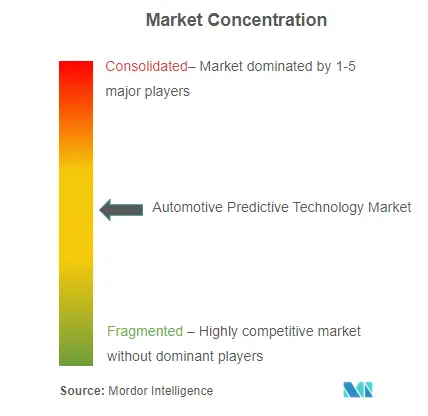
The automotive predictive technology market is moderately consolidated as it accommodates several major and new players vying for significant market share. Some of the prominent companies in the automotive predictive technology market include Continental AG, ZF Friedrichshafen AG, Robert Bosch, Aptiv PLC, and Valeo SA. These companies are focusing on strategic collaborative initiatives to expand their market shares and profits. For instance,
- In November 2021, Valeo launched WoodScape, the first-ever surround‑view fisheye camera 360 degrees open-source dataset, with the aim of taking research in computer vision to develop automated driving and parking. Valeo produces fisheye cameras enabling 360° perception, key for automated driving.
- In June 2020, Bosch announced the launch of a new MEMS sensor, the SMI230. The sensor enables trouble-free navigation and helps realistic visualization of vehicle movements, detects vibrations' impacts against a car, and triggers alarm systems for enhanced safety.
- In January 2019, Visteon Corporation, a leading automotive cockpit technology company, was enhancing its Drive Core Studio™ autonomous driving development environment through software from Microsoft Corp. that maximizes the power and scalability of the Cloud. This Cloud-based development environment enables automakers and partners to create and support an ecosystem of algorithm developers, unlocking innovation potential through an open framework for developing algorithms using sensor-based artificial intelligence (AI).
Automotive Predictive Technology Market Leaders
-
Continental AG
-
Aptiv
-
ZF Friedrichshafen AG
-
Robert Bosch
-
Valeo SA
*Disclaimer: Major Players sorted in no particular order
Automotive Predictive Technology Market News
- In July 2021, ZF premiered its new ZF ProAI supercomputer at IAA in Germany. This system comes equipped with control units, software, sensors, and actuators for software-defined vehicles and offers the latest security mechanisms against cyber threats by offering customized computing power for vehicles of any level of automation.
- In June 2021, Garrett Motion Inc. announced that it launched a new software solution focused on Model-Based Predictive Control (MPC) technology with Hyundai Motor Company (HMC). The launch by Garrett encompasses Hyundai’s all-new i20 N and is expected to include other vehicle models equipped with HMC’s new 1.6-liter turbocharged engine.
- In February 2021, Robert Bosch announced its collaboration with Fetch.ai to leverage the latest technologies like blockchain to exchange data with peers without triggering privacy controls.
- In January 2021, HARMAN announced HARMAN Turbo Connect (TBOT), a new intelligent software agent that anticipates and mitigates vehicle connectivity discrepancies on the road. The HARMAN TBOT satisfies the current demand for high-speed connectivity with low latency, especially when used alongside 5G-enabled technologies like HARMAN’s Smart Conformal Antenna and full 5G and 5G-ready Telecommunications Control Units (TCU).