Project
System-level simulation of an All-Terrain Vehicle
Detailed technical report on All-Terrain Vehicle and its model properties.
ATV: The term ATV stands for All-terrain vehicle. It is also known as quad or quadricycle. They could have 3, 4, or even 6 wheels and engine capacity ranging from 49 cc to 1000 cc depending on their application and categories.
ATVs are not road legal in India, however, some agricultural use ATVs are road legal. ATVs are meant to operate on most terrain and serve as great help in places and situations where other vehicles cannot access them. Modern ATV equips features such as a liquid-cooled engine, twin spark plugs, independent suspension, automatic transmission, 4-wheel drive, etc.
CVT (Continuously Variable Transmission)
Continuously Variable Transmission is a type of automatic transmission which allow the engine to operate at a constant RPM while the vehicle moves at varying speeds. The gear ratios change seamlessly through a wide range depending on the vehicle speed.
This contrasts with the other transmissions that provide a limited number of gear ratios in fixed steps.
Here we are studying an ATV, designed as per BAJA norms with a CVT. We also study the effect of different gear ratios, plot engine speed-torque curves, CVT catio curves, Speed vs throttle curves, effects of brake inputs for different parameter variations.
Model study:
Here we are concerned about 2 ATV models:
1. CVT model without a dashboard
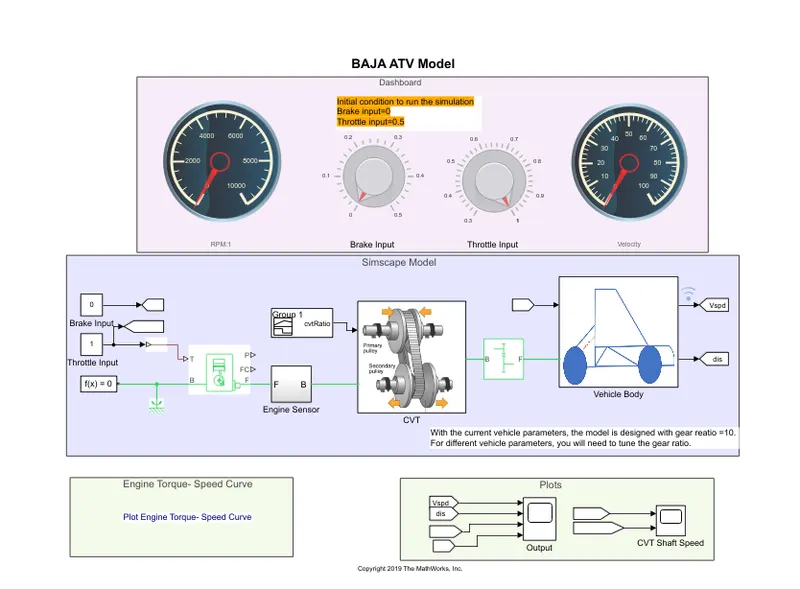
2. CVT model with a dashboard
Simulink blocks used in the ATV model:
- Signal Builder
- Generic engine
- CVT:
- Inertia block
- Ideal rotational motion sensor
- P-S terminator
- Vehicle body
- Tires
- Double shoe brakes
- Engine sensor
- Simple gear
- Variable-ratio transmission block
- Solver configuration
- Mechanical reference
- Scope
- display
- Lookup table
- Mechanical reference
- Constant
1. CVT model without a dashboard:
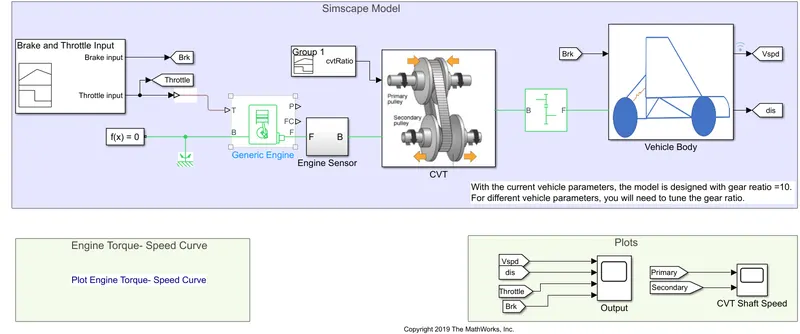
Steps of modeling:
- A signal builder block is used to generate a throttle input signal to the generic engine.
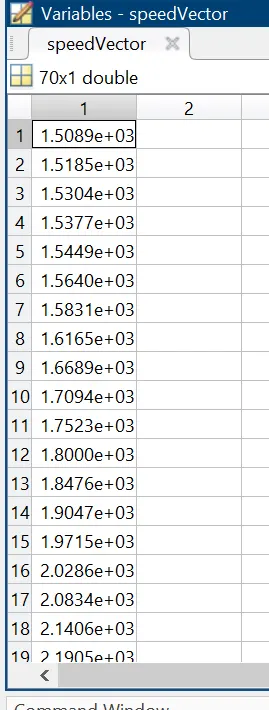
- The other inputs for the generic engine are speed vector(rpm) and torque vector (Nm). They are input to the engine using MATLAB workspace.
- The engine outputs RPM and torque which are read out by an RPM sensor inside the engine sensor.
- The CVT block has 2 inputs for the CVT ratio and engine sensor.
- A signal builder block is used to generate the CVT ratio for the CVT
- A brake signal is also generated to input brake inputs to the vehicle body which is in turn transferred to the double shoe brake.
- The power from CVT is transferred to the vehicle body through a simple gear.
- The distance traveled and the velocity readings are read out using the display block.
Inputs:
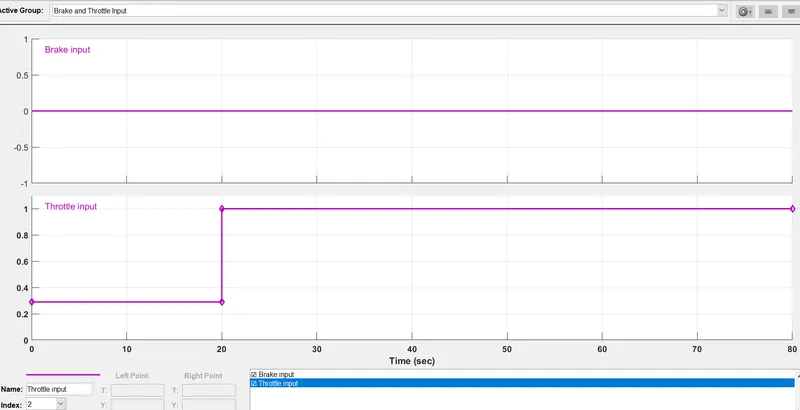
1. Throttle and Brake input:
2. Speed vector :
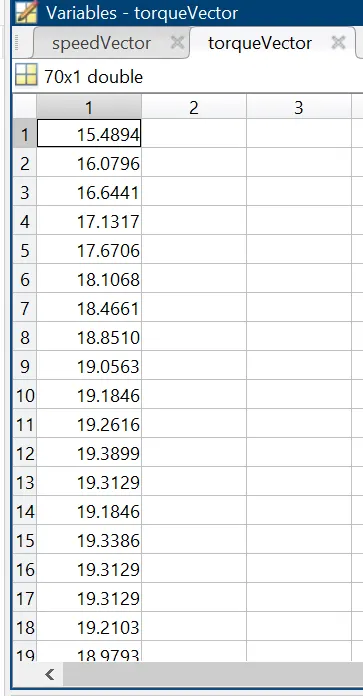
3. Torque vector:
Results:
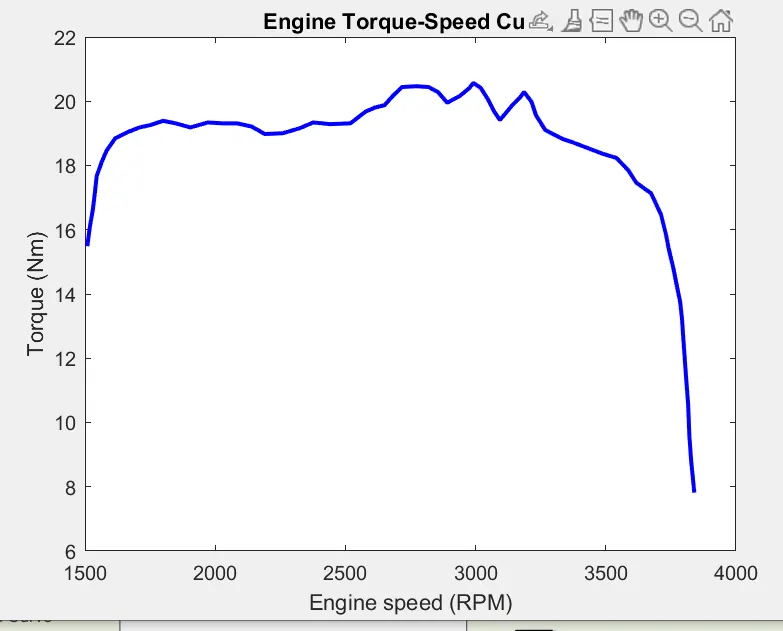
Engine torque vs speed plot:
2. CVT model with a dashboard: