Project 4
1)
Initially calculations are done so as to find out the capacity of the battery.
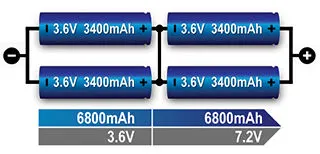
After deciding the capacity next step is to find out the number of series parallel combination of cell.
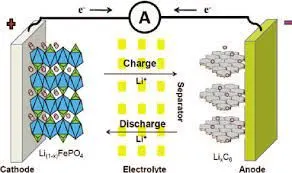
Anode and cathode materials are selected based on their properties.
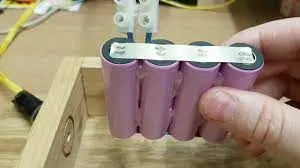
The terminals of the batteries in series and parallel are spot welded using Nickel strip so as to establish connection between them.
Select proper ventillation and cooling method for the battery so as to desipate the heat produced during the working.
Design the BMS
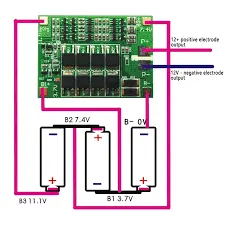
A BMS is a system that manages lithium-ion battery packs through integrated firmware and hardware.
Here the lithium ion battery datasheet of EMB company is used
Battery capacity-: 2600mAh (0.52A Discharge,2.75V)
Typical Capacity:2550mAh(0.52A Discharge,2.75V)
Minimum Capacity:2500mAh (0.52ADischarge,2.75V)
Nominal voltage:3.7V
Given power=1200W
Voltage of motor=65V
Power=VI
so 1200=65*I
I=18.5A
Consider acceleration power required .Here it is assumedd to be 5% that i 5 percent more current will be drawn
I=18.5*1.05=19.5A
Given total distance to cover=225km at 60kmph
So travel factor is to be calculated
Travel factor =225/60=3.75
so total power=3.75*19.5*65=4755Watt
Total power required=4.7kW
Assume battery efficiency=0.85
Motor efficiency=0.85
So total power required
4.7/0.85*0.85=6.5kW
So battery capacity =6.5kWh
Calculation of series parallel combination
Total power = 6.7kWh
Voltage of motor =65v
Current required =6700/65=104A
So parallel connections=104/0.52=200
Series connections=65/2.75=24
Total no of series parallel combinations = 24*200=4800