Project
Aim:
To study and analyze the BAJA All-Terrain Vehicle (ATV) using MATLAB Simulink.
Introduction:
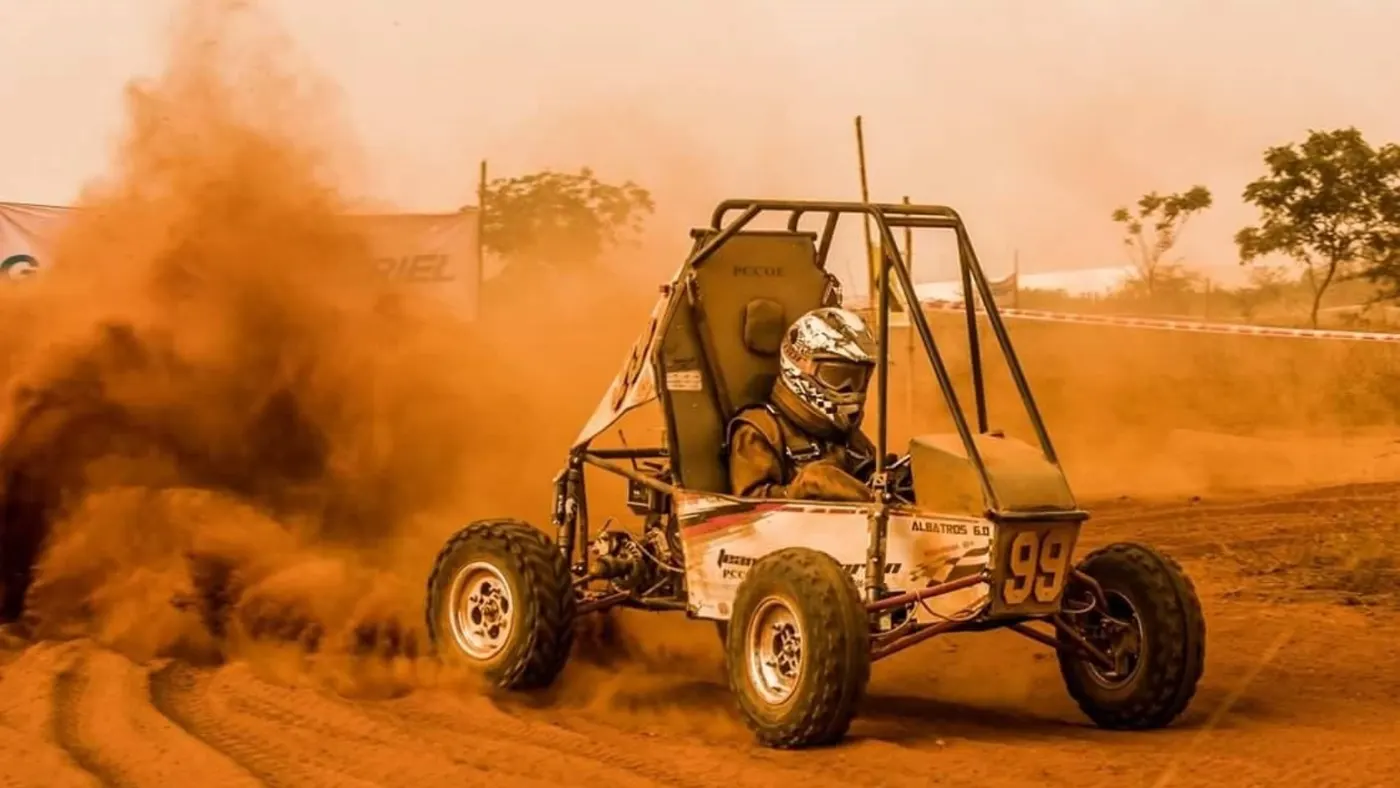
An all-terrain vehicle (ATV), also known as a quad (cycle), three-wheeler, four-track, four-wheeler, or quadricycle, as defined by the American National Standards Institute (ANSI) is a vehicle that travels on low-pressure tires, with a seat that is straddled by the operator, along with handlebars for steering control. It is designed to handle a wider variety of terrain than most other vehicles. In this project, the type of ATV is a Baja one.
Major and Crucial Components :
(1) CVT: The meaning of the abbreviation CVT is Continuously Variable Transmission, and it is a type of single-speed automatic gearbox. The CVT gearbox has been used in various cars, but you'll usually find it fitted to a small car. Its compact size and simplicity of construction mean it's more cost-effective to use in a small car than a conventional automatic gearbox.
A CVT is an automatic, single-speed, and gearless transmission that can shift through an infinite number of gear ratios. A continuously variable transmission (CVT) is a transmission that operates on an ingenious pulley system that automatically varies the transmission ratio, allowing an infinite variability(theoretically) between highest and lowest gears with no discrete steps or shifts. CVTs provide more useable power, better fuel economy, and a smoother driving experience than traditional transmissions that use gearboxes with fixed numbers of gear sets.
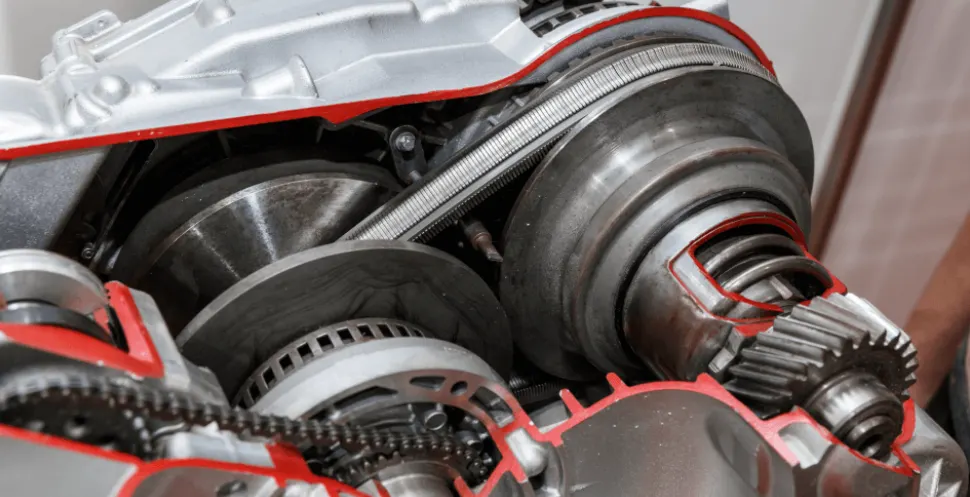
It has a relatively simple arrangement of two cone-shaped pulleys with a V-shaped drive belt connecting them. One pulley is attached to the engine, while the other is joined to the wheels. When you press the accelerator, the engine revs and the cone moves according to the amount of power asked for. The other cone adjusts accordingly so that the drive belt maintains the same tension, and this is what determines how the car accelerates.
The variable gear arrangements of CVT in this model is represented by the Variable Ratio Gear Block :
Where,
B – Base Pulley or Drive Pulley,
F – Follower Pulley or Driven Pulley
r – Variable Transmission Ratio (Input).
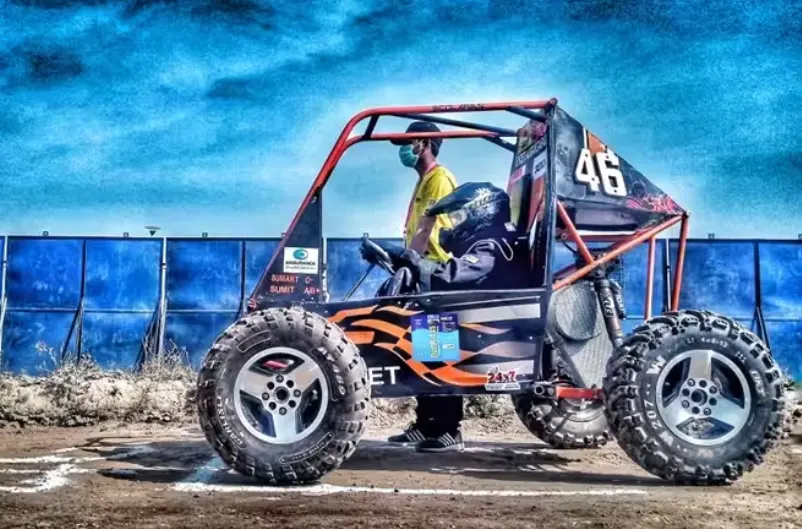
(2) Vehicle body: A Baja ATV of a Two-axle type vehicle with longitudinal dynamics and motion; has adjustable mass, geometry, and drag properties. The vehicle may have the same or a different number of wheels on each axle. For example, two wheels on the front axle and one wheel on the rear axle. The vehicle wheels are assumed identical in size. The vehicle can also have a center of gravity (CG) that is at or below the plane of travel so that it mitigates the chances of rolling over.
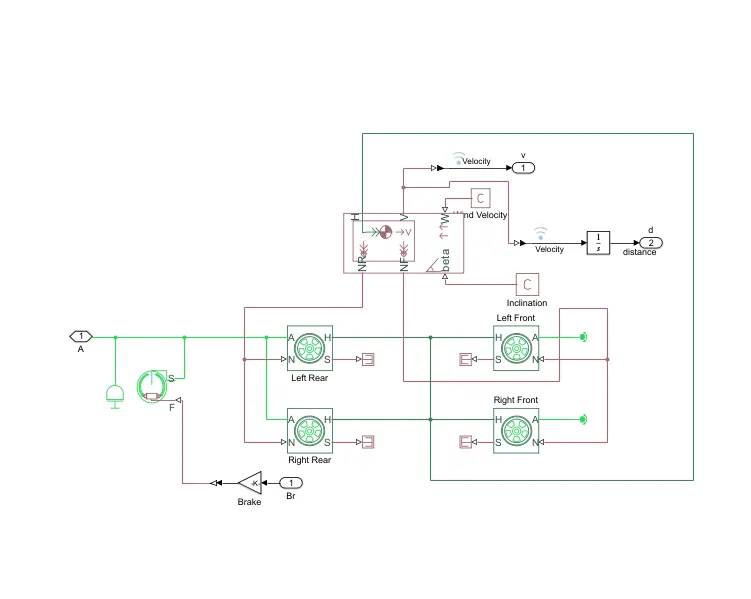
Where, NR – Rear Axle Normal Force (N),
NF – Front Axle Normal Force (N),
Beta – Road Incline Angle (rad),
V – Longitudinal Velocity (m/s),
W – Head Wind Speed (m/s) &
H – Horizontal Motion
(3) Generic Engine: The Generic Engine block represents a general Internal Combustion (IC) Engine which is a type of Compression Ignition (CI-Diesel) or Spark Ignition (SI-Petrol). The speed torque and speed power parameters are provided by the designer.
Where,
- B – Rotational Conserving Port representing the Engine Block
- F – Rotational Conserving Port representing the Engine Crankshaft
- T - Physical signal input port specifying the normalized engine throttle level
- P - Physical signal output port reporting the instantaneous engine power, in W
- FC - Physical signal output port reporting the fuel consumption rate, in kg/s
(4)Simple Gear: The simple gear is a combination of a driver and driven gear where the speed is reduced by the gear ratio. The gear ratio is defined as GearRatio=FollowerGearSpeedBaseGearSpeed
Simulink block is :
Where, B – Base Gear or Driver Gear & F – Follower Gear or Driven Gear.
(5) Tires and Brakes: The vehicle body is connected to 4 tires each per axle to move the vehicle according to the power input to the axle.
Where, N – Normal Force, S – Tire Slip, A – Axle and
H – Mechanical translational port associated with the wheel hub that transmits then the thrust generated by the tire to the remainder of the vehicle.
The Double-Shoe Brake block represents a frictional brake with two pivoted rigid shoes that press against a rotating drum, producing the braking action. The rigid shoes sit inside or outside the rotating drum in an opposed configuration. A positive actuating force causes rigid shoes to press against the rotating drum. Viscous and contact friction between the drum and the rigid shoe surfaces cause the rotating drum to decelerate.
Here, S - Rotational conserving port associated with the rotating drum shaft
F - Physical signal input port associated with the applied actuating force.
-
- The vehicle body subsystem block is shown below -
BAJA ATV Models -
BAJA ATV Model without Dashboard -
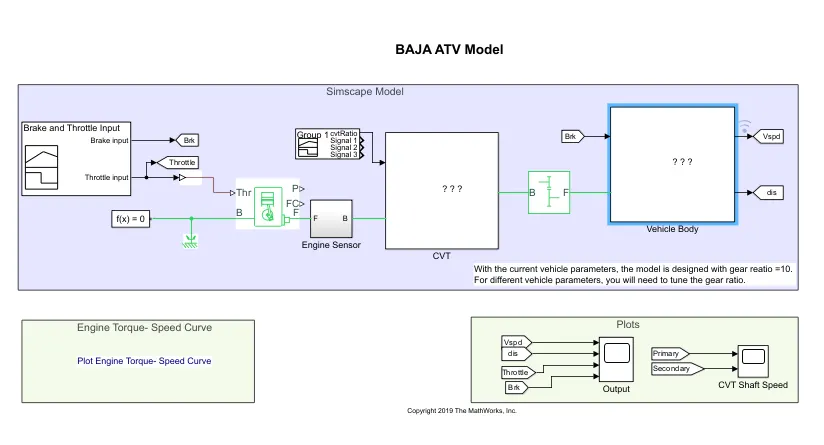
- Working -
- -The Signal Bulider block is used for providing Brake input, Throttle input and CVT Gear Ratio input.
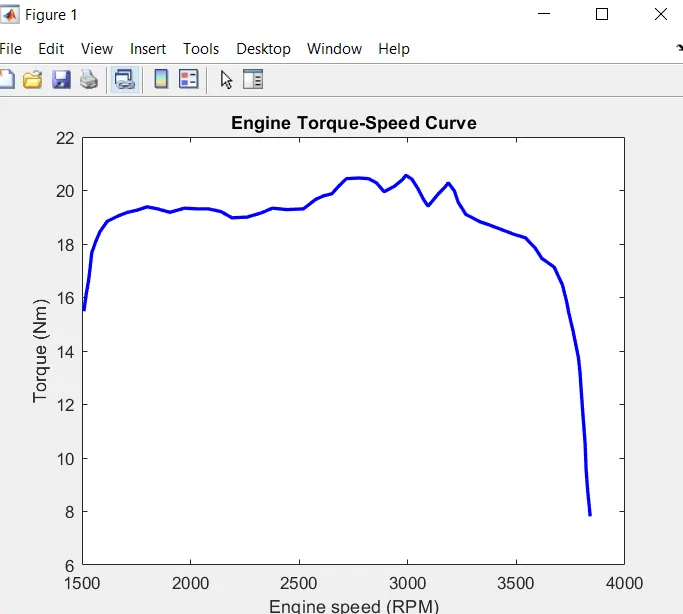
- -The torque vector and speed vector input is provided from MATLAB Workspace.
- -The Throttle input is given to the Engine where the engine parameters changes accordingly.
- -The output from the Generic Engine is the pass through the Engine Sensor block.
- -This sensor block records the rpm of engineand forwards the ouput from engine.
- -The break input is given to the Double Shoe Brake block via Gain block.
- -The ouput from brake block provided to tires.
- -The vehicle body block provides velocity for all tires.
- -It also provides ouput signal velocity and displacement using integrator.
Input Data -
- Signal Builder Block Input -
- Brake and Throttle Input -
- Throttle and Brake is set to zero at initial stage.
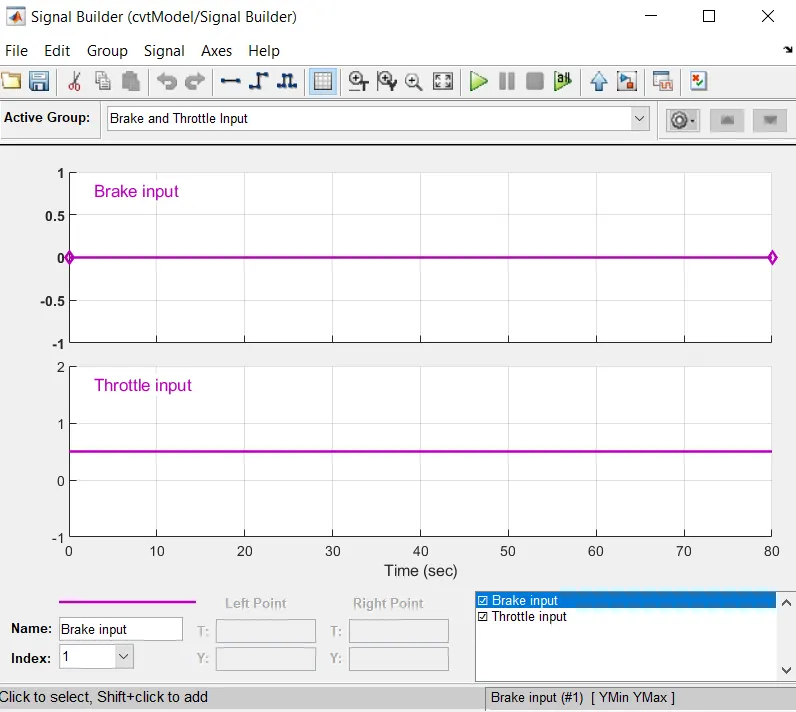
- Brake and Throttle Input -
CVT Ratio:
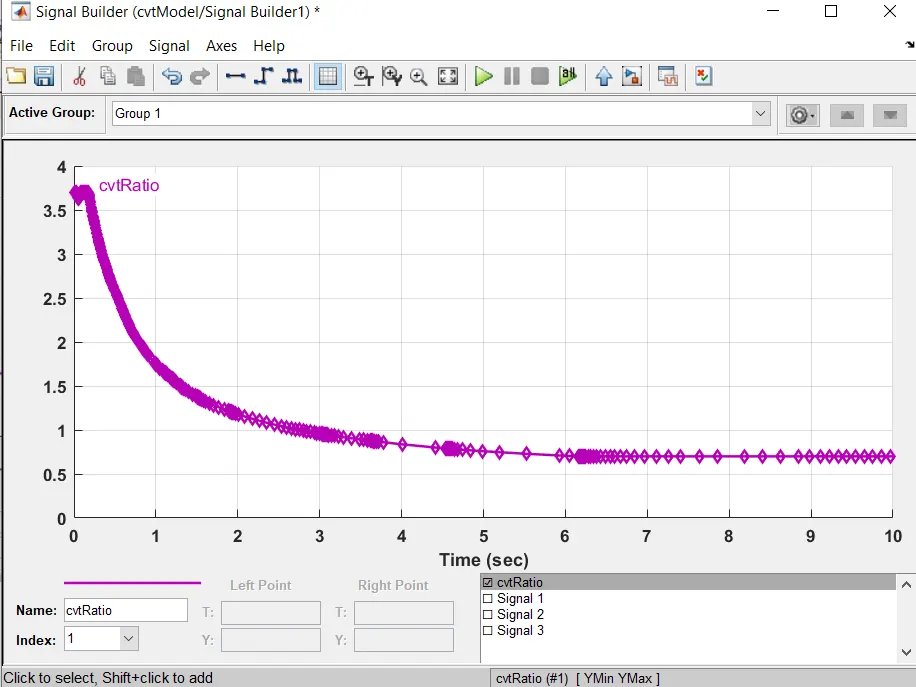
Gear ratio is taken as 10.
Simulation
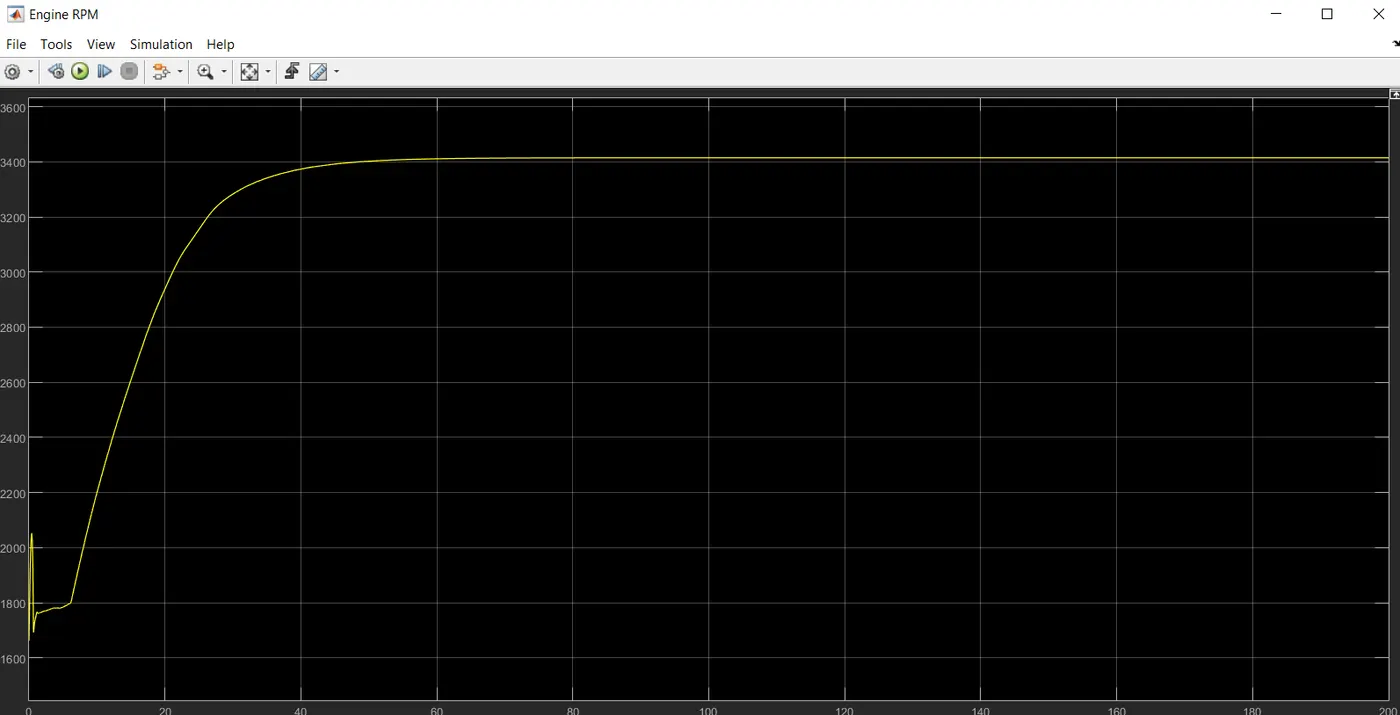
Simulation time is taken as 200.
Engine RPM -
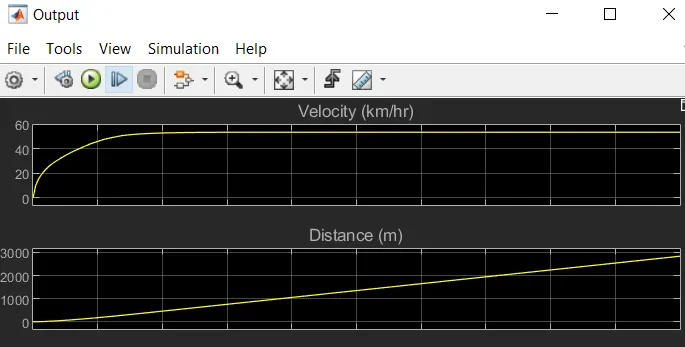
Velocity and Displacement -
Engine Torque speed curve
CVT SHaft speed-
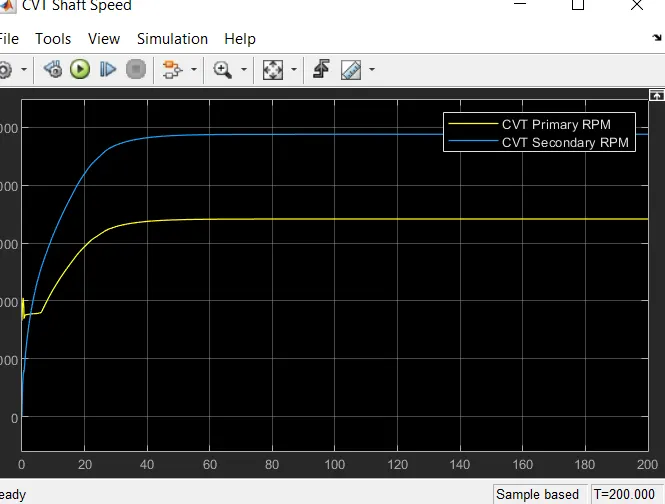
Graph shows variation of primary and secondary wheel w.r.t time.
Primary wheel resembles engine RPM.