Project 3
This program is an object-oriented library for tracking automobile maintenance. It allows you to manage different types of cars such as gas, diesel, and electric. The library provides functionalities to add, update, list, and remove car entries.
The program consists of several classes:
Vehicle: The base class that holds common information like make, model, year, and odometer reading. It also has getter functions to retrieve this information and pure virtual functions for maintenance activities.GasCar,DieselCar, andElectricCar: These classes inherit fromVehicleand provide specific implementations for fuel type and maintenance activities.Library: Manages the collection of vehicles, allowing you to add, list, and remove them. It also provides a function to perform maintenance activities on a specific vehicle.
In the main function, the program presents a menu where you can choose different options such as listing the inventory, adding a new vehicle, removing a vehicle, and performing maintenance activities. The program interacts with the user to gather the necessary information for each action.
The main goal of the program is to provide a simple interface for managing and tracking automobile maintenance for different car types.
#include <iostream>
#include <vector>

using namespace std;

enum class Type {
    GAS,
    DIESEL,
    ELECTRIC
};

class Vehicle {
protected:
    string make;
    string model;
    int year;
    int odometer;

public:
    Vehicle(const string& make, const string& model, int year, int odometer)
        : make(make), model(model), year(year), odometer(odometer) {}

    string getMake() const { return make; }
    string getModel() const { return model; }
    int getYear() const { return year; }
    int getOdometer() const { return odometer; }

    virtual Type getFuelType() = 0;

    virtual void performMaintenanceActivities() = 0;
};

class GasCar : public Vehicle {
public:
    GasCar(const string& make, const string& model, int year, int odometer)
        : Vehicle(make, model, year, odometer) {}

    Type getFuelType() override { return Type::GAS; }

    void performMaintenanceActivities() override {
        // Perform gas car specific maintenance activities
    }
};

class DieselCar : public Vehicle {
public:
    DieselCar(const string& make, const string& model, int year, int odometer)
        : Vehicle(make, model, year, odometer) {}

    Type getFuelType() override { return Type::DIESEL; }

    void performMaintenanceActivities() override {
        // Perform diesel car specific maintenance activities
    }
};

class ElectricCar : public Vehicle {
public:
    ElectricCar(const string& make, const string& model, int year, int odometer)
        : Vehicle(make, model, year, odometer) {}

    Type getFuelType() override { return Type::ELECTRIC; }

    void performMaintenanceActivities() override {
        // Perform electric car specific maintenance activities
    }
};

class Library {
    vector<Vehicle*> vehicles;

public:
    void addVehicle(Vehicle* vehicle) {
        vehicles.push_back(vehicle);
    }

    void listVehicles() {
        cout << "Inventory:" << endl;
        for (const auto& vehicle : vehicles) {
            cout << "Make: " << vehicle->getMake() << ", Model: " << vehicle->getModel()
                 << ", Year: " << vehicle->getYear() << ", Odometer: " << vehicle->getOdometer()
                 << endl;
        }
    }

    void removeVehicle(int index) {
        if (index >= 0 && index < vehicles.size()) {
            delete vehicles[index];
            vehicles.erase(vehicles.begin() + index);
            cout << "Vehicle removed from inventory." << endl;
        } else {
            cout << "Invalid index. No vehicle found." << endl;
        }
    }

    void performMaintenanceActivities(int index) {
        if (index >= 0 && index < vehicles.size()) {
            vehicles[index]->performMaintenanceActivities();
            cout << "Maintenance activities performed." << endl;
        } else {
            cout << "Invalid index. No vehicle found." << endl;
        }
    }
};

int main() {
    Library library;

    int choice;
    do {
        cout << "Menu:\n"
             << "   0. Quit.\n"
             << "   1. List inventory.\n"
             << "   2. Add vehicle.\n"
             << "   3. Remove vehicle.\n"
             << "   4. Perform maintenance activities.\n"
             << "Enter your choice: ";
        cin >> choice;

        switch (choice) {
            case 0:
                cout << "Quitting the program." << endl;
                break;
            case 1:
                library.listVehicles();
                break;
            case 2: {
                cout << "Enter vehicle details:" << endl;
                string make, model;
                int year, odometer;
                cout << "Make: ";
                cin >> make;
                cout << "Model: ";
                cin >> model;
                cout << "Year: ";
                cin >> year;
                cout << "Odometer: ";
                cin >> odometer;

                int fuelTypeChoice;
                cout << "Fuel type:\n"
                     << "   0. Gas\n"
                     << "   1. Diesel\n"
                     << "   2. Electric\n"
                     << "Enter fuel type choice: ";
                cin >> fuelTypeChoice;

                Vehicle* vehicle = nullptr;
                switch (fuelTypeChoice) {
                    case 0:
                        vehicle = new GasCar(make, model, year, odometer);
                        break;
                    case 1:
                        vehicle = new DieselCar(make, model, year, odometer);
                        break;
                    case 2:
                        vehicle = new ElectricCar(make, model, year, odometer);
                        break;
                    default:
                        cout << "Invalid fuel type choice." << endl;
                        break;
                }

                if (vehicle != nullptr) {
                    library.addVehicle(vehicle);
                    cout << "Vehicle added to inventory." << endl;
                }

                break;
            }
            case 3: {
                int index;
                cout << "Enter the index of the vehicle to remove: ";
                cin >> index;
                library.removeVehicle(index);
                break;
            }
            case 4: {
                int index;
                cout << "Enter the index of the vehicle to perform maintenance activities: ";
                cin >> index;
                library.performMaintenanceActivities(index);
                break;
            }
            default:
                cout << "Invalid choice. Please try again." << endl;
                break;
        }
    } while (choice != 0);

    return 0;
}
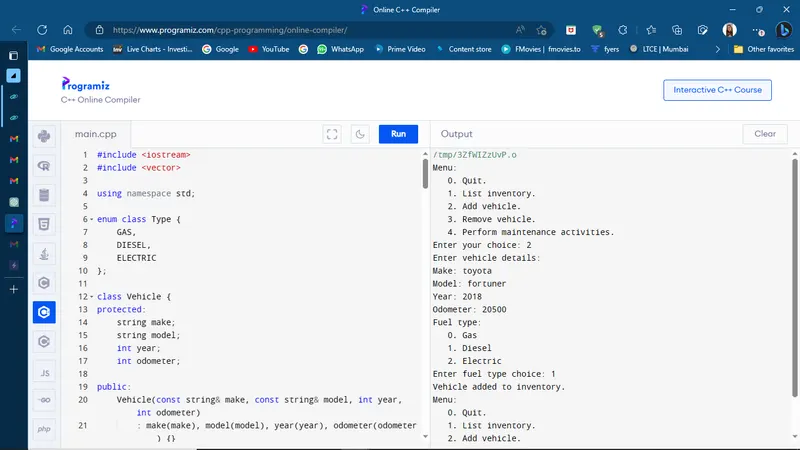
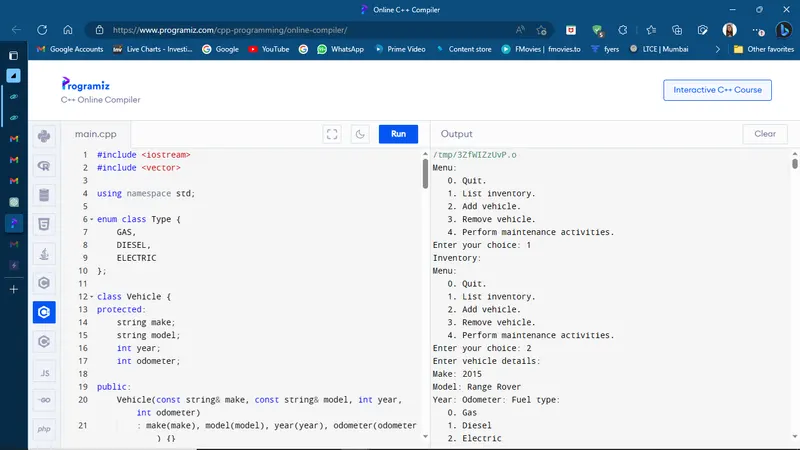
- When you run the program, you will see a menu with options to perform various operations on the automobile maintenance library.
- If you choose to list the inventory (option 1), it will display the details of all the vehicles in the inventory, including their make, model, year, and odometer reading.
- If you choose to add a vehicle (option 2), you will be prompted to enter the details of the vehicle such as make, model, year, odometer reading, and fuel type. The program will add the vehicle to the inventory.
- If you choose to update a vehicle (option 3), you will be prompted to enter the index of the vehicle you want to update. Then, you can enter the new odometer reading for the vehicle. The program will update the vehicle's information.
- If you choose to remove a vehicle (option 4), you will be prompted to enter the index of the vehicle you want to remove. The program will remove the vehicle from the inventory.
- If you choose to perform maintenance activities (option 5), you will be prompted to enter the index of the vehicle for which you want to perform maintenance activities. The program will execute the relevant maintenance activities based on the vehicle type and odometer reading.
- You can repeat these operations until you choose to quit (option 0).