Project 3
Aim:
- Build an object-oriented library which can be used to track automobile maintenance. There can be different car types such as petrol, diesel, gas, electric etc., This library should be able to support at least three of the car types.
- Maintenance tasks include activities like oil change or replace oil filter, replace air filter, replace fuel filter, tire rotations, infotainment system debug, replace spark plugs, replace the cabin or a/c filter, check the level and refill clutch fluid or brake fluid, examine belts, wipers, hoses, check the tire conditions, check the charging systems and battery.
Program:
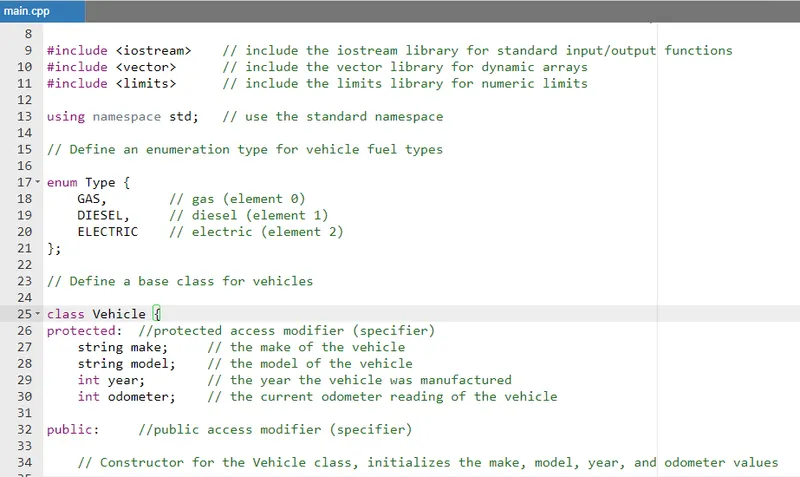
#include <iostream>    // include the iostream library for standard input/output
                         functions
#include <vector>      // include the vector library for dynamic arrays
#include <limits>      // include the limits library for numeric limits

using namespace std;   // use the standard namespace

// Define an enumeration type for vehicle fuel types

enum Type {
    GAS,        // gas (element 0)
    DIESEL,     // diesel (element 1)
    ELECTRIC    // electric (element 2)
};

// Define a base class for vehicles

class Vehicle {
protected:  //protected access modifier (specifier)
    string make;     // the make of the vehicle
    string model;    // the model of the vehicle
    int year;        // the year the vehicle was manufactured
    int odometer;    // the current odometer reading of the vehicle

public:     //public access modifier (specifier)

    // Constructor for the Vehicle class, initializes the make, model, year, and odometer values

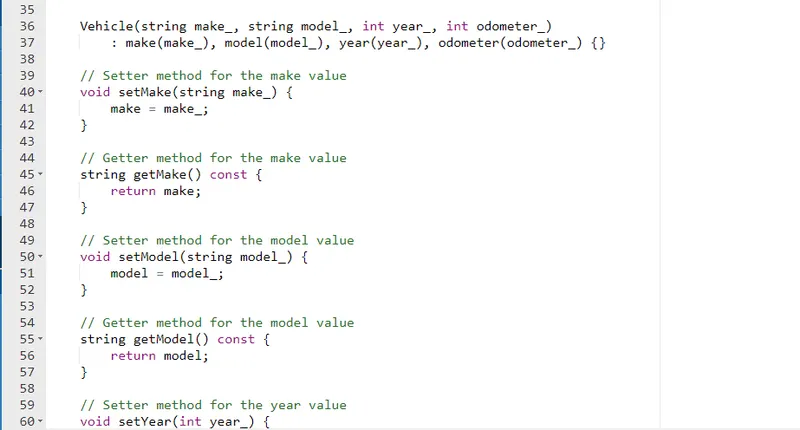
    Vehicle(string make_, string model_, int year_, int odometer_)
        : make(make_), model(model_), year(year_), odometer(odometer_) {}

    // Setter method for the make value
    void setMake(string make_) {
        make = make_;
    }

    // Getter method for the make value
    string getMake() const {
        return make;
    }

    // Setter method for the model value
    void setModel(string model_) {
        model = model_;
    }

    // Getter method for the model value
    string getModel() const {
        return model;
    }

    // Setter method for the year value
    void setYear(int year_) {
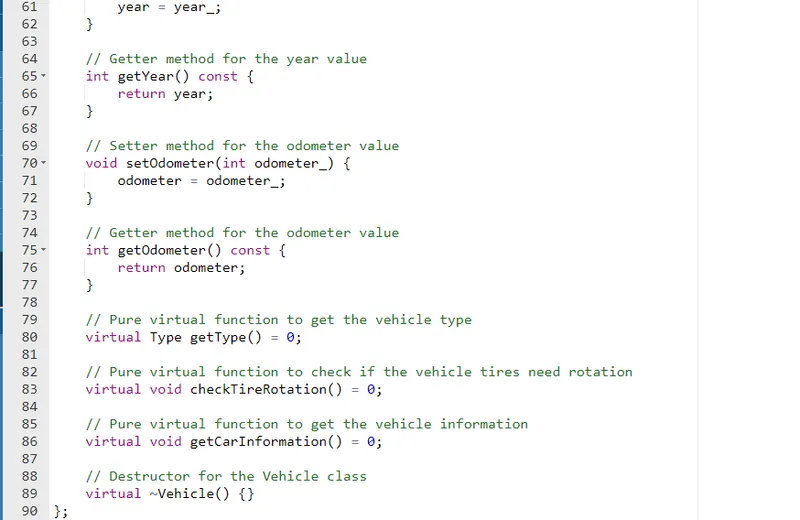
        year = year_;
    }

    // Getter method for the year value
    int getYear() const {
        return year;
    }

    // Setter method for the odometer value
    void setOdometer(int odometer_) {
        odometer = odometer_;
    }

    // Getter method for the odometer value
    int getOdometer() const {
        return odometer;
    }

    // Pure virtual function to get the vehicle type
    virtual Type getType() = 0;

    // Pure virtual function to check if the vehicle tires need rotation
    virtual void checkTireRotation() = 0;

    // Pure virtual function to get the vehicle information
    virtual void getCarInformation() = 0;

    // Destructor for the Vehicle class
    virtual ~Vehicle() {}
};
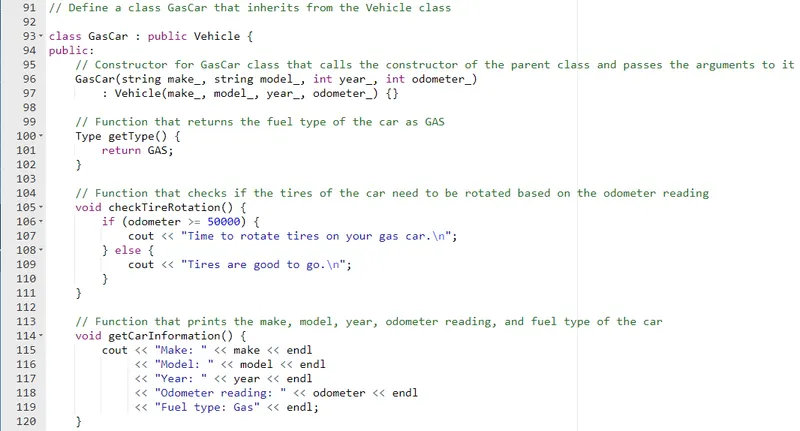
// Define a class GasCar that inherits from the Vehicle class

class GasCar : public Vehicle {
public:
    // Constructor for GasCar class that calls the constructor of the parent class and passes the arguments to it
    GasCar(string make_, string model_, int year_, int odometer_)
        : Vehicle(make_, model_, year_, odometer_) {}

    // Function that returns the fuel type of the car as GAS
    Type getType() {
        return GAS;
    }

    // Function that checks if the tires of the car need to be rotated based on the odometer reading
    void checkTireRotation() {
        if (odometer >= 50000) {
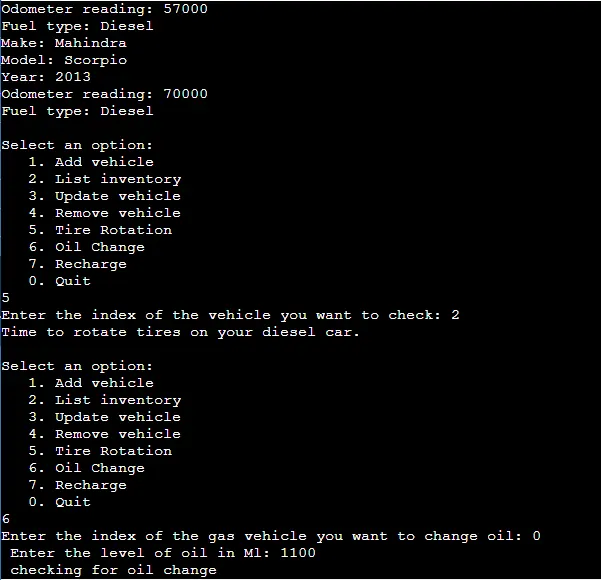
            cout << "Time to rotate tires on your gas car.\n";
        } else {
            cout << "Tires are good to go.\n";
        }
    }

    // Function that prints the make, model, year, odometer reading, and fuel type of the car
    void getCarInformation() {
        cout << "Make: " << make << endl
             << "Model: " << model << endl
             << "Year: " << year << endl
             << "Odometer reading: " << odometer << endl
             << "Fuel type: Gas" << endl;
    }
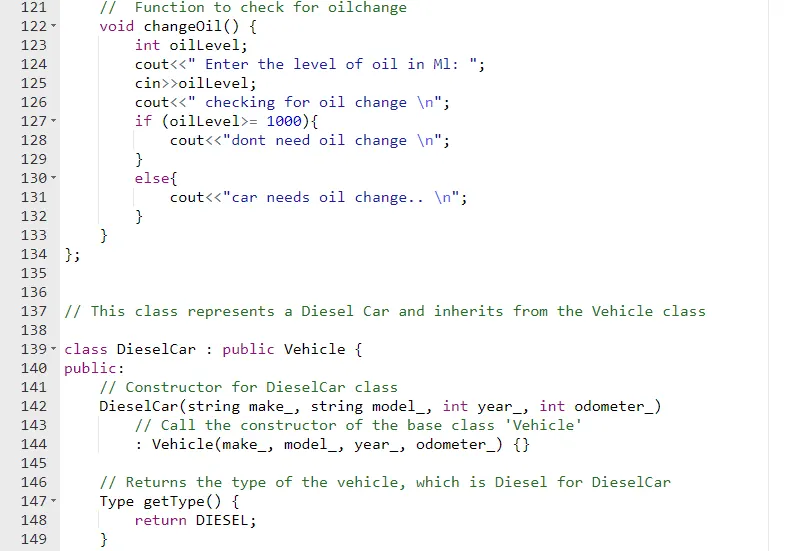
    //  Function to check for oilchange
    void changeOil() {
        int oilLevel;
        cout<<" Enter the level of oil in Ml: ";
        cin>>oilLevel;
        cout<<" checking for oil change \n";
        if (oilLevel>= 1000){
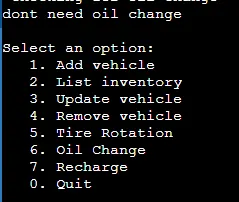
            cout<<"dont need oil change \n";
        }
        else{
            cout<<"car needs oil change.. \n";
        }
    }
};


// This class represents a Diesel Car and inherits from the Vehicle class

class DieselCar : public Vehicle {
public:
    // Constructor for DieselCar class
    DieselCar(string make_, string model_, int year_, int odometer_)
        // Call the constructor of the base class 'Vehicle'
        : Vehicle(make_, model_, year_, odometer_) {}

    // Returns the type of the vehicle, which is Diesel for DieselCar
    Type getType() {
        return DIESEL;
    }

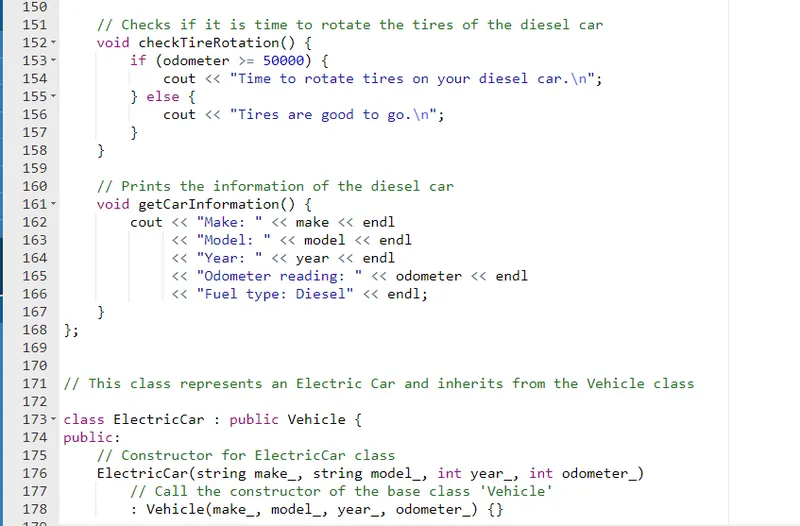
    // Checks if it is time to rotate the tires of the diesel car
    void checkTireRotation() {
        if (odometer >= 50000) {
            cout << "Time to rotate tires on your diesel car.\n";
        } else {
            cout << "Tires are good to go.\n";
        }
    }

    // Prints the information of the diesel car
    void getCarInformation() {
        cout << "Make: " << make << endl
             << "Model: " << model << endl
             << "Year: " << year << endl
             << "Odometer reading: " << odometer << endl
             << "Fuel type: Diesel" << endl;
    }
};


// This class represents an Electric Car and inherits from the Vehicle class

class ElectricCar : public Vehicle {
public:
    // Constructor for ElectricCar class
    ElectricCar(string make_, string model_, int year_, int odometer_)
        // Call the constructor of the base class 'Vehicle'
        : Vehicle(make_, model_, year_, odometer_) {}

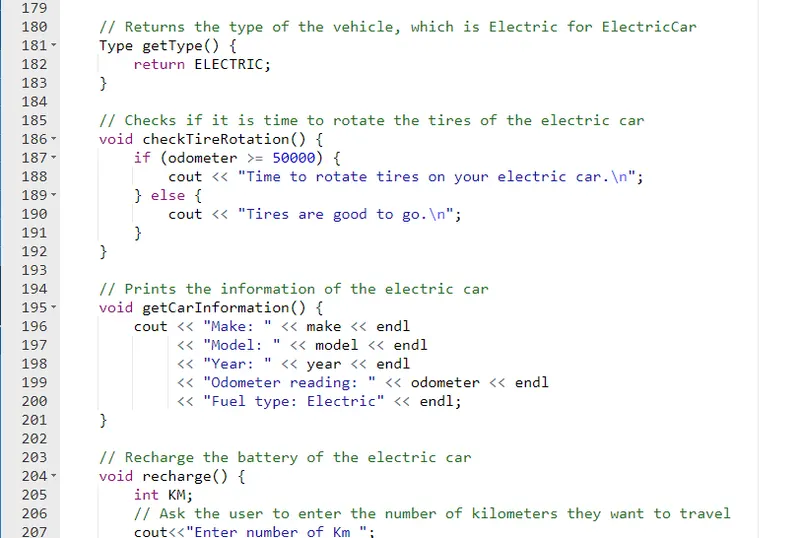
    // Returns the type of the vehicle, which is Electric for ElectricCar
    Type getType() {
        return ELECTRIC;
    }

    // Checks if it is time to rotate the tires of the electric car
    void checkTireRotation() {
        if (odometer >= 50000) {
            cout << "Time to rotate tires on your electric car.\n";
        } else {
            cout << "Tires are good to go.\n";
        }
    }

    // Prints the information of the electric car
    void getCarInformation() {
        cout << "Make: " << make << endl
             << "Model: " << model << endl
             << "Year: " << year << endl
             << "Odometer reading: " << odometer << endl
             << "Fuel type: Electric" << endl;
    }

    // Recharge the battery of the electric car
    void recharge() {
        int KM;
        // Ask the user to enter the number of kilometers they want to travel
        cout<<"Enter number of Km ";
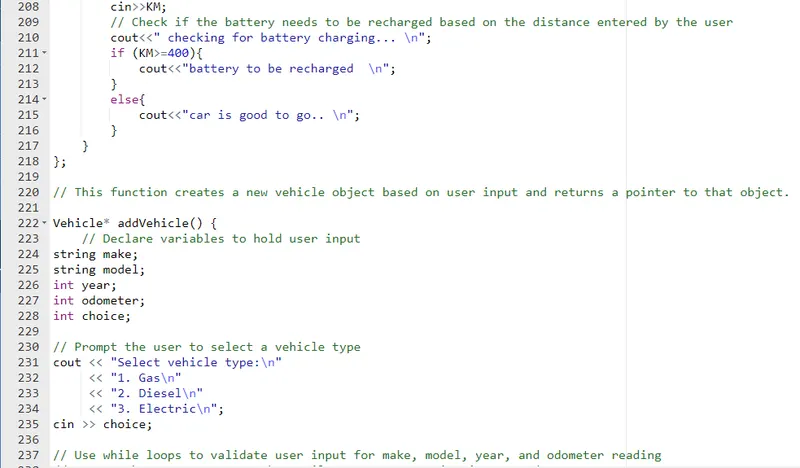
        cin>>KM;
        // Check if the battery needs to be recharged based on the distance entered by the user
        cout<<" checking for battery charging... \n";
        if (KM>=400){
            cout<<"battery to be recharged  \n";
        }
        else{
            cout<<"car is good to go.. \n";
        }
    }
};

// This function creates a new vehicle object based on user input and returns a pointer to that object.

Vehicle* addVehicle() {
    // Declare variables to hold user input
string make;
string model;
int year;
int odometer;
int choice;

// Prompt the user to select a vehicle type
cout << "Select vehicle type:\n"
     << "1. Gas\n"
     << "2. Diesel\n"
     << "3. Electric\n";
cin >> choice;

// Use while loops to validate user input for make, model, year, and odometer reading
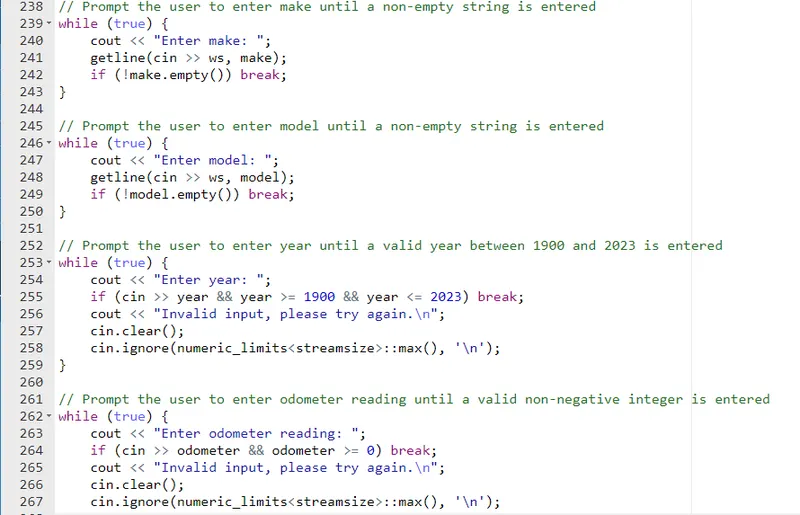
// Prompt the user to enter make until a non-empty string is entered
while (true) {
    cout << "Enter make: ";
    getline(cin >> ws, make);
    if (!make.empty()) break;
}

// Prompt the user to enter model until a non-empty string is entered
while (true) {
    cout << "Enter model: ";
    getline(cin >> ws, model);
    if (!model.empty()) break;
}

// Prompt the user to enter year until a valid year between 1900 and 2023 is entered
while (true) {
    cout << "Enter year: ";
    if (cin >> year && year >= 1900 && year <= 2023) break;
    cout << "Invalid input, please try again.\n";
    cin.clear();
    cin.ignore(numeric_limits<streamsize>::max(), '\n');
}

// Prompt the user to enter odometer reading until a valid non-negative integer is entered
while (true) {
    cout << "Enter odometer reading: ";
    if (cin >> odometer && odometer >= 0) break;
    cout << "Invalid input, please try again.\n";
    cin.clear();
    cin.ignore(numeric_limits<streamsize>::max(), '\n');
}

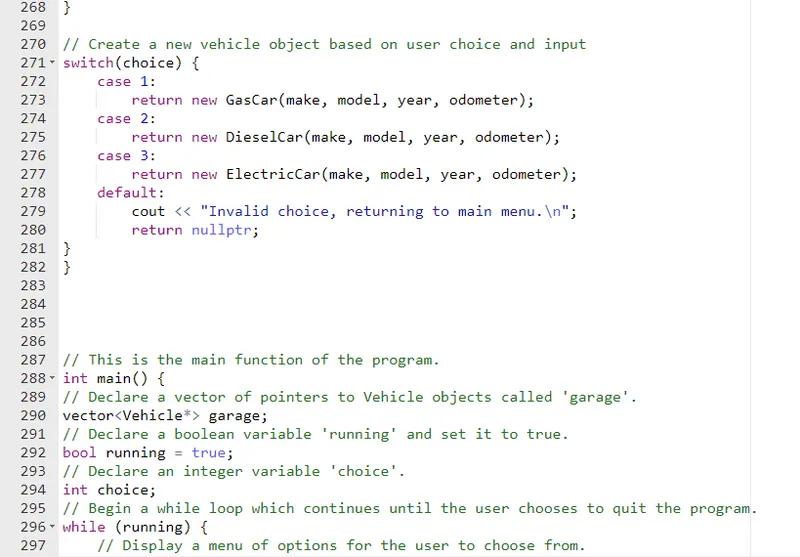
// Create a new vehicle object based on user choice and input
switch(choice) {
    case 1:
        return new GasCar(make, model, year, odometer);
    case 2:
        return new DieselCar(make, model, year, odometer);
    case 3:
        return new ElectricCar(make, model, year, odometer);
    default:
        cout << "Invalid choice, returning to main menu.\n";
        return nullptr;
}
}


// This is the main function of the program.
int main() {
// Declare a vector of pointers to Vehicle objects called 'garage'.
vector<Vehicle*> garage;
// Declare a boolean variable 'running' and set it to true.
bool running = true;
// Declare an integer variable 'choice'.
int choice;
// Begin a while loop which continues until the user chooses to quit the program.
while (running) {
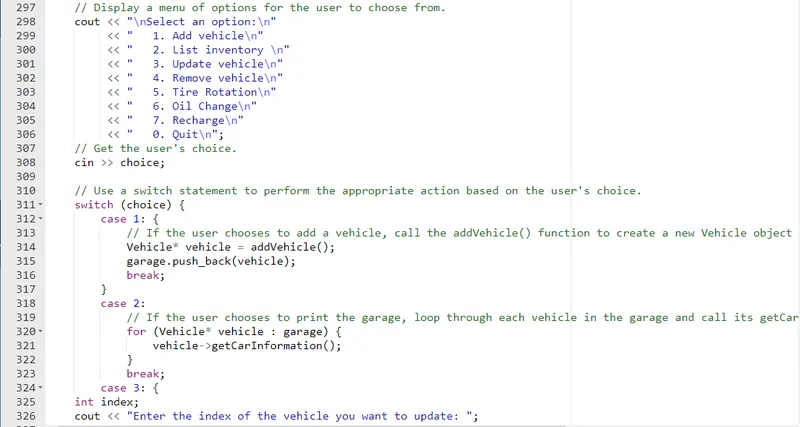
    // Display a menu of options for the user to choose from.
    cout << "\nSelect an option:\n"
         << "   1. Add vehicle\n"
         << "   2. List inventory \n"
         << "   3. Update vehicle\n"
         << "   4. Remove vehicle\n"
         << "   5. Tire Rotation\n"
         << "   6. Oil Change\n"
         << "   7. Recharge\n"
         << "   0. Quit\n";
    // Get the user's choice.
    cin >> choice;

    // Use a switch statement to perform the appropriate action based on the user's choice.
    switch (choice) {
        case 1: {
            // If the user chooses to add a vehicle, call the addVehicle() function to create a new Vehicle object and add it to the garage.
            Vehicle* vehicle = addVehicle();
            garage.push_back(vehicle);
            break;
        }
        case 2:
            // If the user chooses to print the garage, loop through each vehicle in the garage and call its getCarInformation() function to display its information.
            for (Vehicle* vehicle : garage) {
                vehicle->getCarInformation();
            }
            break;
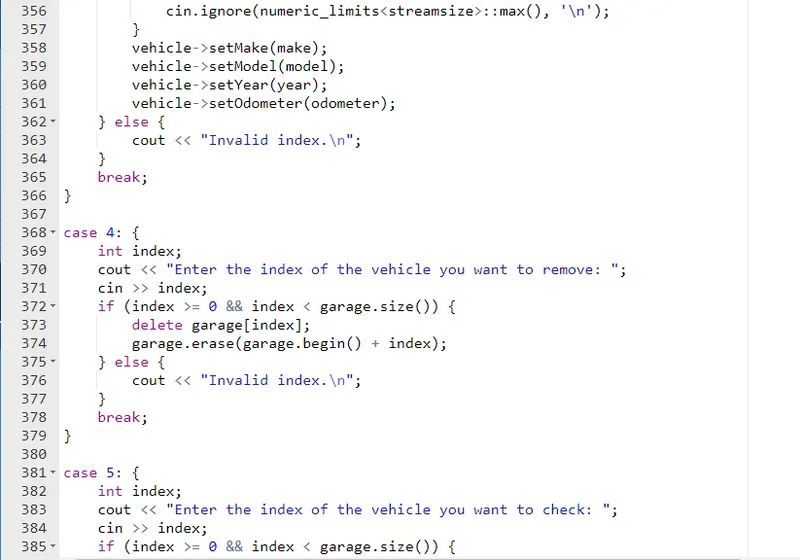
        case 3: {
    int index;
    cout << "Enter the index of the vehicle you want to update: ";
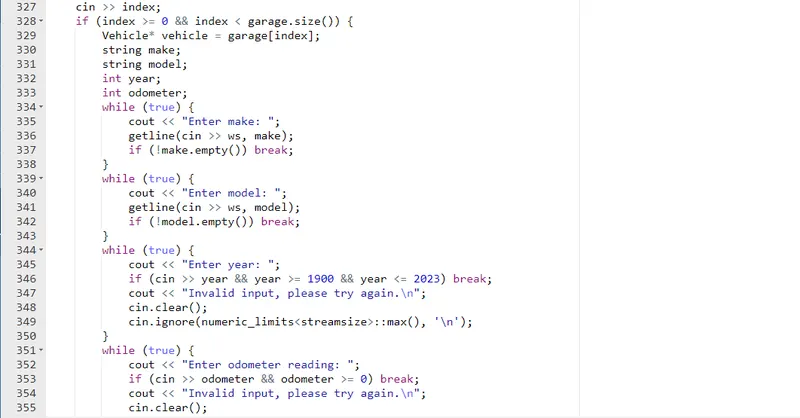
    cin >> index;
    if (index >= 0 && index < garage.size()) {
        Vehicle* vehicle = garage[index];
        string make;
        string model;
        int year;
        int odometer;
        while (true) {
            cout << "Enter make: ";
            getline(cin >> ws, make);
            if (!make.empty()) break;
        }
        while (true) {
            cout << "Enter model: ";
            getline(cin >> ws, model);
            if (!model.empty()) break;
        }
        while (true) {
            cout << "Enter year: ";
            if (cin >> year && year >= 1900 && year <= 2023) break;
            cout << "Invalid input, please try again.\n";
            cin.clear();
            cin.ignore(numeric_limits<streamsize>::max(), '\n');
        }
        while (true) {
            cout << "Enter odometer reading: ";
            if (cin >> odometer && odometer >= 0) break;
            cout << "Invalid input, please try again.\n";
            cin.clear();
            cin.ignore(numeric_limits<streamsize>::max(), '\n');
        }
        vehicle->setMake(make);
        vehicle->setModel(model);
        vehicle->setYear(year);
        vehicle->setOdometer(odometer);
    } else {
        cout << "Invalid index.\n";
    }
    break;
}

case 4: {
    int index;
    cout << "Enter the index of the vehicle you want to remove: ";
    cin >> index;
    if (index >= 0 && index < garage.size()) {
        delete garage[index];
        garage.erase(garage.begin() + index);
    } else {
        cout << "Invalid index.\n";
    }
    break;
}

case 5: {
    int index;
    cout << "Enter the index of the vehicle you want to check: ";
    cin >> index;
    if (index >= 0 && index < garage.size()) {
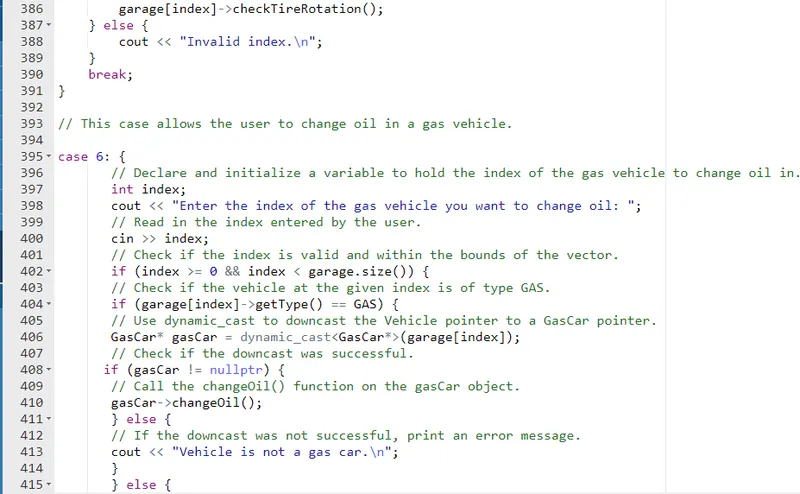
        garage[index]->checkTireRotation();
    } else {
        cout << "Invalid index.\n";
    }
    break;
}

// This case allows the user to change oil in a gas vehicle.

case 6: {
       // Declare and initialize a variable to hold the index of the gas vehicle to change oil in.
       int index;
       cout << "Enter the index of the gas vehicle you want to change oil: ";
       // Read in the index entered by the user.
       cin >> index;
       // Check if the index is valid and within the bounds of the vector.
       if (index >= 0 && index < garage.size()) {
       // Check if the vehicle at the given index is of type GAS.
       if (garage[index]->getType() == GAS) {
       // Use dynamic_cast to downcast the Vehicle pointer to a GasCar pointer.
       GasCar* gasCar = dynamic_cast<GasCar*>(garage[index]);
       // Check if the downcast was successful.
      if (gasCar != nullptr) {
       // Call the changeOil() function on the gasCar object.
       gasCar->changeOil();
       } else {
       // If the downcast was not successful, print an error message.
       cout << "Vehicle is not a gas car.\n";
       }
       } else {
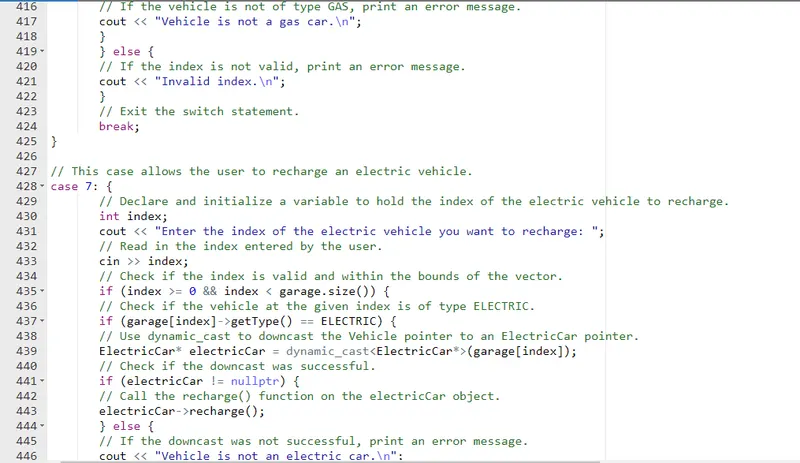
       // If the vehicle is not of type GAS, print an error message.
       cout << "Vehicle is not a gas car.\n";
       }
       } else {
       // If the index is not valid, print an error message.
       cout << "Invalid index.\n";
       }
       // Exit the switch statement.
       break;
}

// This case allows the user to recharge an electric vehicle.
case 7: {
       // Declare and initialize a variable to hold the index of the electric vehicle to recharge.
       int index;
       cout << "Enter the index of the electric vehicle you want to recharge: ";
       // Read in the index entered by the user.
       cin >> index;
       // Check if the index is valid and within the bounds of the vector.
       if (index >= 0 && index < garage.size()) {
       // Check if the vehicle at the given index is of type ELECTRIC.
       if (garage[index]->getType() == ELECTRIC) {
       // Use dynamic_cast to downcast the Vehicle pointer to an ElectricCar pointer.
       ElectricCar* electricCar = dynamic_cast<ElectricCar*>(garage[index]);
       // Check if the downcast was successful.
       if (electricCar != nullptr) {
       // Call the recharge() function on the electricCar object.
       electricCar->recharge();
       } else {
       // If the downcast was not successful, print an error message.
       cout << "Vehicle is not an electric car.\n";
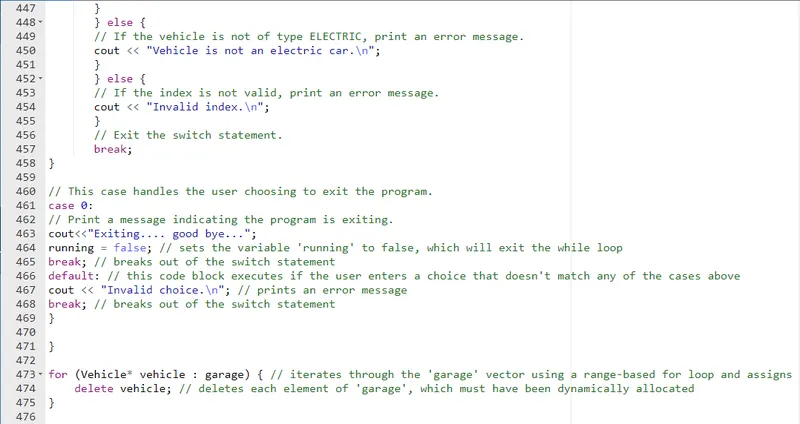
       }
       } else {
       // If the vehicle is not of type ELECTRIC, print an error message.
       cout << "Vehicle is not an electric car.\n";
       }
       } else {
       // If the index is not valid, print an error message.
       cout << "Invalid index.\n";
       }
       // Exit the switch statement.
       break;
}

// This case handles the user choosing to exit the program.
case 0:
// Print a message indicating the program is exiting.
cout<<"Exiting.... good bye...";
running = false; // sets the variable 'running' to false, which will exit the while loop
break; // breaks out of the switch statement
default: // this code block executes if the user enters a choice that doesn't match any of the cases above
cout << "Invalid choice.\n"; // prints an error message
break; // breaks out of the switch statement
}

}

for (Vehicle* vehicle : garage) { // iterates through the 'garage' vector using a range-based for loop and assigns each element to 'vehicle'
    delete vehicle; // deletes each element of 'garage', which must have been dynamically allocated
}

garage.clear(); // removes all elements from the 'garage' vector

return 0; // exits the program with a return value of 0

}
----------------------------------------------------------------------------------------------
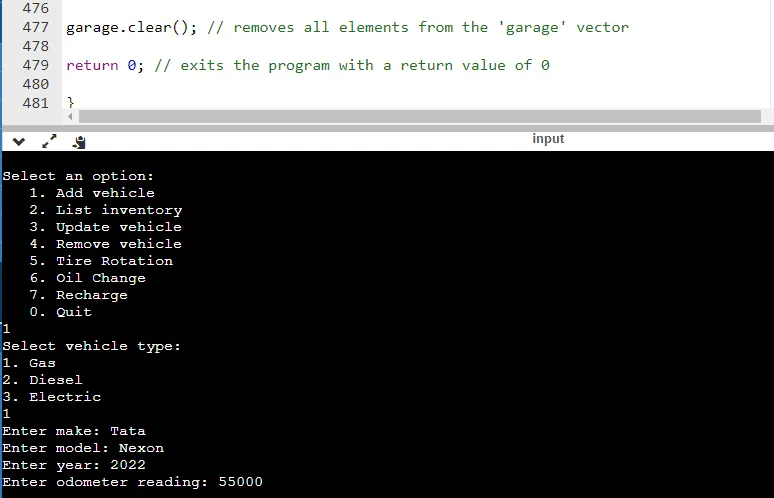
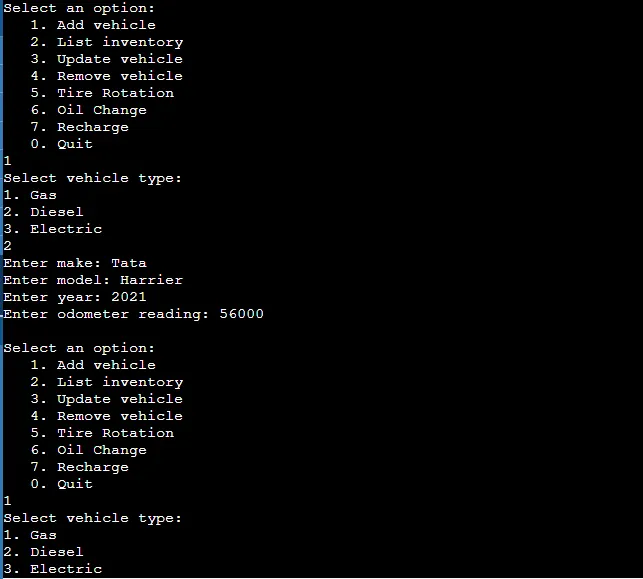
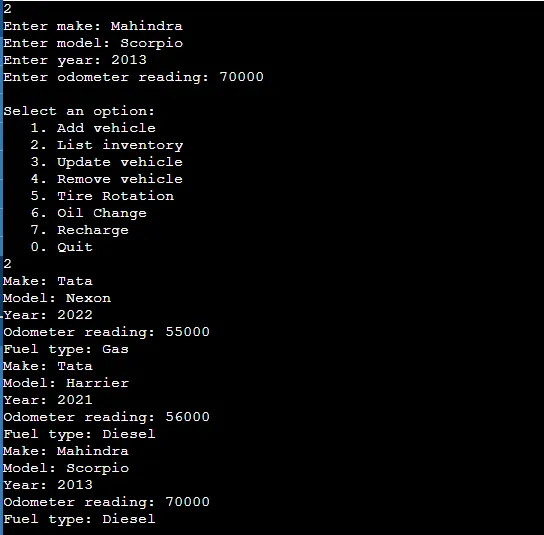
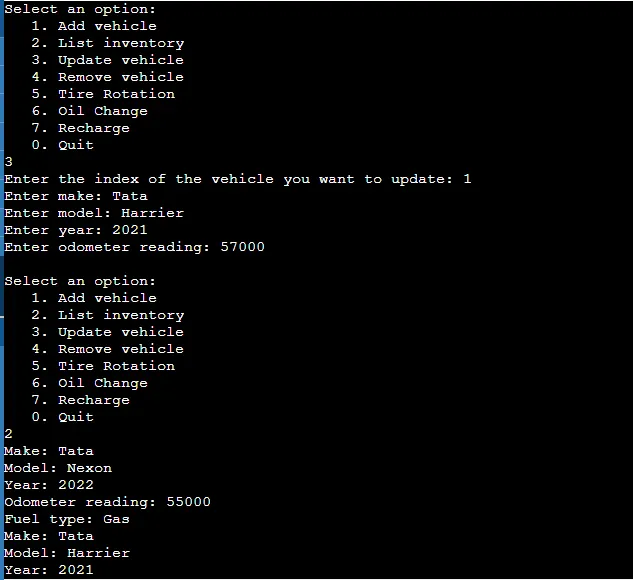
Output: