Project
Aim: To carry out a system-level simulation of an all-terrain vehicle.
Objective: To prepare a technical report explaining the model properties & comments on the results.
Theory: All-Terrain Vehicle (ATV)
ATV is known as quad bike as it as four wheels, also known as light utility vehicle, is a vehicle that travels on low-pressure tires, with a seat that is straddled by the operator, along with handlebars for steering control.
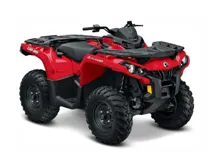
baja atv model
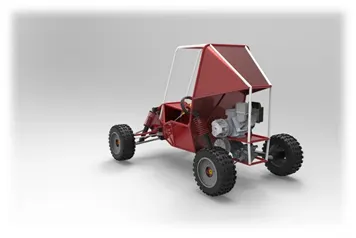
Baja SAE is an Collegiate Design Series competition run by the Society of Automotive Engineers International (SAE International). Teams of students from universities all over the world design and build small off-road cars. The cars all have engines of the same specifications. As of 2018 the engine has been an unmodified Briggs & Stratton Model 19 Vanguard engine single-cylinder with a displacement of 305cc and power output of approximately 10 bhp (7.5 kW).
The goal in Baja SAE racing is to design, build and race off-road vehicles that can withstand the harshest elements of rough terrain. The vehicles used in Baja SAE racing are often similar in appearance to dune buggies. Before 2007, the events were called "Mini Baja."
The given model shows how to build ATV with CVT i.e. continuously variable transmission which is very common in BAJA competitions.
The given model consists of main blocks as follows:
CVT
VEHICLE BODY
GENERIC ENGINE
SIMPLE GEARS
DOUBLE SHOE BRAKE
Continuously variable transmission
A continuously variable transmission (CVT) is an automatic transmission that can change seamlessly through a continuous range of gear ratios. This contrasts with other transmissions that provide a limited number of gear ratios in fixed steps. The flexibility of a CVT with suitable control may allow the engine to operate at a constant RPM while the vehicle moves at varying speeds.
CVTs are used in automobiles, tractors, motor scooters, snowmobiles, and earthmoving equipment.
The most common type of CVT uses two pulleys connected by a belt or chain, however, several other designs have also been used at times.
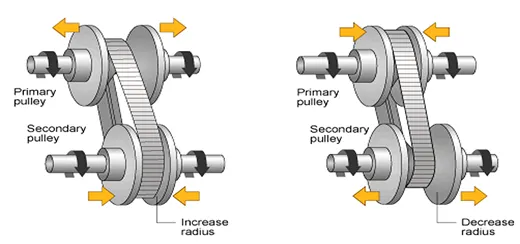
CVT subsystem block
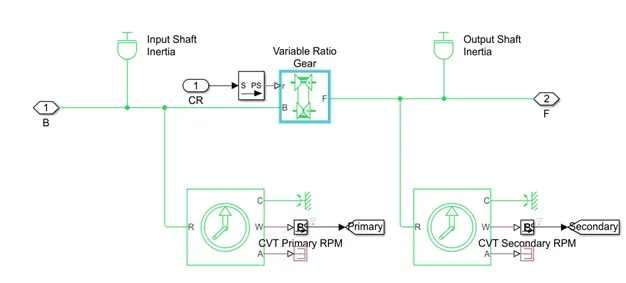
Input shaft inertia = primary pulley (driver)
Output shaft inertia= secondary pulley(driven)
Variable ratio gear= multiple gears of CVT(continuously variable transmission)
Two ideal rotational motion sensors= to track angular velocity of each pulley
Vehicle body
- Vehicle body account for,
Body mass
Aerodynamic drag
Road incline
Weight distribution(b/w axles due to acceleration)
Road profile
Vehicle body subsystem block
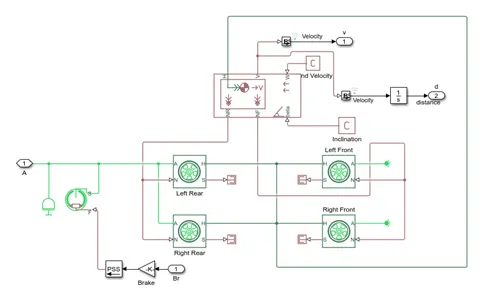
In this block we can include externally defined mass and externally defined inertia.
The mass, inertia and center of gravity may change over the course of simulation in response to system changes.
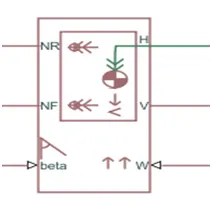
Where,
NR- Rear axle normal force
NF- Front axle normal force
H- Horizontal motion
V-Longitudinal velocity
W-Headwind speed
Beta- road inclined angle
GENERIC ENGINE
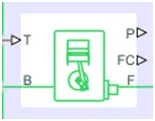
Generic engine = internal combustion engine
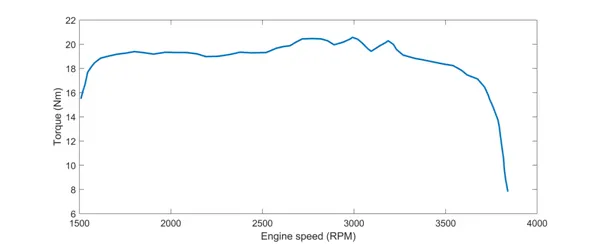
- This engine uses a programmed relationship between speed and torque and been modulated by throttle signal.
- Throttle input has been fed into T port.
- Crankshaft (Port F) is connected to an engine sensor, which is will sense angular velocity and angular displacement of the crankshaft.
- There simple gear between engine and CVT box for reducing the engine RPM before it is fed to CVT.
- Speed and torque curve is shown in below graph:
There was a error when I started making signal for input as below: