Project 2 Thermal modeling of battery pack
1. For a 10 cell series lithium ion battery model, simulate the thermal effects and compare life cycle performance at various temperatures, charge & discharge rates using MATLAB.
Now a days lithium ion battery are mostly used in electric vehicles we must know its charge and discharge rates to operate this batterys in efficient manner and with out damage when this batterys in operation this temperature of it must be kept in limit we simulate the thermal effect of this cell , by knowing the how much temp rise take place we can provide efficient cooling to the batterys so that the life cycle of the battery increases.
This example shows the impact of temperature on a 7.2 V, 5.4 Ah, Lithium-Ion battery module. This can be extended to battery pack. Effect of temperature on the performance of a 7.2 V, 5.4 Ah Lithium-Ion battery model. The model which includes the impact of cell/ambient temperature on the voltage, capacity and resistance is subjected to a variable ambient temperature during a discharge and charge process
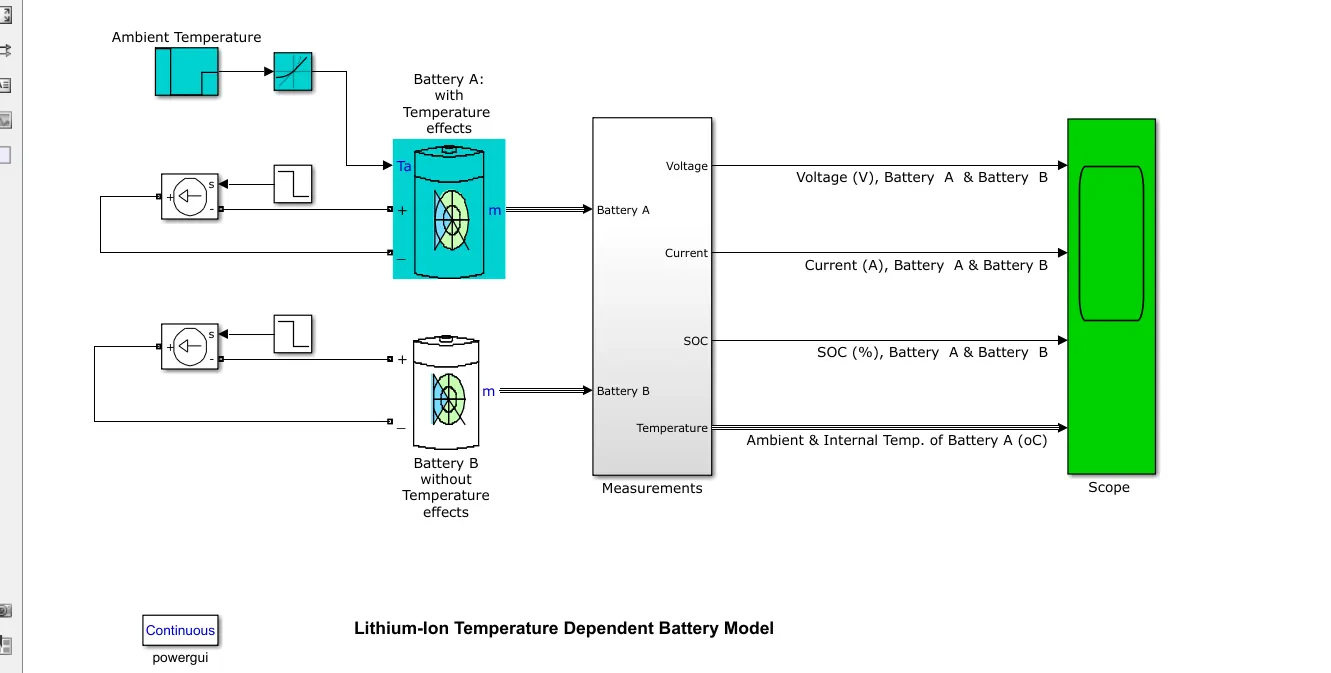
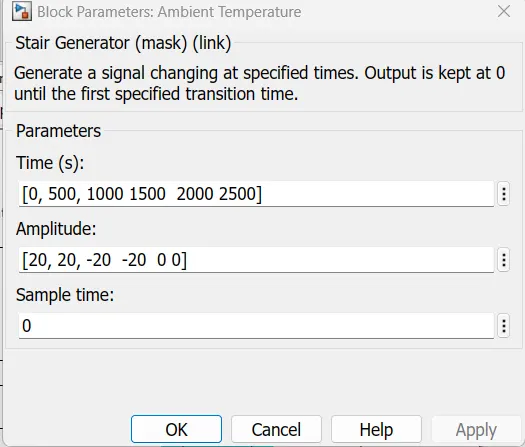
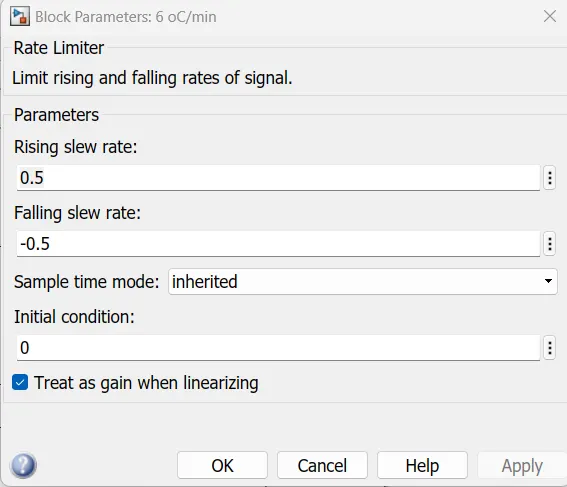
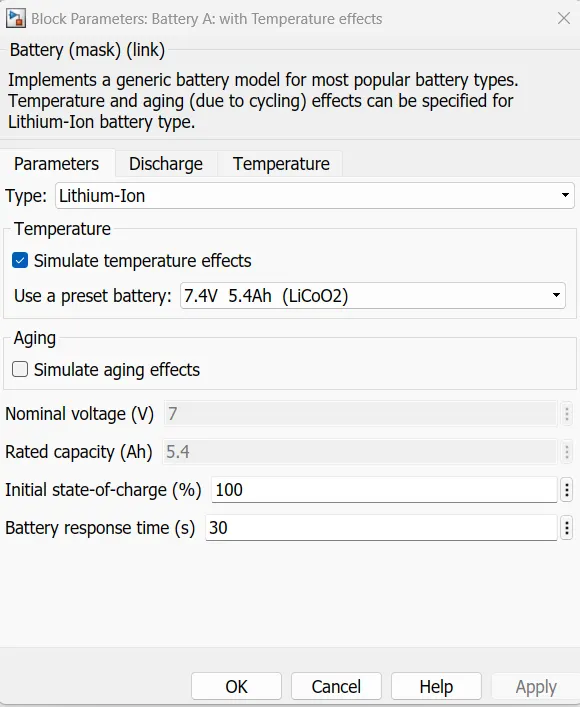
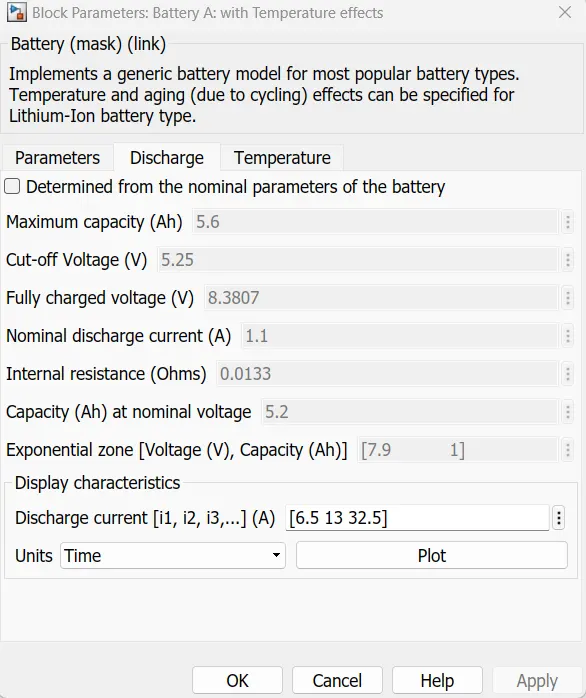
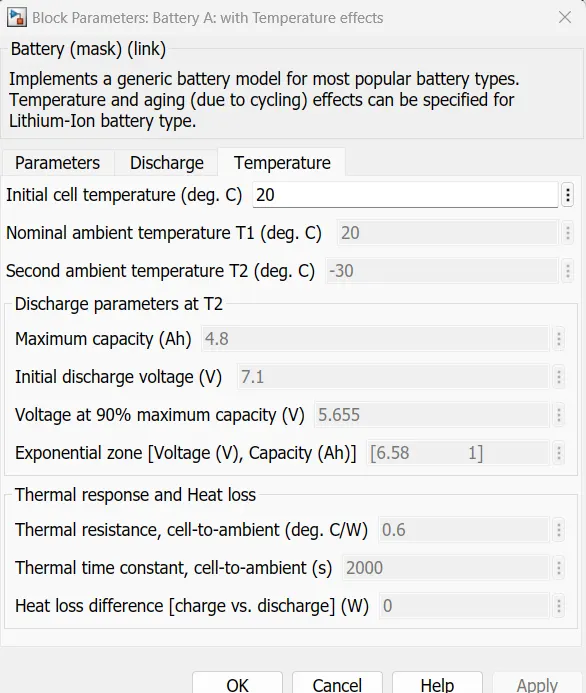
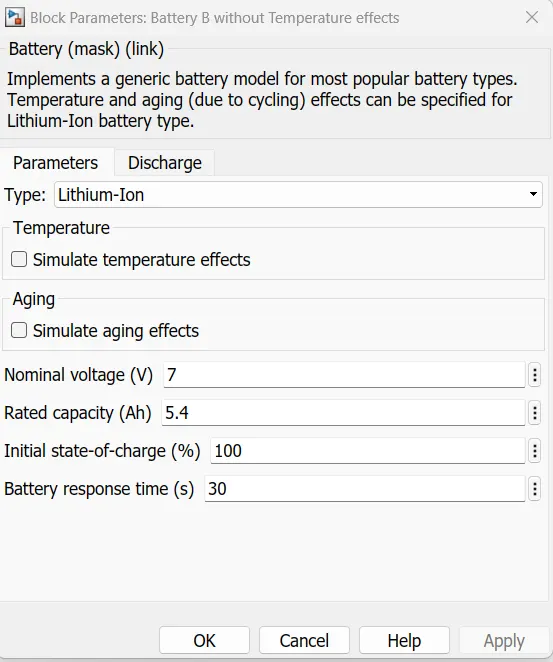
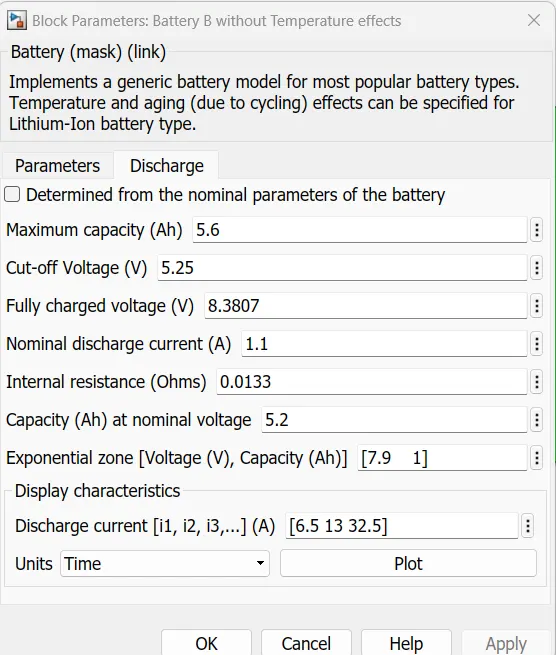
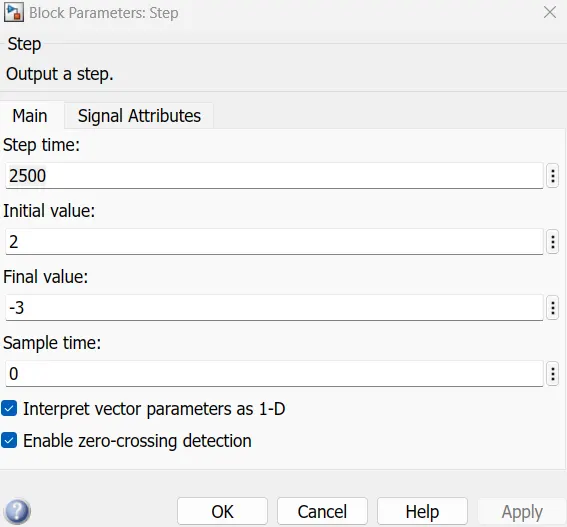
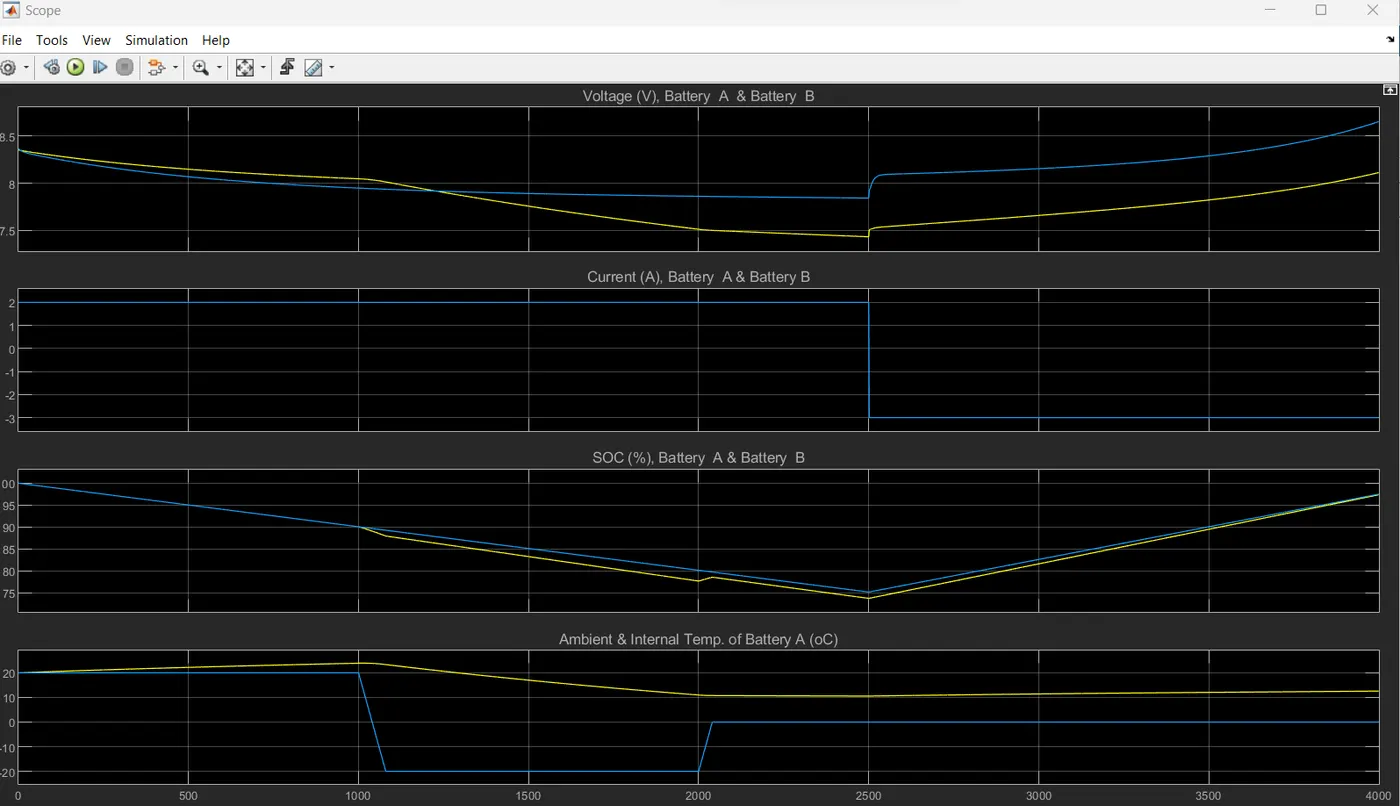
This simulation demonstrates the behavior of two types of lithium-ion batteries, Battery A and Battery B, under varying ambient temperature conditions. Here's a breakdown of the key events and observations during the simulation:
-
Initialization (t = 0 s):
- Both Battery A and Battery B start with a discharge of 2 A at an ambient temperature of 20 degrees Celsius.
-
Steady-State Heat Loss (t = 150 s):
- At this point, the internal temperature of Battery A has reached its steady-state value of 29.2 degrees Celsius.
- The heat losses from the discharge process cause Battery A's output voltage to slightly increase.
- Battery B's output voltage continues to decrease steadily.
-
Temperature Drop (t = 1000 s):
- The ambient temperature is decreased to -20 degrees Celsius.
- This rapid temperature drop significantly reduces the internal temperature of Battery A.
- Battery A's output voltage decreases substantially, and its state of charge (SOC) decreases due to reduced battery capacity.
- Battery B's output voltage continues to decrease slowly but remains relatively stable.
-
Temperature Increase (t = 2000 s):
- The ambient temperature is increased from -20 degrees Celsius to 0 degrees Celsius.
- As the internal temperature of Battery A rises, its output voltage increases.
- Battery A's SOC also increases as the battery's capacity returns.
- Battery B's output voltage remains constant at its steady-state value.
-
Charging (t = 2500 s):
- Both Battery A and Battery B are charged with 3 A at an ambient temperature of 0 degrees Celsius.
- Charging causes the internal temperature of Battery A to rise due to heat losses during the charging process.
- As a result, Battery A's charging voltage increases.
- Battery A and Battery B continue to charge until they are fully charged.
In summary, this simulation highlights the significant impact of temperature on the performance of lithium-ion batteries. Battery A, which considers temperature effects, exhibits variations in output voltage and SOC in response to changing ambient temperatures, while Battery B, which neglects temperature effects, remains less responsive to temperature changes. This simulation underscores the importance of accurate temperature modeling and control in battery systems to optimize performance and prolong battery life.
Extended to two battery cells in series
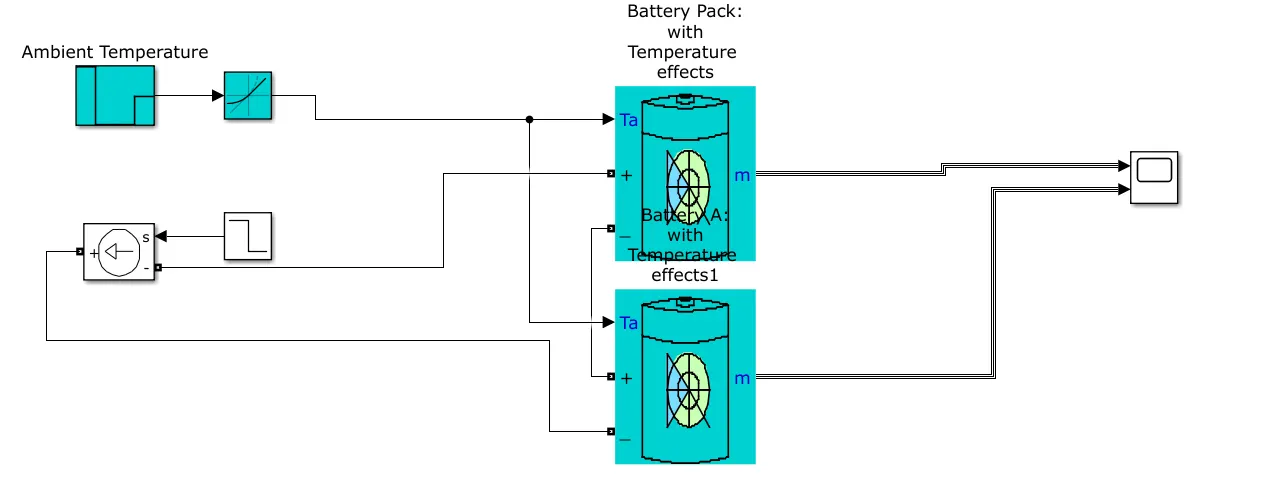
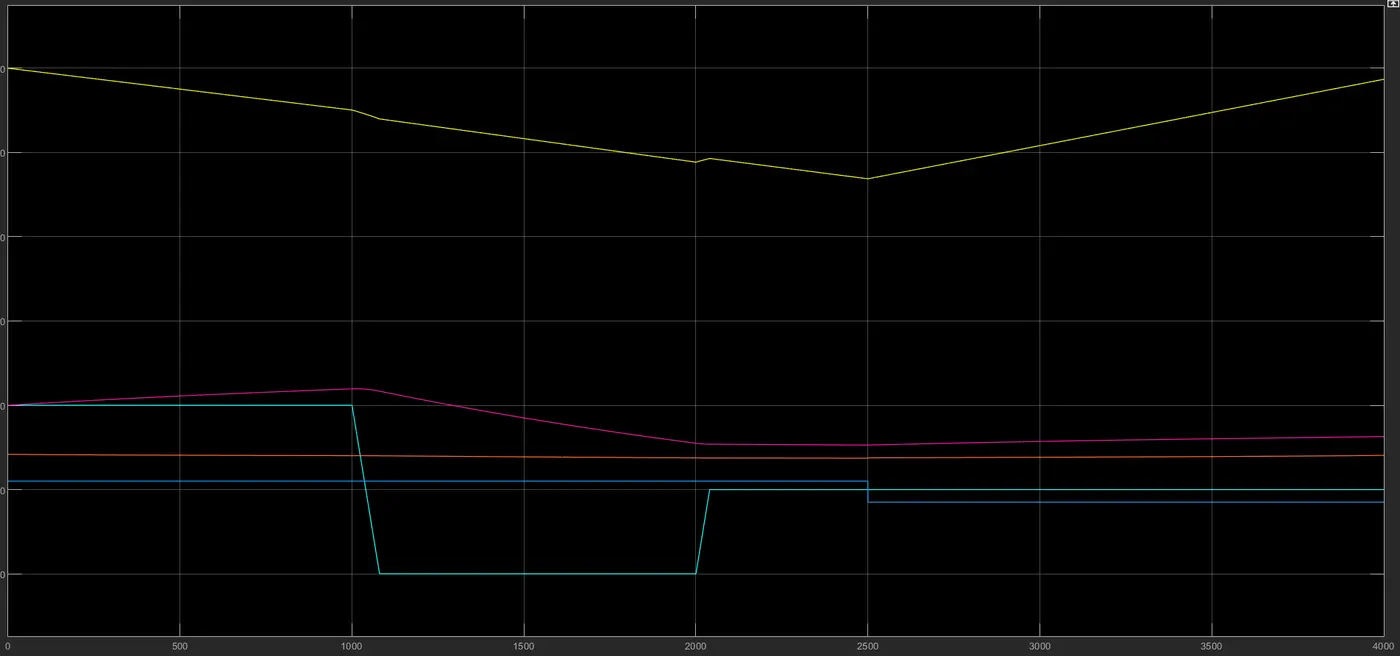
In this simulation, we have demonstrated the temperature-dependent behavior of a single lithium-ion cell (Battery A) and its counterpart with temperature effects neglected (Battery B). The ambient temperature was varied from 20 degrees Celsius to -20 degrees Celsius and then to 0 degrees Celsius to observe their responses.
To further explore the impact of temperature on a larger battery system, this simulation can be extended to include 10 cells in series. By doing so, we can analyze how a multi-cell battery pack responds to temperature variations. This extension will provide valuable insights into the collective behavior of multiple cells connected in series and how temperature affects their overall performance.
By studying a battery pack with 10 cells in series, we can gain a deeper understanding of the challenges and opportunities presented by temperature variations in real-world applications. This knowledge can inform the design and management of battery systems in various industries, including electric vehicles, renewable energy storage, and portable electronics."