Project 2 Thermal modeling of battery pack
Project 2
For a 10 cell series lithium ion battery model, simulate the thermal effects and compare life cycle performance at various temperatures, charge & discharge rates using MATLAB
Objective
To employ the MATLAB software platform for simulating thermal impacts and contrasting the life cycle efficiency of a model featuring a series arrangement of 10 lithium-ion battery cells. This will be executed across diverse scenarios, encompassing a range of temperatures and varying rates of charging and discharging.
Introduction
The transformation in energy storage is profound, and lithium-ion batteries play a central role in this evolution. These compact yet potent devices have reshaped energy solutions for applications ranging from portable electronics to electric vehicles and renewable energy grids. As their application diversifies and their significance magnifies, unraveling the intricate connections between thermal impacts and the performance lifespan of lithium-ion batteries becomes not only an avenue of scientific exploration but a crucial requirement for enhancing their capabilities and extending their endurance.
Temperature, along with the rates of charging and discharging, are three pivotal variables that converge to dictate the functionality and degradation trajectory of lithium-ion batteries. Let's delve into each element to decipher the intricate mesh of influences they exert:
Temperature:
The operational temperature of a lithium-ion battery holds extensive ramifications. Batteries exhibit sensitivity to temperature fluctuations, with both elevated and reduced temperatures affecting their operational prowess. When temperatures are low, a battery's internal resistance can elevate, curbing its capacity to deliver power and diminishing its overall storage capability. Conversely, higher temperatures expedite chemical reactions within the battery, potentially triggering the deterioration of electrode materials and subsequently reducing the battery's projected lifespan. Thus, grasping the distinct impact of varying temperature ranges on a battery's energy storage capacity, power yield, and safety is imperative for the formulation of systems that endure the gamut of real-world operational conditions.
Charging Rate:
The pace at which a battery is recharged, characterized by the incoming current, holds substantial influence over its functionality and lifespan. Swift charging generates thermal energy within the battery, thereby fostering temperature spikes that may incite undesired reactions and hasten the aging process. Striking a harmonious balance between expedited charging and the battery's thermal regulation and long-term durability presents a multifaceted challenge that necessitates an intricate comprehension of the intricate interplay between charging rates, temperature variations, and the inherent attributes of battery materials.
Discharge Rate:
Analogous to the charging rate, the velocity at which energy is extracted from a battery – the discharge rate – shapes its efficacy and enduring performance. Elevated discharge rates can amplify the battery's internal resistance, triggering voltage declines and reducing its output capacity. The apt management of discharge rates holds pivotal importance for domains requiring consistent and dependable power supply, such as electric vehicles and grid-integrated energy storage systems.
Life Cycle Performance:
The lifespan of a battery corresponds to the number of charge and discharge cycles it can withstand before its capacity experiences pronounced deterioration. The intricate interrelation between temperature, charge-discharge rates, and their collective impact directly influences this performance lifespan. Operating a battery under extreme temperature conditions or subjecting it to elevated charge and discharge rates can accelerate degradation mechanisms, curtailing its operational longevity. Conversely, the meticulous optimization of these variables can aid in extending a battery's useful life, maximizing its economic and environmental utility.
In summation, the ramifications of thermal effects and the performance lifespan of lithium-ion batteries stand as pivotal considerations in the pursuit of more effective and sustainable energy storage solutions. By comprehensively discerning the manner in which temperature, charging rates, and discharge rates synergize within these energy reservoirs, we can engineer systems that manifest heightened resilience while striking an equilibrium between the demands of high-performance scenarios and enduring reliability. This erudition propels us into an era where lithium-ion batteries not only achieve heightened efficiency but also elevate their robustness, heralding a new epoch of energy ingenuity.
Block Description
The following blocks are used to build the model:
Battery (Table-Based)
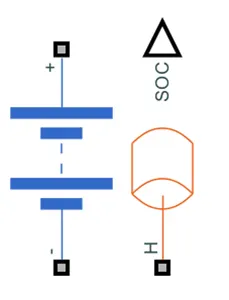
Functioning as a high-fidelity battery model, the Battery (Table-Based) block assumes the role of emulating batteries. By referencing lookup tables, it calculates the open-circuit voltage contingent upon the charge level and temperature, if given. Within the block, diverse modeling options are encompassed, incorporating factors such as battery self-discharge, degradation, and charge dynamics.
It's worth emphasizing that the block facilitates both linear and nearest-neighbor interpolations and extrapolations for all parameters governed by lookup tables. In the context of the lookup table's rows and columns, the sequence adheres to the row-column order, wherein rows are primarily indexed, succeeded by columns.
The presented graph showcases a battery exhibiting performance traits that modulate in response to fluctuations in temperature and state of charge – a semblance to the characteristics commonly encountered in datasheets.
The utility of this block becomes particularly evident in the parameterization of batteries featuring intricate open-circuit voltage behaviors, grounded either in datasheet information or empirical observations. Nevertheless, for simpler battery models, the standard battery block remains a viable choice.
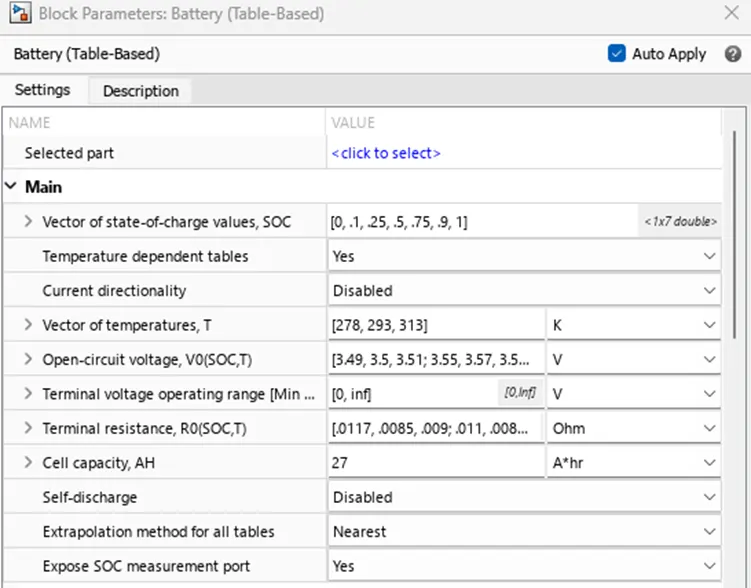
The Battery (Table-Based) block provides a range of modeling options, accessible through a right-click on the block within the block diagram and selection of the desired variant under Simscape > Block choices:
Uninstrumented | No thermal port: This fundamental model lacks the output of battery charge level and operates at a constant temperature (the default version).
Uninstrumented | Show thermal port: This iteration includes an exposed thermal port while omitting the output of the battery's internal charge level.
Instrumented | No thermal port: This version features an exposed charge output port and maintains a consistent temperature throughout the simulation.
Instrumented | Show thermal port: With this variant, you can access the internal charge level of the battery, and both the thermal port and charge output port are available for use.
The enhanced versions incorporate an additional physical signal port that produces the internal state of charge. This feature enables adjustments in load behavior based on the state of charge, circumventing the complexity of constructing a charge state estimator. The versions with thermal ports unveil a thermal port symbolizing the battery's thermal mass. In scenarios necessitating thermal considerations, the Enhanced | Include thermal port variant is the recommended choice.
PS Constant
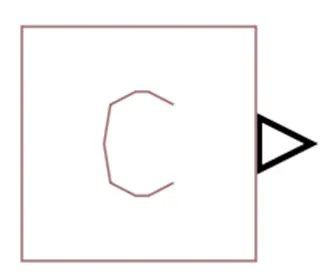
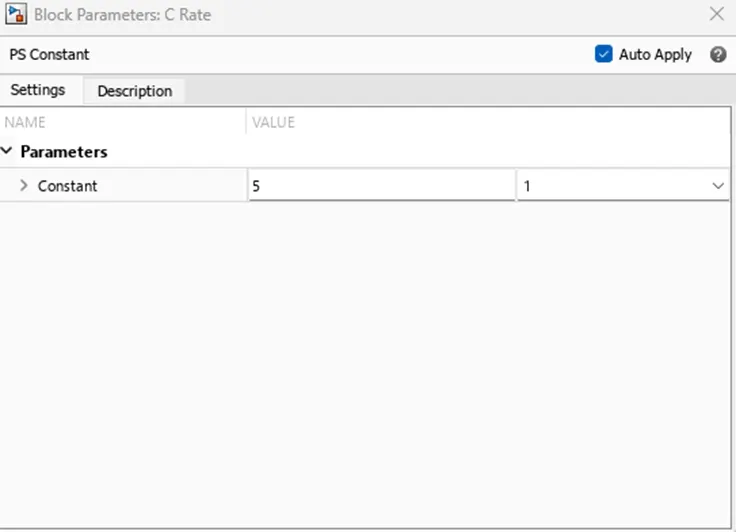
Within this block, a consistent tangible signal is generated, and within the context of this framework, it symbolizes the pace of the current flow. The current rate is maintained at 5C for all test conditions.
Controlled Current Source

The component represents an ideal current source that can uphold a continuous current flow, regardless of the voltage imposed upon it. The resultant output current is labeled as I = Is, wherein Is signifies the numeric value allocated at the physical signal port.
Temperature Source

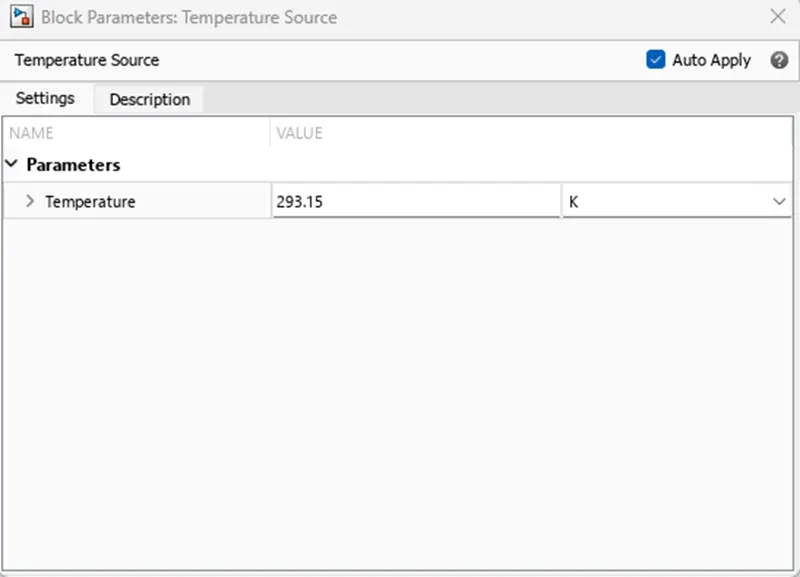
The Temperature Source block embodies a conceptual heat origin that can uphold an unwavering temperature at its exit, regardless of the heat energy engaged by the system. It produces an unchanging absolute temperature, determined by the setting within the Temperature parameter. The temperature is varied at each test condition. The four test conditions are 300K, 330K, 360k, and 390K.
Convective Heat Transfer
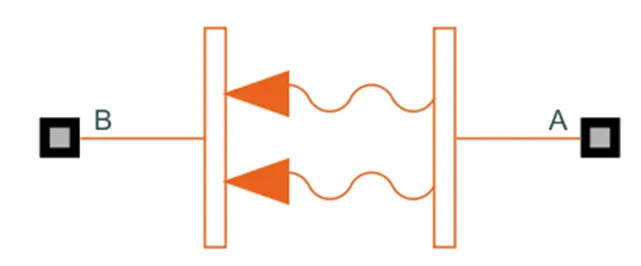
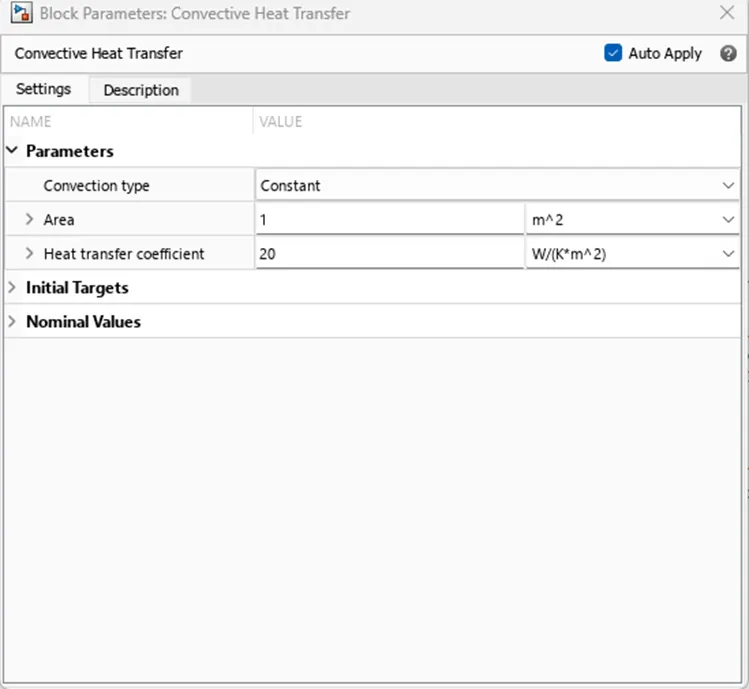
The Convective Heat Transfer block emulates the exchange of heat between two entities through fluid motion, adhering to the principles of convection. The mechanism of heat transfer is elucidated using the formula: Q = k * A * (TA - TB) in which:
- Q signifies the heat flow
- k represents the coefficient of convective heat transfer
- A designates the surface area
- TA and TB correspond to the temperatures of the respective entities
The block encompasses two thermal-preserving ports, labeled A and B, associated with the positions where convection-driven heat transfer takes place. The flow of heat within the block progresses from port A to port B, thereby rendering the heat flow as positive when it transitions from A to B. The convective heat transfer area is maintained at 1 m2 at all test conditions.
Temperature Sensor

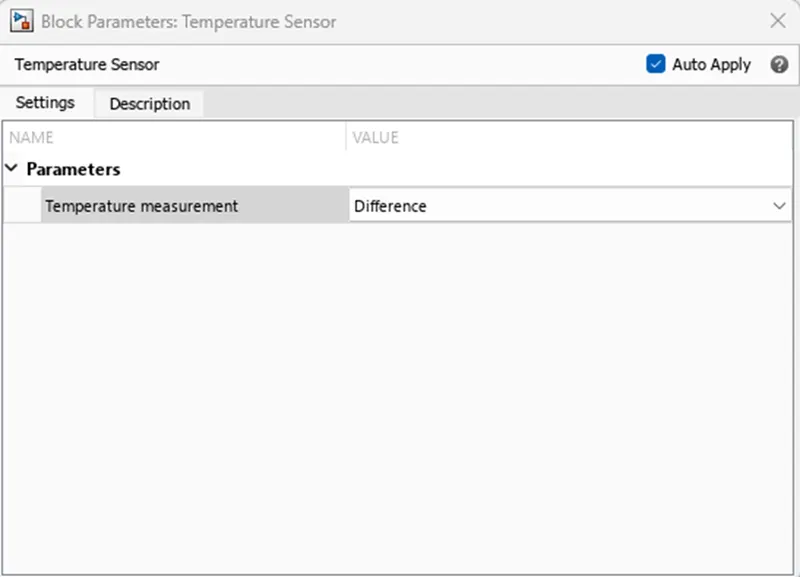
The Temperature Sensor block emulates a flawless temperature sensor, allowing it to gauge the disparity in temperature between two locations without absorbing any thermal energy. This sensor encompasses a duo of thermal-preserving ports, named A and B, interlinking with the two sites under temperature surveillance. Additionally, a physical signal output port, labeled T, delivers the value of the temperature differential. The orientation of the block is affirmative, progressing from port A to port B. The calculated temperature is established as T = TA - TB, with TA signifying the temperature at port A and TB symbolizing the temperature at port B.
Final Model
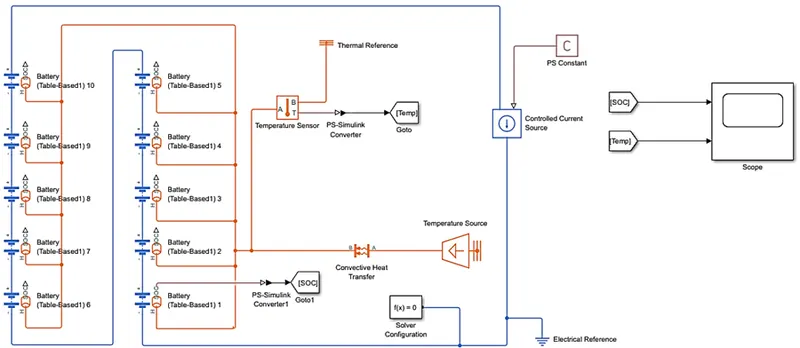
Model Description
The Simscape model is designed to simulate the thermal behavior of a 10-cell series lithium-ion battery pack. It uses various blocks to represent individual battery cells, external temperature input, convective heat transfer, temperature sensing, thermal and electrical references, controlled current sources for charging and discharging, and scope blocks for visualization. This simulation allows for the comparison of battery life cycle performance at different temperatures and charge/discharge rates, providing insights into how these factors affect the battery's thermal characteristics and overall behavior. The simulation is run for 3600 seconds, and the charge-discharge behavior is tested at four different temperatures 300K, 330K, 360k, and 390K.
Test Conditions
|
Test No. |
Temperature (K) |
Temperature (oC) |
|
Test 1 |
300 |
26.85 |
|
Test 2 |
330 |
56.85 |
|
Test 3 |
360 |
86.85 |
|
Test 4 |
390 |
116.85 |
For all test conditions, the initial temperature is 298K, C-rate is 1C, and the convective heat transfer area is 1m2.
Simulation Results
Test 1: 300 K
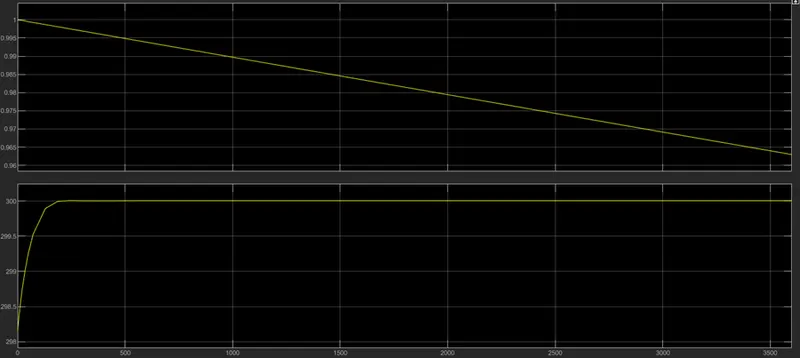
Test 2: 330 K
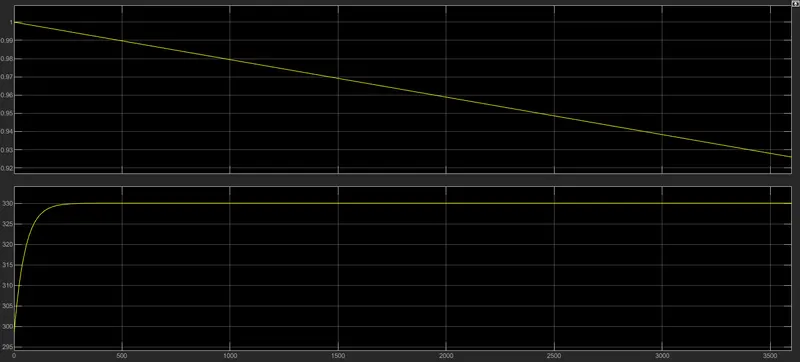
Test 3: 360 K
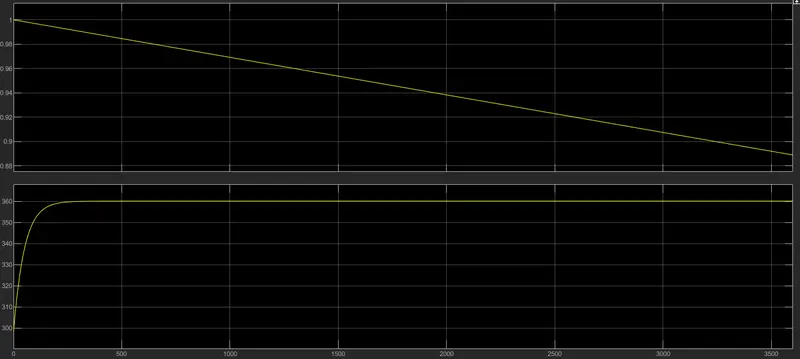
Test 4: 390 K
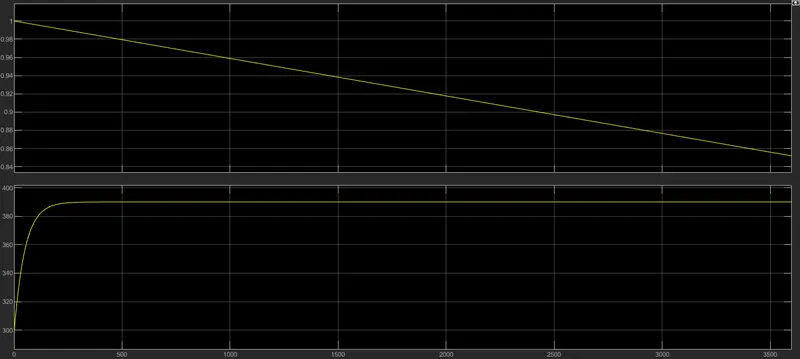
Summary of the Results
|
Test No. |
Temperature (K) |
ΔT in 1hr (K) |
ΔSOC in 1hr (%) |
|
Test 1 |
300 |
2 |
3.6 |
|
Test 2 |
330 |
32 |
7.3 |
|
Test 3 |
360 |
62 |
11.0 |
|
Test 4 |
390 |
92 |
14.8 |
Discussion of the Results
The simulation results clearly demonstrate a direct correlation between higher operational temperatures and the expansion of temperature differentials. Correspondingly, these temperature fluctuations align with an evident decline in the battery's State of Charge (SOC). This intricate interconnection stems from the intricate ramifications of increased temperatures on battery behavior.
As temperatures rise, capacity loss becomes conspicuous, affecting the battery's capability to store and release energy. Likewise, self-discharge becomes more prominent, further contributing to the observed reduction in SOC even during periods of inactivity. Voltage fluctuations emerge as a consequence of heightened temperatures, manifesting as a dip in voltage levels that can mislead SOC evaluations.
Furthermore, efficiency takes a hit under these circumstances, with a notable portion of energy dissipating as heat during charging and discharging cycles. These combined temperature-induced challenges culminate in transformative chemical reactions within the battery's internal composition, subsequently altering its overall performance and capacity.
If the battery's operation exceeds the manufacturer's recommended temperature threshold, a chain reaction of effects is initiated. Most notably, the battery's discharge rate escalates, leading to a proportional decrease in its effective lifespan. This outcome results from the convergence of the aforementioned factors, accelerating the battery's degradation process.
To address these issues, Battery Management Systems (BMS) come into play. BMS is a pivotal component that vigilantly monitors and mitigates the multifaceted repercussions of temperature on battery performance. Through real-time data analysis and control strategies, BMS ensures the battery functions within the stipulated temperature range and optimal parameters, ultimately preserving its efficiency and longevity.
References
- "Battery Thermal Management Systems for Electric Vehicles" by Ralph E. White and Qiquan Qiao.
- "A Review on Thermal Management of Battery Systems for Electric Vehicle Applications" by N. H. Murthy and K. Hemamalini in Renewable and Sustainable Energy Reviews.
- "Advanced Simulation Techniques for Battery Management Systems in Electric Vehicles" by K. S. Ashwin, et al., in Energy Procedia.
- "Thermal Management of Battery Packs" in "Battery Management Systems for Large Lithium-Ion Battery Packs" edited by D. U. Sauer and D. Di Domenico.
- "Thermal Management of Lithium-Ion Battery Packs: Overview and Design Guidelines" by H. Wang, et al., in IEEE Transactions on Components, Packaging and Manufacturing Technology.
- "Modelling and Simulation of Lithium-Ion Batteries from a Systems Engineering Perspective" by D. Di Domenico, et al., in Applied Energy.
- "Battery Systems Engineering" by Christopher D. Rahn and Chris Mi.
- "A Review of Battery Thermal Management Systems for Electric Vehicle Applications: Challenges and Opportunities" by Y. Wang, et al., in Applied Thermal Engineering.
- "Li-ion Battery Thermal Management Systems and Their Multiscale Modeling: A Review" by K. Zhang, et al., in Applied Energy.
- "Multiphysics and Multiscale Modelling, Data and Software Integration for Li-ion Battery Management System" by M. Stroe, et al., in Energy Procedia.
- "Thermal Modeling of Lithium-Ion Batteries Using Equivalent Circuit Approach" by Z. Feng, et al., in Journal of Power Sources.
- "Battery Thermal Management System Modeling and Validation" by T. Huria, et al., in SAE International Journal of Alternative Powertrains.
- "Sensitivity Analysis of Thermal Parameters on Lithium Iron Phosphate Battery for PHEV Applications" by H. Kim, et al., in Journal of Power Sources.
- "A Model-Based Analysis of Thermal Runaway Propagation in Lithium-Ion Battery Packs" by D. L. R. Smyth, et al., in Journal of Power Sources.
- "Dynamic Model for Simulating the Thermal Behavior of Lithium-Ion Battery Packs" by G. Plett and R. Klein in Journal of Power Sources.
- "Sensitivity Analysis of Li-Ion Battery Thermal Management System" by A. Khateeb, et al., in Applied Energy.
- "Simscape Power Systems User's Guide" by MathWorks Documentation.